Summary: When you move house in Japan, the key deadline is 14 days. Within 14 days of moving, you must register your new address at the city or ward office. If you are a mid- to long-term resident with a residence card, that visit also covers your legal duty to tell immigration where you live, and the office writes the new address on the back of your card. If you move to a different city, you first file a moving-out notice at your old office (online is possible with a My Number card), then a moving-in notice at the new one. After that come health insurance, your driving licence, your bank, your phone company and your mail. This guide puts the steps in order, with what to bring to each one.
- First, which kind of move is it?
- Step 1: before you move, file the moving-out notice
- Step 2: within 14 days, register at your new office
- Step 3: health insurance
- Step 4: pension
- Step 5: your driving licence
- Step 6: bank, phone, work and mail
- Common problems and how to avoid them
- Other things people forget: children, pets, cars and bicycles
- FAQ
- Related reading
- Sources
First, which kind of move is it?
The paperwork depends on whether you stay inside the same municipality (city, town, or Tokyo ward).
- Moving within the same city or ward: one visit. You file a change of address notice (転居届 tenkyo todoke) within 14 days after moving.
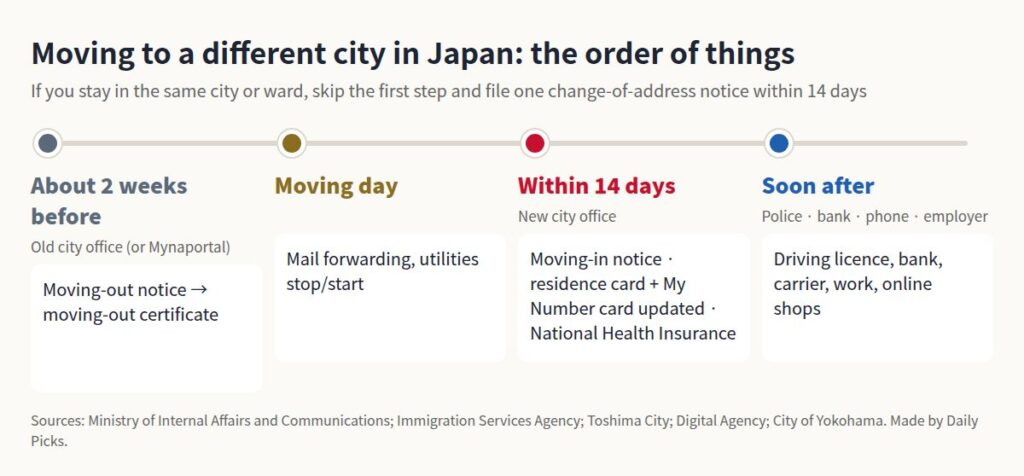
- Moving to a different city or ward: two steps. You file a moving-out notice (転出届 tenshutsu todoke) at your old office, and receive a moving-out certificate. Then, within 14 days of moving, you file a moving-in notice (転入届 tennyū todoke) at your new office.
Moving between two Tokyo wards, say from Shinjuku to Setagaya, counts as moving to a different municipality.
The Ministry of Internal Affairs and Communications says these notices are a legal duty, and that not filing them without a good reason can lead to a fine of up to 50,000 yen.
Step 1: before you move, file the moving-out notice
If you are leaving your city, go to your current office before the move. Toshima City, for example, says you can file the moving-out notice about two weeks before the date you plan to move. You will receive a moving-out certificate (転出証明書 tenshutsu shōmeisho) to take to your new office.
Doing it online: if you have a My Number card with a valid electronic certificate, you can file the moving-out notice through Mynaportal, the government’s online service, and book your moving-in visit at the new office. The Digital Agency says this means you usually do not need to visit your old office at all, and the service is available 24 hours a day. You still need to go to the new office in person to complete the move-in. The Mynaportal screens are in Japanese, so you may want help from a Japanese speaker the first time.
Step 2: within 14 days, register at your new office
This is the visit that matters most. Toshima City’s English page lists what to bring when moving in from another municipality:
- Your moving-out certificate (unless you moved out online through Mynaportal)
- Your residence card
- Your My Number card, if you have one
Bring the cards for every family member who is moving with you. If you are moving within the same city, you need only the residence card and the My Number card.
What happens to your residence card
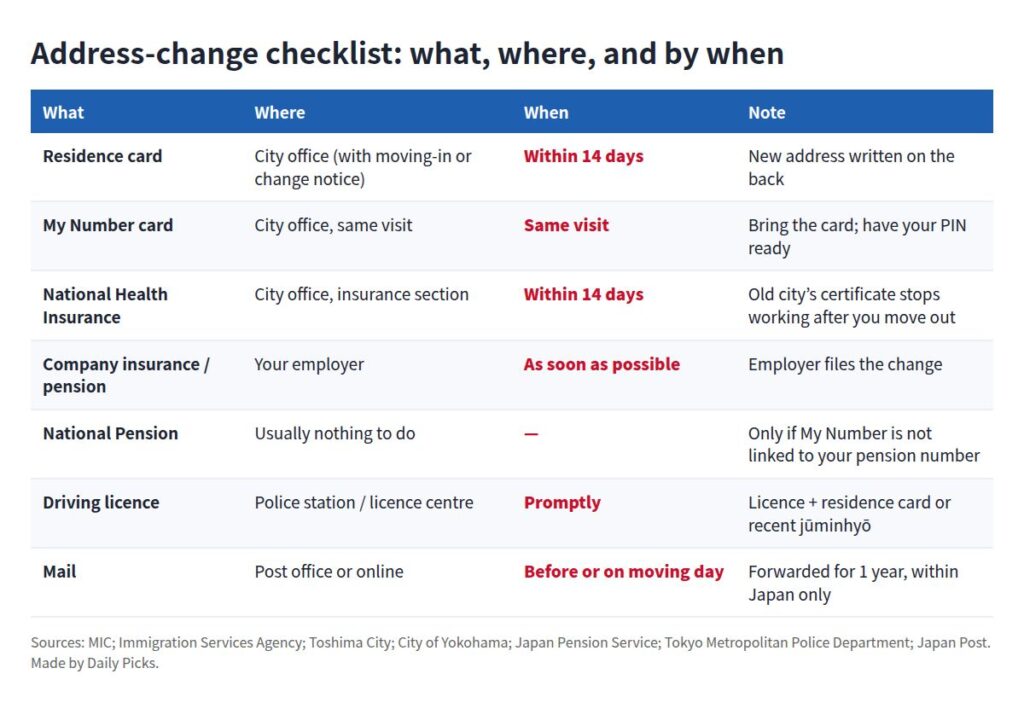
The Immigration Services Agency requires mid- to long-term residents to notify their new place of residence within 14 days, by presenting their residence card at the municipal office. When you file your moving-in or change of address notice with the card, the office writes your new address on the back. Check that it is correct before you leave the counter.
The agency lists failing to notify your place of residence without a good reason, or making a false notification, among the grounds on which a status of residence can be revoked. This is not something to leave until later.
What happens to your My Number card
Your My Number card also shows your address. The Ministry of Internal Affairs and Communications asks residents to bring the card to the new office so that it can be updated at the same time. You may be asked to enter your card’s PIN, so have it ready.
Step 3: health insurance
What you do depends on your insurance.
- Company health insurance (through your employer): tell your employer about the new address. The company files the change.
- National Health Insurance (kokumin kenkō hoken): if you move to another city, you leave your old city’s scheme and join the new one. Yokohama, for example, asks residents to notify the ward office within 14 days, and says your old certificate cannot be used after the date you move out. Most people do this at the same visit as the moving-in notice. If you move within the same city, the insurance section updates your address.
Step 4: pension
According to the Japan Pension Service, if your My Number is linked to your basic pension number, you generally do not need to file a separate change of address. If it is not linked, employees tell their employer, and people on the National Pension (category 1) file the change at the municipal office. You can check whether your numbers are linked on the Japan Pension Service’s online service, Nenkin Net, or at a pension office.
Step 5: your driving licence
If you have a Japanese driving licence, the address on it must be updated too. In Tokyo, the Metropolitan Police Department accepts address changes at any police station in Tokyo, at the licence renewal centres, and at the driving test centres. For foreign nationals registered as residents, it lists the documents as your driving licence and your residence card, or a certificate of residence (jūminhyō) issued within the last six months. If your licence is linked to your My Number card, update the address on the My Number card at the city office first.
Step 6: bank, phone, work and mail
- Bank: update your address through the bank’s app, website or a branch. Banks send cards and important notices by registered mail, and they may not be forwarded.
- Mobile phone: update your address with your carrier, online or in a shop.
- Employer or school: tell them your new address. Employers need it for insurance and tax records.
- Mail forwarding: Japan Post can forward mail sent to your old address for one year after you apply. It cannot forward to addresses outside Japan. You can apply at a post office with ID showing your address, or online.
- Utilities: contact your electricity, gas and water providers to stop service at the old address and start it at the new one. Gas usually needs someone at home when it is turned on.
- Online shops and delivery services: update saved addresses so parcels do not go to your old home.
Common problems and how to avoid them
- Going to the new office late. Book a day off in your first two weeks. Offices are busy in March and April, when many people move.
- Forgetting a family member’s card. Each person’s residence card needs the new address.
- Not bringing the moving-out certificate. Without it (or the online moving-out), the new office cannot register you as moving in.
- Forgetting the PIN for your My Number card. Resetting it takes extra time at the counter.
- Leaving rubbish or large items behind. Book large-item collection early; see our rubbish guide.
Other things people forget: children, pets, cars and bicycles
The resident registration, residence card and My Number card are only part of a move. If you have children, a dog, a car or a bicycle, there are more steps. The deadlines below were checked on official pages as of 30 September 2026. Local details can differ, so check your new city’s website as well.
Timeline at a glance
Only deadlines written on official pages are shown.
| Item | When | Where |
|---|---|---|
| Tell your child’s current school | As soon as the move is decided | Current school |
| Garage certificate (shako shōmei) for a registered car | Before the car address change; the certificate should be about 1 month old or newer when used | Police station for the new parking place |
| Child allowance (jidō teate) application | Within 15 days from the day after the move-in date (or the planned move-out date) | New city office |
| Car registration address change (registered cars) | Within 15 days from the date of the change | Transport bureau (unyu shikyoku) for the new address |
| Kei car address change | No deadline stated on the association’s page | Light Motor Vehicle Inspection Organization office for the new address |
| Dog registration change | Within 30 days | New city office |
| Bicycle crime-prevention registration | No deadline stated on the police pages checked | Registration shop or police, depending on the prefecture |
Children: school transfer
If your child goes to a public elementary or junior high school, the move usually means a school transfer. Shinjuku City explains the steps like this. First, contact the current school once the move is decided. The school then gives you two papers by the last day of attendance: a certificate of enrolment (zaigaku shōmeisho) and a certificate showing which textbooks were given (kyōkasho kyūyo shōmeisho). Next, register your move at the new city office. Then take the papers to the new school.
Shinjuku City also notes that the documents and steps differ by the education board of each municipality. So check with the education board of your new city before the first school day.
Children: child allowance (jidō teate)
The Children and Families Agency explains the child allowance rules on its website. When you move to a different municipality, you must apply at the new city office. The deadline is 15 days from the day after the day you moved in (or your planned move-out date). The agency also explains a “15-day rule”. If you apply within those 15 days, you can receive the allowance from the month you apply for, even if the application falls in the next month.
The agency states that, as a rule, the allowance is paid when the child lives in Japan. If you move within the same city, the steps are different. Ask the child allowance counter at your city office.
Pets: dog registration
Under the Rabies Prevention Act, dogs must be registered with the city, town or village where they live. The owner receives a dog tag (kansatsu) and must keep it on the dog. The law says that when the dog’s location changes, the owner must notify the new municipality within 30 days.
What to bring depends on the city. Saitama City, for example, asks you to bring the dog tag and the rabies vaccination tag (chūsha zumi hyō) from your old city. It gives a new Saitama City tag in exchange for the old one at no charge. If you lost the old tag, a replacement costs 1,600 yen there. Other cities may have different rules and fees, so check your new city’s page.
Cars: garage certificate and registration
If you own a registered car (a car with a white or green plate that is not a kei car), there are two parts. The first is the garage certificate. The National Police Agency says it is needed for a change of registration when the car’s principal place of use changes. You apply at the police station that covers your new parking place. The parking place must be within 2 kilometres of the principal place of use.
The second part is the address change on the vehicle inspection certificate (shaken-shō). The Ministry of Land, Infrastructure, Transport and Tourism (MLIT) portal says you must do this within 15 days from the date of the change. The MLIT document list includes:
- An application form (OCR form No. 1)
- A fee payment form, with revenue stamps or cashless payment
- A residence record (jūminhyō) issued within the last 3 months that shows the link between your old and new address
- The garage certificate, where required (issued about 1 month ago or less)
- The vehicle inspection certificate
- Your number plates, if the plate number will change
The MLIT portal notes that showing only a My Number card or driving licence is not enough; a document such as a residence record is needed. If the move puts you under a different transport bureau, the plates change and you must bring the car. If you move within the same bureau’s area, you do not need to bring the car.
For kei cars (yellow plates), the Light Motor Vehicle Inspection Organization handles the address change. Apply at its office for the new place of use. You need proof of the new address issued within 3 months, the vehicle inspection certificate and the application form. If the area changes, the plates change too. Some areas also require a parking place notice to the police for kei cars. The Tokyo Metropolitan Police Department lists moving into a covered area as one case that needs this notice.
Bicycles: crime-prevention registration
Chiba Prefectural Police and Shimane Prefectural Police both explain that bicycle crime-prevention registration (bōhan tōroku) is required by law. It is run separately in each prefecture. If you move within the same prefecture, you update the address. If you move to another prefecture, the police pages say to cancel the old registration and register again in the new prefecture.
Chiba Prefectural Police lists these items for an address change: photo ID with your current details, and your registration card. If you lost the card, bring the registration number or frame number, your old address, name and phone number. The bicycle itself is needed when you cancel a registration because you are moving out of the prefecture. Shimane Prefectural Police states that its registration is valid for 10 years. Other prefectures may differ.
Checklist for these extra items
- List what is tied to your address: school, dog, car, bicycles.
- Tell the school early and collect the two transfer papers.
- If you have a registered car, find a parking place at the new address and apply for the garage certificate.
- After your moving-in notice, apply for child allowance at the new city office within 15 days.
- Change the car’s registered address within 15 days. Bring the car if the plates will change.
- Take the old dog tag and vaccination tag to the new city office within 30 days.
- Update or re-do your bicycle registration, following your new prefecture’s rules.
FAQ
I moved more than 14 days ago and have not registered. What should I do?
Go to the city office as soon as possible and explain. Do not wait longer; the longer the delay, the bigger the problem can become for both your residence registration and your immigration record.
Do I need to go to the immigration office as well?
No. For a change of address, the notification is made at the municipal office with your residence card. Immigration procedures, such as renewing your period of stay, are separate. For anything about your status of residence, check the Immigration Services Agency’s official information.
Can someone else file the notice for me?
Family members in the same household can often file it for you. Other people usually need a letter of authorisation. Check with your city office first, because what they must bring differs.
I am moving abroad, not within Japan. Is it the same?
No. Leaving Japan needs a different moving-out notice and has its own points for health insurance, pension and tax. This guide covers moves within Japan only.
Related reading
- Extending your period of stay in Japan: new fees from 1 October 2026
- Rubbish and recycling rules in Japan, including large items
- Moving out in Japan: your deposit and the cleaning bill
- What your National Health Insurance notice means
Sources
- Ministry of Internal Affairs and Communications, notifications of change of address (Japanese)
- Immigration Services Agency, When you decide or change the place of residence (English, PDF)
- Toshima City, Resident Registration / Residence Card (English)
- Digital Agency, moving procedures on Mynaportal (Japanese, PDF)
- City of Yokohama, National Health Insurance enrolment and withdrawal
- Japan Pension Service, when a pension member moves (Japanese)
- Tokyo Metropolitan Police Department, changes to driving licence details (Japanese)
- Japan Post, Practical Guide for International Students (English)
- 児童手当制度のご案内 | こども家庭庁
- 《転校の手続き》転入・転居・転出 | 新宿区
- 狂犬病予防法 | 厚生労働省
- 犬の登録と狂犬病予防注射 | さいたま市
- 自動車の保管場所証明申請 | 警察庁
- Q&A | 自動車検査登録総合ポータルサイト(国土交通省)
- 車検証の住所・氏名を変更するために必要な書類 | 自動車検査登録総合ポータルサイト(国土交通省)
- 住所変更(引越し) | 軽自動車検査協会
- 保管場所届出手続(窓口での届出) | 警視庁
- 自転車の防犯登録について | 千葉県警察
- 自転車防犯登録に関するQ&A | 島根県警察
Information checked on 28 September 2026.
コメント