日本語版:日本語で読む(Japanese version) →
You hand back the keys, and a few weeks later an envelope arrives. Inside is a sheet of paper covered in Japanese, a column of numbers, and at the bottom either a small refund or a bill. The words shikikin (敷金), your deposit, and genjo kaifuku (原状回復), “restoration to the original state”, are somewhere on it.
This is the moment a lot of people in Japan discover that they do not know what they agreed to. The good news is that the rules here are unusually clear, and they are published by the government in plain terms. This article explains what the paper says, who is supposed to pay for what, why the number of years you lived there changes the amount, and who you can talk to in English if you think the bill is wrong.
One thing to be clear about from the start: this is general information, not legal advice about your situation. The government guideline described below is guidance, not law. Your contract can say something different, and a signed contract term can be valid even when it departs from the guideline. Always read your own contract alongside this.
- Two words decide almost everything
- The guideline everyone argues from
- Who pays for what under genjo kaifuku (restoring the room)
- Reading the statement
- Why the years matter
- A worked example
- The clause that changes the answer
- What to do before you leave
- If you think the bill is wrong
- The short version
- Sources
- Also on Daily Picks
Two words decide almost everything
Shikikin (敷金) is a security deposit. Under Article 622-2 of the Civil Code, it is money you give the landlord — under any name — to secure the money you might owe. When the lease ends and you hand the property back, the landlord must return it, minus what you actually owe. It is not a fee. It is your money being held.
Genjo kaifuku (原状回復) is narrower than it sounds. The phrase literally means “restore to the original state”, and many people read that as “put the flat back the way it was when I arrived”. That is not what it means. Article 621 of the Civil Code says the tenant must repair damage caused after they received the property, and then explicitly carves out two things:
… excluding any wear of the leased thing caused by the ordinary manner of using and making profit from it and any aging degradation of the leased thing …
Civil Code, Article 621 (Ministry of Justice reference translation)
Those two exclusions have names you will see on the paperwork:
- tsujo sonmo (通常損耗) — ordinary wear from living there normally.
- keinen henka (経年変化) — things getting older by themselves.
Neither is your responsibility. The reasoning, which the Supreme Court has set out, is that the cost of ordinary wear is already built into the rent you paid every month. Charging you again at the end would be charging twice.
This has been written into the Civil Code since the amendment that took effect on 1 April 2020. Before that it was case law. Now it is in the statute.
The guideline everyone argues from
The Ministry of Land, Infrastructure, Transport and Tourism (MLIT, 国土交通省) publishes a 173-page document called Genjo kaifuku o meguru toraburu to gaidorain (原状回復をめぐるトラブルとガイドライン), “Troubles over restoration, and guidelines”. The current re-revised edition dates from August 2011, and MLIT added a volume of reference material in March 2023 with survey data and worked examples.
It exists because this is one of the most common consumer disputes in Japan. MLIT’s own figure: consumer affairs centres receive roughly 30,000 to 40,000 consultations about rental housing every year, and deposits and restoration make up about 30 to 40 per cent of them.
The guideline sorts every kind of damage into categories. Simplified, it comes to this:
| Category | What it covers | Who pays |
|---|---|---|
| A | Things that happen even when you live normally | Landlord |
| A(+G) | Category A, plus freshening up or upgrading for the next tenant | Landlord |
| B | Damage that depends on how you lived — clearly beyond normal use | Tenant |
| A(+B) | Started as A, but got worse because you did not look after it | Tenant |
The guideline then works through real items. Some of the answers surprise people.
Who pays for what under genjo kaifuku (restoring the room)
These are taken directly from the guideline’s landlord/tenant table.
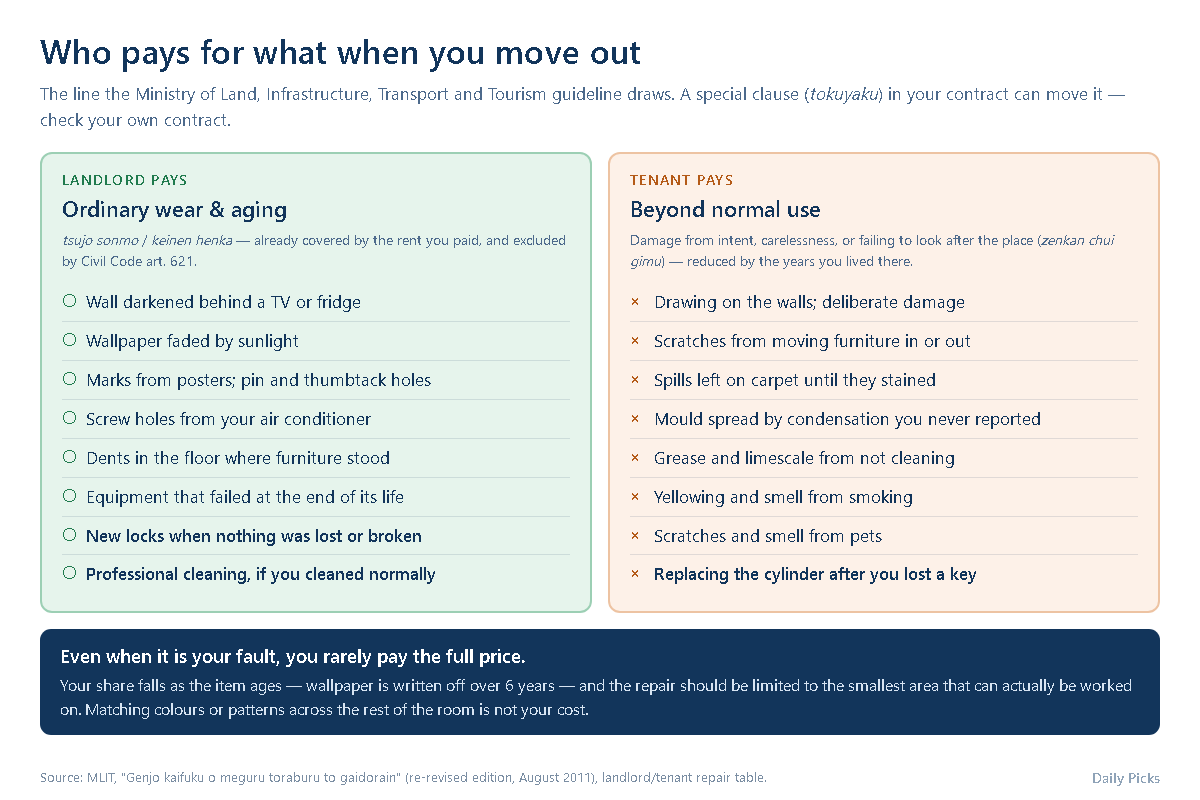
| Landlord’s cost | Tenant’s cost |
|---|---|
| Dark patches on the wall behind a TV or fridge (denki-yake, 電気ヤケ) | Kitchen wall grease from not cleaning during the tenancy |
| Marks left by posters or pictures | Mould and stains that spread because you left condensation and never told anyone |
| Pin and thumbtack holes that do not need the backing board replaced | Nail and screw holes deep enough to need the backing board replaced |
| Screw holes and marks from an air conditioner you installed | Yellowing and smell from smoking |
| Wallpaper discoloured by sunlight | Scratches from moving furniture in or out |
| Dents and marks in the floor from where furniture stood | Stains or mould on carpet from a spill you did not deal with |
| Tatami discoloured, flooring faded by sun or a structural leak | Rust marks under the fridge left to spread |
| Replacing tatami facing or fly screens for the next tenant | Scratches and smell from pets |
| Equipment that failed because it reached the end of its life | Equipment broken by misuse or poor handling |
| Changing the locks when nothing is lost or broken | Replacing the cylinder because you lost the key |
| Professional whole-home cleaning, if you cleaned normally | Grease on the cooker surround and extractor fan from not cleaning |
| Air conditioner internal cleaning, absent smoke smell | Limescale and mould in the bath, toilet and washbasin from not cleaning |
| Disinfecting the kitchen and toilet | Deliberate damage, including drawing on the walls |
The two in bold are the ones people are charged for most often and question least.
Locks. The guideline’s reasoning is that changing locks between tenants is a property-management matter for the landlord, so it belongs to the landlord. If you lost a key, that is different: you pay for the cylinder swap in full, with no reduction for the years you lived there.
Cleaning. If you did normal cleaning — rubbish out, swept, wiped, the wet areas and the greasy bits around the cooker and extractor dealt with — then professional cleaning for the next tenant is the landlord’s cost. You only pay when you did not clean normally. But read the next section before you rely on this, because a cleaning clause in your contract can change the answer, and cleaning clauses are very common.
Reading the statement
The document is usually titled shikikin seisansho (敷金精算書), deposit settlement statement, or genjo kaifuku hiyo meisai (原状回復費用明細), itemised restoration costs. Here are the words you will meet.
Money lines
| Japanese | Reading | What it means |
|---|---|---|
| 敷金 | shikikin | Your deposit, held by the landlord |
| 預り金 | azukarikin | Money held on your behalf |
| 償却/敷引 | shokyaku / shikibiki | A slice of the deposit the contract says is not returned. Check your contract — it should be written there |
| 原状回復費用 | genjo kaifuku hiyo | Restoration costs |
| 修繕費 | shuzenhi | Repair costs |
| 未払賃料 | miharai chinryo | Unpaid rent |
| 日割賃料 | hiwari chinryo | Rent for part of a month, calculated by day |
| 消費税 | shohizei | Consumption tax |
| 返還額/精算金 | henkangaku / seisankin | The amount coming back to you |
| ご請求額/不足額 | goseikyugaku / fusokugaku | The amount you still owe |
Work items
| Japanese | Reading | What it means |
|---|---|---|
| クロス張替 | kurosu harikae | Replacing wallpaper |
| フローリング張替/補修 | furoringu harikae / hoshu | Replacing / repairing wood flooring |
| クッションフロア | kusshon furoa | Vinyl sheet flooring |
| 畳表替え | tatami omotegae | Replacing the woven surface of a tatami mat |
| 畳裏返し | tatami uragaeshi | Turning that surface over to use the clean side |
| 襖/障子 | fusuma / shoji | Sliding paper doors and screens |
| 建具 | tategu | Doors, screens and fittings generally |
| ハウスクリーニング | hausu kuriiningu | Professional cleaning of the whole home |
| エアコンクリーニング | eakon kuriiningu | Cleaning inside the air conditioner |
| 鍵交換 | kagi kokan | Replacing the lock cylinder |
| 消毒 | shodoku | Disinfecting, usually kitchen and toilet |
The calculation columns
| Japanese | Reading | What it means |
|---|---|---|
| 数量 | suryo | Quantity — square metres, mats, pieces |
| 単価 | tanka | Unit price |
| 一式 | isshiki | “One set” — a lump sum with no breakdown |
| 入居期間 | nyukyo kikan | How long you lived there |
| 経過年数 | keika nensu | Years elapsed |
| 耐用年数 | taiyo nensu | Useful life used for the calculation |
| 負担割合 | futan wariai | Your percentage share |
| 残存価値 | zanzon kachi | Residual value |
| 貸主負担/賃貸人負担 | kashinushi / chintainin futan | Landlord’s share |
| 借主負担/賃借人負担 | karinushi / chinshakunin futan | Your share |
| 特約 | tokuyaku | Special clause in the contract |
| 善管注意義務 | zenkan chui gimu | The duty to look after the property properly |
Two columns are worth looking at hardest. Isshiki (一式) means there is no breakdown — no quantity, no unit price. You are entitled to ask what is inside it. And if the keika nensu / taiyo nensu columns are missing entirely, the calculation in the next section has probably not been done.
Why the years matter
This is the part most people do not know, and it is usually worth the most money.
Even when the damage is genuinely your fault, you do not pay the full replacement cost. Wallpaper that is already four years old was not worth its original value on the day you damaged it. So the guideline reduces your share according to how much life the item had left. The longer you lived there, the smaller your share. The floor is a residual value of one yen — so the calculation never drops to zero, but it can get very close.
The guideline sets these useful lives:
| Item | Useful life |
|---|---|
| Sink unit | 5 years |
| Wallpaper (kurosu) | 6 years |
| Tatami core, carpet, cushion flooring | 6 years |
| Air conditioners, heaters, fridge, gas range, intercom | 6 years |
| Non-metal furniture — bookcases, cupboards, chests | 8 years |
| Toilet bowl, washbasin, plumbing and sanitary fittings, metal fittings | 15 years |
| Unit bath, bathtub, shoe cupboard (fixed to the building) | The building’s life |
| Tatami facing, fusuma and shoji paper | No reduction — treated as consumables |
| Flooring, repaired in part | No reduction |
| Flooring, whole room replaced | The building’s life |
| Lost keys, and cleaning | No reduction |
When the building’s life is used, it depends on how the building is built:
| Structure | Life |
|---|---|
| Reinforced concrete (RC) and steel-reinforced concrete (SRC) | 47 years |
| Brick, stone, concrete block | 38 years |
| Steel frame, members thicker than 4 mm | 34 years |
| Steel frame, 3–4 mm | 27 years |
| Wood | 22 years |
| Wood with mortar | 20 years |
| Steel frame, 3 mm or thinner | 19 years |
There is a second limit alongside the years rule: the repair should be kept to the smallest unit that can actually be done. Wallpaper is measured by the square metre, though the guideline accepts that charging for the whole wall face containing the damage is unavoidable in practice. Tatami is per mat, fusuma per panel, pillars per pillar. Matching patterns or colours across the rest of the room is explicitly not your cost.
A worked example
This is MLIT’s own example from the 2023 reference material. The unit prices were chosen to illustrate the method, not as market rates.
A 2LDK in a reinforced-concrete block, 16 years old when the tenant moved in. The tenant stayed 4 years and paid a deposit of ¥120,000. The repair work came to ¥266,000:
- Wallpaper, ¥36,000. The wallpaper was new at move-in. A child drew on two of the wall faces — 15 m² out of the room’s 30 m² — and the whole room was repapered.
- Flooring, ¥150,000. Scratches and dents from the tenant’s carelessness across the whole 10 m² room, so the whole room was refloored.
- Tatami, ¥30,000. Two mats in a six-mat room discoloured by sunlight; all six were resurfaced.
- Cleaning, ¥50,000. The tenant had cleaned the place properly before leaving.
Working through it:
- Wallpaper. Drawing on the walls is deliberate damage, so the tenant is responsible. Wallpaper’s life is 6 years and 4 years had passed, so the tenant’s share is 1 − 4/6 = 1/3. The chargeable area is the two faces the tenant damaged, not the whole room. ¥1,200 × 15 m² × 1/3 = ¥6,000.
- Flooring. The tenant is responsible, and because the whole room is being replaced the building’s life applies. RC means 47 years, and 20 years had passed — 16 before the tenant arrived plus 4 of the tenancy. The tenant’s share is 1 − 20/47 = 27/47, about 57.4%. ¥15,000 × 10 m² × 27/47 = ¥86,170.
- Tatami. Sun damage is aging, and resurfacing the other four mats is preparation for the next tenant. ¥0.
- Cleaning. The tenant cleaned normally and there was no valid cleaning clause. ¥0.
So of the ¥266,000 of work, the tenant pays ¥92,170 and the landlord pays ¥173,830. Out of the ¥120,000 deposit, ¥27,830 comes back.
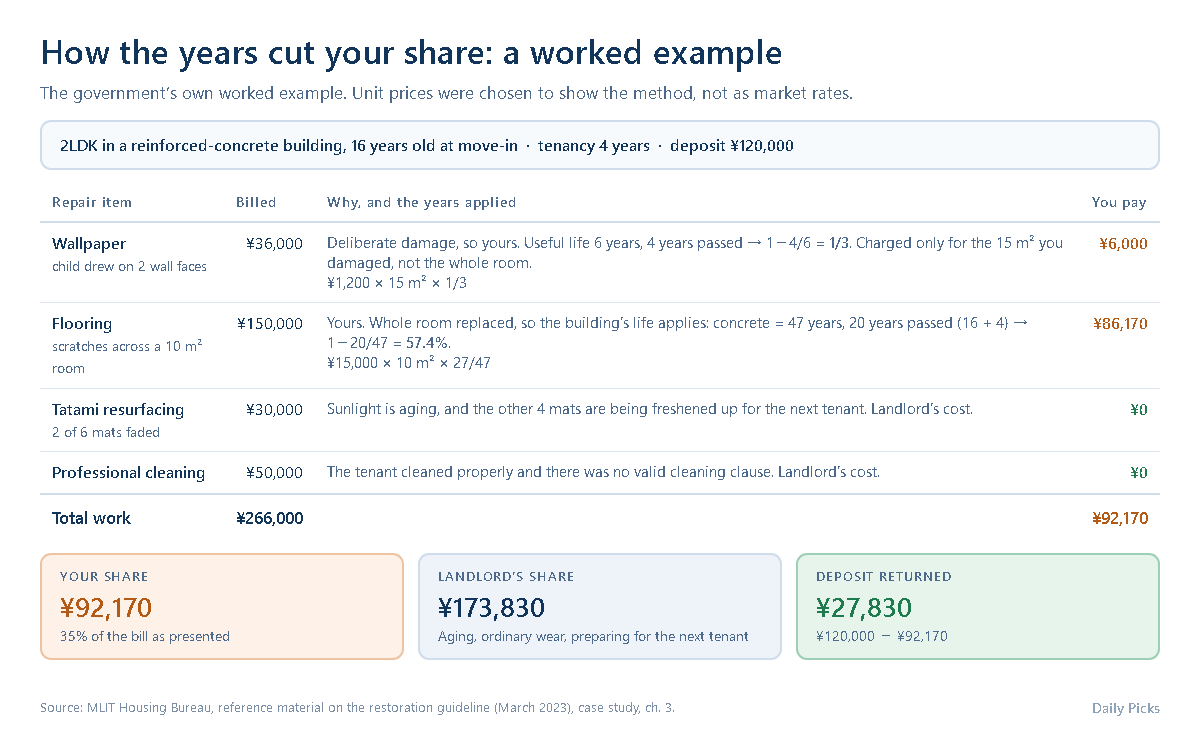
Notice what happened there. Charged at face value, that bill would have exceeded the deposit and produced an invoice. Applied properly, most of it is the landlord’s.
The clause that changes the answer
Everything above is the default. Your contract can override it with a tokuyaku (特約), a special clause — most commonly a house-cleaning clause, often a fixed amount based on the size of the flat, and often an air-conditioner cleaning clause too. MLIT’s 2022 survey of management companies found these are the clauses used most in practice.
Such clauses are not automatically invalid. Japanese contract law allows parties to agree terms, and a clause that makes you pay for ordinary wear can be enforceable. But because it puts a duty on you beyond what the law requires, the guideline — drawing on a Supreme Court judgment of 16 December 2005 and the Consumer Contract Act — sets three conditions, all of which must be met:
- There is an objective, rational reason for the clause, and it is not exploitative.
- You understood that the clause gives you repair duties beyond the ordinary ones.
- You actually expressed agreement to take on that burden.
The Supreme Court put the second and third conditions in concrete terms: the scope of the ordinary wear you are agreeing to pay for has to be specifically written in the contract itself, or, if it is not, the landlord must have explained it orally and you must have clearly understood it and made it part of the agreement.
On the first condition, the guideline gives an example of what a rational reason looks like — rent set clearly below the local market in exchange for the extra burden — and says this should be read narrowly. It also says the expected amounts or unit prices should be shown up front, since you cannot meaningfully agree to a cost you were never told.
Two practical consequences. If you are signing a contract, find the restoration clause before you sign and ask what the cleaning charge will be in yen. If you are moving out and being charged under a clause, the question is not only “is there a clause” but “does it say specifically what I am paying for, and was that explained to me”. Whether any particular clause meets the three conditions is a judgement on the individual facts — which is exactly what the consultation desks below are for.
What to do before you leave
Most of these disputes come down to a question nobody can answer afterwards: was that mark already there? MLIT says plainly that not being able to establish when damage happened is one of the main causes of trouble, especially in long tenancies when memories have faded.
On the day you move in. Photograph everything, before you bring furniture in. Walls, floor corners, the bath and washbasin, window frames, any existing scratch or stain. Photos carry a date. Write a condition list and share it with the agent or landlord so that you both hold the same record — the guideline includes a property condition list for exactly this, and MLIT notes you can use it even if nobody asks you for one.
While you live there. Two duties matter at the end. You must take proper care of the property (zenkan chui gimu), so wiping condensation, dealing with spills and keeping the wet areas and extractor clean is not housekeeping advice — it is the difference between category A and category A(+B). And if something needs repair you must tell the landlord or management company, whether or not it is your fault. Letting a leak spread quietly can turn a landlord’s repair into your damages claim. Do not arrange repairs yourself without telling them.
On the day you leave. In the 2022 survey, about 60 per cent of companies inspect the property with the tenant present, point out what needs repair there and then, and send the statement later. About 7 per cent do not ask the tenant to attend at all.
Be at that inspection (taikyo tachiai, 退去立会い) if you can. Bring your move-in photos. If you are asked to sign something, read it — you may be signing agreement to the items listed. If you do not understand it or you disagree, you can say that you would like the itemised statement first. And if there will be no inspection, photograph the empty flat before you hand back the keys.
The survey also shows where trouble concentrates, which tells you what to photograph most carefully: wallpaper 73.5%, flooring 52.4%, carpet and cushion flooring 33.4%, cleaning 30.2%.
If you think the bill is wrong
Start by asking, not by refusing to pay. In the same survey, 96.1 per cent of these disputes were settled by discussion between the two sides. Lawyer negotiation was 11.9%, small claims 10.5%, ordinary litigation 6.2%, and ADR 3.2%.
Ask the management company, in writing if you can, for:
- the breakdown behind any isshiki line — quantity and unit price;
- which contract clause each charge rests on;
- the useful life and years elapsed used for each item, and when the item was last replaced, since that is what the years are counted from;
- why the repair area is as large as it is, if it is bigger than the damage.
Put your own evidence next to theirs — the move-in photos, the condition list, the contract. MLIT’s advice is that both sides show their grounds and work towards a figure they can both accept.
Who you can call
Consumer Hotline 188 (ichi-ya-ya). Dialling 188 from anywhere in Japan connects you to your local consumer affairs centre (shohi seikatsu senta, 消費生活センター), which handles exactly this kind of dispute. The advice is free; you pay for the call (about ¥9.35 including tax per 180 seconds from a landline, ¥11 per 20 seconds from a mobile). These centres work in Japanese, and interpreting is not part of the 188 service — so either use one of the multilingual routes below first, or ask a Japanese-speaking friend to call with you. If 188 is engaged, the National Consumer Affairs Center’s backup line is 03-3446-0999, weekdays 10:00–16:00.
Houterasu multilingual information service — 0570-078-377 (from IP phones and prepaid mobiles, 050-3754-5430), weekdays 09:00–17:00. Houterasu is the Japan Legal Support Center, a public body. An interpreter answers first, then connects you and a Houterasu staff member in a three-way call. Available in English, Chinese, Korean, Spanish, Portuguese, Vietnamese, Tagalog, Nepali, Thai and Indonesian. Note what this is: they explain the system and point you to the right organisation. They do not give legal advice on your case on that call.
Your local one-stop consultation centre. The Immigration Services Agency lists one-stop centres set up with local governments to take questions about daily life from foreign residents, by phone or in person, in English, Chinese and other languages. A deposit dispute is a daily-life question. Examples on the ISA’s list include the Foreign Residents’ Support Center in Shinjuku, Tokyo (03-3202-5535 / 03-5155-4039), the Saitama centre (048-833-3296) and the Hamamatsu multicultural one-stop centre (053-458-2170); languages and days vary by centre. Many municipalities run their own multilingual desk as well — check your city or ward’s website.
FRESC (Foreign Residents Support Center, 外国人在留支援センター), Yotsuya Tower 13F, Shinjuku, Tokyo — 0570-011000, weekdays 09:00–17:00. Several government support desks in one place, including a Houterasu desk.
If talking does not work
Two formal routes are designed to be used without a lawyer. These are for information; whether either fits your situation is something to discuss with one of the desks above.
| Small claims (shogaku sosho) | Civil mediation (minji chotei) | |
|---|---|---|
| Where | Summary court | Summary court |
| Limit | Money claims up to ¥600,000 | Civil disputes generally |
| Court fee | ¥5,000 on a ¥500,000 claim | ¥2,500 on a ¥500,000 claim |
| Average time | 2.5 months | 3.9 months |
| Handled without a lawyer | 90.7% | 61.7% at summary court |
| Watch out for | One hearing only and no appeal, so prepare your evidence. Becomes ordinary litigation if the other side objects | Fails if the other side does not take part. Once agreed, it has the force of a final judgment |
The short version
- Your deposit is your money. The landlord returns it minus what you actually owe.
- Ordinary wear and things getting older are not your responsibility. That is in the Civil Code, not just the guideline.
- Sun-faded wallpaper, furniture dents, pin holes, TV shadow on the wall, lock changes with nothing lost, and professional cleaning after you cleaned normally are all the landlord’s side of the line.
- Even when damage is your fault, the years you lived there cut your share. Wallpaper is written off over 6 years.
- A cleaning clause can change all of this — but only if it meets all three conditions.
- Photograph the flat on the day you move in. It is the cheapest insurance available.
- Ask for the breakdown before you pay. Almost every one of these disputes ends in a conversation.
And the caveat worth repeating: the MLIT guideline is guidance, not law. It is what courts, consumer centres and management companies reason from, which makes it powerful in a discussion — but your contract, and the actual condition of your flat, decide your case. If the amount matters to you, take the statement and the contract to one of the desks above and have someone look at both.
Sources
- Ministry of Land, Infrastructure, Transport and Tourism, 「原状回復をめぐるトラブルとガイドライン」について (about the restoration guideline)
- MLIT, 原状回復をめぐるトラブルとガイドライン(再改訂版) (PDF, August 2011) — definitions, the A/B categories, the landlord/tenant table, useful lives, special-clause conditions
- MLIT Housing Bureau, 「原状回復をめぐるトラブルとガイドライン」に関する参考資料 (PDF, March 2023) — the 2022 survey, the worked example, dispute-resolution routes
- e-Gov, 民法 (Civil Code), Articles 621 and 622-2
- Ministry of Justice, Japanese Law Translation — Civil Code (reference English translation, not legally binding)
- Consumer Affairs Agency, 消費者ホットライン (Consumer Hotline 188, call charges, backup line)
- National Consumer Affairs Center of Japan, 相談(国民生活センターの紹介)
- Japan Legal Support Center (Houterasu), 法テラスには、外国語で問合せができますか。 (multilingual information service)
- Immigration Services Agency, 外国人在留総合インフォメーションセンター・ワンストップ型相談センター
- Immigration Services Agency, 外国人在留支援センター(FRESC)
All figures and rules were checked against the sources above on 20 September 2026. This article is general information about how the system works, not legal advice about your own contract or bill.
Also on Daily Picks
- The resident tax notice in Japan: how to read the juminzei letter and how to pay it
- The National Health Insurance notice in Japan: how to read the kokumin kenko hoken bill and how to pay it
- Missed a delivery in Japan? How to read the absence slip (fuzai renraku-hyō), book a redelivery in English, and spot fake text messages