Summary: From 1 November 2026, tax-free shopping in Japan changes to a refund system. Eligible visitors will pay the tax-inclusive price at the shop, have their goods confirmed by Customs when they leave Japan within 90 days, and then receive the consumption tax back from the shop or its refund operator. Foreign residents who live in Japan on a work, student or similar status are not on the official list of eligible purchasers, but many host family and friends who are. This guide explains who is eligible, what changes, what to do at the airport and a checklist for visitors, as of 30 September 2026.
- What is changing on 1 November 2026
- Who can shop tax-free, and why most residents cannot
- Until 31 October vs from 1 November 2026
- At the shop: passport, purchase records and refund method
- Japanese words you will see
- At the airport or seaport: customs before check-in
- If goods are used, eaten or not shown
- Checklist for visitors (and hosts helping them)
- FAQ
- I live in Japan on a work visa. Can I use the new refund system?
- When will the visitor get the money back?
- Can the visitor get the refund in cash?
- What if the visitor already checked in their suitcase?
- The visitor ate some of the snacks. Can they still get a refund for the rest?
- What about goods bought on or before 31 October 2026?
- Related reading
- Sources
What is changing on 1 November 2026
Japan’s tax-free shopping system lets eligible visitors buy goods without paying Japanese consumption tax, on the condition that they take the goods out of Japan. The Japanese name for the system is 輸出物品販売場制度 (yushutsu buppin hanbaijo seido), and shops that take part are called tax-free shops (免税店, menzeiten).
Under the FY2025 tax reform, the National Tax Agency (NTA) says the system moves to a “refund method” (リファンド方式, rifando hoshiki) from 1 November 2026. The Japan Tourism Agency explains that the new rules apply to sales made on or after 1 November 2026.
The main idea is simple. Until 31 October 2026, the tax is removed at the till. From 1 November 2026, the visitor pays the tax first and gets it back only after Customs has confirmed at departure that the goods are leaving Japan.
Who can shop tax-free, and why most residents cannot
Tax-free shopping is only for “non-residents” who meet certain conditions. The NTA’s Q&A on the refund method (July 2026) lists the eligible purchasers. The Japan Tourism Agency publishes a similar list in English.
| Group | Official condition (summary) | What to show |
|---|---|---|
| Foreign nationals | Status of residence “Temporary Visitor” (短期滞在), “Diplomat” or “Official”, or certain landing permits (for example shore pass, cruise, transit or crew permits), or U.S. forces members with a SOFA stamp | Passport (or the landing permit document) |
| Japanese nationals living abroad | Non-residents who have lived outside Japan continuously for two years or more | Passport plus a proof of overseas address, such as a family register attachment (戸籍の附票), a residence certificate from a Japanese embassy or consulate, or a My Number Card showing the move abroad |
The Japan Tourism Agency’s list also describes eligible foreign non-residents as people who can confirm they have been in Japan for less than six months since entry. If you live in Japan on a mid- to long-term status of residence, such as a work, student or family status, you are not on this list. So the change does not give you a new way to shop tax-free.
It still matters to you if parents, relatives or friends come to visit on a Temporary Visitor status. They can shop tax-free with their own passport, and the steps they need to follow are different from 1 November 2026. The purchase must be made by the eligible visitor, and the visitor must carry the goods out of Japan themselves.
Until 31 October vs from 1 November 2026
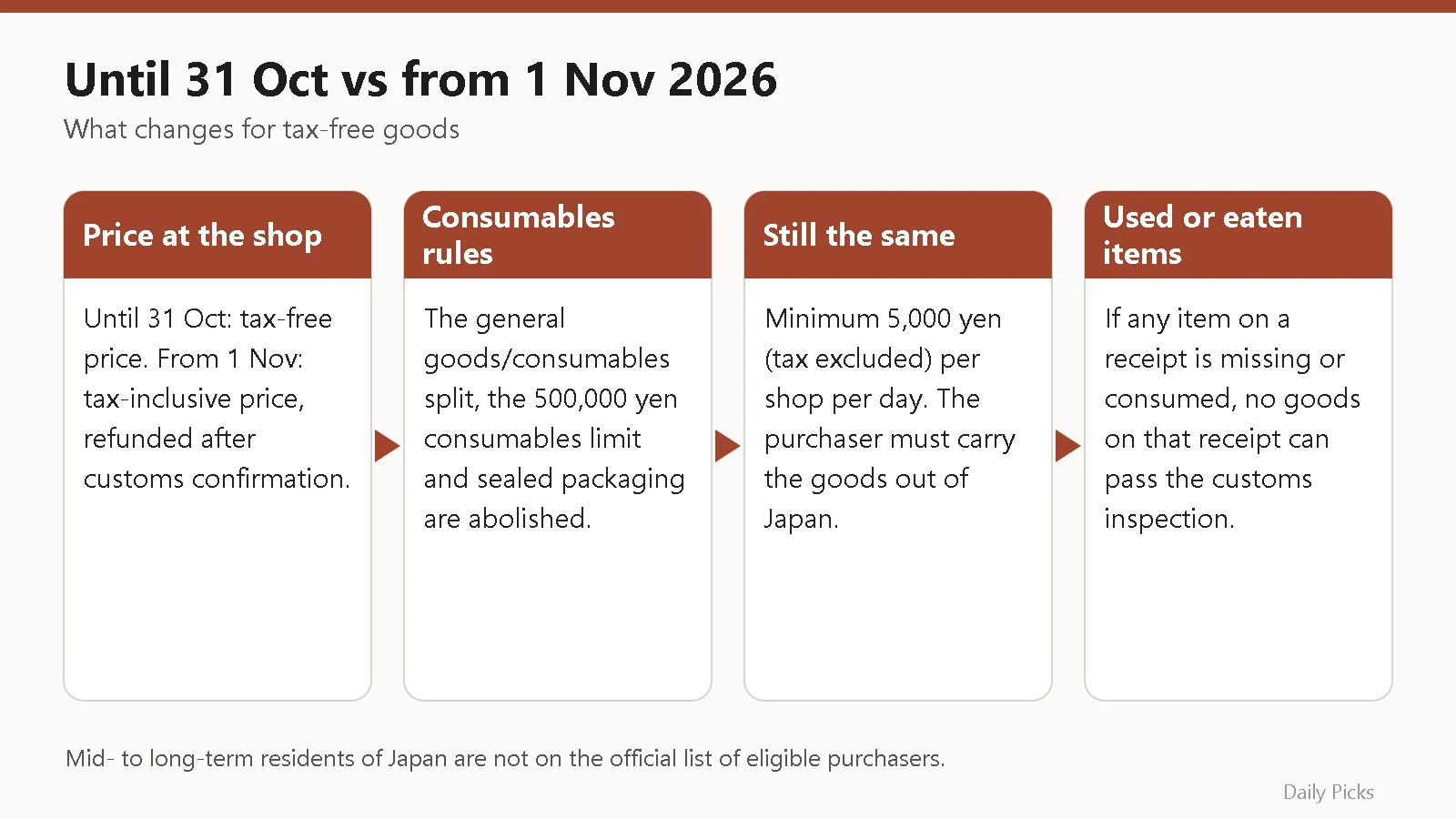
The table below compares the two systems, based on NTA and Japan Tourism Agency materials. It is a general summary, not advice for a specific trip.
| Point | Until 31 October 2026 | From 1 November 2026 |
|---|---|---|
| Price paid at the shop | Tax-free price | Tax-inclusive price |
| When the tax comes back | Not charged at the till | Refunded after Customs confirms export |
| Minimum purchase | 5,000 yen or more (tax excluded) per shop per day | No change: 5,000 yen or more (tax excluded) per shop per day |
| General goods vs consumables | Separate rules for each | Distinction abolished |
| Upper limit for consumables | 500,000 yen | Abolished |
| Special sealed packaging for consumables | Required | Abolished |
| Check at departure | Show passport and goods to Customs | Customs confirmation within 90 days of purchase, before baggage check-in |
| Who pays the refund | Not applicable | The shop or a refund service provider it uses |
Some items stay outside the system. The Japan Tourism Agency lists gold and platinum bullion as excluded, and from 1 November 2026 gold and platinum coins are added to that exclusion. Items that are already exempt from consumption tax are also outside the system. The quantity must be limited to what the visitor can personally carry out of Japan when they leave.
At the shop: passport, purchase records and refund method
The visitor shows their passport at the tax-free shop. The shop sends the purchase record information (購入記録情報, konyu kiroku joho) to the tax authorities electronically. The NTA says shops had to move to this electronic procedure, and shops that have not done so by 31 October 2026 lose their tax-free permission.
The Japan Tourism Agency’s FAQ says that information on how to register a refund method is given at the shop when you buy. It lists possible refund methods as bank transfer, credit card, app-based refund, or cash at the port of departure after customs confirmation. Which of these are available depends on the shop or its refund service provider. The NTA notes that the consumption tax law does not set out how the shop must pay the refund.
Keep each receipt. Customs checks goods per purchase transaction, so it helps to know which items belong to which receipt. For items priced 1,000,000 yen or more (tax excluded) per unit, the NTA says shops must record more detailed product information, such as a serial number.
Japanese words you will see
| Japanese | Reading | Meaning |
|---|---|---|
| 免税店 | menzeiten | Tax-free shop |
| 免税手続 | menzei tetsuzuki | Tax-free procedure |
| リファンド方式 | rifando hoshiki | Refund method |
| 税込 | zeikomi | Tax included |
| 税抜 | zeinuki | Tax excluded |
| 返金 | henkin | Refund |
| 税関 | zeikan | Customs |
| 短期滞在 | tanki taizai | Temporary Visitor (status of residence) |
| 消耗品 / 一般物品 | shomohin / ippan buppin | Consumables / general goods |
| 出国 | shukkoku | Departure from Japan |
At the airport or seaport: customs before check-in
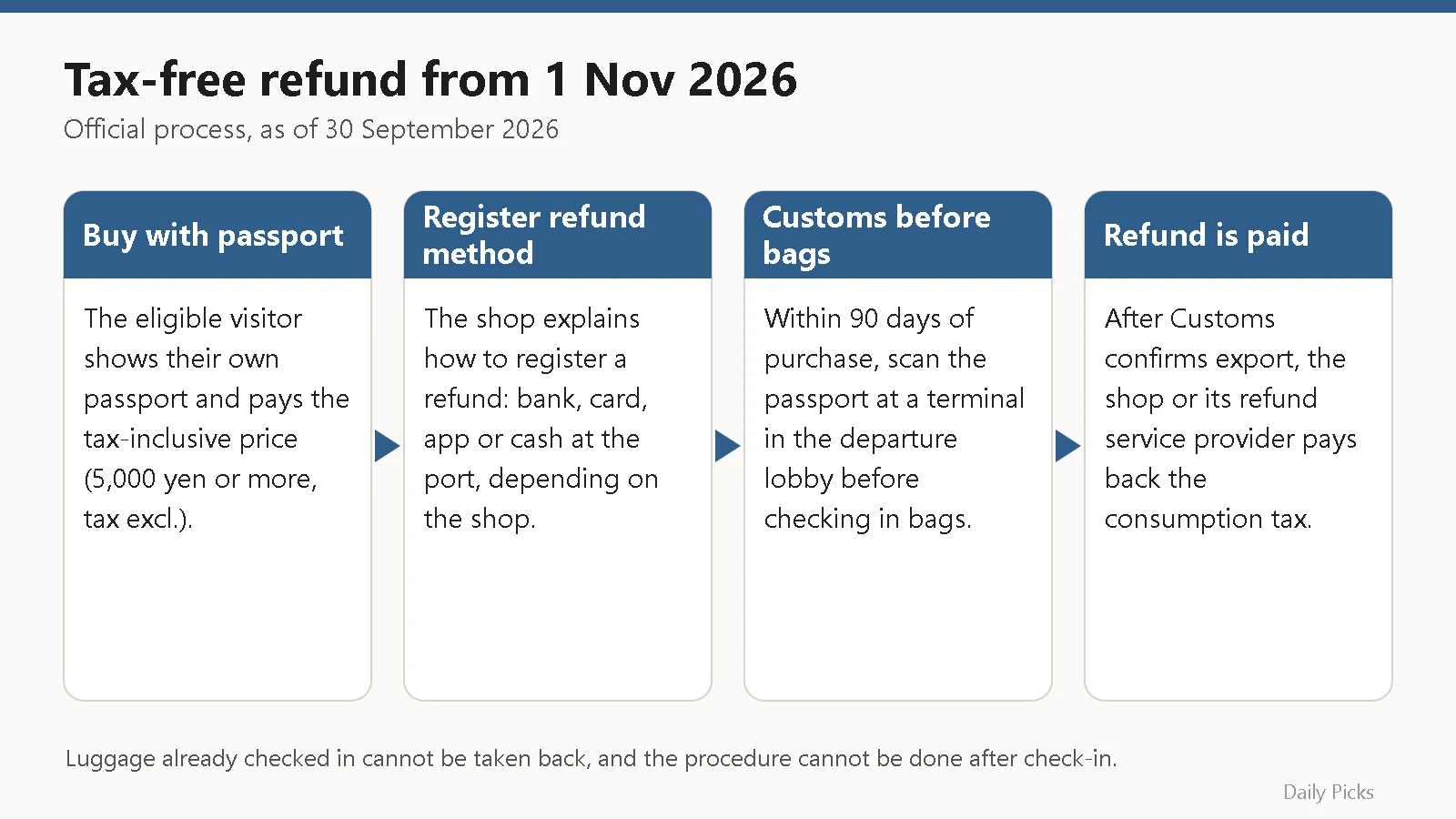
The Japan Tourism Agency’s page for travellers says the customs inspection must be done within 90 days of purchase. The NTA explains that “within 90 days” means up to the 90th day counting from the day after the purchase date.
Tax-free procedure terminals and inspection areas are in the international departure lobby, before baggage check-in. The visitor scans their passport at a terminal. A green result means no inspection is needed and the procedure is complete. A red result means the visitor must take the goods to the inspection area.
Timing is the key point. According to the Japan Tourism Agency, you cannot complete the procedure after checking in your luggage, and checked luggage cannot be taken back. If there is not enough time, neither the airline nor Customs will provide compensation. The NTA Q&A also states that customs confirmation cannot be received after baggage has been checked in.
At Narita, Haneda, Kansai, Chubu, Fukuoka, New Chitose and Naha airports, the procedure can also be done online through Visit Japan Web, using the designated Wi-Fi in the international departure lobby. A visitor who flies from a domestic airport to an international hub does the procedure at the airport where they actually leave Japan.
If goods are used, eaten or not shown
Special packaging for consumables is abolished, but that does not mean visitors can use them in Japan and still get the refund. The Japan Tourism Agency FAQ says that if consumables are consumed in Japan, the visitor is not eligible for the customs inspection and the tax refund. If food, drinks or cosmetics were consumed before departure, the visitor should not go through the tax-free procedure for them, and should tell a customs officer at the counter instead.
Customs checks goods per purchase transaction. If the visitor does not have even one item from a receipt, none of the goods on that receipt can pass the customs inspection. So if one bottle out of a set bought on the same receipt was opened and finished, the whole receipt is affected.
After passing the inspection, the goods must be taken out of Japan without delay. The Japan Tourism Agency warns that if they are not, the consumption tax will be collected and penalties may apply. The option of shipping goods separately at departure was abolished on 31 March 2025.
Checklist for visitors (and hosts helping them)
If you are hosting a visitor, you can go through this list with them before they shop and again before they fly home.
- Confirm the visitor is on the official eligible list (for example, Temporary Visitor status). A resident cannot shop tax-free on their behalf.
- Carry the visitor’s own passport when shopping. Look for tax-free shops, which may display the official tax-free shop symbol mark.
- Check that the total is 5,000 yen or more (tax excluded) at one shop on one day.
- Expect to pay the tax-inclusive price. Ask the shop how the refund will be paid and register the refund method as the shop explains.
- Keep every receipt, and keep goods from the same receipt together.
- Do not open, eat, drink or use tax-free goods in Japan if the visitor wants the refund.
- Note the purchase date. The visitor must leave Japan within 90 days of it, counting from the next day.
- Pack tax-free goods so they are easy to show, in case the terminal shows a red result.
- Arrive at the airport or port with enough time. Do the customs procedure before checking in any baggage.
- After a green result or a completed inspection, take the goods out of Japan without delay, and follow up with the shop or refund provider if the refund does not arrive.
FAQ
I live in Japan on a work visa. Can I use the new refund system?
Generally no. The official list of eligible purchasers covers foreign nationals with Temporary Visitor, Diplomat or Official status, certain landing permits and U.S. forces members with a SOFA stamp, plus Japanese nationals who have lived abroad for two years or more. Mid- to long-term residents are not on it. If you are unsure about your own case, ask the tax office.
When will the visitor get the money back?
The Japan Tourism Agency says the refund is generally processed after the tax-free sale is confirmed through the customs inspection. The NTA notes that the law does not set out how or when the shop must pay. Timing and method depend on the shop or its refund service provider, so ask at the time of purchase.
Can the visitor get the refund in cash?
Possibly. The Japan Tourism Agency lists bank transfers, credit card transfers, app-based refunds and cash refunds at the port of departure after customs confirmation as possible methods. Each shop decides which it offers.
What if the visitor already checked in their suitcase?
The procedure cannot be completed after checking in luggage, and checked luggage cannot be taken back. The Japan Tourism Agency says neither the airline nor Customs provides compensation in this case. This is why the procedure should be done first.
The visitor ate some of the snacks. Can they still get a refund for the rest?
Only for receipts where every item is still in their possession. If even one item from a receipt is missing, none of the goods on that receipt can pass the customs inspection. They should tell a customs officer about goods that were consumed.
What about goods bought on or before 31 October 2026?
The refund method applies to sales from 1 November 2026. Goods bought on or before 31 October 2026 were sold tax-free under the current system. Under the current rules, Customs asks non-residents who bought tax-free goods to show their passport when leaving Japan, and the goods must be taken out of Japan.
Related reading
- What changes in Japan from October 2026
- Extending your period of stay in Japan
- Emergency numbers in Japan: 119, 110 and #7119
- Seeing a doctor in Japan
Sources
- Special page for travellers (English) – Japan Tourism Agency
- Frequently Asked Questions for Travelers (Refund Method) – Japan Tourism Agency
- List of eligible tax-free goods purchasers (PDF) – Japan Tourism Agency
- Changes to tax-free goods (PDF) – Japan Tourism Agency
- Japan Tax-free Shop site – Japan Tourism Agency
- Tax-free shop symbol mark (Japanese) – Japan Tourism Agency
- Overview of the tax-free shop system (Japanese) – National Tax Agency
- Q&A on the tax-free shop system (refund method), July 2026 (Japanese PDF) – National Tax Agency
- Q&A on the tax-free shop system (refund method, overview) (Japanese PDF) – National Tax Agency
- Image of the refund method (English PDF) – National Tax Agency
- Customs procedures at departure (Japanese) – Japan Customs
- For foreign travellers buying tax-free goods (PDF) – Japan Customs
- Japan’s Tax Exemption – Japan National Tourism Organization
コメント