One day an envelope turns up in your mailbox with no name on it. Inside is a form in Japanese, a logo you recognise from the television, and a number to call. Or someone knocks on your door and starts explaining something about a contract. Either way, the subject is the same: NHK’s receiving fee (jushinryo), the money that pays for Japan’s public broadcaster.
This article explains what the letter is, what the law actually requires, how much the fee is now, which discounts and exemptions exist, and what to do when you move house or leave Japan. It does not tell you to pay or not to pay. Everything below comes from NHK’s own published rules and from the Broadcasting Act.
- The envelope with no name on it
- When somebody comes to the door
- What the law says
- Which devices create the obligation
- How much it costs
- Discounts and exemptions
- Deadlines, the first month, and unpaid fees
- Moving house, going home, leaving Japan
- Fake NHK letters, emails and visitors
- Where to ask, in English
- Questions people ask
- Sources
- Also on Daily Picks
The envelope with no name on it
The most common letter is sent by a Japan Post service called tokubetsu ate-sho haitatsu yubin (特別あて所配達郵便), “special address delivery mail”. It lets a sender deliver mail to an address even when the sender does not know the name of the person living there. That is why the envelope has a street address but no name.
NHK explains on its own site that it sends this mail to addresses where it has not been able to confirm a receiving contract. Inside is a jushin keiyakusho (受信契約書), a receiving contract form, together with a request to complete it. NHK asks you to do one of three things, depending on your situation:
- You have a TV or have started using NHK’s online service, and have no contract yet — complete the enclosed form, or apply online.
- You already have a contract but have moved — use the enclosed form to register your new address.
- You already completed a procedure recently — nothing to do; the letter and your paperwork crossed in the post.
NHK also states directly what happens if none of that applies to you: if you have neither a device that can receive NHK broadcasts nor have started receiving NHK’s online service, no procedure is needed. It adds that it may still send documents or send someone to your door in future to confirm that.
Two other kinds of mail are easier to recognise. If you already have a contract and chose to pay by haraikomi yoshi (払込用紙), a payment slip, NHK posts the slip to you for each payment period. And if NHK learns through a public records check that a contract holder has moved, it may treat the new address as registered and send a notice saying so.
When somebody comes to the door
NHK still carries out some of this work in person. The people who do it are called chiiki communicator (地域コミュニケーター), local communicators. Some of the visiting work is contracted out to private companies, and NHK publishes the list: a notice dated 10 September 2026 names two companies operating in parts of Osaka and Hyogo prefectures.
NHK publishes two rules that a genuine visitor always follows, and they are worth knowing because fake visitors have been reported:
- A visitor always carries an identification certificate issued by NHK. NHK says its visitors never ask for payment without one, and you may ask to see it.
- If you pay cash, the visitor issues a receipt on the spot. NHK says its visitors never tell you that a receipt will be posted later.
If you are not sure whether a visitor, letter, email or phone call is really from NHK, you can check with NHK directly using the numbers at the end of this article.
What the law says
The obligation comes from Article 64 of the Broadcasting Act (放送法, Hoso-ho). This is NHK’s own published English translation of the first paragraph:
A person that falls under any of the following items must conclude a receiving contract with NHK in accordance with the authorized contract clauses: (i) a person who has installed specified receiving equipment; (ii) a person that has begun to receive specified compulsory distribution.
Broadcasting Act, Article 64 (1), as translated by NHK
Three points in that sentence matter in daily life.
First, the duty is to enter into a contract, not to watch anything. NHK puts it plainly on its English page: you are not paying for access to particular programmes, you are contributing to the running of NHK as a whole. Receiving fees make up about 96% of NHK’s income.
Second, the duty applies regardless of nationality. There is no separate rule for foreign residents, and no exemption simply for being a short-term resident.
Third, the Act itself does not set the price. Article 64 (5) requires NHK to write the detailed contract terms and obtain the authorization of the Minister for Internal Affairs and Communications. Those terms are the Hoso Jushin Kiyaku (放送受信規約), the Broadcast Receiving Contract Clauses, and that is where the amounts, deadlines and cancellation rules actually live. Article 64 (2) is also useful to know: a second installation in the same residence, or an installation by someone who shares your residence and living expenses, does not require a second contract.
Which devices create the obligation
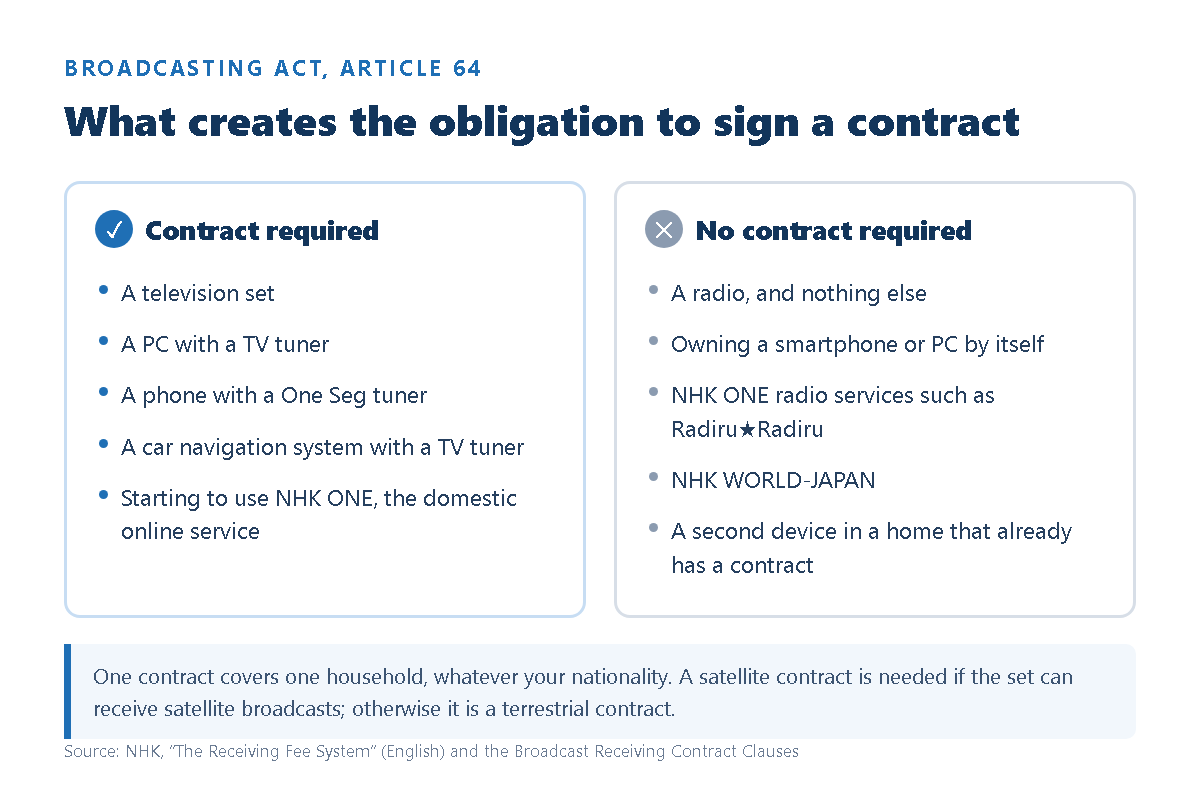
NHK lists the equipment that counts: a television set, a PC with a TV tuner, a smartphone with a One Seg tuner, and a car navigation system with a TV tuner. A radio on its own does not count.
Since October 2025 there is a second route. NHK ONE, NHK’s domestic online service, also creates the obligation once you start using it, excluding its radio services such as Radiru★Radiru. NHK is specific about the limits here:
- Owning a smartphone or a PC is not enough by itself. Before you can start using NHK ONE you have to go through a step that confirms a contract is needed.
- NHK WORLD-JAPAN, the international English service, does not require a contract.
- If your household already has a contract, NHK ONE costs nothing extra and needs no separate contract.
There are two normal contract types. A terrestrial contract (地上契約) covers a set that receives only terrestrial broadcasts, and also covers the online service on its own. A satellite contract (衛星契約) is required if your television can receive satellite broadcasts — and NHK notes that a satellite-capable set means a satellite contract even if you came in through the online service. A third, rarer type, the special contract (特別契約), exists for places where terrain blocks terrestrial reception and only satellite reception is possible.
How much it costs
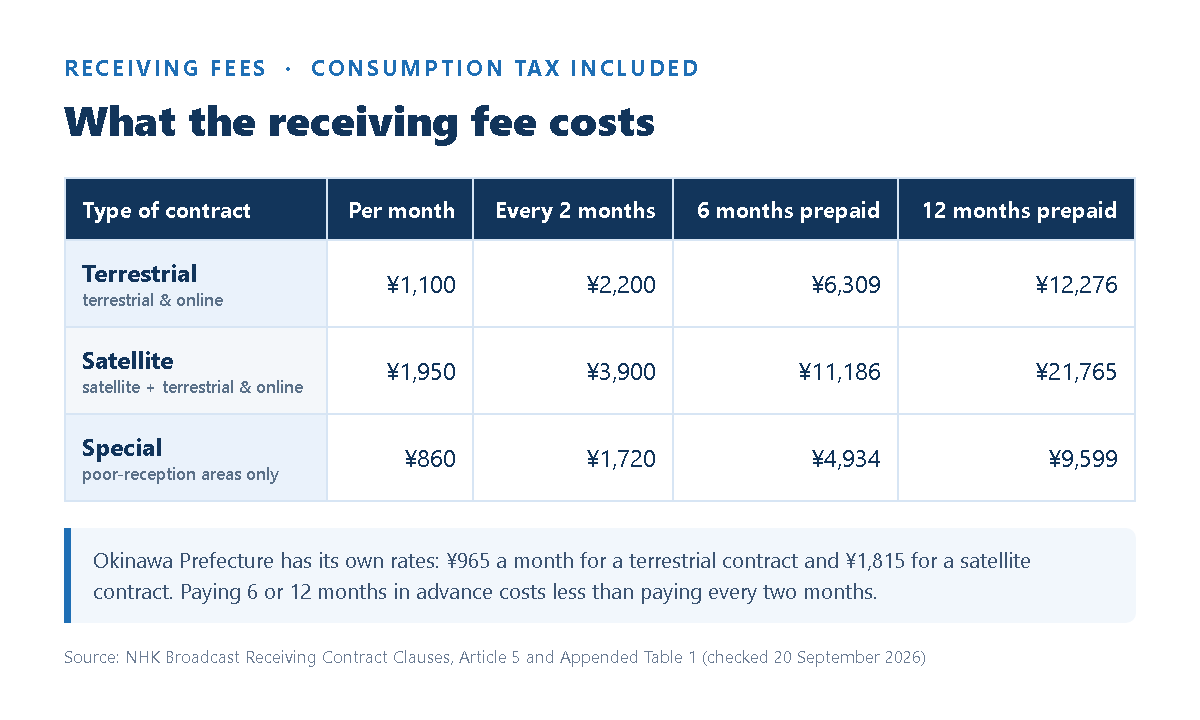
The monthly and advance-payment amounts are set in Article 5 of the Broadcast Receiving Contract Clauses and include consumption tax; the two-month amounts are two months of the monthly fee, billed together. A terrestrial contract is ¥1,100 a month, or ¥2,200 every two months. A satellite contract is ¥1,950 a month, or ¥3,900 every two months. Paying in advance is cheaper: ¥6,309 for six months or ¥12,276 for twelve on a terrestrial contract, and ¥11,186 or ¥21,765 on a satellite contract.
Okinawa Prefecture has separate rates under Appended Table 1 of the same rules: ¥965 a month for a terrestrial contract and ¥1,815 for a satellite contract.
The two-month billing periods are fixed, not counted from the day you sign: April–May, June–July, August–September, October–November, December–January, February–March. Payment is normally made by bank account direct debit (口座振替), continuing credit-card payment, or continuing bank transfer; NHK covers the handling fee for these. If you use payment slips instead, you can pay at a bank, a post office or a convenience store.
Discounts and exemptions
Several reductions exist, and almost all of them require you to apply. They are not applied automatically.
Students living away from their family
A student who lives apart from their parents or guardians can have the fee waived in full if one of several conditions applies. NHK’s published list includes being a dependant on someone else’s health insurance, receiving a scholarship that is awarded on financial grounds, receiving a tuition waiver awarded on financial grounds, having an annual income of ¥1.87 million or less in the previous year, being covered by the student payment exception for National Pension contributions, or having a family household that is exempt from municipal residents’ tax.
The exemption covers students at universities, junior colleges, specialist schools with courses of one year or more, and certain national college-equivalent institutions. Two things to note: you have to sign the contract first and then apply for the exemption, and the exemption does not reduce what you can watch — NHK ONE is included at no extra cost.
A second home in the same family
The kazoku waribiki (家族割引), family discount, cuts the fee by half on a second contract when the contract holder, or someone who shares living expenses with them, already pays for a contract at another residence. It is the rule that applies to a student or a worker posted away from home who does not qualify for a full exemption. It applies only if both contracts are paid by direct debit, continuing credit-card payment or continuing bank transfer, and NHK may ask for documents confirming what is written on the application.
Welfare and disability
NHK’s exemption standards, which are also approved by the Minister for Internal Affairs and Communications, list full exemptions for households receiving public assistance under the Public Assistance Act, households where a member holds a physical, intellectual or mental disability certificate and every member of the household is exempt from municipal residents’ tax, and residents of social welfare facilities. Half exemptions apply where the head of the household is also the contract holder and has a visual or hearing disability, a severe physical or intellectual or mental disability, or is a severely disabled war veteran.
Separately, NHK grants time-limited exemptions to households in declared disaster areas. These are announced region by region and, unusually, the contract clauses allow them to be applied without an application.
Deadlines, the first month, and unpaid fees
Article 3 of the contract clauses sets the deadline for submitting the contract form: the last day of the month two months after the month in which you installed the equipment or started receiving the online service. So a television installed in April means a form due by the end of June.
Article 5 then says the fee runs from the month after the month in which the obligation arose, up to the month before cancellation. In NHK’s own wording on its letter page, the first month is free.
Article 12 covers the other direction. If the fee was avoided by fraudulent means, NHK may demand the unpaid fee plus a surcharge of twice that amount. NHK gives false statements in a cancellation notice or an exemption application as examples, and the surcharge also applies where a contract application was not made by the deadline without a justifiable reason. A cancellation based on a false statement can be undone retroactively. Beyond that, NHK says it turns to civil procedures such as a payment demand or a civil lawsuit as a last resort, and it publishes notices about the cases it files.
Moving house, going home, leaving Japan
These are the procedures most likely to matter to a foreign resident, and they are different from each other.
Moving within Japan. Article 8 requires a contract holder to notify NHK immediately of a change of name or address. There is an online change-of-address form, and NHK publishes an English step-by-step guide to it as a PDF. Note that if you are leaving a shared household to live alone, that is treated as a new contract at the new address rather than a change of address.
Cancelling. Article 9 covers cancellation, and NHK lists the main grounds: nobody lives at the address any more, two households merge into one, you move abroad, all the receiving equipment is removed, broken or given away, or you stop receiving the online service. You must notify NHK of your name, address, the location of the equipment, and the reason. NHK confirms the facts and the contract is treated as cancelled on the day you gave notice.
Cancellation is handled by phone through the NHK Fureai Center. Only one case — two households merging — can be started online, and even then NHK posts you a confirmation document to sign, seal and return. If you stop using NHK ONE, deleting the app or the account is not a cancellation; you still have to contact NHK. NHK says it will not ask you to dispose of your phone or PC.
Money back. Article 11 requires NHK to refund overpayments after a cancellation or an exemption. If a payment has already been taken because the timing was too tight to stop it, NHK refunds the amount covering the month the cancellation was accepted and afterwards. NHK may also apply a refund against future fees instead of paying it out.
The English page carries one specific instruction on this point: if you move away from Japan or stop owning a relevant reception device, contact NHK to cancel the contract. The fee stops from the month after cancellation.
Fake NHK letters, emails and visitors
NHK runs a standing warning page about people impersonating it, and the patterns it lists are worth knowing before you click anything.
- Phishing emails with subject lines such as “confirm your NHK receiving fee within 24 hours” or “NHK upgrade notice”, linking to a fake registration page that asks for a credit card or bank account number.
- NHK says that when it emails you about a fee procedure, it directs you to its own website and never sends you straight to an outside site. Its fee emails go to people who recently signed a contract or changed address.
- Registering an NHK ONE account, or linking it to your contract, has no field for a card or bank account number. Nor does NHK’s official app.
- NHK ONE’s launch did not change the fee, so a message saying your fee has gone up because of it is not from NHK.
- Fake visitors demanding payment have been reported — hence the identification certificate and on-the-spot receipt described above.
If you have already entered card details on a site you now doubt, NHK’s advice is to contact your card company immediately.
Where to ask, in English
NHK runs an English page about the receiving fee system, and an English-language toll-free line for receiving contracts:
- 0120-151515 — receiving contract line, 9:00–18:00. Ask NHK to post you a contract form, or ask about cancelling.
- 0570-077-077 — general receiving fee enquiries, 9:00–18:00, including weekends and public holidays. Japanese.
- 0570-099-033 — NHK ONE registration, 9:00–18:00. Japanese.
The online forms for a new contract and for a change of address are in Japanese, but NHK publishes English PDF walkthroughs that show each screen and each field, including how to write your name in the Western alphabet and in katakana. Those two PDFs are linked in the sources below.
One last practical note. Almost every rule described here — the deadline, the discounts, the exemptions, the cancellation grounds — is a procedure with a form behind it. Nothing in the system is applied automatically except the disaster exemption. If your situation has changed, the change only takes effect once NHK has it in writing.
Questions people ask
I do not own a television. Do I still have to sign?
No. Article 64 attaches the duty to installing specified receiving equipment or to beginning to receive the online service — not to living in Japan. If you have no television, no PC with a TV tuner, no One Seg smartphone and no car navigation system with a tuner, and you have not started using NHK ONE, no contract is required. A radio on its own does not count, and NHK WORLD-JAPAN does not count. Owning an ordinary smartphone or PC is not enough by itself either. Two cautions, though. A satellite-capable television means a satellite contract even if nobody in the household watches satellite channels, and a false statement is expensive: under Article 12 of the contract clauses a cancellation based on one can be undone retroactively, with a surcharge of twice the unpaid fee. Say you have no receiver only if that is true.
NHK wants fees for months before I signed. Is that right?
Usually yes, and this surprises people more than anything else in the system. The fee does not start when you sign. Under Article 5 it runs from the month after the month in which the obligation arose — that is, from the month after you installed the television or started using the online service — which is why NHK describes the first month as free. Article 3 gives you until the last day of the month two months after that to send the contract form in, so a television installed in April means a form due by the end of June. Sign in October for a television you set up in April and the bill reaches back to May. Article 12 adds a surcharge of twice the unpaid amount where the application was not made by the deadline without a justifiable reason, or where the fee was avoided by fraudulent means. If the amount NHK is asking for does not match the month you actually installed the set, that is the thing to raise on the 0120-151515 line, in writing if you can — nothing in this system changes until NHK has it on paper.
Sources
- NHK, The Receiving Fee System (English)
- NHK, Receiving Contracts and Broadcast Receiving Fees (PDF, English translation of Broadcasting Act Article 64)
- NHK, 日本放送協会放送受信規約 (Broadcast Receiving Contract Clauses, incl. Article 3, 5, 5-4, 6, 8, 9, 10, 11, 12 and Appended Table 1)
- NHK, NHKから宛名のない郵便物が届いたら (on unaddressed “special address delivery mail”)
- NHK, 受信料免除の対象となる方について (exemption categories)
- NHK, 一人暮らしの学生のみなさま NHK受信料の学生免除 (student exemption)
- NHK, 受信契約の解約 (cancellation)
- NHK, NHKを名乗る不審なメールにご注意ください (impersonation warning)
- NHK, 受信料の公平負担に向けた取り組みについて知りたい (FAQ, incl. civil procedures)
- NHK, 引越しをするので手続きをしたい (FAQ, moving)
- NHK, Apply for a New Contract and Register a Change of Address (PDF, English walkthroughs)
- NHK 営業局, 受信料の契約・収納業務について (PDF, 10 September 2026, contracted visiting companies)
- e-Gov, 放送法 (Broadcasting Act, Japanese original)
All pages were checked on 20 September 2026, and the fee amounts in Article 5 of the contract clauses were checked again on 17 October 2026. Fees, exemption conditions and procedures are set by NHK with the approval of the Minister for Internal Affairs and Communications and can change; check the NHK pages above, or call the numbers listed, before you act on anything here. This article describes the published rules and is not legal advice on any individual case.