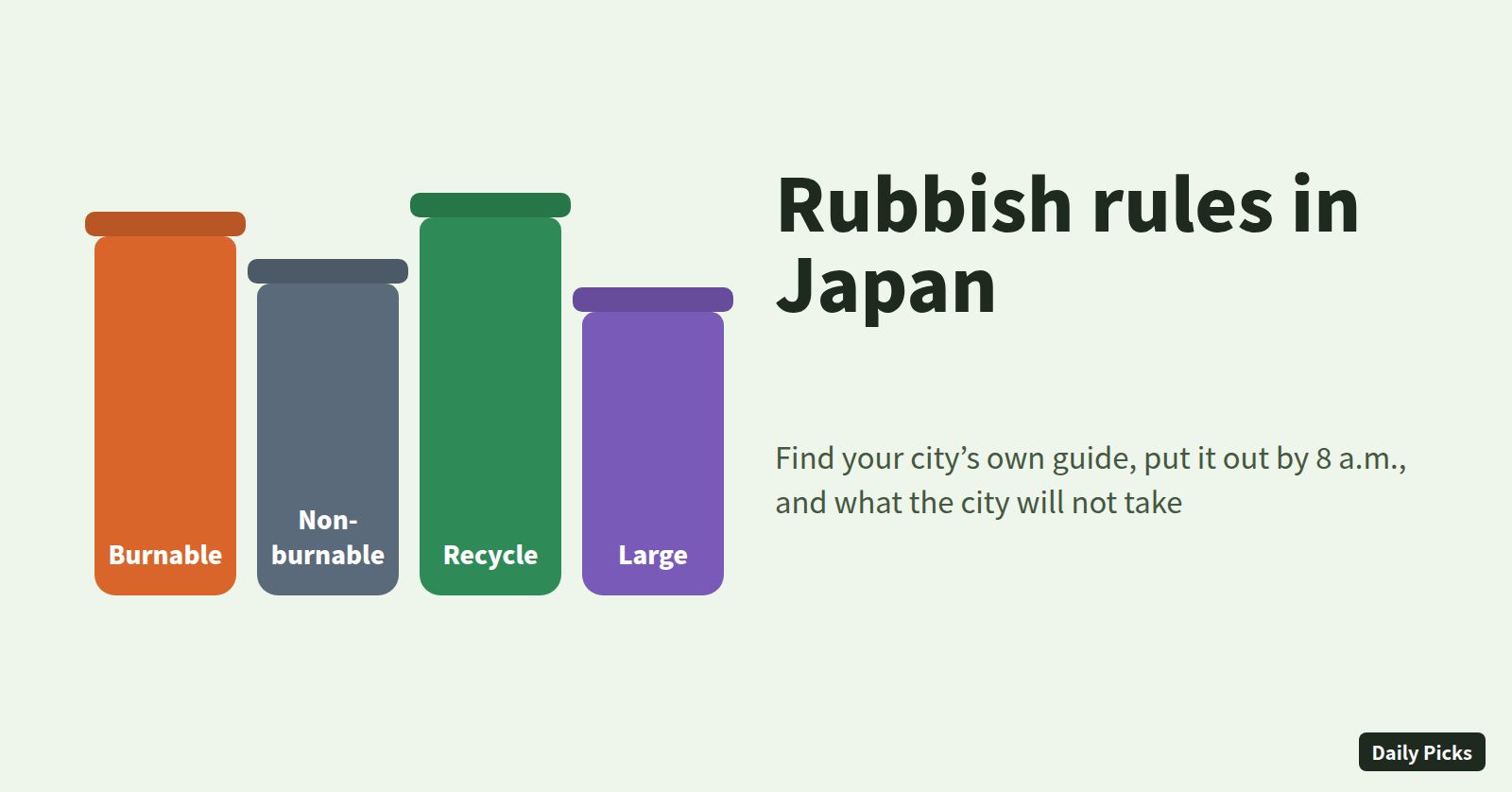
Summary: Japan has no single national rulebook for household rubbish. Each city, and in Tokyo each ward, decides its own categories, collection days and bag rules. So the first job is to get your city’s guide, usually available in English, and its collection calendar for your address. Most places sort into burnable waste, non-burnable waste and several kinds of recyclables, and ask you to put bags out by 8:00 a.m. on the collection day. Large items such as furniture need a booking and a paid sticker. Air conditioners, TVs, fridges and washing machines are not collected by the city at all. This guide explains how the system works, how to find your local rules, and what to do with the things people most often get wrong.
- Why the rules change when you move
- Step 1: get your own guide and calendar
- Step 2: learn the usual categories
- Step 3: put it out correctly
- Large items: how sodai gomi works
- Things the city will not take
- A warning about “free collection” trucks
- Moving out: plan your rubbish early
- Reading the recycling marks on packaging
- FAQ
- Related reading
- Sources
Why the rules change when you move
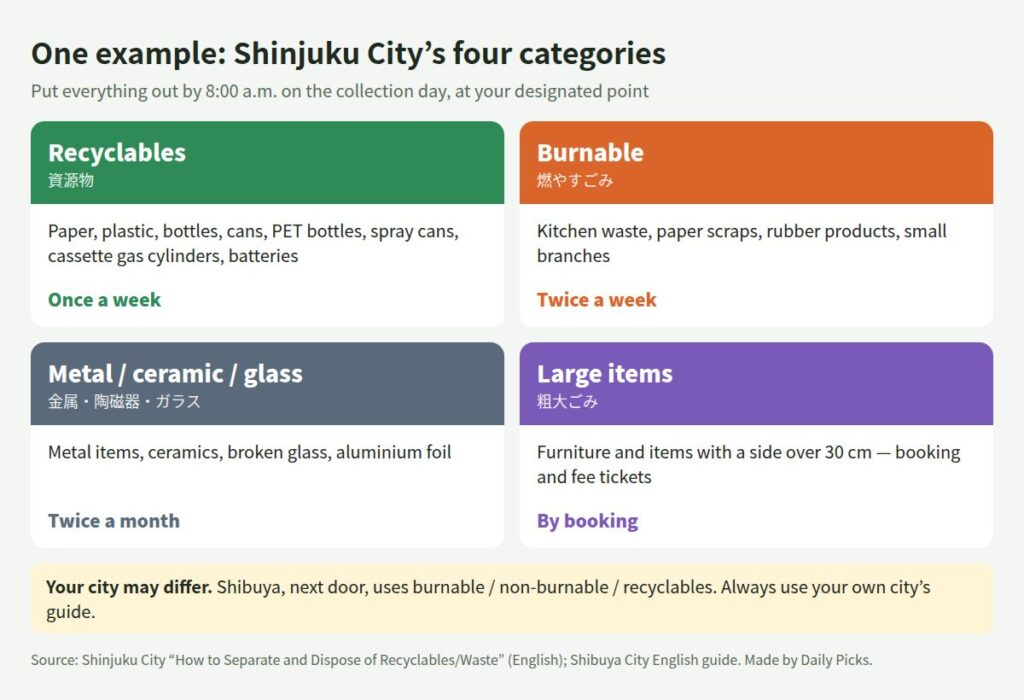
Rubbish collection is run by municipalities, so the details depend on where you live. Two neighbouring Tokyo wards show how different it can be. Shinjuku City’s English guide uses the categories recyclables, burnable waste (燃やすごみ moyasu gomi) and metal, ceramic and glass (金属・陶磁器・ガラス). Shibuya City’s English guide uses burnable, non-burnable and recyclables. The same item can go in a different bag, on a different day, depending on the side of the street you live on.
That is why friends’ advice, or a guide written for another city, can be wrong for you. Use it only as a starting point.
Step 1: get your own guide and calendar
- Ask at the city or ward office when you register your address (jūmin tōroku). Many offices hand out a sorting guide and a collection calendar, often in several languages.
- Search your city’s website for “garbage” or “waste” plus “English”, or the Japanese words ごみ 分け方 (gomi wakekata, how to sort). Many cities publish a PDF guide in English.
- Find your collection days by address. Days are set by area, even within one ward. The guide or the city website will have a table or a search by district (chōme).
- Look at your building’s collection point. Many apartment buildings post the local schedule by the rubbish area. Your landlord or management company can also tell you.
- Check for an app. Many municipalities offer a sorting and reminder app, sometimes with an English setting.
Step 2: learn the usual categories
Names differ, but most places use something like these:
- Burnable / combustible (燃やすごみ, 可燃ごみ kanen gomi): kitchen scraps, paper that cannot be recycled, and in many cities some plastics and rubber. Usually collected twice a week.
- Non-burnable / incombustible (燃やさないごみ, 不燃ごみ funen gomi): small metal items, ceramics, broken glass. Often collected only once or twice a month, so check the date carefully.
- Recyclables (資源 shigen): usually split into bottles, cans, PET bottles, paper and cardboard, and sometimes plastic packaging. Often weekly.
- Large items (粗大ごみ sodai gomi): furniture and other big items. Shinjuku and Shibuya both define these as things with a side of about 30 cm or more. They need a booking (see below).
- Hazardous or special items: spray cans, cassette gas cylinders, dry batteries and lighters have their own rules because they can start fires in collection trucks. Your guide will say how to put them out.
Step 3: put it out correctly
- Time: Shinjuku City asks residents to put rubbish out “by 8:00 am on collection day.” Many places use the same time. Do not put it out the night before unless your building’s rules allow it; crows and cats will get into it.
- Place: only at your designated collection point.
- Bags: some cities require specific paid bags sold in supermarkets and convenience stores; others accept any clear or semi-clear bag. Your guide will say which.
- PET bottles: Shinjuku’s guide asks you to remove the caps and labels, rinse lightly and flatten the bottle. Caps and labels usually go with plastic or burnable waste, depending on the city.
- Cans and bottles: rinse them. Many cities collect them together, then sort them later.
- Cardboard and paper: fold, tie with string and put out on the paper day. Do not put paper in plastic bags unless your guide says so.
Shibuya’s guide is clear that bags “will not be collected if the contents are not separated.” In many areas, a wrongly sorted bag is left behind with a sticker explaining the problem. Take it back, fix it and put it out on the right day.
Large items: how sodai gomi works
For furniture, bicycles, bedding and other big items, you book a collection and pay by buying a sticker or ticket. Shinjuku City’s steps are typical:
- Book with the ward’s large-item reception centre, online or by phone. You will be told the collection date and the fee.
- Buy fee tickets for that amount. Shinjuku uses an A ticket (200 yen) and a B ticket (300 yen), sold at convenience stores, supermarkets and ward waste offices.
- Write your name or booking number on the ticket and stick it on the item.
- Put the item out at the place and on the date you were given, by the time stated.
Fees depend on the item and the municipality. Book early before moving out, especially in March and April when many people move and slots fill up.
Things the city will not take
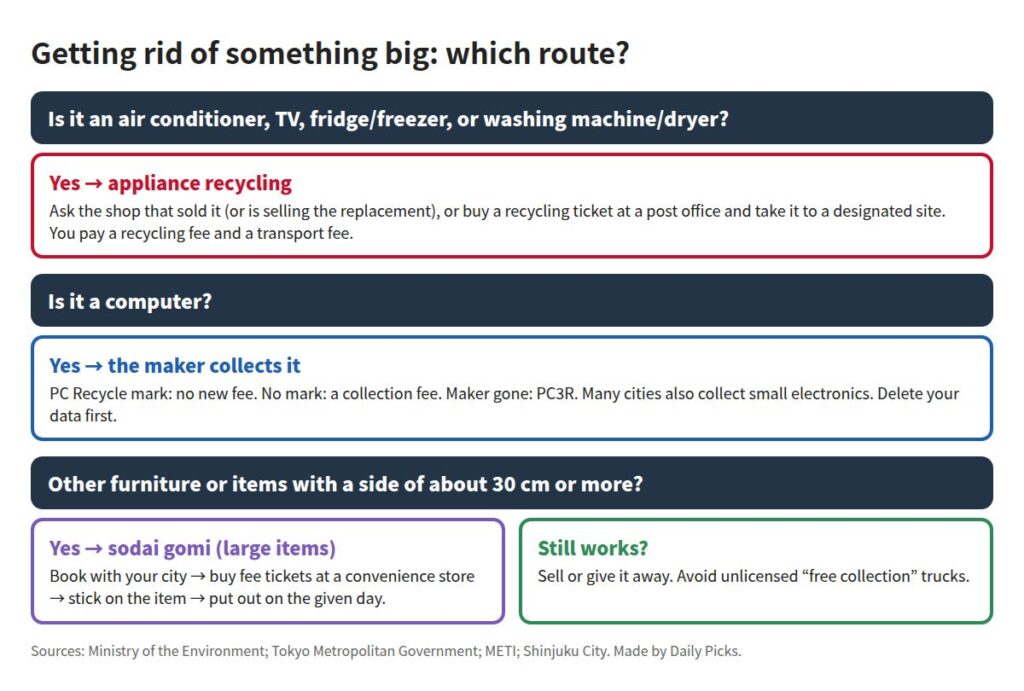
Air conditioners, TVs, fridges and freezers, washing machines and dryers
These four kinds of appliance are covered by Japan’s Home Appliance Recycling Law. The city does not collect them as ordinary large items. When you dispose of one, you pay a recycling fee and a collection and transport fee. The Ministry of the Environment explains that shops are required to take back items they sold, and items being replaced when you buy a new one.
According to the Tokyo Metropolitan Government, the options are:
- Ask the shop where you bought it, or the shop selling you a replacement, to take it back and pay the fees.
- Buy a home appliance recycling ticket at a post office and take the item, with the ticket, to a designated collection site yourself.
- Check your city’s website for any other arrangement it offers.
Computers
Shinjuku also lists personal computers among the items it does not collect. In Japan, the manufacturer collects household PCs. According to the Ministry of Economy, Trade and Industry, a PC with a PC Recycle mark is collected with no new fee, while one without the mark has a collection fee. If the maker no longer exists, a collection scheme run by the industry (PC3R) handles it, and many cities also collect small electronics under the small appliance recycling scheme. Delete your data before handing a computer over.
Other items
Shinjuku’s guide also lists tyres, pianos, fire-resistant safes and non-cassette gas cylinders as items it does not collect. Ask the seller or a specialist dealer.
A warning about “free collection” trucks
You may see trucks driving around with loudspeakers, or leaflets in your mailbox, offering to take unwanted appliances and furniture, sometimes “for free.” The Ministry of the Environment warns against using collectors who do not hold the right licence. To collect household waste, a business needs a municipal general waste licence; an industrial waste licence or a second-hand dealer’s licence is not enough. The ministry lists the risks: illegal dumping, harmful substances such as refrigerant gas being released, fires from batteries, and unexpectedly high charges once your items are on the truck.
If an item still works, selling it to a licensed second-hand shop or giving it away is fine. For everything else, use your city’s system or the shop routes above.
Moving out: plan your rubbish early
- Book large-item collections two or three weeks before you move.
- Arrange the four appliance types with a shop or a recycling ticket.
- Check the last collection days for each category before your move-out date, so you are not left with bags you cannot put out.
- Do not leave rubbish in the apartment or at the collection point after you move. It can be charged to you from your deposit.
Reading the recycling marks on packaging
Most food and drink packaging in Japan carries a small printed mark. It is often a word inside an arrow shape, such as プラ (pura) or 紙 (kami). These marks tell you what the packaging is made of. Once you can read them, sorting at home becomes much faster, even when the rest of the label is only in Japanese.
This section explains the common marks, what each one means, and how to use them together with your city’s guide. The information below is as of 30 September 2026 and is based on pages from the Ministry of the Environment and the official recycling councils listed in the sources at the end of this article.
Why the marks exist
According to the Ministry of the Environment, several of these marks are required by the Act on the Promotion of Effective Utilization of Resources (資源有効利用促進法). Makers and sellers print them so that people can sort packaging more easily after use. The Japan Containers and Packaging Recycling Association says the marks help people sort at home and help cities run separate collection.
The Plastic Packaging Recycling Council (プラスチック容器包装リサイクル推進協議会) adds an important point. The プラ mark shows the material. It does not tell you whether the item will be recycled. That decision belongs to your city.
The common marks at a glance
The table below lists the marks you are most likely to see on everyday shopping. “Required” means the mark is required by law for the items shown, according to the Ministry of the Environment’s environmental label database. “Voluntary” means an industry group created it and uses it by choice.
| Mark (what it says) | What it is printed on | Required or voluntary | Usual category (check your city’s guide) |
|---|---|---|---|
| プラ (pura) in an arrow shape | Plastic containers and packaging, except PET bottles for drinks, alcohol and certain seasonings. Examples include trays, bags, cups, films, caps and labels. | Required | Often “plastic packaging” (プラスチック製容器包装). Some cities collect it with burnable rubbish. |
| Triangle with 1 and PET | PET bottles for drinks, alcohol and certain seasonings, such as soy sauce, mirin-style seasoning and vinegar. | Required | Often “PET bottles” (ペットボトル) as a separate resource. |
| 紙 (kami) in an arrow shape | Paper containers and packaging, such as boxes and paper bags. Drink cartons lined with aluminium also carry this mark. Cardboard and drink cartons without aluminium do not. | Required | Often “paper packaging” or “mixed paper”. Rules vary a lot. |
| 紙パック (kami pakku) | Drink cartons without an aluminium lining, such as milk, juice and tea cartons. | Voluntary | Often “paper cartons”. Some cities also use community or shop collection. |
| 段ボール (danbōru) | Cardboard boxes. | Voluntary | Often “cardboard” with other old paper. |
| アルミ (arumi) | Aluminium cans for drinks and alcohol. | Required | Often “cans” (缶). |
| スチール (suchīru) | Steel cans for drinks and alcohol. | Required | Often “cans” (缶). |
| Glass bottle mark | Some glass bottles. The official database limits it to soda-lime glass bottles, excluding milky-white bottles. | Voluntary | Often “bottles” (びん), sometimes sorted by colour. |
The last column is only a guide. The same mark can go into different bags in different cities. Always check the category names in your own city’s guide, which Step 1 above explains how to get.
One bottle, three marks
A single product can carry more than one mark. A PET drink bottle is a good example. According to the PET Bottle Recycling Council (PETボトルリサイクル推進協議会), the marks for the bottle, the cap and the label are often printed together on the label. When they are printed together, the law also requires the name of each part to be written next to its mark.
In that case, the PET mark refers to the bottle. The プラ mark refers to the cap and the label, which count as other plastic packaging. This is why many city guides ask you to take off the cap and label and put them out separately. Your guide will tell you which bag they go in.
You may see Japanese part names next to the marks. Common ones are キャップ (cap), ラベル (label), ボトル (bottle), 容器 (container), 袋 (bag) and 外装 (outer wrapping).
Not every PET bottle is a “PET bottle”
This point confuses many people. The PET Bottle Recycling Council explains that some bottles are made of PET but are not treated as designated PET bottles. These include bottles for cooking oil, dressings that contain oil, strongly spiced sauces such as barbecue sauce, and non-food products such as detergent, shampoo, cosmetics and medicines. These bottles are classed as other plastic packaging.
So the mark printed on the bottle is the best clue. If you see the triangle with 1 and PET, it is a designated PET bottle. If you see プラ instead, treat it as plastic packaging and follow your city’s rule for that category.
Two paper marks that look alike
Paper cartons have two different marks. The National Council for Milk Carton Environment (全国牛乳容器環境協議会) explains the difference. Drink cartons with no aluminium lining can carry the 紙パック mark. This applies not only to milk but also to juice, tea and small 200 ml cartons.
Paper drink cartons that use aluminium are classed as paper packaging. They carry the 紙 mark instead. Many cities collect the two kinds in different ways, so the mark helps you pick the right one.
What if there is no mark?
Some packaging has no mark at all. For example, the Plastic Packaging Recycling Council notes that small businesses are exempt from the duty to print the プラ mark. Items that are not packaging, such as plastic toys, buckets or clothes hangers, are also outside this marking system.
In these cases, look up the item in your city’s sorting list. If you still cannot find it, the rubbish or environment section at your city office can tell you where it goes.
A quick routine for sorting with the marks
- Find the mark. It is usually small and printed near the barcode, on the bottom, or on the back label.
- Read the part names next to each mark, such as キャップ or ラベル, to see which part it refers to.
- Separate the parts that carry different marks, if your city asks you to.
- Empty the item. The Plastic Packaging Recycling Council says food left on packaging causes smell and hygiene problems and lowers the quality of recycled goods. It suggests rinsing off food and wiping the item dry.
- Match the mark to a category in your city’s guide, and put it in that bag or box.
- If the item is still dirty after a light rinse, follow your city’s rule for that case.
The Plastic Packaging Recycling Council also explains why rules differ from place to place. Each city handles its own rubbish, and each has different facilities and capacity. So the marks are the same across Japan, but what you do with them depends on where you live.
FAQ
I missed the collection day. Can I put the bag out the next day?
No. Keep it until the next collection day for that category. Putting it out on the wrong day is one of the most common complaints between neighbours.
Where do batteries go?
It depends on the city and the type of battery. Dry batteries often have their own day or collection box. Rechargeable batteries, including those in small electronics, should never go in ordinary rubbish because they can start fires. Many electronics stores have a collection box for them.
Is there a fee for normal household rubbish?
Many large cities, including Tokyo’s wards, collect household rubbish without a fee, but some cities charge through designated paid bags. Your guide will say which applies.
What happens if I keep sorting wrongly?
Usually the bag is left behind with a notice. If problems continue, the building management or the city may contact residents. Ask your management company to explain the local rules if anything is unclear.
Related reading
- Moving out in Japan: your deposit and the cleaning bill
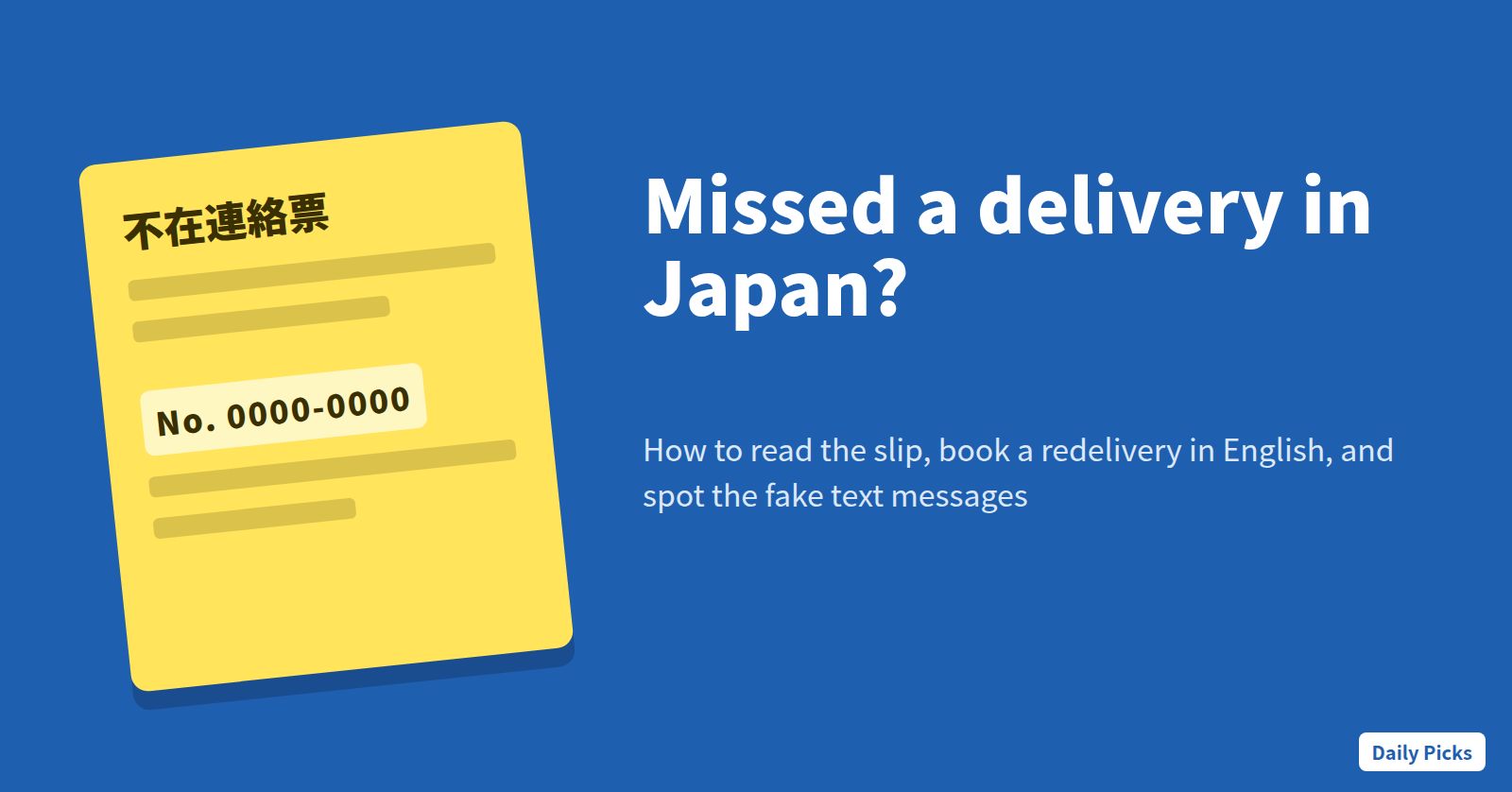
- Missed a delivery in Japan? How to read the absence slip
Sources
- Shinjuku City, How to Separate and Dispose of Recyclables/Waste (English, PDF)
- Shibuya City, How to Sort and Dispose of Resources and Garbage (English, PDF)
- Ministry of the Environment, overview of the Home Appliance Recycling Law (Japanese)
- Tokyo Metropolitan Government, home appliance recycling (Japanese)
- Ministry of Economy, Trade and Industry, recycling of personal computers (Japanese)
- Ministry of the Environment, do not use unlicensed collectors (Japanese)
- Environmental label database: marks for reuse and recycling | Ministry of the Environment
- The Containers and Packaging Recycling Law and identification marks | Japan Containers and Packaging Recycling Association
- What is the pura mark | Plastic Packaging Recycling Council
- Q&A | Plastic Packaging Recycling Council
- Identification mark | PET Bottle Recycling Council
- Q&A Section 10: identification marks | PET Bottle Recycling Council
- Paper cartons and recycling law | National Council for Milk Carton Environment
- Marks useful for recycling (list) | Japan Environmental Beautification Association for Food Containers
Information checked on 28 September 2026.
コメント