
Summary: If you want to stay in Japan longer with the same status of residence, you apply to the Immigration Services Agency (ISA) for an extension of your period of stay. People with a period of stay of six months or more can apply from about three months before it ends. From 1 October 2026 the fee depends on the length of stay you are granted, and it is lower if you apply online. This guide explains the timing, documents, fees, the “special period” while you wait and how you receive your new residence card, as of 30 September 2026.
For your employer or HR team, a Japanese version of the fee change is here: 在留手続きの手数料が2026年10月1日から改定.
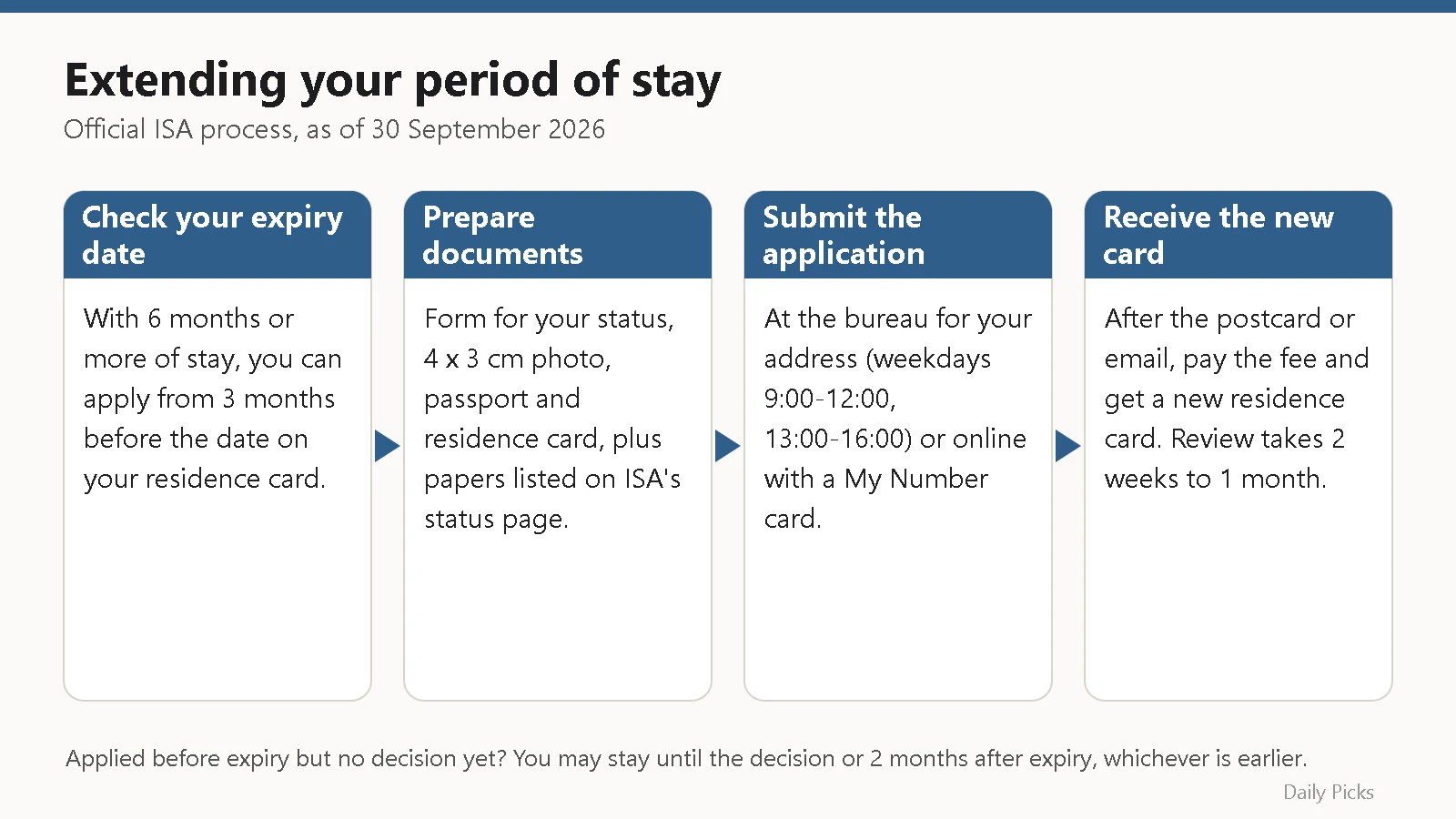
What an extension of period of stay is
Every status of residence comes with a period of stay, for example one year or three years. The expiry date is printed on the front of your residence card. ISA explains that the extension application (在留期間更新許可申請, zairyu kikan koshin kyoka shinsei) is for people who want to keep living in Japan beyond that date without changing their status of residence.
If your activity in Japan changes, for example from student to employee, that is a different procedure: a change of status of residence. This guide covers only the extension.
An extension is a permission, not an automatic renewal. ISA reviews each application and makes the decision. ISA has published examples of applications that were refused, and it says it looks at the applicant’s situation as a whole. This article cannot tell you whether your application will be approved. For questions about your own case, contact ISA directly.
When you can apply
According to ISA, you apply before your period of stay expires. If your period of stay is six months or more, you can apply from three months before the expiry date. ISA says that if you have a special reason, you may be able to apply earlier than three months. In that case you should consult the regional immigration bureau first.
ISA’s standard processing time for an extension is two weeks to one month. Some cases take longer. Applying early in the three-month window gives you more time if ISA asks for extra documents.
If you apply online, note one extra rule. ISA’s online Q&A says you cannot submit an online application on the last day of your period of stay. After the expiry date you cannot apply online at all.
Where to apply and who can submit
You apply at the regional immigration services bureau, or its branch office, that covers the area where you live. ISA lists the counter hours as weekdays from 9:00 to 12:00 and from 13:00 to 16:00. Immigration bureaus are national government offices, so they are closed on weekends, national holidays and from 29 December to 3 January.
ISA says the application can be submitted by:
- the applicant (you)
- your legal representative, for example a parent of a child
- an approved agent (取次者), such as registered staff of your employer or school, or a lawyer or administrative scrivener (gyoseishoshi) who has registered with the bureau
- a family member or person living with you, if you are under 16 or cannot come because of illness
Applying online
ISA also runs an online residence application system. Its user manual lists the extension of period of stay among the applications a foreign national can submit for themselves. According to ISA’s online Q&A, users include the applicant, legal representatives, relatives, lawyers and administrative scriveners, and registered staff of employers and support organisations.
To use the system yourself, ISA says you need a My Number card and a smartphone with the Mynaportal app installed, together with your residence card. Check the latest conditions on ISA’s online application page before you start.
Documents you need
The documents depend on your status of residence. A worker, a student and a spouse of a Japanese national each have their own list. ISA’s extension page links to a separate page for each status, with the right application form. Open the page for your own status and follow that list. Your employer or school may also have to prepare some papers.
Some items are common to most applications:
| Item | What ISA says |
|---|---|
| Application form | The extension form for your status of residence, from ISA’s website or the bureau |
| Photo | 4 cm high x 3 cm wide, taken within 6 months before submission, no background or shadows, your name written on the back |
| Passport | Shown at the counter when you apply |
| Residence card | Shown at the counter when you apply |
| Status-specific papers | Listed on ISA’s page for your status of residence |
ISA’s photo page gives more detailed rules about the size of the face and the image quality. A photo that does not meet the rules may cause delays, so check that page before you take it.
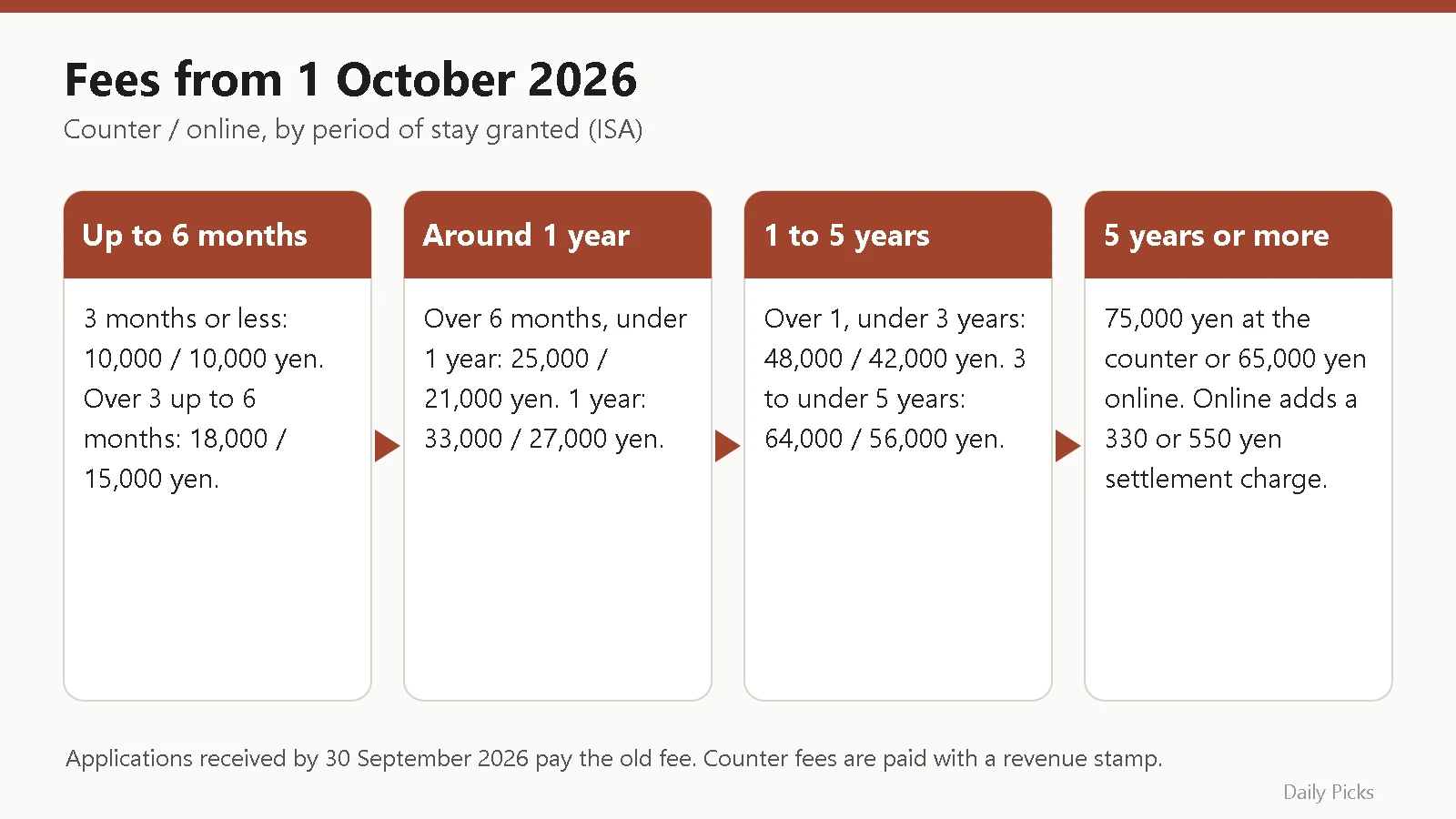
Fees from 1 October 2026
The fee was 4,000 yen until March 2025. From April 2025 it became 6,000 yen at the counter and 5,500 yen online. From 1 October 2026 the fee changes again. It now depends on the period of stay you are granted, and online applications cost less. ISA’s fee pages show these amounts as of 30 September 2026:
| Period of stay granted | Counter application | Online application |
|---|---|---|
| 3 months or less | 10,000 yen | 10,000 yen |
| Over 3 months, up to 6 months | 18,000 yen | 15,000 yen |
| Over 6 months, under 1 year | 25,000 yen | 21,000 yen |
| 1 year | 33,000 yen | 27,000 yen |
| Over 1 year, under 3 years | 48,000 yen | 42,000 yen |
| 3 years or more, under 5 years | 64,000 yen | 56,000 yen |
| 5 years or more | 75,000 yen | 65,000 yen |
You pay when permission is granted, not when you apply. For counter applications, ISA says you pay with a revenue stamp (収入印紙, shunyu inshi). Revenue stamps can only be bought with cash. ISA also warns that shops inside bureaus and convenience stores may have limited stock, so it is safer to buy the stamp in advance.
For online applications, ISA sends a payment guide by email after the review is finished. You pay at a convenience store or by bank payment. A settlement charge is added: 330 yen, or 550 yen for periods of three years or more.
ISA says applications received by 30 September 2026 are charged the old fee, even if permission is granted on or after 1 October 2026. A fee reduction exists only for a small group of people in severe financial hardship who also need humanitarian consideration. Ask ISA if you think it may apply to you.
Waiting for the decision and getting your card
The special period
Sometimes your expiry date passes before ISA makes a decision. ISA calls the time after that the special period (特例期間, tokurei kikan). If you applied for an extension before your period of stay expired, you can keep living in Japan with your current status and continue the same activities. This lasts until the decision is made, or until two months after the expiry date, whichever comes first.
When you apply at a counter, a note that your application is pending is written on the back of your residence card. ISA says this does not happen for online applications. If the date on the front has passed, check the back of the card.
ISA also warns that if you have not received your result two months after your expiry date, you can no longer stay in Japan. If anything in your application changes while you wait, such as your job or address, ISA asks you to tell the bureau straight away.
ISA’s Q&A says the bureau does not keep your passport while you wait. It also says you can leave Japan with a re-entry permit or special re-entry permit while an extension is pending. Because the special period has an end date, ask ISA before you plan a trip.
Receiving the result and your new card
ISA says it tells you by postcard or letter when your result is ready. If permission is granted at a counter application, ISA lists these items to bring when you collect it:
- the fee, as a revenue stamp
- your passport
- your residence card
- the notification postcard
You then receive a new residence card with the new expiry date. For online applications, ISA’s Q&A says you choose how to receive the card, either by post or at a counter. If you choose post, you return the envelope and documents ISA asks for within 14 days of the completion notice.
If your expiry date has already passed
Staying after your period of stay ends without a pending application is a serious matter under Japanese law. This article does not give legal advice about what will happen in an individual case. The decision belongs to ISA.
What ISA says officially is limited. In its Q&A, ISA says that if you could not apply in time because of a disaster, illness, accident or other reason that was not your fault, it will accept the application without starting deportation procedures only because the date passed. It asks you to consult the nearest regional immigration bureau promptly once you are able to apply. Online applications are not possible after the expiry date.
If you notice your date has passed, contact the regional immigration bureau or ISA’s Immigration Services information centre for foreign residents (0570-013904) as soon as possible and follow their instructions.
Japanese words you will see
| Japanese | Reading | Meaning |
|---|---|---|
| 在留期間更新許可申請 | zairyu kikan koshin kyoka shinsei | Application for extension of period of stay |
| 在留期限 | zairyu kigen | Expiry date of your period of stay |
| 特例期間 | tokurei kikan | Special period while a decision is pending |
| 収入印紙 | shunyu inshi | Revenue stamp used to pay the fee |
| 地方出入国在留管理局 | chiho shutsunyukoku zairyu kanri kyoku | Regional immigration services bureau |
| 取次者 | toritsugisha | Approved agent who submits for you |
Checklist before you apply
- Check the expiry date on your residence card and mark the date three months before it.
- Open ISA’s page for your status of residence and print the document list.
- Ask your employer or school early for any papers they must prepare.
- Take a 4 cm x 3 cm photo and write your name on the back.
- Decide whether to apply online (My Number card and Mynaportal app needed) or at the counter.
- Check the counter hours and the bureau for your address. Avoid the year-end closure.
- Keep your passport and residence card with you on the day.
- After applying, keep the postcard safe and watch your mail or email.
- If the decision is late, check the back of your card and remember the two-month limit.
- When notified, bring the fee, passport, residence card and postcard.
FAQ
How early can I apply for an extension?
ISA says people with a period of stay of six months or more can apply from three months before the expiry date. Earlier applications may be possible for special reasons, after consulting the bureau.
How much is the fee now?
For applications received from 1 October 2026, it depends on the period granted. For example, a one-year extension is 33,000 yen at the counter or 27,000 yen online. Applications received by 30 September 2026 pay the old fee.
My card expired but I applied in time. Am I staying illegally?
ISA says you can stay with your current status during the special period, which lasts until the decision or two months after the expiry date, whichever is earlier. If you have questions about your case, contact ISA.
Does the bureau keep my passport during the review?
No. ISA’s Q&A says the bureau does not keep your passport while an extension application is being reviewed.
Can I apply online on the last day?
No. ISA’s online Q&A says online applications cannot be made on the last day of your period of stay. Apply earlier, or go to the counter.
Related reading
Sources
- Application for extension of period of stay (Japanese) – Immigration Services Agency
- Residence permission fees and revenue stamps (Japanese) – Immigration Services Agency
- Fees and payment for online applications (Japanese) – Immigration Services Agency
- Residence permission fees from 1 October 2026, leaflet (Japanese) – Immigration Services Agency
- Residence permission fee amounts and reductions (Japanese) – Immigration Services Agency
- Q&A on the fee revision of 1 October 2026 (Japanese) – Immigration Services Agency
- Fee reduction and exemption from 1 October 2026 (Japanese) – Immigration Services Agency
- What is the special period? (Japanese) – Immigration Services Agency
- Notices and cautions for residence applications (Japanese) – Immigration Services Agency
- Immigration and residence examination Q&A (Japanese) – Immigration Services Agency
- Photo specifications for applications (Japanese) – Immigration Services Agency
- Q&A on online applications (Japanese) – Immigration Services Agency
- Online Residence Application System user manual (English) – Immigration Services Agency
- Act on Holidays of Administrative Organs (Japanese) – e-Gov Law Search, Digital Agency
- Examples of refused extension and change applications (Japanese) – Immigration Services Agency




コメント