Summary: In Japan, a great many everyday things — opening a bank account, giving your employer a contact number, receiving a one-time code by SMS — assume you hold a voice mobile number starting with 090, 080 or 070. A data-only SIM does not give you one, and it cannot call 110 or 119. To sign a normal Japanese contract you need a residence card with your address already written on the back, so the city hall comes before the phone shop. If you need a number sooner, providers that work from your passport can give you one. This guide covers the plan types, the documents each route wants, what changed in the identity check on 1 April 2026, and the order to do things in during your first two weeks.
- What people mean by “a Japanese phone number”
- Why the voice number keeps coming up
- What a Japanese carrier actually asks for
- What changed in the identity check on 1 April 2026
- Your options, side by side
- The first two weeks, in the order that works
- Two rules you should not break
- A note on visas
- FAQ
- Related reading
- Sources
What people mean by “a Japanese phone number”
Three different things get called a phone number here, and they are not interchangeable.
A mobile voice number begins with 090, 080 or 070. It comes with a voice SIM, makes and receives ordinary calls, receives SMS, and reaches the emergency services. This is what forms and staff mean by keitai bangō (携帯番号, mobile number).
A data-only SIM gives you internet on your phone and nothing else. Some data-only plans add an SMS function, but there is still no voice number attached to them in the ordinary sense. IIJmio, one of the larger budget providers, states the position plainly in its own FAQ: emergency calls work on a voice SIM, and emergency calls cannot be made on a data SIM or an SMS SIM. If you dial 110 (police) or 119 (fire and ambulance) from a data-only line, the call does not go through.
An 050 number belongs to an internet calling app rather than to a mobile network. It is useful and it is cheap, but it is a separate product and it sits outside this guide.
Finally, eSIM is not a plan type. It is the way the SIM is delivered — a profile downloaded to your phone instead of a small piece of plastic. An eSIM can be a voice line or a data-only line. Do not assume that “eSIM” on a website means you are getting a voice number; look for the words 090, 080 or 070.
| Voice SIM | Data-only SIM | |
|---|---|---|
| Number starting 090 / 080 / 070 | Yes | No |
| Ordinary calls | Yes | No |
| SMS one-time codes | Yes | Only on plans that add an SMS function |
| 110 and 119 emergency calls | Yes | No |
| Identity check required by law | Yes, since the law took full effect in 2006 | Not yet — but an amendment passed in May 2026 will bring data SIMs in |
Why the voice number keeps coming up
You can live in Japan with a data-only SIM and a calling app, and plenty of people do for a few weeks. The problem is not phoning your friends. It is that the voice number has quietly become part of the identity paperwork.
Banks. Opening an account is where most new arrivals get stuck, and it has its own trap that has nothing to do with the phone. Japan Post Bank, the bank most often recommended to new residents because its conditions are the mildest, asks to see your residence card to confirm your nationality, status of residence and period of stay. It then adds a hard rule: if the expiry date of your period of stay falls within three months of the day you apply, the account cannot be opened. You are expected to renew your status first.
SMS one-time codes. Japanese banking apps, payment apps, parcel redelivery systems and government services lean heavily on codes sent by SMS. A code sent to a number you do not have is a door that does not open.
Forms. The contact-number box on a Japanese employment, school or tenancy form is normally filled with a mobile number.
Emergencies. This is the one that is not a nuisance. If you fall ill at three in the morning, or there is a fire, you want a line that reaches 119.
What a Japanese carrier actually asks for
The three large carriers publish their document lists in English, and they agree with each other on the essentials.
docomo lists, for foreign residents, the residence card together with your foreign passport. If you hold permanent residency you do not need the passport. It then adds a condition that catches people near the end of a visa: if you do not present a residence card, or the remaining period of stay is less than three months, you must pay by a credit card in your own name. Separately, if the expiry date on your residence card falls before the end of an instalment payment period, the instalment contract may not be available — which matters when a handset is spread over twenty-four or thirty-six payments.
au accepts the residence card, again with a foreign-issued passport alongside it, and also accepts the tokubetsu eijūsha shōmeisho (特別永住者証明書, special permanent resident certificate) and the new tokutei zairyū kādo (特定在留カード, specified residence card) on their own. Its threshold is expressed in days: with fewer than 90 days left on your status of residence, applications are accepted only if the monthly bill is paid by a credit card in the subscriber’s own name.
SoftBank accepts a residence card plus a passport showing the same name and date of birth as the application form, or a special permanent resident certificate that shows your current address. If your period of stay ends earlier than the contract period of the monthly instalments, the instalment contract is not available.
Two details are easy to miss, and they sink more applications than the visa rules do.
First, the address on your ID has to be your current address. On a residence card the address is written on the back, by the city hall, after you register. A card straight from the airport has a blank address field, and a blank address field is not an address.
Second, if the address on your document does not match where you now live, the carriers want a supplementary document. au names three: a utility bill from the last three months, a jūminhyō (住民票, residence certificate) issued within three months, or an evacuation-shelter certificate. SoftBank asks for a residence certificate, a utility bill, or an official printed item addressed to you. The name on it has to match the name on your ID.
What changed in the identity check on 1 April 2026
This is recent enough that guides written last year are now wrong, so it is worth being precise.
The Mobile Phone Improper Use Prevention Act is the law that makes carriers verify who you are. Under an amendment to its enforcement regulations, from 1 April 2026 a new verification method was added: the carrier receives the information recorded in the IC chip of your identity document. At the same time two older remote methods were abolished — sending a copy of an identity document, and sending a photograph of a photo ID. In plain terms, uploading a picture of your card is no longer enough when you sign up without going to a shop.
Your residence card has an IC chip, so this is not a wall for foreign residents. But it changes what happens on screen: you now hold the card against the back of your phone and let the app read the chip, instead of photographing it.
The carriers moved on their own timetables. ahamo, docomo’s online-only brand, switched on 12 March 2026: new contracts and number transfers are verified by reading the IC chip, using either JPKI (the public personal authentication service) or IC-based eKYC, with the My Number Card, driver’s licence, residence card or special permanent resident certificate. The old “upload your documents” and selfie eKYC routes were ended. ahamo also warns that if your current address differs from the one on the document, you cannot complete the application online at all. Rakuten Mobile’s sumaho de kantan honnin kakunin (スマホでかんたん本人確認, simple verification on your phone) likewise reads the IC chip and supports the residence card and the special permanent resident certificate.
One more thing is in motion. The Immigration Services Agency began operating the specified residence card — a single card carrying both residence card and My Number Card functions — on 14 June 2026, with applications accepted at regional immigration bureaus from the next working day. New-format residence cards started at the same time. Providers are adding support in stages: Rakuten Mobile accepted them in shops from 14 June 2026 and for online verification from 1 September 2026, while ahamo says the newer cards cannot be used for its online application and directs holders to a shop. If you have just been issued one, check the provider’s page before you spend an evening on the form.
Your options, side by side
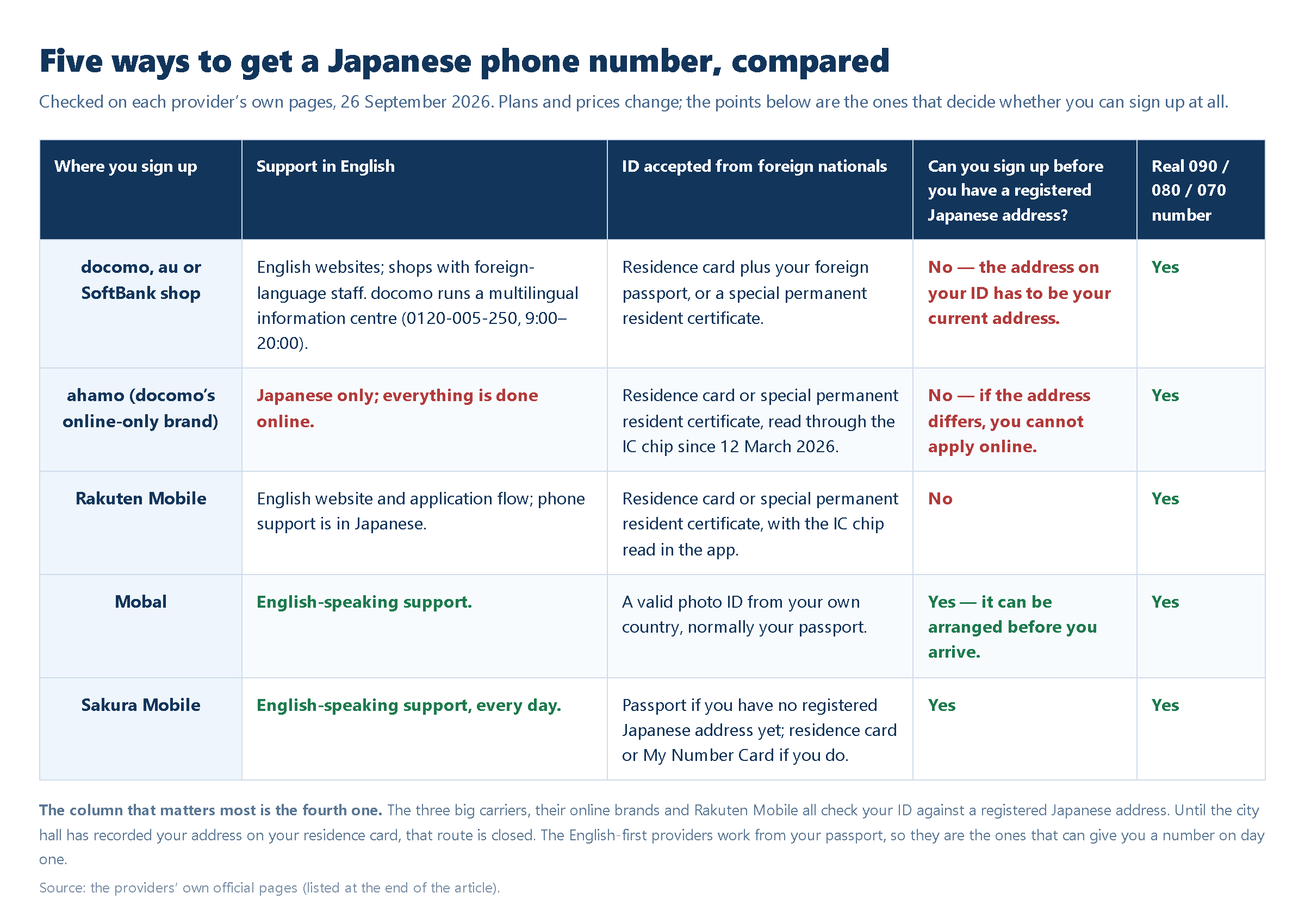
The pattern in that table is the useful part. There are really two families.
The Japanese-market route — docomo, au, SoftBank, their online-only brands, Rakuten Mobile and the budget providers that rent their networks — is cheaper over a year and has the best coverage and handset choice. It verifies you against a registered Japanese address. docomo runs a multilingual information centre on 0120-005-250 from a landline, or 15770 free of charge from a docomo mobile, open 9:00 to 20:00 all year round, in English, Portuguese, Chinese and Spanish; au and SoftBank both publish English sites and list shops with foreign-language staff. But the application form and the fine print are Japanese, and the online-only brands are Japanese end to end.
The English-first route — Mobal, Sakura Mobile and similar providers — costs more per month and verifies you against your passport. Mobal issues a real 070, 080 or 090 number on the docomo network, accepts credit and debit cards including foreign ones, needs no Japanese bank account, has English-speaking support and no minimum contract. Sakura Mobile’s voice plans also give a real Japanese number, run month to month with no lock-in, accept cards issued outside Japan, and let you verify with your passport if you have no registered Japanese address yet, or with your residence card or My Number Card once you do. GTN Mobile is another provider aimed specifically at foreign residents, offering multilingual support with both voice and data SIMs.
There is no prize for choosing correctly the first time. Because you can move your number between providers, the sensible plan for many people is to start on the route that will have them today and change later.
The first two weeks, in the order that works
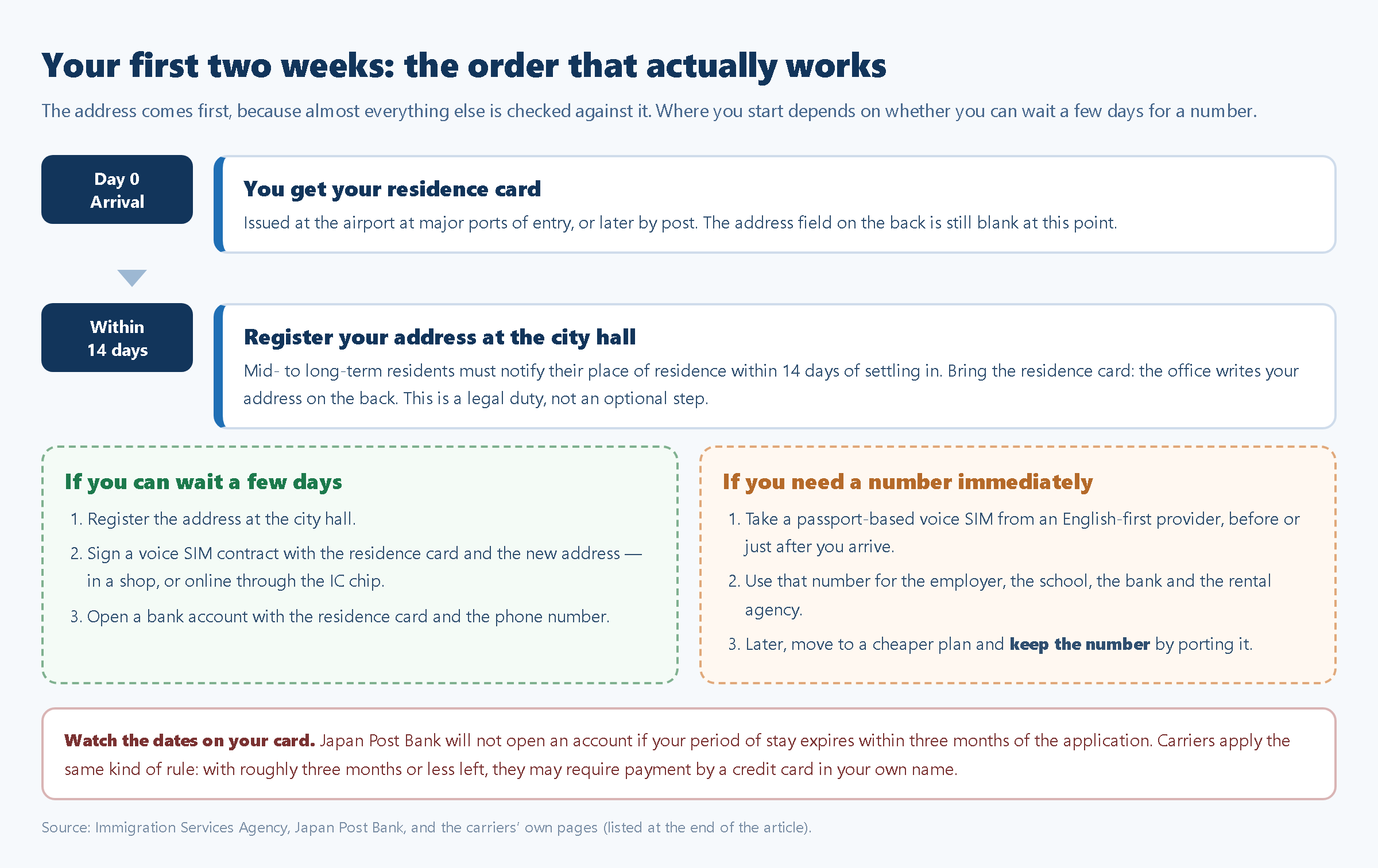
Step one is not the phone shop. It is the city hall. If you become a mid- to long-term resident, you must notify your place of residence at the municipal office within 14 days of the day you settle in. That duty sits in Article 19-7, paragraph 1 of the Immigration Control and Refugee Recognition Act. Take your residence card with you: if you hand in the moving-in form without it, the municipal paperwork may be accepted but the immigration notification is not treated as done, and you will have to go back. When it is done, the office writes your address on the back of the card. That is the moment the ordinary carrier route opens.
Then the number, then the bank. With an address on the card you can walk into a shop, or complete an online application by reading the chip. The bank account is then straightforward: bring the residence card, and if your status is ryūgaku (留学, student) or ginō jisshū (技能実習, technical intern training), Japan Post Bank also wants to see your student or employee identification.
If you cannot wait, break the loop from the other end. Take a passport-based voice SIM from an English-first provider before you arrive or in your first days, use that number everywhere the forms ask for one, and move to a cheaper plan later. It costs a few thousand yen a month for a short while, and it saves you the deadlock where the bank wants a phone number, the carrier wants an address, and your employer wants both by Monday.
Moving later does not cost you the number. Number portability lets you change carrier and keep it, and since 24 May 2023 the “one-stop” method means you apply at the new provider’s website and no longer have to obtain a reservation number from the old one first — provided both providers support it.
Two rules you should not break
These matter because the penalties are real and because scammers actively target newcomers.
Do not give, sell or lend your line to anybody else. Under the Act on Prevention of Improper Use of Mobile Voice Communications Services, a subscriber who intends to transfer the terminal facilities to another person must get the carrier’s prior consent, except where the transfer is to a family member, a relative or a dependant. Breaching that carries, in the official English translation of the Act, imprisonment with work of up to two years or a fine of up to 3,000,000 yen, or both. The same range applies to the lending prohibitions, and giving false identification details when you sign up is punishable by a fine of up to 500,000 yen.
People are approached with this in real life — “just sign one more line in your name and I’ll pay you”. It is the mechanism behind a large share of Japanese telephone fraud, and the person whose name is on the contract is the person the police visit. When you leave Japan, cancel the line rather than passing the SIM to a friend.
Expect the rules to tighten. An amendment to the same Act passed the Diet on 22 May 2026 and was promulgated on 29 May 2026, to come into force on a date set by cabinet order within one year. It brings data-only SIMs into the identity-verification regime (the exact SIM types are being set by ministerial ordinance, with SMS-capable data SIMs the main target and IoT SIMs expected to be excluded), it lets carriers refuse service above a set number of lines per individual — the major carriers’ own voluntary ceiling is around five — and it adds a provision letting short-stay visitors be verified by passport alone, since a passport carries no Japanese address. If you use a data-only SIM, assume you will be asked to identify yourself for it too.
A note on visas
Nothing here is advice about your status of residence, and a phone contract has no effect on it. The period of stay printed on your residence card does affect what a carrier and a bank will offer you, which is why renewal timing matters in practice. For anything about the status itself — renewals, changes, permanent residency — go to the Immigration Services Agency, not to a phone shop.
FAQ
Q. Can I get a Japanese number before I land?
Yes. Providers aimed at foreign residents verify you with a photo ID from your own country rather than a residence card, so the SIM or eSIM can be arranged in advance and collected at the airport or delivered to your first address. Mobal can be set up before arrival with no minimum contract; Sakura Mobile lets you verify with your passport if you have no registered Japanese address yet. The trade-off is price.
Q. Is a data-only SIM plus a calling app good enough?
For messaging friends, yes. For living here it has two concrete gaps: you cannot reach 110 or 119 from it, and you have no 090/080/070 number for the forms and the SMS codes. If money is tight, a cheap voice line alongside your data usually works better than a large data-only plan.
Q. Do I need a Japanese bank account or a Japanese credit card first?
Not always. Mobal accepts major credit and debit cards and PayPal and says no Japanese bank account is needed; Sakura Mobile accepts cards issued outside Japan. The Japanese carriers generally expect a domestic payment method, and if you have less than three months (docomo) or 90 days (au) left on your status of residence they may require a credit card in your own name specifically. That last rule stops more applications than anything else, so check both expiry dates before you queue.
Q. My residence card has just been replaced. Does anything happen to my contract?
Your line is unaffected, but expect the new cards to be handled inconsistently for a while. The specified residence card and the new-format residence card only started on 14 June 2026. Rakuten Mobile added them for shop applications from that date and for online verification from 1 September 2026; ahamo cannot process them online and asks holders to visit a shop.
Q. Can I put a line in my name for my partner or a friend?
A line for a family member, a relative or a dependant is normal, and the Act’s transfer rule expressly carves those cases out. Handing a line to somebody outside that circle, or to somebody offering you money for it, is what carries up to two years’ imprisonment with work or a fine of up to 3,000,000 yen. If someone asks you to open lines in your name, the answer is no.
Q. I cannot read the application form. What are my options?
Three, in increasing order of cost. Use a provider whose whole process is in English. Go to a shop that lists foreign-language service — au and SoftBank both publish shop finders, and docomo’s multilingual centre answers questions in English, Portuguese, Chinese or Spanish. Or bring someone who reads Japanese. What you should not do is sign a Japanese contract you have not understood, especially one with a handset on instalments attached.
Related reading
Once you have a number, save the ones you may need to call: emergency numbers in Japan (119, 110, #7119 and others).
Once your number is active, you may also get calls from strangers claiming to be the police. Read Fake police calls in Japan to learn how the scam works and what to do.
Two other letters that land on new residents in their first year are explained here in the same way: the National Health Insurance notice, which arrives once you register your address, and the resident tax notice, which arrives the year after you start earning here.
Related on Daily Picks: When does your My Number card expire? The expiry notice letter, the period-of-stay date no one tells you about, and what to do after a visa renewal
Sources
- Ministry of Internal Affairs and Communications: Preventing criminal use of mobile phones (Japanese)
- Ministry of Internal Affairs and Communications: Q&A for mobile voice communications carriers, including the 1 April 2026 change to verification methods (Japanese)
- Japanese Law Translation: Act on Prevention of Improper Use of Mobile Voice Communications Services — Articles 3, 7, 19, 20 and 22 (English)
- Ministry of Internal Affairs and Communications: Direction of the regime following the 2026 amendment to the Act (Japanese)
- Ministry of Internal Affairs and Communications: Direction of the regime following the amendment, presentation slides, PDF (Japanese)
- Ministry of Internal Affairs and Communications: Mobile Number Portability and the one-stop method from 24 May 2023 (Japanese)
- Immigration Services Agency: Notification of place of residence after a new landing, within 14 days (Japanese)
- Immigration Services Agency: Applying for a specified residence card, operation from 14 June 2026 (Japanese)
- Telecommunications Carriers Association: Identity verification at the time of contract (Japanese)
- NTT docomo: Documents Verifying Identity (English)
- NTT docomo: Contact Us, multilingual information centre (English)
- au: Identity documents required at au Style and au shops (Japanese)
- au: English site, including the finder for shops with foreign-language service (English)
- SoftBank: Identification documents (English)
- SoftBank: Mobile, English support and shops with English-speaking crew (English)
- ahamo: Change to the identity verification method for new contracts and number transfers, 12 March 2026 (Japanese)
- ahamo FAQ: Can foreign nationals sign an ahamo contract? (Japanese)
- Rakuten Mobile: Identity verification documents and methods (Japanese)
- Rakuten Mobile: Notice to foreign customers about residence cards and special permanent resident certificates (Japanese)
- IIJmio Q&A: Can emergency calls be made on a voice SIM? (Japanese)
- Mobal: Japan SIM card, plans and requirements (English)
- Sakura Mobile: Voice + Data SIM and eSIM (English)
- GTN: Mobile and internet services for foreign residents (Japanese)
- Japan Post Bank: To foreign customers opening an account (Japanese)
All pages above were checked on 26 September 2026.
コメント