Summary: Most foreign residents can open a Japanese bank account with a valid residence card, but banks check more than your ID. They ask about your job, your period of stay and why you want the account, because Japanese law requires them to fight money laundering. Japan Post Bank, city and regional banks, and online banks all follow these rules, but their steps differ. Before you leave Japan, close your account: giving or selling it to someone else is a crime, and the penalties went up on 10 July 2026.
- Who can open an account, and the “6-month” rule
- Documents to prepare
- Why the bank asks about your job and the purpose of the account
- Japan Post Bank, city banks and online banks: how they differ
- Step-by-step checklist
- Keeping your account usable while you live in Japan
- Before you leave Japan: close the account, never sell it
- Scams to watch out for
- Japanese words you will see
- FAQ
- Related reading
- Sources
Who can open an account, and the “6-month” rule
Japan Post Bank says in its FAQ that foreign nationals can open an account if they have a place to live in Japan. You need a valid residence card. Japan Post Bank will not open an account if your period of stay ends within 3 months of the day you apply. If that is your situation, renew your period of stay first.
You may also hear about a “6-month rule”. This comes from the Foreign Exchange and Foreign Trade Act, not from each bank. According to Japan Post Bank, a foreign national who has been in Japan for less than 6 months and does not work at an office in Japan is treated as a “non-resident” under this law. Non-residents can still hold an account at Japan Post Bank, but they must submit a non-resident notification form, and domestic transfers involving a non-resident are handled like international transfers. That means different fees, and ATM transfers are not available.
When 6 months have passed, you usually become a “resident” under the law. Japan Post Bank asks you to tell a post office savings counter or a Japan Post Bank branch about the change, so that the account can be switched to normal settings. Other banks may have their own rules about new arrivals. Ask the bank directly before you visit.
Documents to prepare
The Financial Services Agency (FSA) publishes a leaflet for foreign residents called “Living in Japan: How to Open a Bank Account and Send Money” (revised September 2024, available in 17 languages). It lists the basic items below. Each bank can ask for more, so check the bank’s own page too.
| Item | What it is for | Notes (as of 30 September 2026) |
|---|---|---|
| Residence card (zairyu card) | Proves your identity, address, status of residence and period of stay | Must be valid. Japan Post Bank needs more than 3 months left on your period of stay. |
| Passport | Extra identity check | The FSA leaflet lists “residence card or passport”. Japan Post Bank says it may ask to see your passport. |
| Employee ID or student ID | Shows your job or school | Japan Post Bank asks students and technical intern trainees for a student ID, employee ID or certificate of enrollment. |
| Personal seal (hanko / inkan) | Used as your “signature” for the account | The FSA leaflet says some institutions accept a signature instead. |
| My Number | Tax-related registration | Needed at Japan Post Bank to send money abroad or receive money from abroad. Banks also ask customers to register it for deposit accounts. |
| Contact details | For notices from the bank | The Japan Post Bank app needs a smartphone and an email address. Ask other banks whether a Japanese phone number is required. |
If your Japanese is limited, Japan Post Bank says it may ask you to bring someone who can understand the explanations in Japanese. The Japanese Bankers Association (JBA) also publishes a pictogram communication board in 14 languages that bank staff can use at the counter.
Why the bank asks about your job and the purpose of the account
The staff may ask what you will use the account for, where you work, and how much money you expect to move. Under Japanese law, financial institutions must confirm customer information to prevent money laundering and the financing of terrorism.
The FSA leaflet says banks verify “the name, address, period of stay, status of residence, and employment status” of customers. It also says you may not be able to open or use an account if your identity information cannot be verified. The JBA explains that banks check the name, address, date of birth, occupation and purpose of transactions, following international standards set by the FATF (Financial Action Task Force).
These checks do not stop after the account is open. The Government of Japan’s public relations site says banks confirm this information again from time to time, often by post. If you do not reply by the deadline, your transactions may be limited. Answer these letters honestly and on time.
Japan Post Bank, city banks and online banks: how they differ
There is no single right choice. The table below describes the general types of bank in plain terms. It is not a ranking. Services and conditions change, so read each bank’s official page before you apply.
| Type | How you usually apply | Things to know |
|---|---|---|
| Japan Post Bank (Yucho) | At a post office savings counter, or with the Yucho Tetsuzuki app | Counters are in post offices across Japan. The app is for people aged 16 or over with a residence card; it opens a bankbook-free account, screening takes about one week, and the cash card comes by registered mail. |
| City banks and regional banks | At a branch, or through the bank’s own app | Branches offer face-to-face help. Each bank sets its own document list and rules for new arrivals. |
| Online banks | Through a website or smartphone app | No counters for walk-in help. You usually confirm your identity online with your residence card and a smartphone. |
Step-by-step checklist
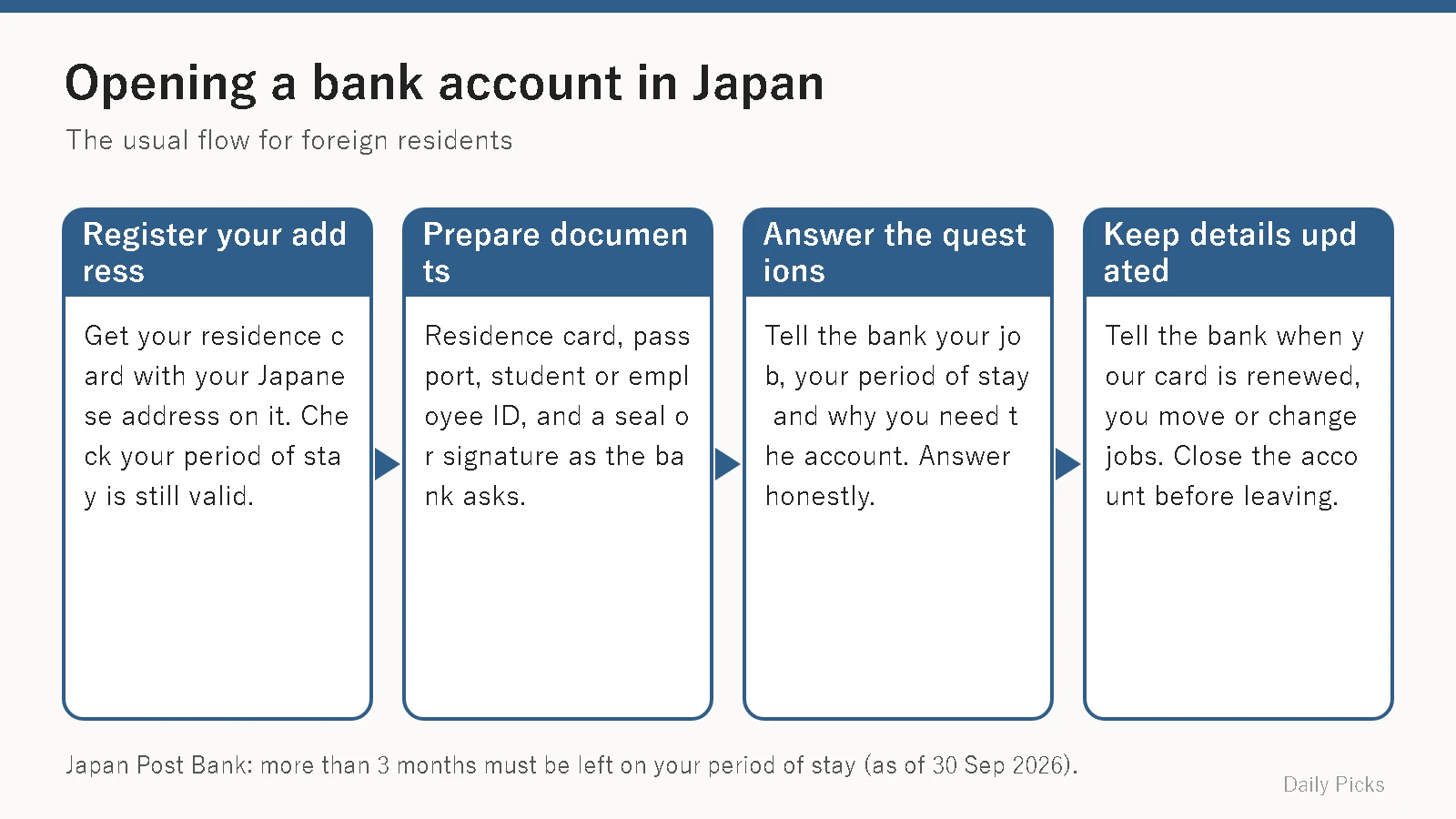
- Check that your residence card is valid and that your address on the back is up to date after moving in.
- Check how long is left on your period of stay. At Japan Post Bank, it must be more than 3 months.
- Get your student ID, employee ID or certificate of enrollment if you are a student or trainee.
- Decide whether you will use a personal seal or a signature, and ask the bank which it accepts.
- Prepare a short, true answer about why you need the account and where you work.
- Read the bank’s official page for its document list, or use the Yucho Tetsuzuki app if you apply online.
- Apply, and keep your bankbook or cash card and PIN in a safe place. Never share the PIN.
- Register your My Number if you plan to send money abroad or receive money from abroad.
Keeping your account usable while you live in Japan
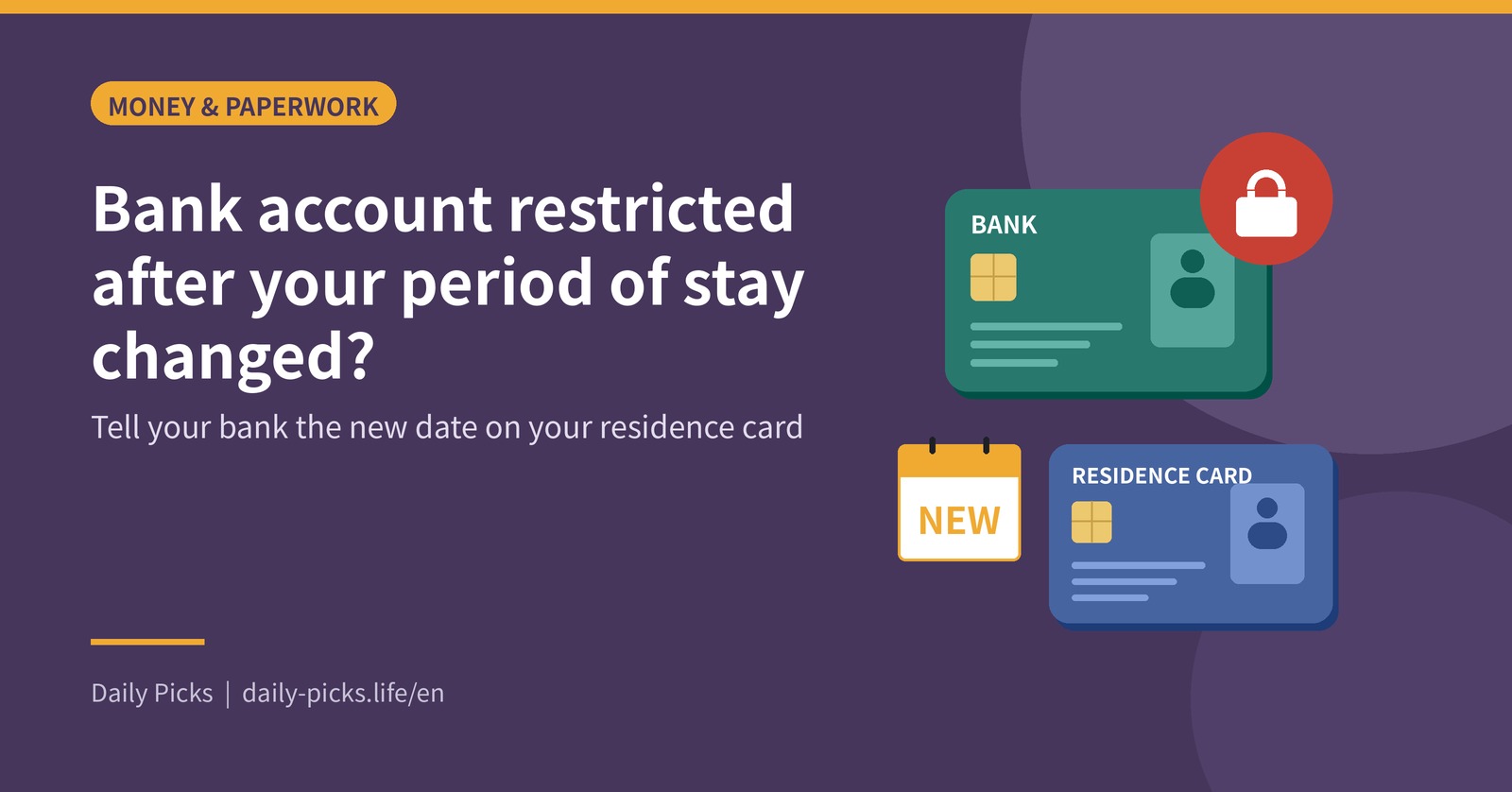
An account can become restricted even when you have done nothing wrong. The most common reason is out-of-date information. The FSA leaflet asks you to contact your bank when your address, period of stay, status of residence or employment status changes, or when you lose your documents.
In April 2025, the FSA, the National Police Agency and the Immigration Services Agency published a leaflet called “How to Stop Transactions Being Limited”. It explains that you need to tell your bank when you extend your period of stay. Japan Post Bank also says that when your residence card is renewed or your address changes, you should update your information promptly in the app or at a counter, or your transactions may be limited.
- After renewing your residence card: update the bank.
- After moving house: update the bank as well as the city office.
- After changing jobs or finishing school: tell the bank if it asks about your employment status.
- When a letter asks you to confirm your details: reply by the deadline.
Before you leave Japan: close the account, never sell it
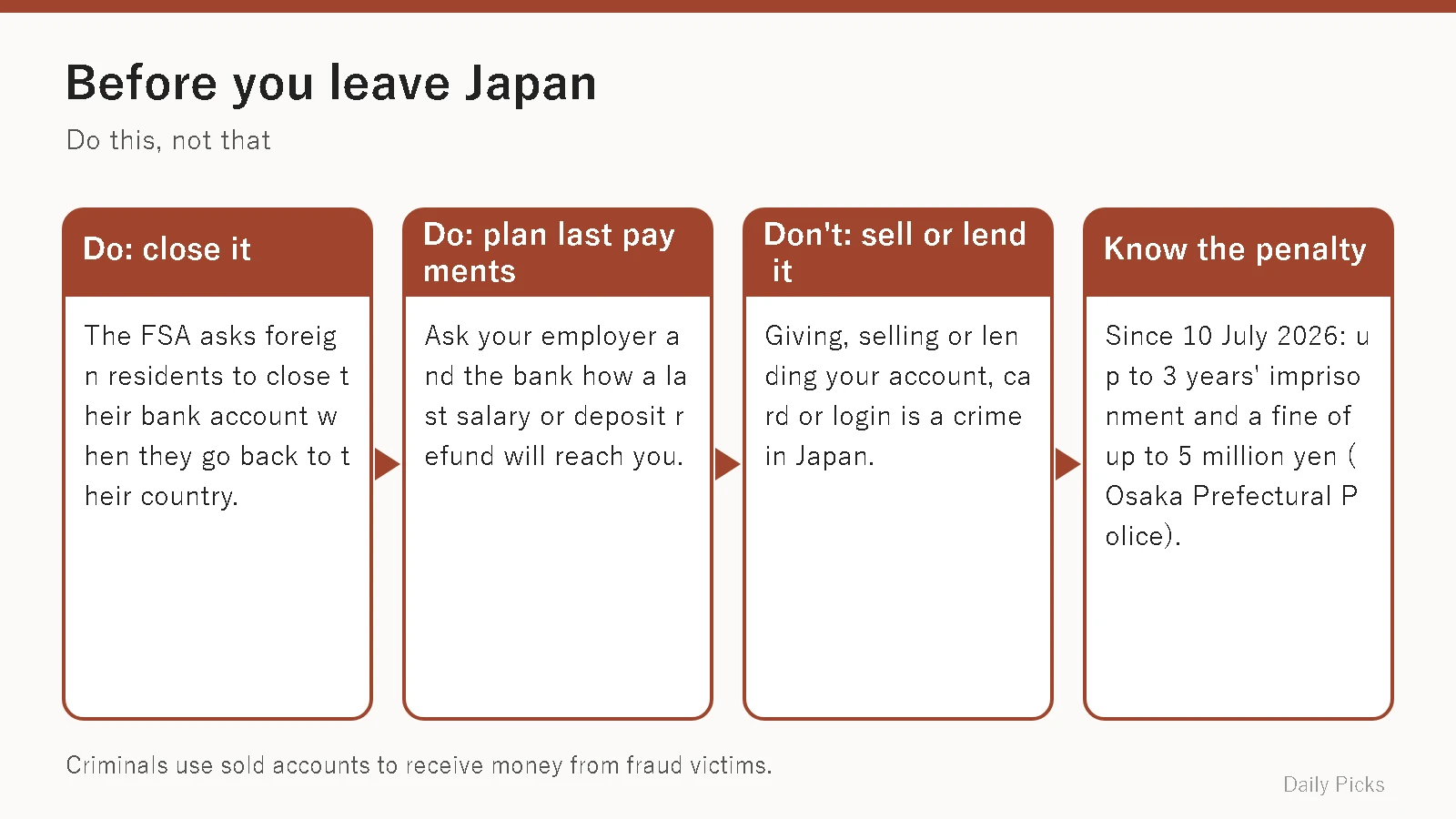
The FSA leaflet gives a clear message: when you go back to your country, close your bank account. If you still expect money to arrive, such as a final salary payment or a deposit refund, ask the bank and your employer how to handle it before you close the account.
Do not give, sell, lend or “rent” your account, bankbook, cash card or online banking login to anyone. The FSA leaflet marks this as illegal, and it warns that if you do something illegal, such as giving your bank account to others, you may not be able to stay in Japan or enter Japan. Criminals use such accounts to receive money from fraud victims.
The Act on Prevention of Transfer of Criminal Proceeds was amended in 2026. The National Police Agency says the higher penalties for transferring bankbooks and similar items took effect on 10 July 2026, and a new offence covering “remittance crimes” started on the same day. According to Osaka Prefectural Police, the penalty for transferring bankbooks, cash cards or internet banking details is now up to 3 years’ imprisonment and a fine of up to 5 million yen. Moving money that other people send into your account for someone else can also be a crime, with up to 2 years’ imprisonment and a fine of up to 3 million yen.
Scams to watch out for
Keep these points in mind.
- Banks do not ask for your PIN or your internet banking ID and password by email or text message, according to the Government of Japan’s public relations site.
- The JBA warns that criminals pretend to be bank staff or police officers to get PINs and cash cards. Never hand your card to someone who visits your home.
- Job offers that ask you to receive and forward money, or to open an account for someone else, can make you part of a crime.
- If a message looks suspicious, contact the bank using the phone number on its official website or on your card, not the one in the message.
For general questions about financial services, the FSA Counseling Office accepts calls on 0570-016811 (IP phone: 03-5251-6811) on weekdays from 10:00 a.m. to 5:00 p.m., and email at equestion@fsa.go.jp.
Japanese words you will see
| Japanese | Reading | Meaning |
|---|---|---|
| 口座開設 | koza kaisetsu | Opening an account |
| 在留カード | zairyu kado | Residence card |
| 在留期間 | zairyu kikan | Period of stay |
| 印鑑 / 届出印 | inkan / todokede-in | Personal seal / seal registered with the bank |
| 取引目的 | torihiki mokuteki | Purpose of transactions |
| 職業 | shokugyo | Occupation |
| 非居住者 | hikyojusha | Non-resident (under the foreign exchange law) |
| 通帳 / キャッシュカード | tsucho / kyasshu kado | Bankbook / cash card |
| 暗証番号 | ansho bango | PIN |
| 解約 | kaiyaku | Closing (cancelling) an account |
FAQ
Can I open an account on my first day in Japan?
It depends on the bank. You need a residence card with your address registered. Under the foreign exchange law, a foreign national who has been in Japan for less than 6 months and does not work at an office in Japan is treated as a non-resident, which changes how some transfers work. Ask the bank before you go.
Do I need a hanko?
Not always. The FSA leaflet says some institutions accept a signature instead of a seal. Ask the bank which one it accepts before your visit.
Why did the bank send me a letter asking about my job?
Banks confirm customer information from time to time to prevent money laundering. If you do not reply by the deadline, your transactions may be limited, so answer it. If you are not sure the letter is real, call the bank using the number on its official website.
My residence card was renewed. Do I need to tell the bank?
Yes. The FSA, the National Police Agency and the Immigration Services Agency say you should tell your bank when you extend your period of stay. Otherwise your transactions may be limited.
A friend offered to buy my account when I leave. Is that OK?
No. Selling or giving your account to someone else is a crime in Japan, and penalties were raised on 10 July 2026. Close the account before you leave.
Related reading
- How to get a Japanese phone number
- My Number card expiry: what to do
- Moving house in Japan: address change checklist
- Fake police calls: how to spot them
- Moving out of your apartment: deposit and cleaning bill
Sources
- Living in Japan: How to Open a Bank Account and Send Money – Financial Services Agency
- Bank account and money transfer leaflet (English, revised September 2024) – Financial Services Agency
- Useful Tools and leaflets for foreign customers – Japanese Bankers Association
- Confirmation of customer information (money laundering prevention) – Japanese Bankers Association
- Please register your My Number – Japanese Bankers Association
- Requests from financial institutions to confirm customer information – Government of Japan Public Relations Office
- For foreign customers opening an account – Japan Post Bank
- Can foreign nationals open an account? (FAQ) – Japan Post Bank
- Becoming a resident under the Foreign Exchange Act (FAQ) – Japan Post Bank
- Domestic transfers for non-resident customers – Japan Post Bank
- Is My Number needed for international transfers? (FAQ) – Japan Post Bank
- Yucho Tetsuzuki App quick guide for foreign nationals – Japan Post Bank
- 2026 amendment of the Act on Prevention of Transfer of Criminal Proceeds – National Police Agency
- Selling or transferring bank accounts is a crime – Osaka Prefectural Police
コメント