Summary: If you own a car in Japan, it must pass a regular vehicle inspection called shaken to be driven on public roads. A private passenger car gets its first inspection 3 years after it is first registered, and then one every 2 years. Each renewal needs your vehicle inspection certificate, valid compulsory insurance (jibaiseki), the weight tax, and an inspection fee. This guide explains the timing, documents, costs and your options, based on official pages from the Ministry of Land, Infrastructure, Transport and Tourism (MLIT) and related bodies, as of 30 September 2026.
What shaken is and how often you need it
Shaken is the national inspection that checks whether a vehicle meets Japan’s safety and environmental standards. When a car passes, the validity period on its vehicle inspection certificate (shakensho) is renewed. For a car already on the road, this is a continued inspection (keizoku kensa).
The validity period depends on the type of vehicle. The table below shows the main types from the MLIT vehicle inspection and registration portal.
| Vehicle type | First inspection valid for | After that |
|---|---|---|
| Private passenger car and motorcycle over 250cc | 3 years | 2 years |
| Kei car (light vehicle), passenger type | 3 years | 2 years |
| Kei car, cargo type | 2 years | 2 years |
| Rental car | 2 years | 1 year |
| Cargo vehicle under 8 tonnes gross weight | 2 years | 1 year |
| Bus or taxi | 1 year | 1 year |
For a private car or passenger kei car: every 2 years, after the first 3.
When you can take the inspection
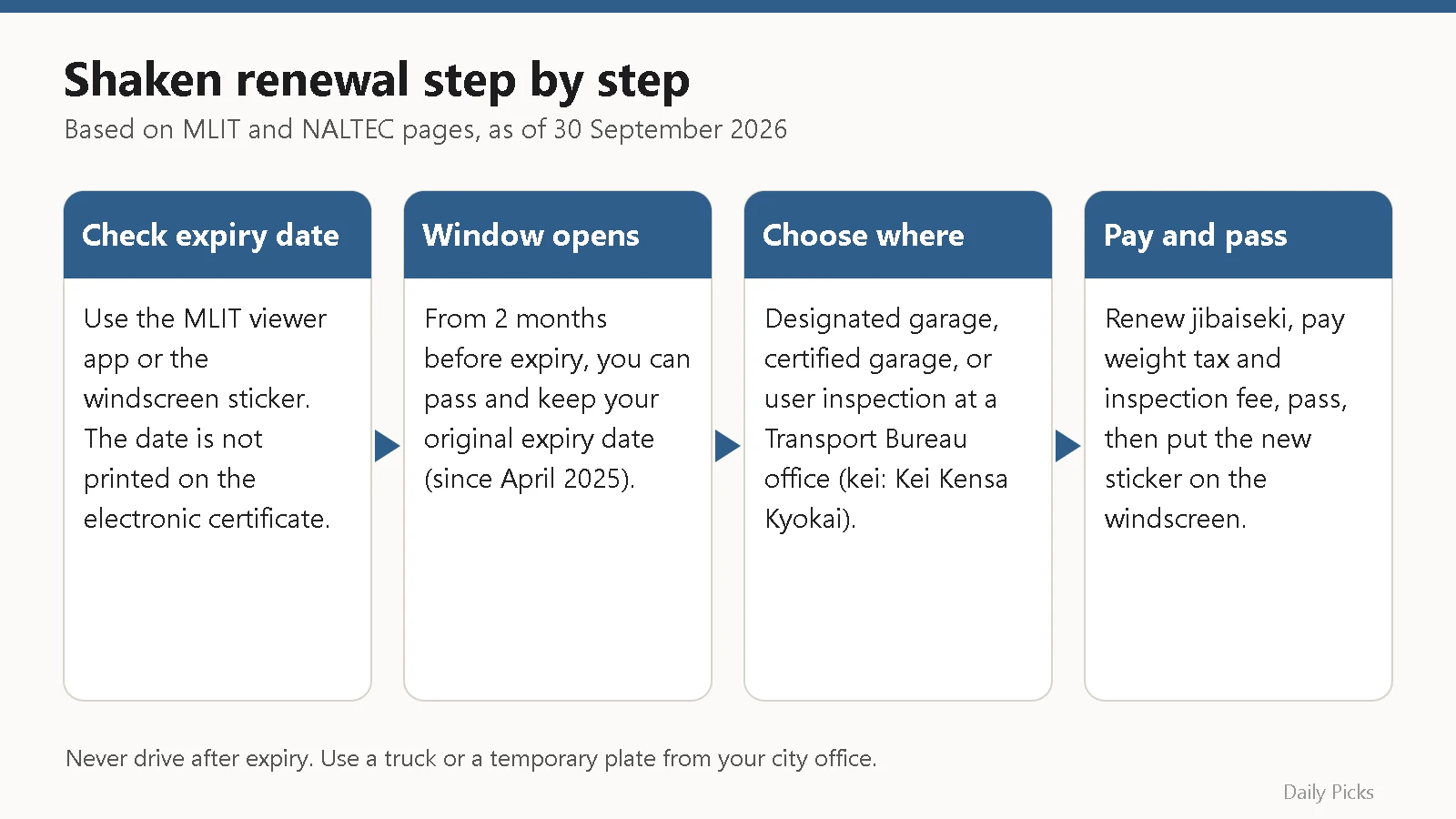
Since 1 April 2025, MLIT allows you to take the continued inspection from 2 months before the expiry date up to the expiry date itself. If you pass within this window, the new validity period still starts from the old expiry date, so you do not lose any days. Before April 2025, this window was only 1 month.
How to find your expiry date
According to MLIT, electronic vehicle inspection certificates have been issued since 4 January 2023 whenever a car is registered or passes an inspection. The certificate is about A6 size, thick paper with an IC tag.
The expiry date is not printed on it. It is stored in the IC tag, with the owner’s and user’s addresses. You can check it in these ways:
- The official vehicle inspection certificate viewer app (shakensho etsuran app) from MLIT, which reads the IC tag.
- The inspection sticker (kensa hyosho) on the inside of your windscreen. The large number on the front shows the year and month of expiry. The back shows the full date.
- The paper record sheet (jidosha kensasho kiroku jiko) you may have received with the certificate.
MLIT states that the certificate must be kept in the car whenever you drive; the record sheet need not be. If the IC tag is damaged, apply for a new certificate at your Transport Bureau office.
Documents you need for a continued inspection
According to the MLIT portal, the documents for a continued inspection of a registered (non-kei) car are:
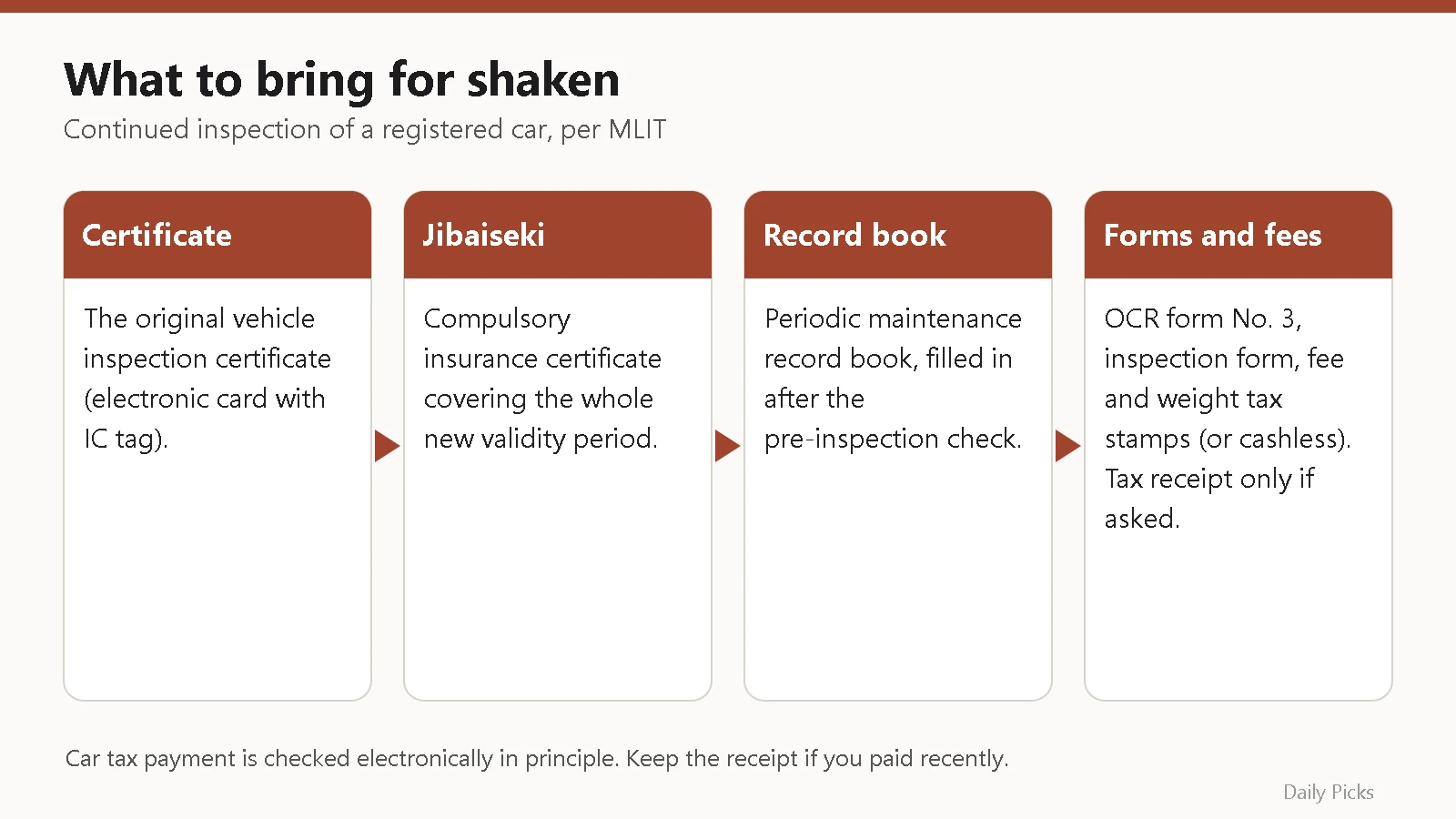
- Vehicle inspection certificate (jidosha kensasho), the original.
- Compulsory insurance certificate (jibaiseki hoken shomeisho). It must cover the whole of the new validity period.
- Periodic inspection and maintenance record book (tenken seibi kirokubo).
- Application form (OCR form No. 3), available at the office or online.
- Inspection record form (jidosha kensahyo), or a safety standards compliance certificate (hoan kijun tekigo sho) if a designated garage inspected the car.
- Fee payment slip with the fee stamps, unless you pay cashless.
- Weight tax payment slip with the weight tax stamps, unless you pay cashless.
Automobile tax receipt: MLIT says the tax payment certificate is “in principle not needed”, because payment is now checked electronically. However, it can take some days for a payment to appear in the local tax system. If it cannot be confirmed, you must show the paper certificate as before. If you paid your automobile tax shortly before the inspection, keep the receipt with you.
For kei cars, the Light Motor Vehicle Inspection Organization (Kei Jidosha Kensa Kyokai) lists similar documents. Since January 2023 it confirms light motor vehicle tax payment electronically, but a certificate may still be needed in some cases.
Annual car tax
The yearly car tax is separate from shaken costs. According to the Ministry of Internal Affairs and Communications:
- Automobile tax (jidosha-zei shubetsuwari): a prefectural tax charged to the person who owns the car on 1 April. It is paid in May, on a date set by each prefecture.
- Light motor vehicle tax (kei jidosha-zei shubetsuwari): a city tax on kei cars, also charged to the owner on 1 April. The due date is set by each city, so check your notice.
Unpaid car tax can hold up your inspection, because payment is confirmed as part of the process.
Where to get the inspection done
The National Agency for Automobile and Land Transport Technology (NALTEC), which runs the national inspection lanes, describes these main options:
- Designated garage (shitei kojo): a private garage approved to inspect cars on behalf of the state. Its inspector issues a safety standards compliance certificate, so the car does not need to go to the Transport Bureau.
- Certified garage (ninsho kojo): a garage approved to do major repairs. It can service your car, but the car must still be taken to a national inspection site.
- User inspection (user shaken): you take the car to the inspection site at a Transport Bureau office yourself and go through the lane.
- Agent: someone else takes the car and handles the paperwork for you.
MLIT explains that certified and designated garages display different official signs, so you can check which type a garage is before you book.
Kei cars are inspected at offices of the Light Motor Vehicle Inspection Organization, not at the Transport Bureau lanes. Its site explains the steps and has its own booking system.
Doing a user inspection yourself
With a user inspection you handle maintenance and paperwork yourself, and counters run in Japanese. According to MLIT and NALTEC:
- You must book online. MLIT says bookings open 2 weeks before the inspection date. Registered cars use the NALTEC booking system. Kei cars use the Light Motor Vehicle Inspection Organization’s booking site.
- You should do the periodic maintenance first and fill in the record book.
- NALTEC recommends watching its guidance video before the day.
- Remove wheel covers, luggage and spare items that are not needed, and make sure the chassis number can be seen.
- Only the driver should be in the car in the lane.
If the car fails a check, NALTEC says you can re-enter the lane for the failed items up to twice on the same day (3 entries in total for one application). After that, you need a new application and a new fee. You can also ask for a limited inspection certificate, valid for up to 15 days, to have the problem fixed at a garage.
What it costs: the statutory part
Every shaken includes three statutory costs. Garages add their own charges for maintenance and handling, so compare written quotes.
| Statutory cost | Amount (official source) |
|---|---|
| Inspection fee, user inspection, ordinary car | 2,600 yen (from 1 April 2026) |
| Inspection fee, user inspection, small car (kogata) | 2,500 yen (from 1 April 2026) |
| Inspection fee, user inspection, kei car | 2,500 yen (from 1 April 2026) |
| Inspection fee with a designated garage certificate, counter application | 2,100 yen (from 1 April 2026) |
| Compulsory insurance, private passenger car, 24 months (not Okinawa or remote islands) | 17,650 yen now; 18,560 yen for policies starting on or after 1 November 2026 |
| Compulsory insurance, kei car, 24 months (not Okinawa or remote islands) | 17,540 yen now; 18,660 yen for policies starting on or after 1 November 2026 |
| Weight tax (jidosha juryozei) | Depends on weight, age and fuel efficiency. Check with the MLIT inquiry service. |
Inspection fees are from the Kanto Transport Bureau and NALTEC. Insurance premiums are from the General Insurance Rating Organization of Japan (GIROJ) filing of 30 April 2026.
For the weight tax, MLIT runs a free online service (jikai jidosha juryozei-gaku shokai). You enter the chassis number from your certificate, and it shows the weight tax due at your next inspection. There is a separate service for kei cars.
Driving without valid shaken or insurance
Driving a car on public roads after its inspection has expired is a criminal offence. Under Article 108 of the Road Transport Vehicle Act, the penalty is imprisonment of up to 6 months or a fine of up to 300,000 yen. The Tokyo Metropolitan Police lists 6 points on your licence for driving without a valid inspection.
Compulsory insurance is normally renewed at shaken to cover the new period, so a car with expired shaken may also be uninsured. MLIT states that driving without compulsory insurance carries imprisonment of up to 1 year or a fine of up to 500,000 yen, 6 points and an immediate licence suspension. Not carrying the insurance certificate can mean a fine of up to 300,000 yen.
If your inspection has already expired, do not drive the car to the inspection site. Transport it on a truck, or borrow a temporary operation permit plate (rinji unko kyoka, red-striped) from your city office. The Kinki Transport Bureau says these are lent for up to 5 days and need compulsory insurance covering the trip; the fee on its page is 750 yen.
Japanese words you will see
| Japanese | Reading | Meaning |
|---|---|---|
| 車検 | shaken | Vehicle inspection |
| 継続検査 | keizoku kensa | Continued (renewal) inspection |
| 自動車検査証 | jidosha kensasho | Vehicle inspection certificate |
| 検査標章 | kensa hyosho | Inspection sticker on the windscreen |
| 自賠責保険 | jibaiseki hoken | Compulsory third-party insurance |
| 自動車重量税 | jidosha juryozei | Vehicle weight tax |
| 点検整備記録簿 | tenken seibi kirokubo | Maintenance record book |
| 指定工場 | shitei kojo | Designated garage |
| 運輸支局 | un’yu shikyoku | District Transport Bureau office |
Shaken checklist
- Check your expiry date with the app or the windscreen sticker.
- Mark the date 2 months before expiry in your calendar. That is when the window opens.
- Decide: dealer or designated garage, certified garage, or user inspection.
- Ask for written quotes that separate statutory costs from garage charges.
- Check your weight tax with the MLIT inquiry service.
- Make sure your automobile tax (or light motor vehicle tax) is paid. Keep the receipt if you paid recently.
- Renew compulsory insurance so it covers the whole new period.
- For a user inspection, book online, do the maintenance, and bring all documents.
- After passing, put the new sticker on the windscreen and keep the new certificate in the car.
FAQ
Can I take shaken early without losing time?
Yes, within the window. Since 1 April 2025, if you pass within 2 months before the expiry date, the new period starts from the old expiry date.
Do I still need the paper car tax receipt?
In principle, no. MLIT and the Light Motor Vehicle Inspection Organization confirm payment electronically. If the payment has not appeared in the system yet, you will be asked for the paper certificate, so keep it if you paid recently.
Will compulsory insurance cost more this year?
GIROJ filed an average 6.2% increase for policies starting on or after 1 November 2026. For a private passenger car, the 24-month premium (outside Okinawa and remote islands) goes from 17,650 yen to 18,560 yen.
Where is a kei car inspected?
At an office of the Light Motor Vehicle Inspection Organization. If you do it yourself, book on the organization’s reservation site. The same 3-year, then 2-year cycle applies to passenger kei cars.
Related reading
- Driving in Japan with a foreign licence: IDP limit and conversion rules
- Driver’s licence renewal in Japan for foreign residents
- Moving house in Japan: address change checklist
- Year-end and New Year holidays in Japan: what closes
- Lost property in Japan: police report and residence card
Sources
- Validity period of the vehicle inspection certificate (Japanese) – MLIT
- Inspection window extended from April 2025 (Japanese) – MLIT
- Documents needed to renew inspection (Japanese) – MLIT
- How users can do the inspection themselves (Japanese) – MLIT
- Inspection sticker (Japanese) – MLIT
- About the electronic vehicle inspection certificate (Japanese) – MLIT
- Electronic certificate FAQ (Japanese) – MLIT
- Rule changes for the electronic certificate (Japanese) – MLIT
- Certified and designated garages (Japanese) – MLIT
- Methods of continued inspection (Japanese) – NALTEC
- For first-time inspection users (Japanese) – NALTEC
- Re-entry when the car fails (Japanese) – NALTEC
- Cost guide (Japanese) – NALTEC
- Statutory registration and inspection fee change, 1 April 2026 (Japanese, PDF) – Kanto Transport Bureau
- Compulsory insurance rate revision filing, April 2026 (Japanese, PDF) – General Insurance Rating Organization of Japan
- If you are not covered by compulsory insurance (Japanese) – MLIT
- About the vehicle weight tax (Japanese) – MLIT
- Next weight tax inquiry service (Japanese) – MLIT
- Road Transport Vehicle Act (Japanese) – e-Gov Laws
- Traffic violation points table (Japanese) – Tokyo Metropolitan Police Department
- Temporary operation permit (Japanese) – Kinki Transport Bureau
- Continued inspection for kei cars (Japanese) – Light Motor Vehicle Inspection Organization
- Automobile tax and light motor vehicle tax (Japanese) – Ministry of Internal Affairs and Communications
コメント