Summary: In Japan, your city, ward, town or village pays some or all of the medical bills for children who have public health insurance. The program has different names, such as kodomo iryohi josei, shoni iryohi josei or “maru nyu / maru ko / maru ao” in Tokyo. Age limits, income limits and small fees at the clinic are set by each local government, so the rules are not the same everywhere. You apply at your city office after a birth or a move, get a medical certificate (iryosho), and show it with the child’s health insurance at every visit.
- What the children’s medical expense subsidy is
- Examples: age limits, income limits and fees in three areas
- Japanese words you will see
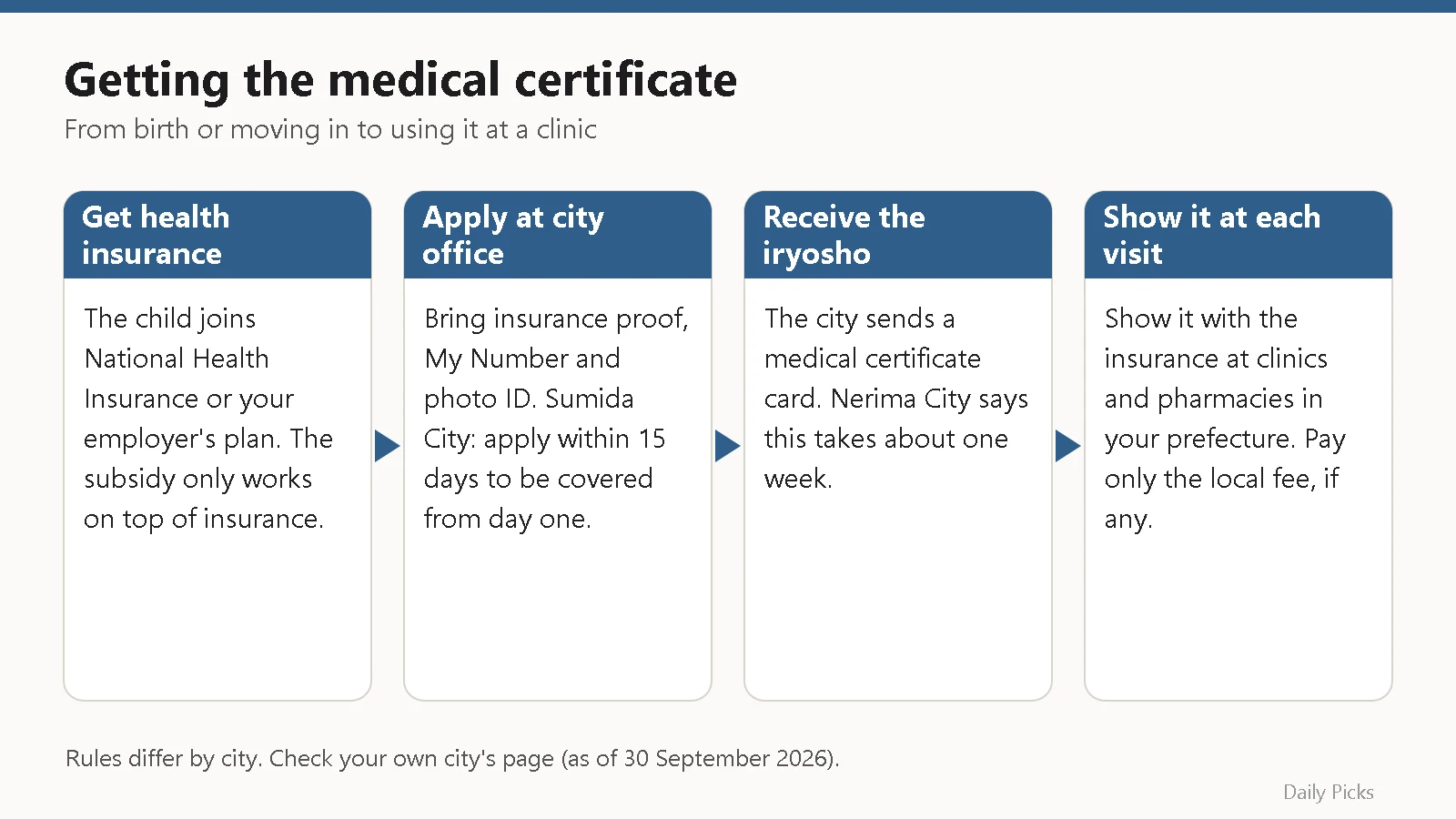
- How to apply after a birth or a move
- Using the medical certificate (iryosho) at clinics
- What the subsidy does not cover
- Getting a refund if you forgot the card or went outside the prefecture
- When you move or change insurance
- Checklist for parents
- FAQ
- Related reading
- Sources
What the children’s medical expense subsidy is
When a child sees a doctor in Japan, public health insurance pays most of the bill. The family normally pays the rest at the counter. The children’s medical expense subsidy is a local program that pays this remaining share for you, fully or partly.
It is not a national cash payment. Each municipality runs its own program, often with help from the prefecture. This is why the name, the age limit and the fee at the counter change when you move from one city to another.
The subsidy only works on top of health insurance. It covers the self-pay part of care that insurance covers. The child must be in National Health Insurance or an employee health insurance plan first. The pages of Tokyo, Yokohama, Osaka and Sumida City all list this as a basic condition. None of these pages lists nationality as a condition, so foreign residents who are registered at the city office and have Japanese health insurance should ask their city office about applying.
Examples: age limits, income limits and fees in three areas
The table below shows how the rules differ. It is based on the official pages listed in Sources, as of 30 September 2026. Use it only as an example. Your own city’s page is what counts.
| Area | Age covered | Income limit | What you pay at the counter |
|---|---|---|---|
| Tokyo (standard set by the Tokyo Metropolitan Government) | Up to the first 31 March after age 18, in three stages: maru nyu (preschool), maru ko (elementary and junior high), maru ao (high school age, since April 2023) | Tokyo’s pages say income limits and other rules can differ by municipality | Maru nyu: the insured self-pay share is covered. Maru ko and maru ao: up to 200 yen per outpatient visit; pharmacy free. Hospital meals are excluded unless your municipality covers them |
| Sumida City and Nerima City (Tokyo wards) | Up to the first 31 March after age 18 | Nerima’s page says there is no income limit | Both pages say the ward pays the full insured self-pay share |
| Yokohama City | Up to the first 31 March after age 18 (extended from 1 June 2026) | Removed in August 2023 | Full subsidy; the 500 yen per visit fee was also removed in August 2023 |
| Osaka City | Up to the first 31 March after age 18 | Removed in April 2024 | Up to 500 yen per clinic per day, for up to 2 days a month per clinic; monthly total up to 2,500 yen; no fee at the pharmacy |
Three points stand out. First, many large cities now cover children up to the end of high school age. Second, several cities have removed income limits in recent years. Third, the fee at the counter can be zero, 200 yen or 500 yen, depending on where you live. Smaller towns may have different rules again.
Yokohama’s page explains that children aged 13 to 18 who were newly covered from June 2026 did not get any subsidy for April and May 2026. Their certificates are valid from 1 June 2026. Families who moved to Yokohama after 26 April 2026 need to apply themselves.
Japanese words you will see
| Japanese | Reading | Meaning |
|---|---|---|
| 子ども医療費助成 | kodomo iryohi josei | Children’s medical expense subsidy (common name) |
| 小児医療費助成 | shoni iryohi josei | Another name, used in Yokohama and other cities |
| マル乳・マル子・マル青 | maru nyu, maru ko, maru ao | Tokyo’s three stages: preschool, compulsory school, high school age |
| 医療証 | iryosho | Medical certificate card for the subsidy |
| 自己負担 | jiko futan | The part of the bill you pay yourself |
| 所得制限 | shotoku seigen | Income limit |
| 払い戻し / 償還払い | haraimodoshi / shokan barai | Refund after you paid at the counter |
| 領収書 | ryoshusho | Receipt |
| 保険適用外 | hoken tekiyo gai | Not covered by health insurance |
How to apply after a birth or a move
You apply at the office of the municipality where you live. In large cities this is your ward office. The section is often the child support section (kosodate shien) or the insurance and pension section. Some cities also accept mail or online applications. Yokohama accepts applications through its child-rearing website “Pamatoco”. Osaka City accepts online applications for births.
Timing matters. Sumida City’s page says that if you apply within 15 days from the day after a birth or a move-in, the certificate is valid from the date of birth or move-in. It also warns that after 15 days, you may lose coverage back to that date. Other cities may count this differently, so check your city’s page.
For a newborn, the child first needs health insurance. Apply for the baby’s health insurance through your employer or at the National Health Insurance counter. If the insurance proof is not ready yet, ask the counter staff how your city handles the application, so you do not miss the deadline.
Documents differ by city. Sumida City lists the following, and other cities ask for similar items:
- Proof of the child’s health insurance (insurance certificate, qualification notice, or a screen of the My Number portal showing the insurance)
- My Number of the parent and child
- The parent’s photo ID (for example a residence card or My Number card), or two other ID documents
- The application form (available at the counter or on the city’s website)
Osaka City says that in some cases it may also ask for a consent form for using My Number, an income certificate or family documents. Nerima City says the certificate is issued about one week after the application.
Using the medical certificate (iryosho) at clinics
After approval, the city sends you a medical certificate card. At each visit, show the certificate together with the child’s health insurance at the reception desk. The clinic or pharmacy then charges only the local fee, or nothing, instead of the normal share.
Certificates have an expiry date. In Tokyo, the maru nyu, maru ko and maru ao certificates are renewed every year on 1 October. The Tokyo Metropolitan Government says the new certificates are pale green and valid from 1 October 2026 to 30 September 2027. Show the new card from October.
The certificate usually works only at clinics, hospitals and pharmacies inside your own prefecture. Outside the prefecture, you normally pay the usual share and claim a refund later.
What the subsidy does not cover
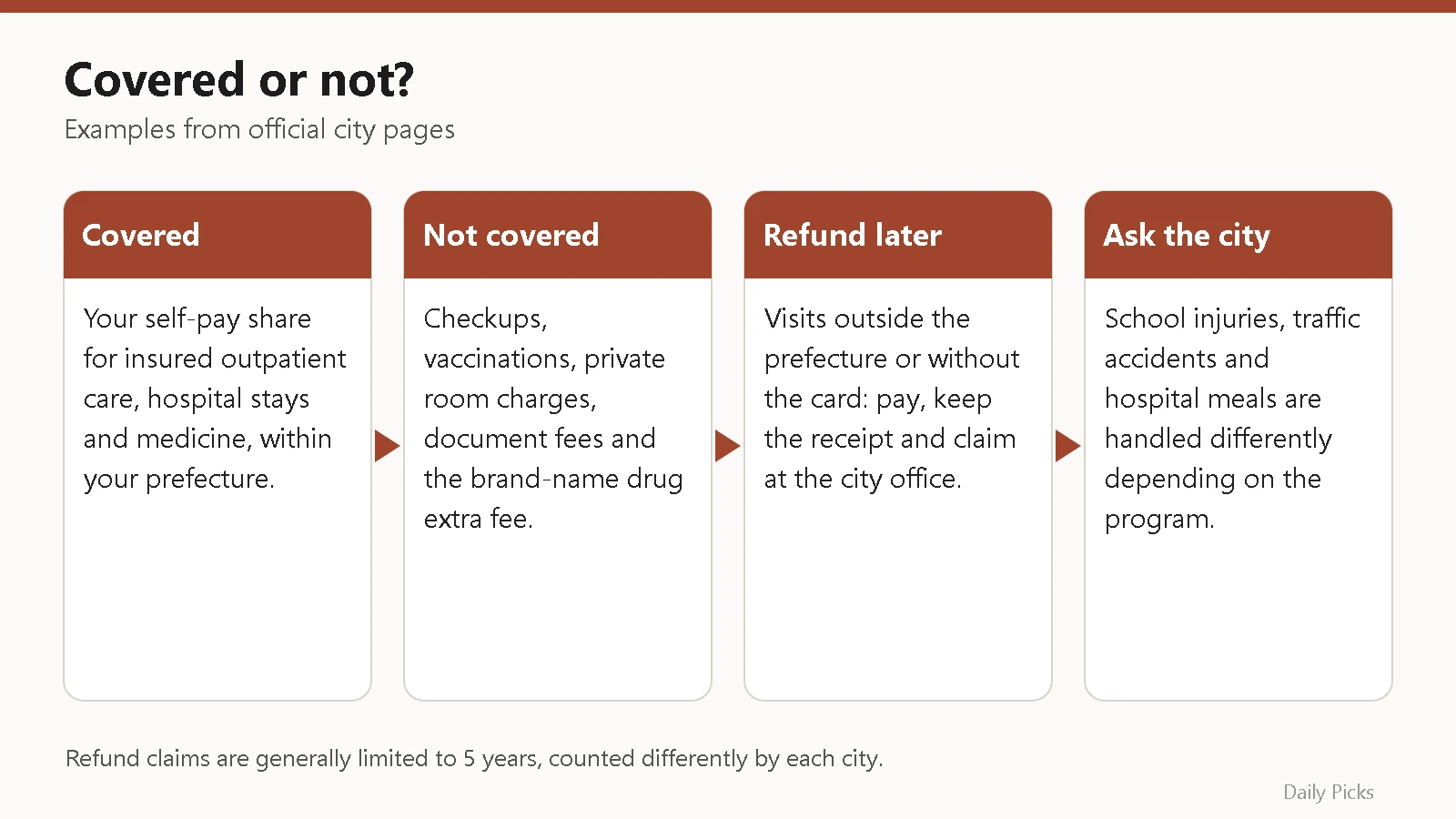
The subsidy only pays the self-pay part of insured care. Items outside health insurance stay at your cost. The official pages of Tokyo, Yokohama, Osaka, Sumida and Nerima list these examples:
- Health checkups and vaccinations
- Extra charges for a private or better hospital room
- Document fees, such as medical certificates for school or work
- Container fees for medicine
- Extra fees for choosing certain services (sentei ryoyo), such as the extra charge when you ask for a brand-name drug instead of a generic one
- Meals during a hospital stay (in most areas)
- Treatment not covered by health insurance
Some cases need special handling. Tokyo’s maru ko page says injuries at school that are covered by the Japan Sport Council’s school injury benefit are not covered by the subsidy. For injuries caused by another person, such as a traffic accident, rules differ. Tokyo’s page says the certificate can in principle be used when health insurance is used. Sumida City lists traffic accident treatment as not covered. Tell your city office if your child is hurt in an accident.
Getting a refund if you forgot the card or went outside the prefecture
If you pay the normal share because you forgot the certificate, visited a clinic in another prefecture, or saw a doctor before the card arrived, you can usually claim the money back. This is called haraimodoshi or shokan barai. Keep every receipt.
Sumida City asks for the original receipts, proof of health insurance and bank account details. It also asks for any notice of high-cost medical care payments from your insurer. Its page says receipts must be within 5 years from the day after you paid. Yokohama’s page says the right to claim ends 5 years from the first day of the month after the visit. Osaka City handles refunds through its medical subsidy refund center.
If your child stays in hospital, the insurer may pay part of the bill as high-cost medical care first. The city may then refund only the remaining part.
When you move or change insurance
The certificate belongs to the city that issued it. Sumida City lists these changes that you must report: a new address or name, a change of health insurance, moving out of the ward, starting public assistance, and a change of guardian. Nerima City also asks you to report a move out of the ward or a change of insurance.
If you move to another municipality, report the move, stop using the old certificate and apply again in the new city. Yokohama’s page says that if the certificate is used after the child is no longer eligible, the family must pay back the subsidy. The same applies when you change jobs and the child’s health insurance changes. Report the new insurance so the certificate shows the right details.
Checklist for parents
- Find your city’s page. Search for your city name plus “子ども医療費助成” or “小児医療費助成”.
- Check the age limit, income limit and counter fee on that page.
- Make sure the child has Japanese health insurance.
- Apply at the city office soon after a birth or move-in. In Sumida City, applying within 15 days keeps coverage from the start date.
- Bring proof of insurance, My Number and photo ID. Ask which other documents your city needs.
- When the certificate arrives, keep it with the child’s insurance proof.
- Show both at every clinic, hospital and pharmacy visit.
- Keep receipts for visits outside the prefecture or without the card, and claim a refund.
- Watch for the renewal date (1 October in Tokyo) and use the new card.
- Report a move or a change of insurance to the city office.
FAQ
Can foreign residents use the children’s medical expense subsidy?
The official pages set conditions such as living in the municipality and having Japanese health insurance. They do not list nationality as a condition. If you are registered at the city office and your child has health insurance, ask your city office about applying.
Is medical care for children free everywhere in Japan?
No. It depends on the city and the child’s age. For example, as of 30 September 2026, Yokohama pays the full insured self-pay share, Tokyo’s standard for school-age children allows a fee of up to 200 yen per visit, and Osaka City charges up to 500 yen per clinic per day.
Are vaccinations and health checkups covered?
Not by this subsidy. The official pages list vaccinations and checkups as not covered. Check the separate notices your city sends about them.
My child got sick while we were travelling in another prefecture. What do I do?
Show the health insurance, pay the normal share and keep the receipt. After you return, apply for a refund at your city office with the receipt, insurance proof and bank details.
Do I need to apply again every year?
It depends on your city. In Tokyo, certificates are renewed every year on 1 October, and the new cards run from 1 October 2026 to 30 September 2027. Osaka City says it still checks income for preschool children, even though income does not affect eligibility. Read any letter from your city carefully and reply by the date it gives.
Related reading
- National Health Insurance notice in Japan
- Seeing a doctor in Japan: clinic or hospital
- Moving house in Japan: address change checklist
Sources
- Infant medical expense subsidy (maru nyu) (Japanese) – Tokyo Metropolitan Government Bureau of Social Welfare
- Medical expense subsidy for compulsory school children (maru ko) (Japanese) – Tokyo Metropolitan Government Bureau of Social Welfare
- Medical expense subsidy for high school age children (maru ao) (Japanese) – Tokyo Metropolitan Government Bureau of Social Welfare
- Renewal of maru nyu, maru ko and maru ao certificates (Japanese) – Tokyo Metropolitan Government Bureau of Social Welfare
- Children’s medical expense subsidy (Japanese) – Sumida City
- Children’s medical expense subsidy (Japanese) – Nerima City
- Child medical expense subsidy (Japanese) – Yokohama City
- Child medical expense subsidy extended to age 18 from June 2026 (Japanese) – Yokohama City
- Is there an income limit for the child medical expense subsidy? (Japanese) – Yokohama City
- Children’s medical expense subsidy (Japanese) – Osaka City
- Income limit removed from the children’s medical expense subsidy (Japanese) – Osaka City
コメント