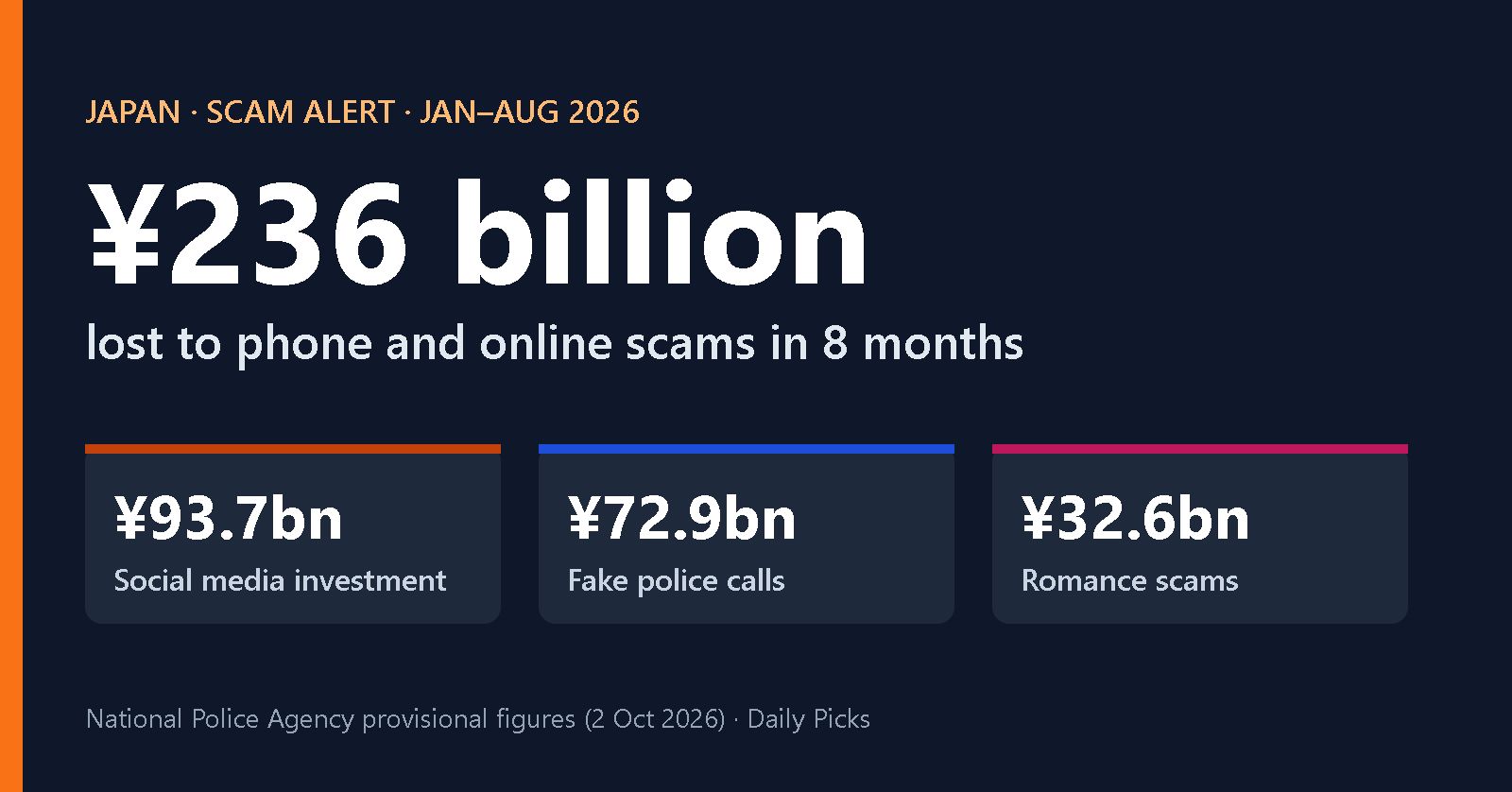
Summary: On 2 October 2026, Japan’s National Police Agency (NPA) published provisional figures for phone and online fraud from January to August 2026. Police recorded 29,687 cases and ¥236.07 billion in losses, up 14.4% and 33.2% on the same period in 2025. The three biggest types are investment scams that start on social media (¥93.74 billion), fake police calls (¥72.86 billion) and romance scams that start on social media or dating apps (¥32.58 billion). Anyone living in Japan can be targeted, and Tokyo police and universities have warned about calls aimed at foreign residents and students. What you can do now: learn how these three scams begin, install a free call-blocking app recommended by the police, and save the police advice number #9110 (in Tokyo it also works in English, Chinese and Korean).
What the new figures say
In Japan, police group phone and online scams under the name tokushu sagi (“special fraud”). From 2026, the NPA counts investment scams and romance scams that start on social media as part of this group, and it treats fake police calls (nise keisatsu sagi) as a separate type. The 2025 comparison figures were recalculated with the same groups, so the year-on-year changes compare like with like.
The totals for January to August 2026 (provisional):
- Cases: 29,687 (+3,732, +14.4%)
- Losses: ¥236.07 billion (+¥58.84 billion, +33.2%)
- Cases solved by police: 5,443 (+25.2%), with 1,949 people arrested or referred (+26.6%)
These are eight months of data, not a full year, and the NPA may revise them. People who never report a scam are not counted.
| Type of scam | Cases (Jan–Aug 2026) | Change | Losses | Change | Average loss per case* |
|---|---|---|---|---|---|
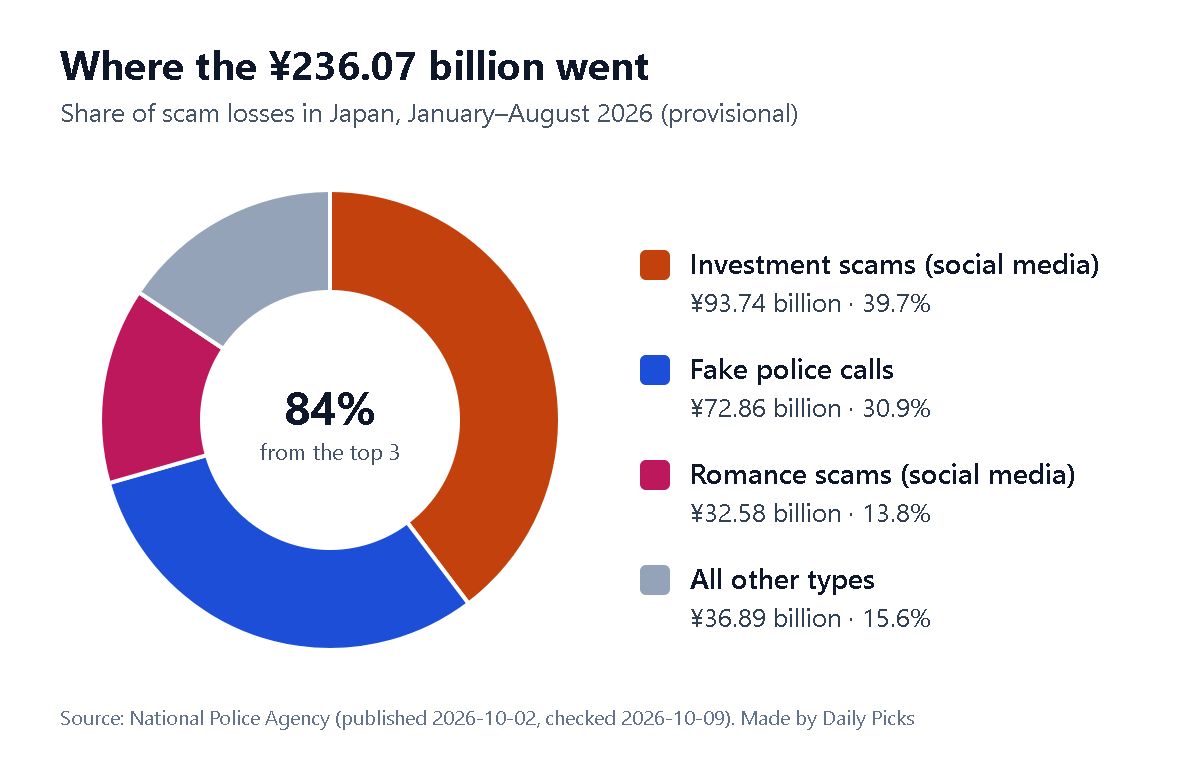
| Investment scams that start on social media | 7,097 | +49.4% | ¥93.74 billion | +53.8% | about ¥13.2 million |
| Fake police calls | 6,346 | −4.1% | ¥72.86 billion | +27.0% | about ¥11.5 million |
| Romance scams that start on social media | 3,506 | +0.4% | ¥32.58 billion | +0.8% | about ¥9.3 million |
| “It’s me” calls pretending to be family (ore ore) | 2,739 | +20.9% | ¥10.42 billion | +19.3% | about ¥3.8 million |
| Fake bills and fees | 4,211 | +13.6% | ¥9.75 billion | +16.0% | about ¥2.3 million |
| Fake refunds (tax, insurance, pension) | 2,058 | −10.0% | ¥4.65 billion | +7.2% | about ¥2.3 million |
| All types | 29,687 | +14.4% | ¥236.07 billion | +33.2% | about ¥8.0 million |
Checked: 2026-10-09. Source: National Police Agency, provisional figures for the end of August 2026 (published 2 October 2026). *Average loss per case is losses divided by cases, calculated by Daily Picks. Other smaller types are included in “All types”.
Two points stand out. First, the top three types make up about 84% of all losses. Second, fake police calls fell slightly in number but rose 27% in losses, so each case is costing victims more. The scams with the largest losses per case are the slow ones, where the criminal builds trust over days or weeks before asking for money.
Who is affected
The NPA figures are not broken down by nationality, so they do not show whether foreign residents are targeted more or less than Japanese people. But there are clear warnings aimed at foreign residents:
- The Tokyo Metropolitan Police Department (MPD) warns that Chinese residents receive calls from people pretending to be Chinese police, public security officers or embassy staff. The caller says your bank account or phone was used in a crime, asks you to install a messaging app, shows a fake arrest warrant on a video call, and demands money.
- In June 2026, Waseda University warned students about calls from people claiming to be from the Chinese Embassy or from Japan’s Immigration Services Agency, sometimes with fake documents that looked like they came from the university.
Investment and romance scams on social media work in any language. They often start in English on Instagram, Facebook, X, LINE or a dating app, so being new to Japan or not reading Japanese does not protect you.
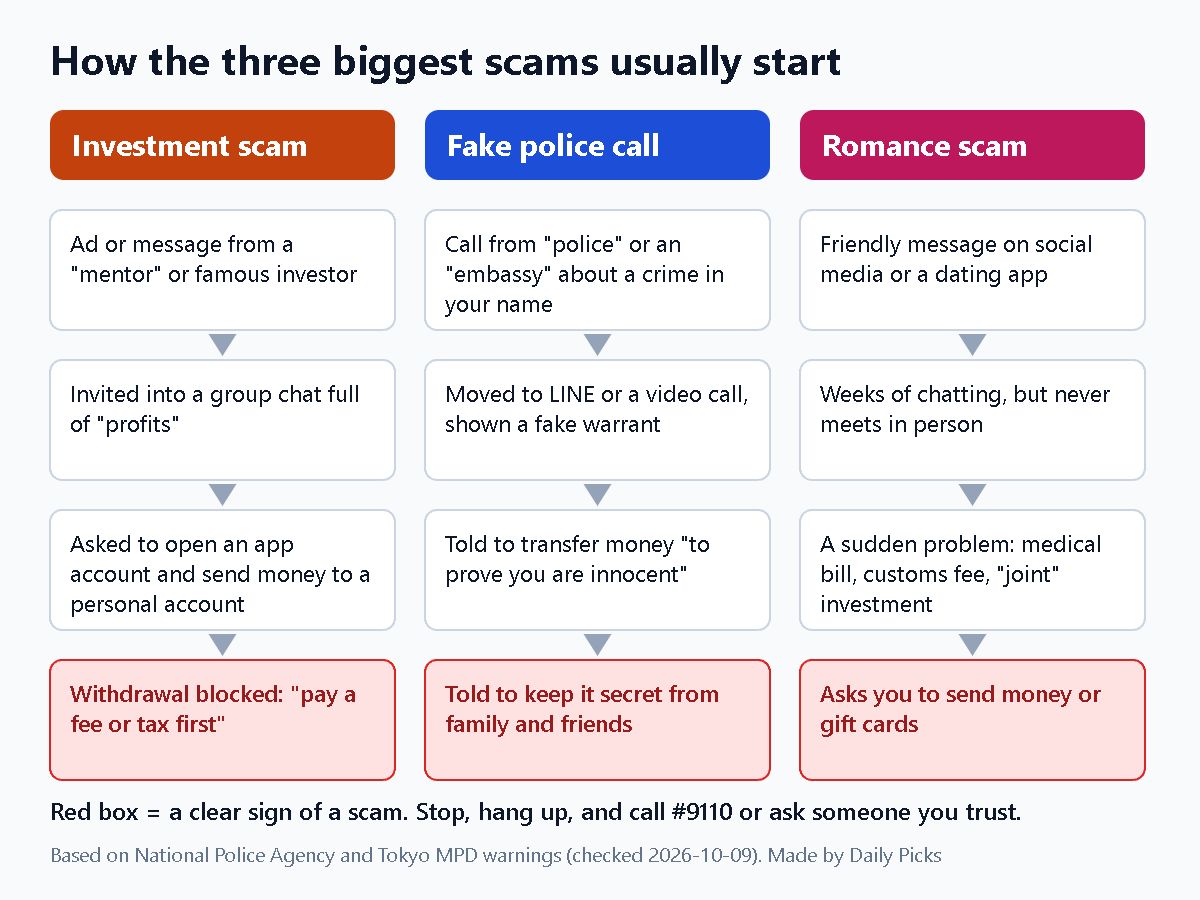
How the three biggest scams usually start
1. Investment scams that start on social media
You see an ad or get a message from someone who looks like a famous investor, a “mentor” or a friendly stranger. You are invited into a group chat where other members (often fake) post their profits. You are then asked to open an account on an app or website and send money to a personal bank account. The “balance” on the screen grows, but when you try to withdraw, you are asked for more fees or taxes. The NPA’s message is simple: there is no such thing as a “guaranteed” or “certain” investment.
2. Fake police calls
Someone calls and says they are a police officer (or, for some foreign residents, an embassy official). They say your name came up in a crime investigation. They move the conversation to a video call or messaging app, show a fake warrant or badge, and tell you to transfer money “to prove you are innocent” or to “protect your savings”. The NPA says real police in Japan never contact you through messaging apps, never send images of police IDs or arrest warrants, and never suddenly video-call your phone. They also never ask you to send money. Our guide to fake police calls in Japan explains the script step by step and how to block unknown callers.
3. Romance scams that start on social media
Someone contacts you on social media or a dating app and becomes friendly or romantic over weeks. They never meet you in person. Then a problem appears: a medical bill, a customs fee, a business opportunity, or a “joint” investment. Asking for money from someone you have never met is the warning sign, however long you have been talking.
What you can do now
- Never send money to someone you only know online. This includes bank transfers, cryptocurrency, gift cards and cash sent by courier. If someone asks you to pay to withdraw your own “profit”, stop.
- Check investment companies yourself. Businesses that sell investments in Japan must be registered. The Financial Services Agency (FSA) publishes a list of registered companies in English. If the company is not on the list, do not send money.
- Do not call back the number the caller gives you. If someone says they are from the police, a bank, the city office or an embassy, hang up and call the official number you find yourself.
- Do not send photos of your residence card, passport or other ID to anyone who contacts you first. The MPD gives the same advice.
- Install a call-warning app. The NPA recommends two free apps: “詐欺対策 by NTTタウンページ” (NTT Town Page) and “詐欺バスター Lite” (Trend Micro). Both warn about numbers linked to fraud on iPhone and Android. Blocking all international calls is only available on Android.
- Talk to someone before you act. Scammers often tell you to keep the call secret. Ask a friend, your school or your company, or call #9110, the police advice line. In Tokyo, the MPD says #9110 is available in Japanese, English, Chinese and Korean. If you think money has already been stolen, call 110, then your bank. Our guide to emergency numbers in Japan explains when to use 110, #9110 and 188.
If you have already sent money
Act quickly. Call your bank first and ask it to stop or freeze the transfer, then report to the police (110 if it is happening now, or your local police station). Keep screenshots of the chats, the account numbers you sent money to, and the app or website address. Be careful of a second scam: people who contact you offering to “recover” lost money for a fee are often part of the same fraud.
FAQ
Is ¥236 billion the total for the whole of 2026?
No. It is the total for January to August 2026, and the figures are provisional. The NPA publishes updated totals every month.
Why did losses grow faster than the number of cases?
Because the average loss per case went up. Fake police calls fell 4.1% in number but rose 27.0% in losses. The largest losses come from scams that build trust over a long time.
Can the Japanese police contact me through LINE or a video call?
No. The NPA says real police never contact you through messaging apps and never suddenly video-call your phone. Treat any police contact that asks for money, or for your ID photos, as a scam. If you are not sure whether a call was real, hang up and call #9110 or your local police station using a number you looked up yourself.
Are the recommended apps in English?
The NPA page does not say which languages the apps support. Both apps are free on the App Store and Google Play, and the NPA page links to them.
Someone from “Immigration” says my visa will be cancelled unless I pay. What should I do?
Do not pay and do not send ID photos. Hang up and contact the Immigration Services Agency using contact details from its official website. We cannot give advice on individual visa or residence status questions.
Related reading
- Fake police calls in Japan: how the scam works and how to block unknown callers
- Emergency numbers in Japan: 119, 110, #7119, #9110 and 188
- Amazon Prime sale in Japan: how to spot fake Amazon emails and survey calls
Sources
- National Police Agency: Special fraud figures for the end of August 2026, provisional (Japanese) (published 2026-10-02, checked 2026-10-09)
- National Police Agency: Detailed tables, end of August 2026 (PDF, Japanese)
- National Police Agency: What real police never do (fake police scam warning, Japanese)
- National Police Agency: Recommended anti-fraud apps (Japanese)
- Tokyo Metropolitan Police Department: Help hotline information (#9110, English)
- Tokyo Metropolitan Police Department: Scam calls pretending to be Chinese police or the Chinese Embassy (Japanese)
- Waseda University: Warning about scam calls to students (5 June 2026)
- Financial Services Agency: List of licensed (registered) financial institutions (English)