Summary: Amazon Japan’s autumn sale for Prime members, Prime Kanshasai (プライム感謝祭, “Prime appreciation sale”), runs from 16 to 19 October 2026, with an early sale from 13 October. During this week, real emails and SMS about orders, points and deliveries increase, and fake ones copy the same wording. Amazon was the brand most often used in phishing reports in Japan in August 2026 (about 26%). At the same time, a national government survey is being delivered to homes, and fake “survey” calls and emails also appear. The safe rule for both is the same: do not use the link or phone number in the message. Open the Amazon app yourself and check the Message Centre and your order history. For the survey, remember that the government does not ask for survey answers by phone or email.
What is happening this month
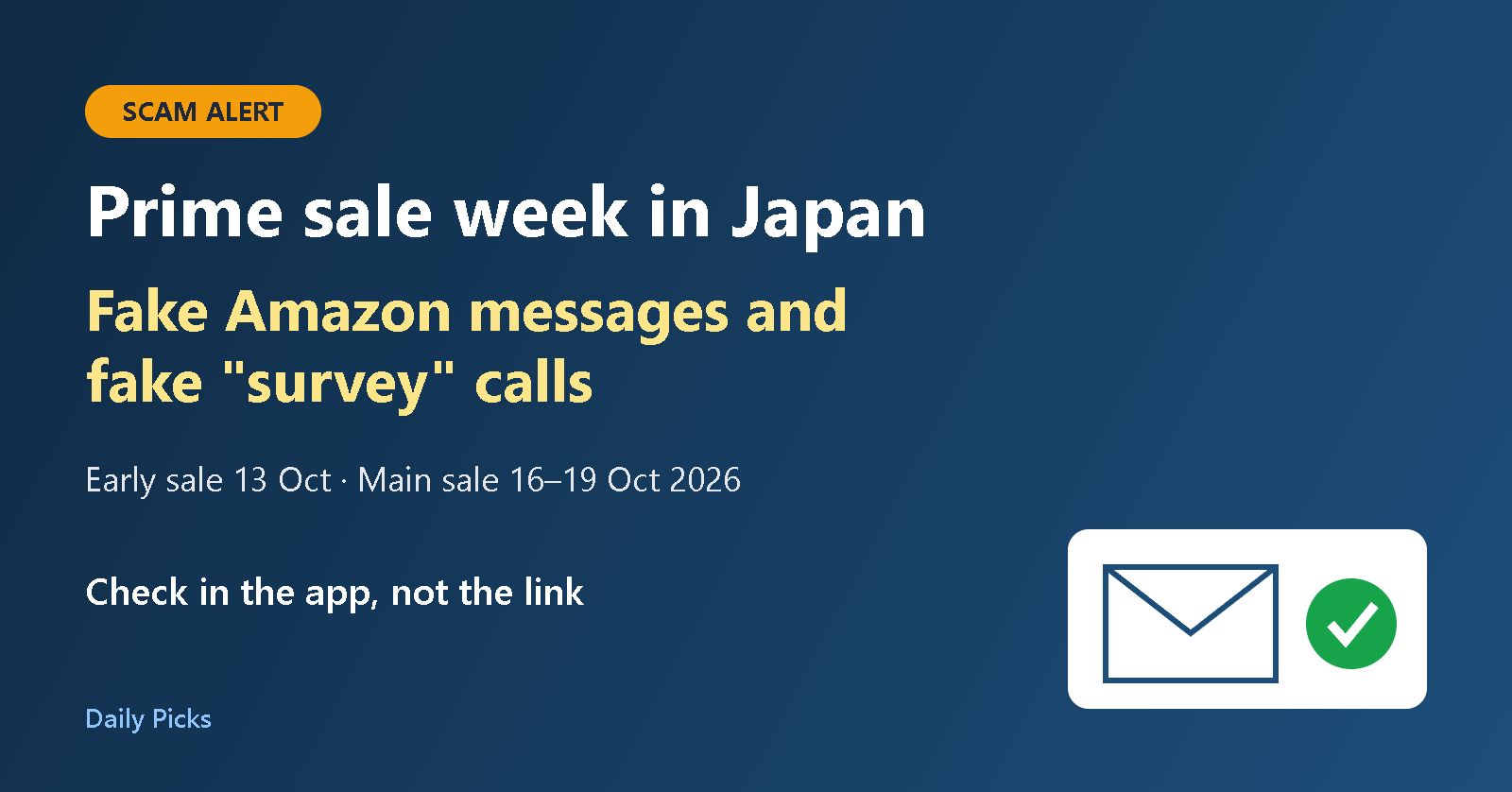
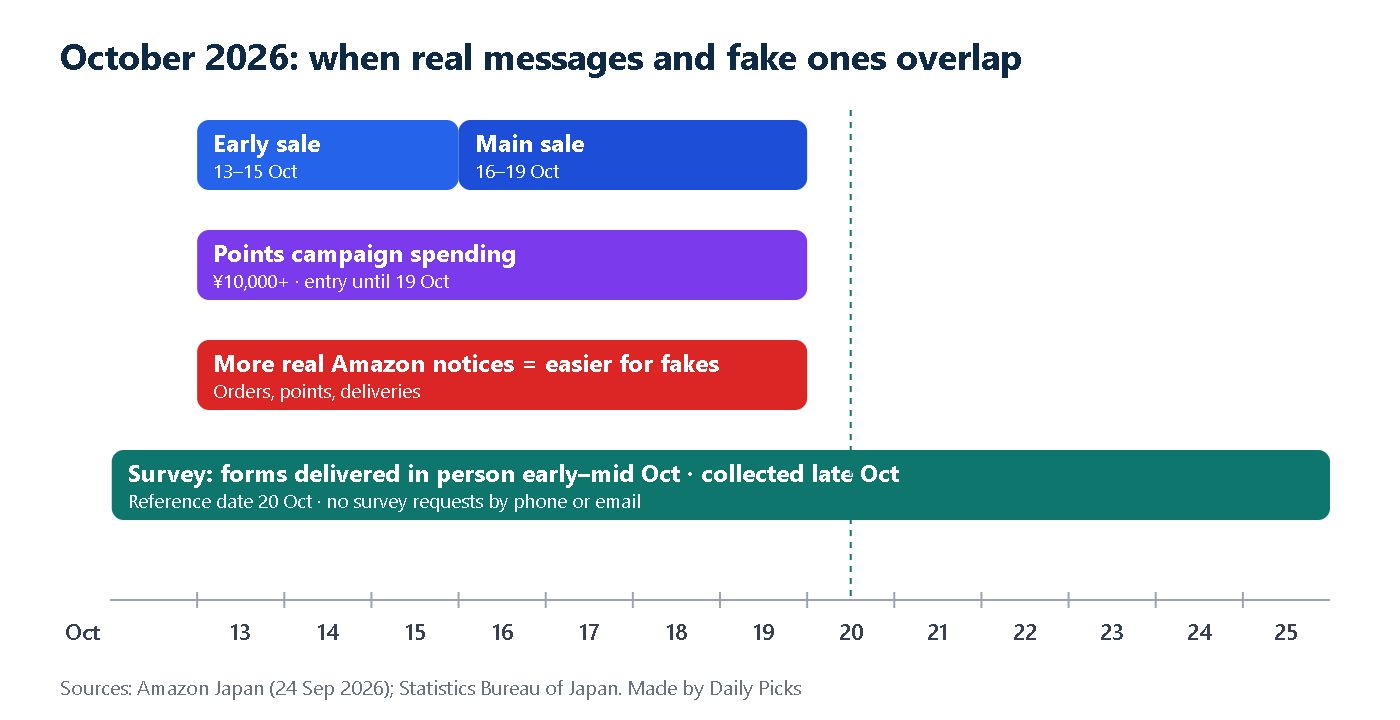
Amazon announced the sale on 24 September 2026. The main sale runs from 0:00 on Friday 16 October to 23:59 on Monday 19 October. An early sale for Prime members runs from 0:00 on Tuesday 13 October to 23:59 on Thursday 15 October. Amazon says more than 4 million items will be on sale.
There is also a points campaign. You enter it first (entry is already open), then spend a total of ¥10,000 or more (tax included) between 13 and 19 October. Depending on the conditions, you get extra Amazon points, up to 10,000 points, and a chance in a prize draw for up to 100,000 points.
Because the real campaign uses words like “entry”, “points” and “prize draw”, a fake message saying “Your entry is not complete” or “You have won points” can look normal this week.
| What | Dates (Japan time) | Who sends real messages |
|---|---|---|
| Prime early sale | 13 Oct 0:00 – 15 Oct 23:59 | Amazon (order, delivery and points notices) |
| Prime main sale | 16 Oct 0:00 – 19 Oct 23:59 | Amazon |
| Points campaign entry | 24 Sep 14:00 – 19 Oct 23:59 | Amazon |
| Survey on Time Use and Leisure Activities | Forms delivered early to mid October; reference date 20 October; collected late October | Survey staff visit in person (no survey requests by phone or email) |
Checked: 2026-10-07. Sources: Amazon Japan press release (24 September 2026); Statistics Bureau of Japan, 2026 Survey on Time Use and Leisure Activities.
Why fake Amazon messages are hard to spot
The Council of Anti-Phishing Japan collects phishing reports from the public. Its report for August 2026, published on 18 September, counted 82,338 reports, up about 24.5% from July. Amazon was the most-used brand at about 26.1%, followed by Apple (about 16.1%) and ANA (about 12.5%). The Statistics Bureau, which runs government surveys, was also in the top five.
The report says fake emails pretend to be order and delivery notices, refunds, payment updates, “unusual activity” alerts, identity checks, expiring points and member benefits. Amazon really sends these kinds of messages during a big sale, so “this looks unusual” is not a reliable warning sign this week.
Three common checks also fail more often than people expect:
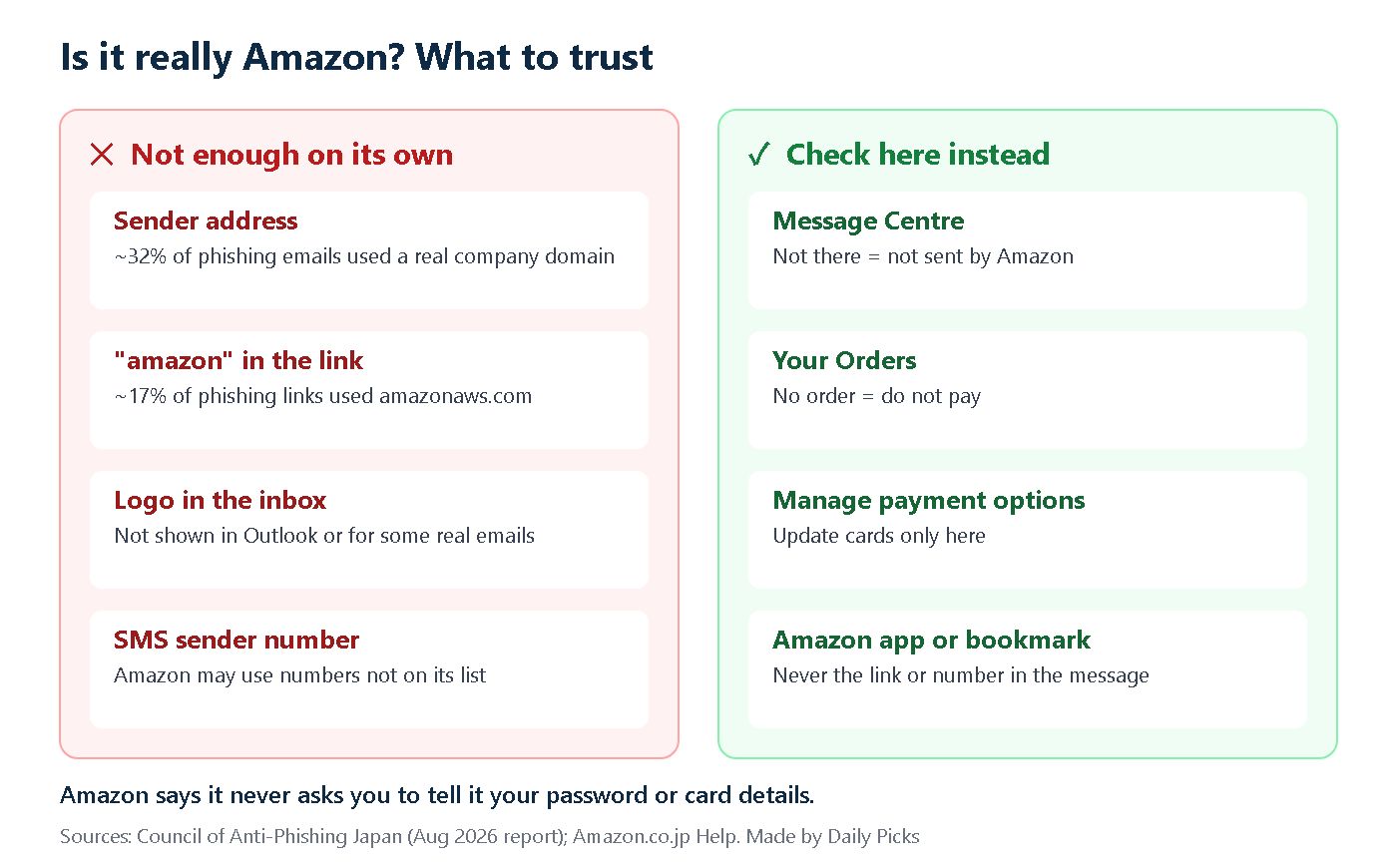
- The sender address. About 32.3% of the phishing emails in the report used a real company’s domain in the sender address. The “From” line can look exactly right.
- The link address. About 17% of reported phishing URLs used amazonaws.com, which is a real Amazon cloud domain anyone can rent. Seeing “amazon” in a link proves nothing. Amazon says the address of the Amazon.co.jp site starts with “https://” and ends in “.amazon.co.jp”.
- The logo. Amazon’s help page says Gmail, Apple Mail, Yahoo! Mail and docomo mail can show the Amazon logo next to real emails. But the logo does not appear in mail programs such as Outlook, and some real Amazon emails come from domains that do not show it. A logo is a good sign; no logo does not prove a message is fake.
How to check a message in four steps
Put the message aside and check inside Amazon yourself. These checks come from Amazon Japan’s help pages.
- Open Amazon yourself. Use the Amazon app or a bookmark you made. Do not tap the link or call the number in the message.
- Look in the Message Centre. Amazon says emails sent by Amazon.co.jp can be seen in the Message Centre in your account. If the same message is not there, Amazon did not send it.
- Compare with your order history. If a message says you owe money or have an order problem, check that the order exists in “Your Orders”. Amazon says a message that threatens legal action is a scam, and you should not pay any charge that is not in your order history.
- Check payment settings in the app. If you are asked to update your card, go to “Manage payment options” in your account. Amazon says it never asks you to tell it your password or card details.
Amazon lists the numbers it mainly uses for SMS, but says it may use others too. Do not decide by the sender number alone.
If you already tapped a link or typed your password
- Change your Amazon password from the app or a bookmark, not from the message.
- Turn on two-step verification (2SV) in your account’s security settings. Amazon recommends this.
- If you use the same password on other sites, change it there too.
- Report it to Amazon on its “Report suspicious communications” page. You choose what you shared: nothing, your Amazon account details, your bank details, or remote access to your computer.
- If you shared card details, call the number on the back of your card. If money was lost, talk to the police. The non-emergency police line is #9110, and the Consumer Hotline 188 can help with consumer problems. Our guide to emergency and advice numbers in Japan explains each one.
You can also ask Amazon to check a message for you. Amazon says you can forward a suspicious message to verify@amazon.co.jp or use the form on its help page. If you do not have an Amazon account, forward it to reportascam@amazon.com (receive only).
Fake “government survey” calls and emails
This part matters for many foreign residents. The Statistics Bureau is running the 2026 Survey on Time Use and Leisure Activities (Shakai Seikatsu Kihon Chosa). About 95,000 households and 194,000 people aged 10 and over are chosen at random. The Bureau’s English page says foreigners living in Japan are included. English questionnaires are available.
The real survey works like this: a survey worker (chosain) brings the forms to your home in early to mid October. You answer online or hand the paper forms back, and the forms are collected in late October. Survey workers always carry an ID card (chosain-sho).
The Statistics Bureau says government staff and survey workers will never ask you to take part in a survey, or ask about you or your household, by phone or email. They may phone only in two cases: to check something unclear after you have sent your answers, or to remind you if your answers did not arrive. Even then, they do not ask for personal or household information by phone. If someone visits without a survey worker ID card, they may be pretending. If you are unsure, contact the statistics section of your prefecture’s government.
Delivery SMS during the sale
More parcels means a fake “We tried to deliver your parcel” SMS can seem believable. Follow Amazon deliveries from your order history. For other delivery companies, open their official app and type the tracking number yourself. Our guide to missed-delivery slips and redelivery shows what a real notice looks like. For phone calls from unknown numbers, see how to block unknown and international calls.
FAQ
Q. An email has no Amazon logo in my inbox. Is it fake?
A. Not necessarily. Amazon says the logo appears only in some mail services and apps, not in programs like Outlook, and some real Amazon emails do not show it. Check the Message Centre instead.
Q. The link in the SMS contains “amazon”. Is it safe?
A. No. About 17% of reported phishing links in August 2026 used amazonaws.com, a real cloud domain that anyone can use. Open the Amazon app yourself instead of using the link.
Q. I got an email saying I won Prime sale points. Is it real?
A. The real campaign gives points to people who entered and spent ¥10,000 or more during the sale. Check your account in the app. Amazon says it never asks you to tell it your password or card details.
Q. Someone called saying they are from a government survey and asked about my family. What should I do?
A. Do not answer the questions. The Statistics Bureau says personal and household information is never collected by phone. If you want to check, contact your prefecture’s statistics section using a number from its official website.
Q. I am a foreign resident. Can I be chosen for the real survey?
A. Yes. The Bureau says foreigners living in Japan are included, and English questionnaires are available. A real survey worker will come to your home with an ID card.
Related reading
- Fake police calls in Japan: how the scam works and how to block unknown numbers
- Emergency numbers in Japan: 119, 110, #7119, #9110 and 188 explained
日本語で読む:プライム感謝祭に便乗する偽メール・偽SMSに注意|本物かどうかはメッセージセンターで確かめられる
Sources
- Amazon Japan: Prime Kanshasai 2026 announcement (24 September 2026, Japanese) — main sale 16–19 October, early sale 13–15 October, over 4 million items, points campaign (¥10,000 or more, up to 10,000 points, draw for up to 100,000 points). Checked 7 October 2026.
- Council of Anti-Phishing Japan: Phishing reports for August 2026 (18 September 2026, Japanese) — 82,338 reports; Amazon about 26.1%; spoofed real domains about 32.3%; amazonaws.com about 17%; common message types. Checked 7 October 2026.
- Amazon.co.jp Help: Identifying scam contacts (Japanese) — Message Centre; logo display and its limits; verify@amazon.co.jp; reportascam@amazon.com. Checked 7 October 2026.
- Amazon.co.jp Help: Is a call or SMS really from Amazon.co.jp? (Japanese) — no request for password or card details; legal-action messages are scams; “Manage payment options”; URL format; SMS sender numbers may vary; two-step verification. Checked 7 October 2026.
- Amazon.co.jp Help: Report suspicious communications (Japanese) — report by what you shared. Checked 7 October 2026.
- Statistics Bureau of Japan: 2026 Survey on Time Use and Leisure Activities, outline (English) — about 95,000 households; foreigners living in Japan included; enumerators deliver and collect forms; online response. Checked 7 October 2026.
- Statistics Bureau of Japan: Survey outline (Japanese) — reference date 20 October 2026; forms delivered early to mid October and collected late October. Checked 7 October 2026.
- Statistics Bureau of Japan: Warning about fake surveys (katari chosa, Japanese) — no survey requests by phone or email; two phone exceptions; ID cards; prefectural statistics sections. Checked 7 October 2026.
This article reflects official information available on 7 October 2026. Daily Picks is not affiliated with Amazon.