Summary: The most common phone scam in Japan now is the “fake police” scam (nise keisatsu sagi). A caller says your bank account or phone number was used in a crime, then moves you to a video call or messaging app, shows a fake police ID or arrest warrant, and asks you to move money for an “investigation”. Real police never do this. Hang up, call your local police station or #9110 yourself, and set your phone to screen unknown callers. Foreign residents are targeted too, often in English or with international numbers.
How big the problem is
According to the National Police Agency’s final figures for 2025, there were 27,832 cases of phone and similar fraud (tokushu sagi) in Japan, with losses of about 142.3 billion yen, almost double the year before. The fake police type alone accounted for 11,014 cases and 100.5 billion yen. These scams are no longer aimed only at older people; police in several prefectures warn that younger people are also losing money.
How the scam works
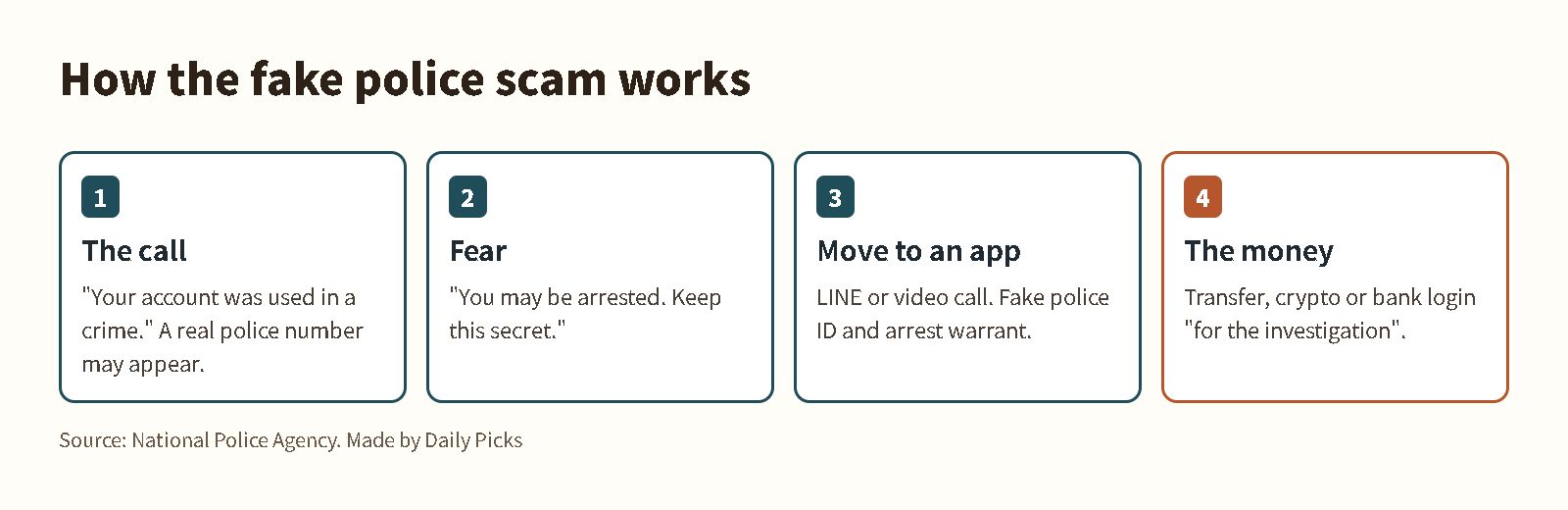
- The first call. Someone claiming to be from a phone company, a government office or the police says your account or phone contract was used in a crime. The number on your screen may even look like a real police station, because scammers can fake it.
- Fear. They say you may be arrested, or that you must prove your innocence quickly and keep it secret.
- Moving to an app. They ask you to continue on LINE or another messaging app, or on a video call, and show a “police officer” in uniform, a police ID or an arrest warrant.
- The money. For a “check” of your funds, they ask you to transfer money, buy crypto-assets, or share your bank app login. The money is gone.
What real police never do
The National Police Agency’s warning page is clear. Real police officers:
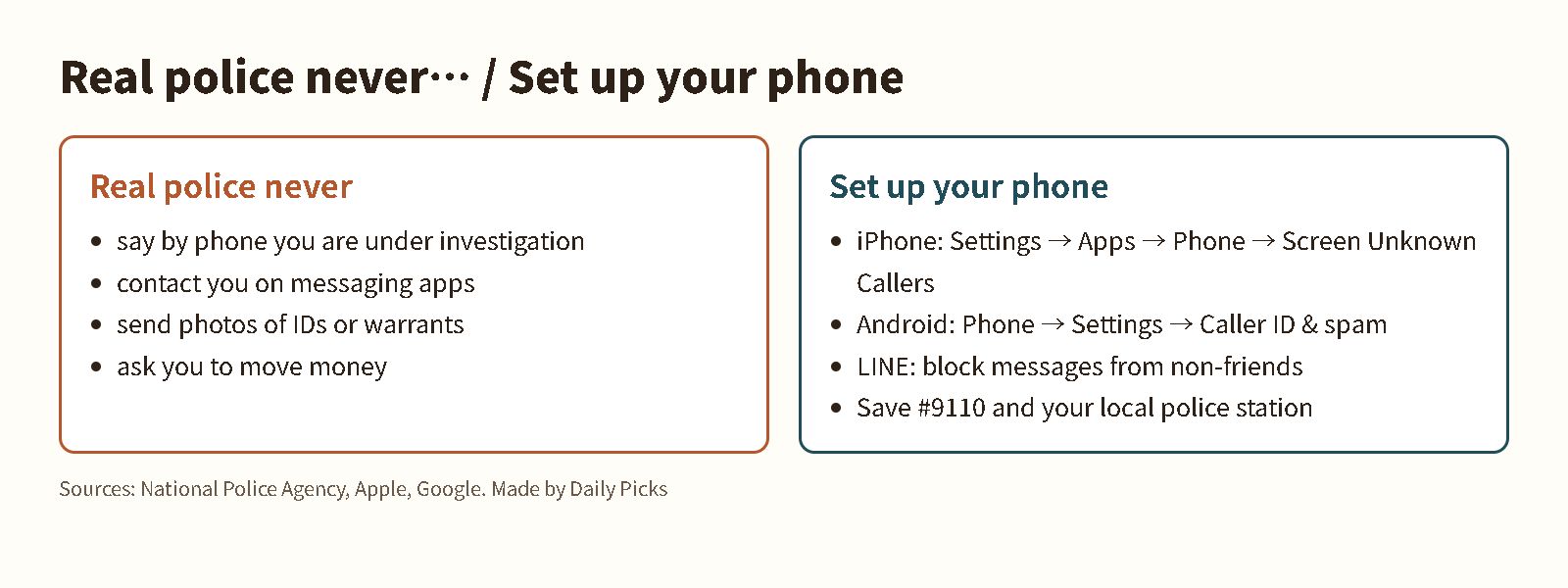
- do not tell you by phone that you are under investigation,
- do not contact you through messaging apps,
- do not send photos of police IDs or arrest warrants, and
- do not make surprise video calls to your personal phone.
Police also never ask you to transfer money to “protect” it or to prove you are innocent. If anyone asks, it is a scam.
What to do if you get this call
- Hang up. You do not need to be polite. Ask for their department, name and extension number if you like, then end the call.
- Call back on a number you found yourself. Look up your local police station, or call #9110, the police consultation line. Do not use the number that called you.
- Talk to someone you trust. A friend, your company, or your school’s international office. Scammers want you to keep it secret; that is a warning sign in itself.
- Do not install apps they ask for. Remote control apps let them see your screen and your banking app.
Set up your phone to block these calls
iPhone (iOS 26)
Go to Settings → Apps → Phone → Screen Unknown Callers and choose Ask Reason for Calling or Silence. With “Ask Reason”, your iPhone answers first, asks the caller who they are and why they are calling, and shows you the answer as text. With “Silence”, calls from numbers not in your contacts go straight to voicemail. Save the numbers of your doctor, school, office and landlord so that you do not miss them.
Android (Google Phone app)
Open the Phone app, tap the three-dot menu, then Settings → Caller ID & spam. Turn on See caller and spam ID and Filter spam calls. On Pixel 6 and later, Call Screen can also answer unknown callers for you. Other brands have similar settings under names like “Block numbers” or “Spam protection”.
Messaging apps
In LINE, go to Settings → Privacy → Filter messages (called “メッセージ受信拒否” in Japanese) to block messages from people who are not your friends. Never accept a video call from someone you do not know.
Calls in English and from abroad
Foreign residents often get scam calls in English or recorded messages that say they come from an embassy, an immigration office, a shipping company or a phone carrier. Some come from numbers starting with “+” and a foreign country code. The same rule applies: hang up, and contact the organisation on a number you found on its official website. For questions about your residence status, use the official Immigration Services Agency information centre, not a number someone gave you on the phone.
If you already sent money or shared details
- Call your bank at once and ask them to freeze the transfer and your account access.
- Change your bank app and email passwords, and log out of other devices.
- Report it to the police: call 110 if it is happening now, or visit your local police station with screenshots, call history and transfer records.
- If you paid by card, contact the card company. If you bought crypto-assets or gift cards, contact the exchange or issuer.
Acting quickly matters. Transfers can sometimes be stopped if the bank is told early.
FAQ
The caller knew my name and address. Does that mean it is real?
No. Scammers often have personal data from leaks or other sources. Knowing your details does not make them police.
The number on my phone was a real police station. Is it safe to talk?
Not necessarily. The National Police Agency warns that scammers can make a real police number appear on your screen. Hang up and call the station yourself.
Can I talk to the police in English?
For emergencies, call 110 and say “English, please.” For advice, #9110 and the consumer hotline 188 are mainly in Japanese, so ask a Japanese-speaking friend, your company or your school to help if you can.
Related reading
- Emergency numbers in Japan: 119, 110, #7119, #9110 and 188
- Getting a Japanese phone number as a new resident
日本語で読む:親のスマホの詐欺対策
コメント