Summary: A Japanese payslip (kyuyo meisai) shows what your employer paid you, what it took out, and what reached your bank account. The deductions are mainly health insurance, nursing care insurance from age 40, the new child and childcare support levy, employees’ pension, employment insurance, income tax and resident tax. Most of these follow fixed public rules, so you can check them yourself with a calculator. This guide explains each line, the rates as of 30 September 2026, and why your take-home pay changes in certain months.
The basic layout of a payslip
Every employer uses its own design, and many now send payslips through an app or web portal instead of paper. Still, most payslips have the same three blocks.
- Attendance (kintai): days worked, paid leave used, overtime hours, late arrivals or absences.
- Payments (shikyu): basic pay, allowances, overtime pay and the total before deductions.
- Deductions (kojo): social insurance, taxes and any company items such as union fees or staff meals.
At the bottom you will usually find the net pay (sashihiki shikyugaku), which is the amount paid into your account. A simple rule to remember: total payments minus total deductions equals net pay. If this sum does not match, ask your payroll team.
Japanese words you will see
| Japanese | Reading | Meaning |
|---|---|---|
| 給与明細 | kyuyo meisai | Payslip |
| 基本給 | kihonkyu | Basic pay |
| 時間外手当・残業手当 | jikangai teate / zangyo teate | Overtime pay |
| 通勤手当 | tsukin teate | Commuting allowance |
| 総支給額 | so shikyugaku | Gross pay (total payments) |
| 健康保険 | kenko hoken | Health insurance |
| 介護保険 | kaigo hoken | Nursing care insurance (age 40 to 64) |
| 子ども・子育て支援金 | kodomo kosodate shienkin | Child and childcare support levy |
| 厚生年金 | kosei nenkin | Employees’ pension |
| 雇用保険 | koyo hoken | Employment insurance |
| 所得税 | shotokuzei | Income tax (withheld each month) |
| 住民税 | juminzei | Resident tax (city and prefecture) |
| 控除合計 | kojo gokei | Total deductions |
| 差引支給額 | sashihiki shikyugaku | Net pay (take-home) |
| 年末調整 | nenmatsu chosei | Year-end adjustment |
Gross pay: basic pay, allowances and overtime
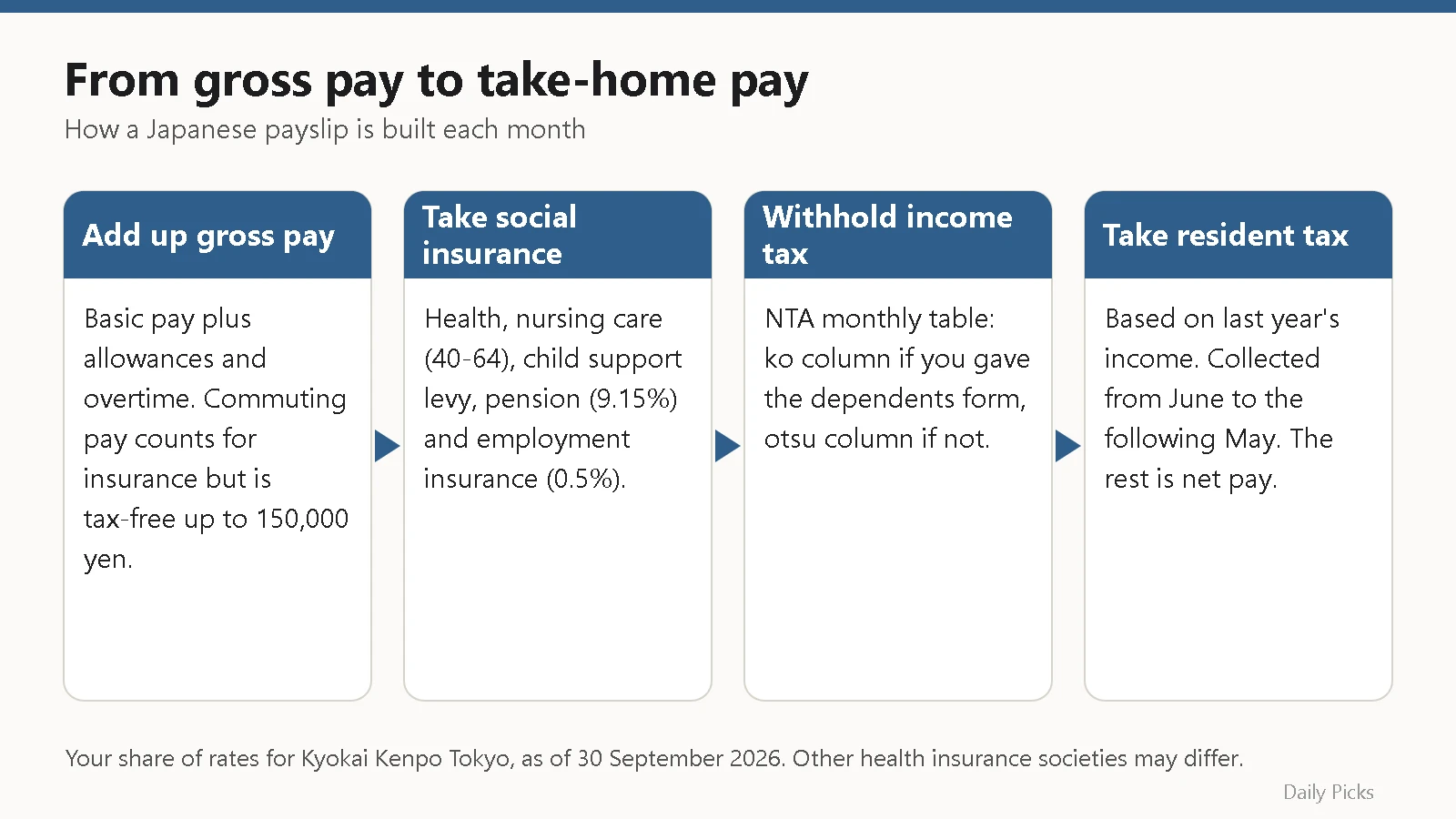
Gross pay is everything your employer pays you before deductions. It usually starts with basic pay. Then come allowances, which depend on your contract and company rules. Common ones are a commuting allowance, a housing allowance, a family allowance and a position allowance. Overtime, late-night work and holiday work are often shown on separate lines.
Two points matter when you check the numbers:
- Social insurance looks at almost all of it. The Japan Pension Service says the pay used to set your insurance amount is pre-tax pay including basic pay plus items such as overtime pay, commuting allowance, family allowance and housing allowance.
- Income tax does not look at all of it. According to the National Tax Agency (NTA), a commuting allowance or pass for public transport is non-taxable up to 150,000 yen a month, if it follows the most economical and reasonable route. That is why some payslips show a separate “non-taxable commuting” line.
So a higher commuting allowance can raise your social insurance deductions even though it does not raise your income tax.
Social insurance deductions and current rates
Health insurance and pension are not calculated on your exact pay each month. They use a “standard monthly remuneration” (hyojun hoshu getsugaku), a band that your pay falls into. For pension there are 32 bands, from 88,000 yen to 650,000 yen. The Japan Pension Service explains that the band is normally reset once a year using your average pay for April, May and June, and the new band applies from September to the following August. A large pay rise or cut can also change the band during the year.
You and your employer each pay half of health insurance and pension. The table shows the rates for people in Kyokai Kenpo (Japan Health Insurance Association) in Tokyo, as of 30 September 2026.
| Item | Total rate | Your share | Notes |
|---|---|---|---|
| Health insurance (Kyokai Kenpo, Tokyo) | 9.85% | 4.925% | From the March 2026 portion. Rates differ by prefecture. |
| Nursing care insurance | 1.62% | 0.81% | Only for ages 40 to 64. Same rate nationwide in Kyokai Kenpo. |
| Child and childcare support levy | 0.23% | 0.115% | New. Added from the April 2026 portion (paid in May). |
| Employees’ pension (kosei nenkin) | 18.3% | 9.15% | Fixed at 18.3% since September 2017. |
| Employment insurance (general business) | 13.5/1,000 | 5/1,000 (0.5%) | 1 April 2026 to 31 March 2027. Agriculture, forestry, fisheries, sake brewing and construction: 6/1,000. |
If your insurance card is from a company health insurance society (kenko hoken kumiai) and not from Kyokai Kenpo, the health insurance rate is set by that society and may be different. Employment insurance is different from the others: it is charged on the wages actually paid, not on a band.
Timing can also confuse people. The Japan Pension Service says an employer may deduct the previous month’s premium from this month’s salary. So your April salary may carry the March premium. Bonuses are charged too: the “standard bonus amount” is the bonus with amounts under 1,000 yen cut off. It is capped at 5.73 million yen per fiscal year for health insurance and 1.5 million yen per month for pension.
A worked example
Here is a simple calculation using the rates above. It assumes a 45-year-old employee in Tokyo, in Kyokai Kenpo, with a standard monthly remuneration of 300,000 yen and wages of 300,000 yen in the month. These figures are rate multiplied by amount. Your employer’s rounding may make the result differ by a yen or so.
| Line | Calculation | Amount |
|---|---|---|
| Health insurance | 300,000 × 4.925% | 14,775 yen |
| Nursing care insurance | 300,000 × 0.81% | 2,430 yen |
| Child and childcare support levy | 300,000 × 0.115% | 345 yen |
| Employees’ pension | 300,000 × 9.15% | 27,450 yen |
| Employment insurance | 300,000 × 5/1,000 | 1,500 yen |
| Social insurance total | 46,500 yen |
Income tax and resident tax come on top of this. They depend on your dependants, other deductions and last year’s income, so they are not shown here.
Income tax and resident tax
Income tax withheld each month
Your employer withholds income tax (gensen choshu) using the NTA’s withholding tax tables. The monthly table has two columns. The NTA says the “ko” column is used for people who have submitted the Application for (Change in) Exemption for Dependents of Employment Income Earner (fuyo kojo to shinkokusho). The “otsu” column is used for everyone else, and it generally gives a higher tax. If the income tax on your payslip looks high, check with payroll whether they have this form from you. Bonuses use a separate rate table.
The amount withheld also includes the special income tax for reconstruction. The NTA says this is 2.1% of the income tax and applies from 2013 to 2037. From January 2027, a new defense special income tax of 1% starts and the reconstruction tax falls to 1.1%. The NTA states that the combined rate stays at 2.1%, so the way withholding is calculated does not change.
Resident tax (special collection)
Resident tax is charged by your city and prefecture on last year’s income, from 1 January to 31 December. When your employer takes it from your salary, this is called special collection (tokubetsu choshu). Nakano City in Tokyo explains that it is collected over one year, from June to the following May. This is why a new employee in their first year in Japan often sees no resident tax at first, and then a new line appears the next June. If you leave your job partway through, the remaining tax usually moves to ordinary collection (futsu choshu), where you pay using bills from the city.
Why your take-home pay changes
Many changes on a payslip happen in the same months every year. If your net pay moves, look first at these points.
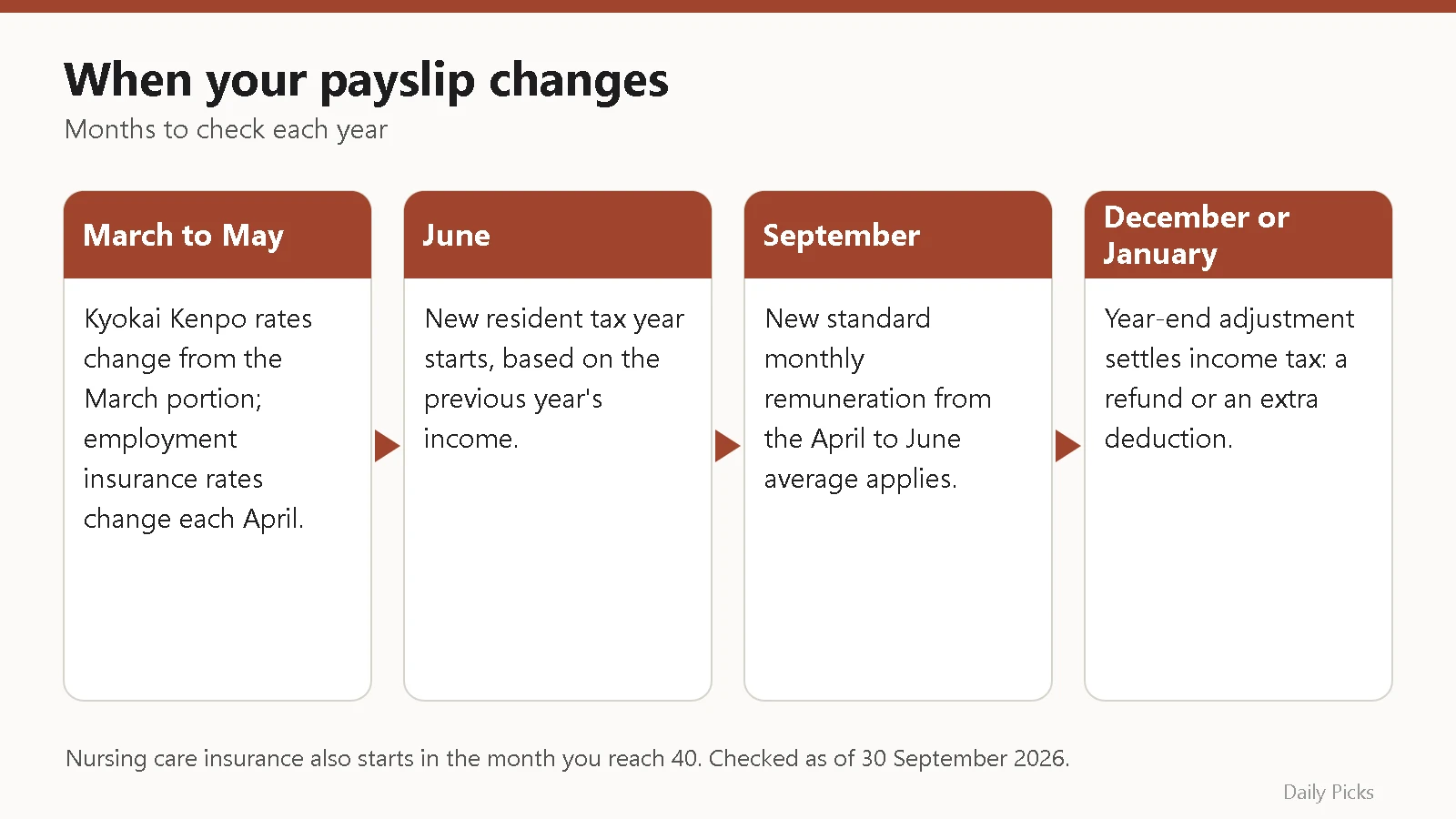
- June: the new resident tax year starts, based on last year’s income. A pay rise last year can mean a higher deduction now.
- September (or October): your new standard monthly remuneration from the April to June average applies from September. If your employer deducts the previous month’s premium, you may first see the change in October’s pay.
- The month you turn 40: nursing care insurance starts from the month that includes the day before your 40th birthday. It stops from the month that includes the day before your 65th birthday, when you move to your city’s nursing care insurance.
- March to May: Kyokai Kenpo changes its rates from the March portion, and employment insurance rates change each April. In 2026 the child and childcare support levy was also added from the April portion.
- December or January: the year-end adjustment settles your income tax for the year.
The year-end adjustment (nenmatsu chosei) compares the income tax withheld during the year with the tax you actually owe. The NTA says that if too much was withheld, the employer refunds the difference. If too little was withheld, it is taken from the salary in the month of the adjustment and, if needed, from later salaries. In some cases, an employee can ask for a shortfall to be spread into January and February. This is why December or January pay can be higher or lower than usual.
Payslip checklist
- Check that total payments minus total deductions equals the net pay, and that the net pay matches your bank account.
- Compare days worked, paid leave and overtime hours with your own records.
- Check that every allowance in your contract appears, including commuting.
- Find your standard monthly remuneration (some payslips show it) and multiply by the rates in the table above.
- If you are 40 to 64, check that nursing care insurance appears; if you are under 40, check that it does not.
- Check employment insurance against 5/1,000 of your wages (or 6/1,000 in agriculture, forestry, fisheries, sake brewing or construction).
- If income tax looks high, confirm that your employer has your dependents exemption form.
- In June, check the new resident tax line and ask payroll if it looks wrong.
- In December or January, look for the year-end adjustment line and keep your withholding slip (gensen choshuhyo).
- Keep payslips. You may need them for a tax return, a visa application, a loan or an unemployment claim.
FAQ
Why did my take-home pay drop in June?
Most likely because of resident tax. Special collection runs from June to the following May and is based on last year’s income. If you arrived in Japan last year, or earned more last year, a new or larger resident tax line appears from June.
Why did my deductions jump when I turned 40?
Nursing care insurance starts at 40. It begins from the month that includes the day before your 40th birthday. In Kyokai Kenpo the rate is 1.62%, and your half is 0.81% of your standard monthly remuneration, as of 30 September 2026.
What is the new “kodomo kosodate shienkin” line?
It is the child and childcare support levy. Kyokai Kenpo added a nationwide 0.23% from the April 2026 portion (paid in May), shared between you and your employer. Check whether your payslip shows it on its own line or combined with health insurance.
My pay went up in April, so why did my insurance stay the same?
Health insurance and pension use your standard monthly remuneration band, which is normally reset once a year from the April to June average and applied from September. A normal pay rise shows up in insurance later, not at once. A large change can trigger an earlier revision.
Do I still need a tax return if I get a payslip?
Many employees with one employer are covered by the year-end adjustment. Some people still need or want to file, for example to claim certain deductions. Check the NTA’s guidance for your situation, or ask your local tax office.
Related reading
Sources
- Employees’ pension premiums (Japanese) – Japan Pension Service
- Employees’ pension premium table (Japanese) – Japan Pension Service
- Payment of employees’ pension premiums (Japanese) – Japan Pension Service
- How are premiums on bonuses calculated? (Japanese) – Japan Pension Service
- FY2026 insurance rates from the March portion (Japanese) – Kyokai Kenpo
- FY2026 premium table for Tokyo (Japanese, PDF) – Kyokai Kenpo
- Nursing care insurance and premiums (Japanese) – Kyokai Kenpo Ibaraki branch
- Employment insurance rates from 1 April 2026 to 31 March 2027 (Japanese, PDF) – MHLW
- No.2511 Types of withholding tax tables and how to use them (Japanese) – National Tax Agency
- No.2582 Non-taxable commuting allowance (Japanese) – National Tax Agency
- No.2507 Withholding of special income tax for reconstruction (Japanese) – National Tax Agency
- Defense and reconstruction special income tax withholding from January 2027 (Japanese, PDF) – National Tax Agency
- No.2675 Settling the year-end adjustment difference (Japanese) – National Tax Agency
- How to do the 2026 year-end adjustment (Japanese) – National Tax Agency
- Resident tax special collection Q&A (Japanese) – Nakano City
コメント