Summary: Tokyo Gas is raising the basic charge on household city-gas contracts by ¥150 a month. The new price starts on 1 October 2026, but because Japanese utility bills are named after the month your meter is read, you will first see it on the November bill. It is the company’s first price-raising revision in 46 years, since 1980. The November bill is also the first one without the government’s winter-and-summer discount of ¥14 per cubic metre, so for a typical home the jump from October to November will be bigger than ¥150. This article explains what is changing, which bills are affected, and how to read the key lines on a Tokyo Gas bill.
What is changing
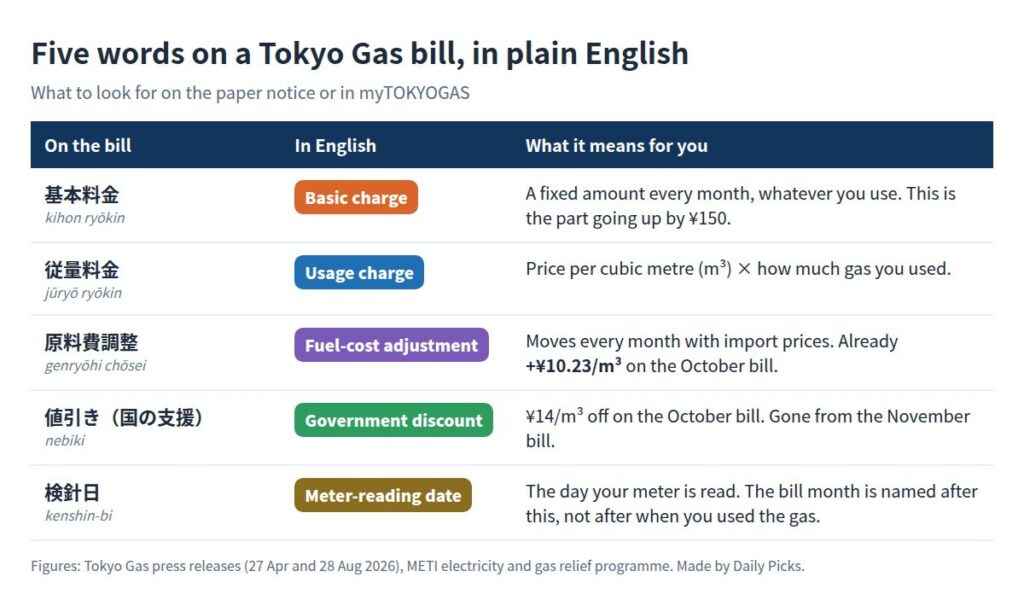
Tokyo Gas announced on 27 April 2026 that it will revise its household gas rates from 1 October 2026, “applicable from the November 2026 meter reading.” The main change is to the basic charge (kihon ryōkin), the fixed amount you pay every month no matter how much gas you use. For households in the Tokyo area it goes up by ¥150 per contract per month.
According to reporting on the announcement, about 8.66 million contracts are affected, including businesses, and it is the first time Tokyo Gas has raised rates this way since 1980, during the second oil crisis. Tokyo Gas gives three reasons: higher prices from its wholesale suppliers, rising costs across the board, and falling gas sales.
Using Tokyo Gas’s own example of a “standard household” that uses 30 cubic metres (m³) of gas a month, the monthly bill goes from ¥5,734 to ¥5,884. That example isolates the rate revision only; your real bill also moves with the monthly fuel-cost adjustment and, until October, the government discount.
The revision covers the general rate and the main household plans, including the popular Zuttomo Gas contract and plans tied to high-efficiency water heaters, floor heating and home fuel cells. The Gunma area has its own rate table, so the figures there are different. Customers affected receive a flyer or letter from Tokyo Gas.
Why your October bill will not show it
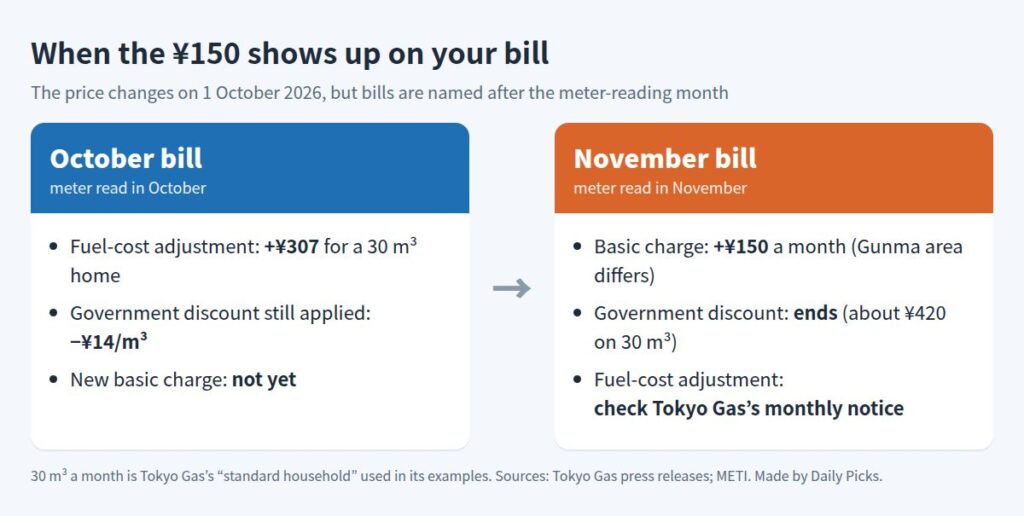
In Japan, a gas bill is named after the month in which the meter is read (kenshin-bi), not the month you used the gas. The “October bill” mostly covers gas used in September. Tokyo Gas says the new rates apply “from the November 2026 meter reading,” so the ¥150 appears for the first time on the bill whose meter reading falls in November.
If you pay by card or bank transfer and never look at the paper notice, it is easy to miss. You can check the breakdown each month in myTOKYOGAS, the company’s online account service, or on the paper gas ryōkin no oshirase (gas bill notice) left in your mailbox.
Your October bill is already higher for a different reason
Separately from the basic charge, every Tokyo Gas bill includes a fuel-cost adjustment (genryōhi chōsei) that follows the import price of liquefied natural gas. Tokyo Gas announced on 28 August that for the October 2026 meter reading, the adjustment goes up by ¥10.23 per m³ in the Tokyo area. For the 30 m³ standard household, that is ¥307 more than the previous month.
The October bill still includes the government discount of ¥14 per m³, paid through the Ministry of Economy, Trade and Industry’s relief programme for electricity and gas bills. That programme covered gas used in July, August and September 2026, and September use is the last month. On Tokyo Gas’s calendar, the discount appears on bills up to the October meter reading.
November: three changes land on the same bill
On the November bill, three things change at once:
- Basic charge: +¥150 per month (Tokyo area). This is the rate revision.
- Government discount: ends. On 30 m³, the ¥14 per m³ discount was worth about ¥420 a month. From November it simply is not there.
- Fuel-cost adjustment: changes again. Tokyo Gas publishes each month’s adjustment about a month in advance. Check its notice for the November meter reading before assuming a number.
Put together, a household using 30 m³ should expect its November bill to be roughly ¥570 higher than October from the first two changes alone, before the November fuel-cost adjustment is added. Homes that use more gas lose more from the end of the discount, because it was charged per m³. In winter, when you run the bath and gas heating more, the effect grows.
If your gas does not come from Tokyo Gas
Not everyone in the Kanto area buys city gas from Tokyo Gas. Since 2017, other companies such as electricity retailers have sold city gas through the same pipes. If your bill has another company’s name on it, this particular ¥150 revision does not apply directly; check that company’s own notices, because many set their prices with reference to Tokyo Gas.
If your building uses propane (LP gas, delivered in cylinders outside the building), you are not on city gas at all. Propane prices are set by each dealer and are not covered by this revision.
What you can do now
- Find your meter-reading date. It is printed on the bill notice and shown in myTOKYOGAS. Your November bill starts from that date.
- Compare October and November line by line. Look at the basic charge, the fuel-cost adjustment and the discount line separately, so you know which part moved.
- Check your plan. Tokyo Gas’s English page explains its rate plans and the discount for buying gas and electricity together. Changing plans is a paperwork step, so do it before the heavy-use months if it makes sense for you.
- Plan for winter use. Hot water is usually the biggest part of a home’s gas use. Shorter showers and keeping the bath lid on are simple ways to use less.
Most Tokyo Gas forms and procedures are available in Japanese only, but the company has an English page for customers and an English FAQ. If you rent through an agency, it can often help you read a notice.
FAQ
Is the ¥150 a one-time fee?
No. It is an increase to the monthly basic charge, so it is added to every bill from the November meter reading onward.
I live alone and use very little gas. Does it still apply?
Yes. The basic charge is fixed, so it rises by the same amount whether you use 5 m³ or 50 m³. What changes with your usage is the effect of the discount ending, which is smaller if you use less gas.
Will the government bring back the discount this winter?
As of the date of this article, the published programme ends with September use. Past programmes were announced at short notice, so check the ministry’s page before the winter months.
Does this affect my electricity bill?
This revision is for gas. However, the same government programme also gave a discount on electricity, and that discount ends at the same time. Your electricity bill may rise in November for that reason.
Related reading
日本語で読む: 東京ガスが46年ぶりに基本料金を値上げ(Japanese version)
Sources
- Tokyo Gas, press release on household gas rate revision (27 April 2026, Japanese)
- Tokyo Gas, Gunma area rate revision (27 April 2026, Japanese)
- Tokyo Gas, gas rates for the October 2026 meter reading (28 August 2026, Japanese)
- Ministry of Economy, Trade and Industry, electricity and gas bill relief programme (Japanese)
- Tokyo Gas, gas and electricity rate plans for foreign residents (English)
- Nippon.com / Jiji Press, “Tokyo Gas to Carry Out 1st Rate Hike in 46 Years” (27 April 2026)