Summary: For a cold, a stomach ache or a small injury, start at a local clinic (kurinikku or iin), not a big hospital. Large hospitals in Japan charge an extra fee of at least 7,000 yen on your first visit if you come without a referral letter, unless it is an emergency. Bring your My Number card registered as a health insurance card or your eligibility certificate (shikaku kakuninsho). Since August 2026, expired paper insurance cards alone are no longer accepted in the same way. For help finding a doctor who speaks your language, call AMDA International Medical Information Center (free, weekdays).
Clinic or hospital?
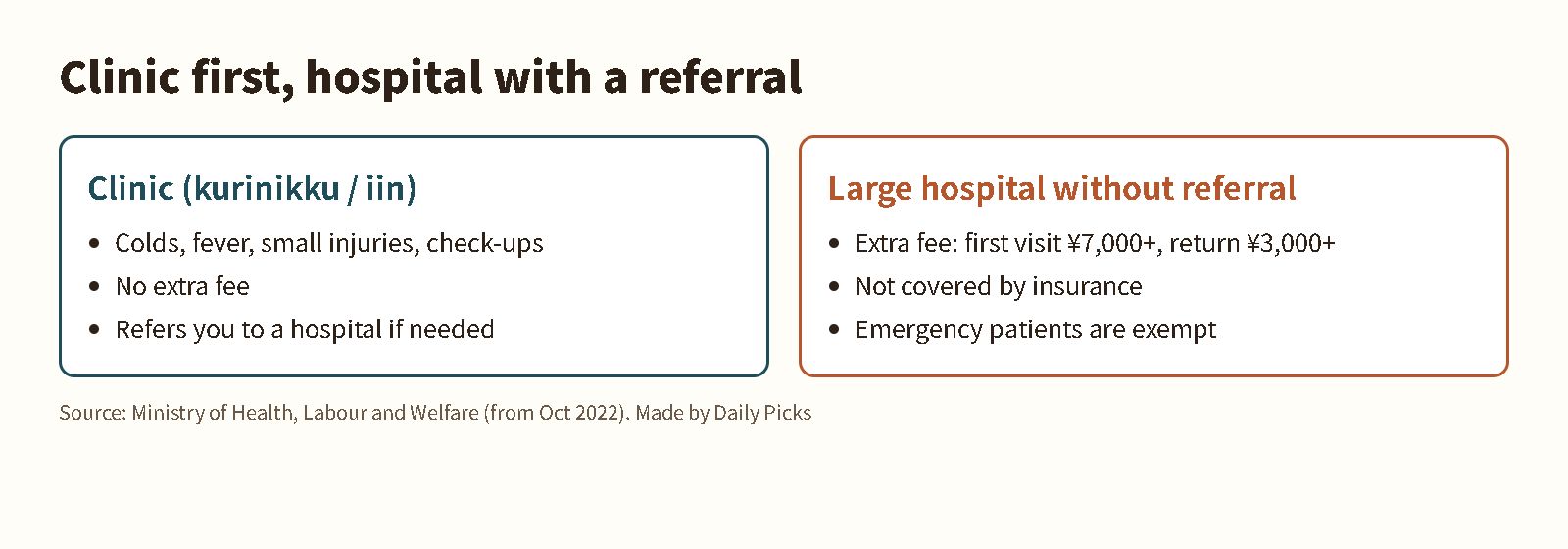
Japan separates small local clinics from large hospitals. Clinics handle everyday problems and refer you to a hospital if you need tests or treatment they cannot do. Large hospitals are meant for patients with a referral.
Since October 2022, three types of hospitals must charge an extra fee to patients who come without a referral letter (shokaijo): specified function hospitals (mainly university hospitals), community medical support hospitals with 200 or more general beds, and other large hospitals designated for referral patients. The fee is at least 7,000 yen for a first visit and at least 3,000 yen for a return visit (dental: 5,000 and 1,900 yen). It is not covered by health insurance. Emergency patients are exempt.
How to find a clinic
- Choose the right department. Internal medicine (naika) for colds and fever, pediatrics (shonika) for children, orthopedics (seikei geka) for joints and injuries, dermatology (hifuka), ENT (jibiinkoka), eye (ganka) and dental (shika).
- Search your prefecture’s medical information site. Most prefectures run a search site listing clinics, opening hours and languages spoken. Search for “[your prefecture] 医療情報ネット” or use the national Medical Information Net.
- Call AMDA if you need a language. AMDA International Medical Information Center answers questions about clinics that speak foreign languages and about Japan’s medical system: 0120-339-266 or 03-6233-9266, weekdays 10:00–16:00, in English, Chinese, Korean, Spanish, Portuguese, Thai, Filipino, Vietnamese and Japanese. It is free.
- Check the hours and booking. Many clinics close on Thursday or Saturday afternoon and on Sundays. Some take walk-ins, others want you to book online. Arrive before the reception closing time, which is often 30 minutes before the clinic closes.
What to bring
- Proof of insurance. Your My Number card registered for health insurance (called maina hokensho), or the eligibility certificate (shikaku kakuninsho) sent by your insurer. New paper insurance cards stopped being issued in December 2024. The temporary rule that let people use expired paper cards ended in July 2026.
- Cash and a card. Many clinics still take cash only.
- Medicine notebook (okusuri techo) or a list of your medicines and allergies.
- Referral letter if you are going to a large hospital.
- For children: the child’s insurance proof and the local medical subsidy card, if your city issues one.
If you forget your insurance proof and the clinic cannot check it, you may have to pay the full cost and claim the difference later from your insurer. Most working-age adults pay 30% of the cost when insured. If you are on National Health Insurance, see our guide to National Health Insurance in Japan.
At the clinic, step by step
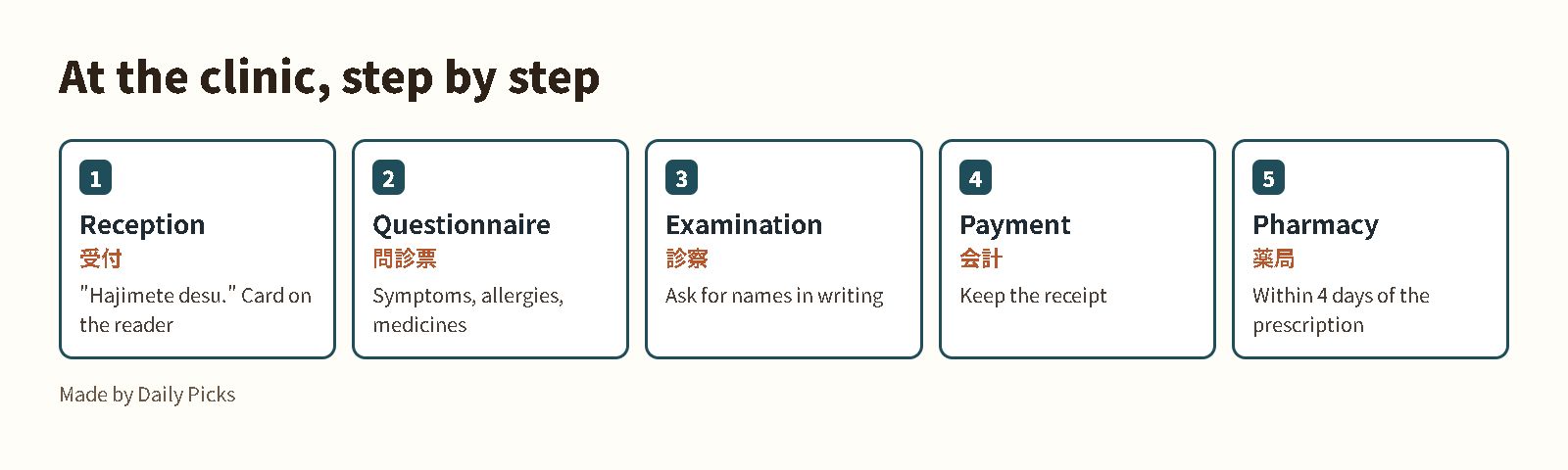
- Reception (uketsuke). Say it is your first visit: “Hajimete desu.” Hold your My Number card over the reader, or show your certificate.
- Questionnaire (monshinhyo). Write your symptoms, when they started, allergies and medicines. Some clinics have English forms, and a translation app helps.
- Waiting and examination. The doctor may explain in simple Japanese. Ask them to write down the name of the condition and the medicine.
- Payment (kaikei). You pay at reception and receive a receipt (ryoshusho) and a detailed statement. Keep them for tax deductions.
- Pharmacy (yakkyoku). Take the prescription (shohosen) to any pharmacy within four days, including the day it was issued.
At night and on holidays
Your city usually runs a holiday or night clinic (kyujitsu yakan kyukyu shinryojo). Check your city website. If you are not sure whether you need an ambulance, call #7119 where available, or #8000 for children. In an emergency, call 119. Our guide to emergency numbers in Japan explains each number.
FAQ
Do I have to pay the 7,000-yen fee if I go to a big hospital by ambulance?
Emergency patients are exempt from the no-referral fee. If you walk in without a referral for something that is not an emergency, the hospital will charge it.
My My Number card works, but the reader says the insurance is not linked.
Your card must be registered as a health insurance card. You can do this at the reader in many clinics or through the Mynaportal app. Also check that the card’s electronic certificate has not expired. It needs renewing every five years, separately from the card.
Can I get English-speaking doctors?
In large cities there are clinics with English-speaking staff. Search your prefecture’s medical information site by language, or ask AMDA International Medical Information Center.
Is a flu shot covered by insurance?
Generally no, except for groups covered by the regular vaccination program, such as older people. See flu shots in Japan 2026-27.
Related reading
Sources
- Outline of the FY2022 medical fee revision (outpatient) – Ministry of Health, Labour and Welfare (Japanese)
- Telephone consultation – AMDA International Medical Information Center
- My Number card as health insurance card – Government of Japan Public Relations Online (Japanese)
- Expired health insurance cards not accepted from August 2026 – Dai-ichi Life Research Institute (Japanese)
コメント