Summary: If you live in Japan and hold a foreign driving licence, you can usually drive on an International Driving Permit (IDP) or an approved translation only for a limited time, normally up to one year from the day you landed. To keep driving after that, you need a Japanese licence, and most foreign residents get one through the licence conversion called gaimen kirikae. Since 1 October 2025, conversion requires a residence certificate (jumin-hyo), and the knowledge test has grown from 10 to 50 questions. This guide explains the rules, documents, tests and fees, based on official police and JAF pages as of 30 September 2026.
- Three ways to drive legally in Japan
- The International Driving Permit and the one-year limit
- Licence conversion (gaimen kirikae): who can apply
- Documents to prepare
- Getting the JAF translation
- The tests after October 2025
- Fees: an example from Tokyo
- What happens if you drive without a valid licence
- Before-you-go checklist
- Japanese words you will see
- FAQ
- Related reading
- Sources
Three ways to drive legally in Japan
According to the National Police Agency (NPA), you can drive in Japan only if you hold one of the following:
- A Japanese driving licence.
- An International Driving Permit issued under the Geneva Convention on Road Traffic of 1949.
- A licence from Switzerland, Germany, France, Belgium, Monaco or Taiwan, together with an official Japanese translation (this list is from the NPA English guide, as of 1 April 2026).
The second and third options are temporary. The Japanese licence is the only one with no one-year limit. Also note that a licence from any other country, on its own, does not allow you to drive in Japan.
The International Driving Permit and the one-year limit
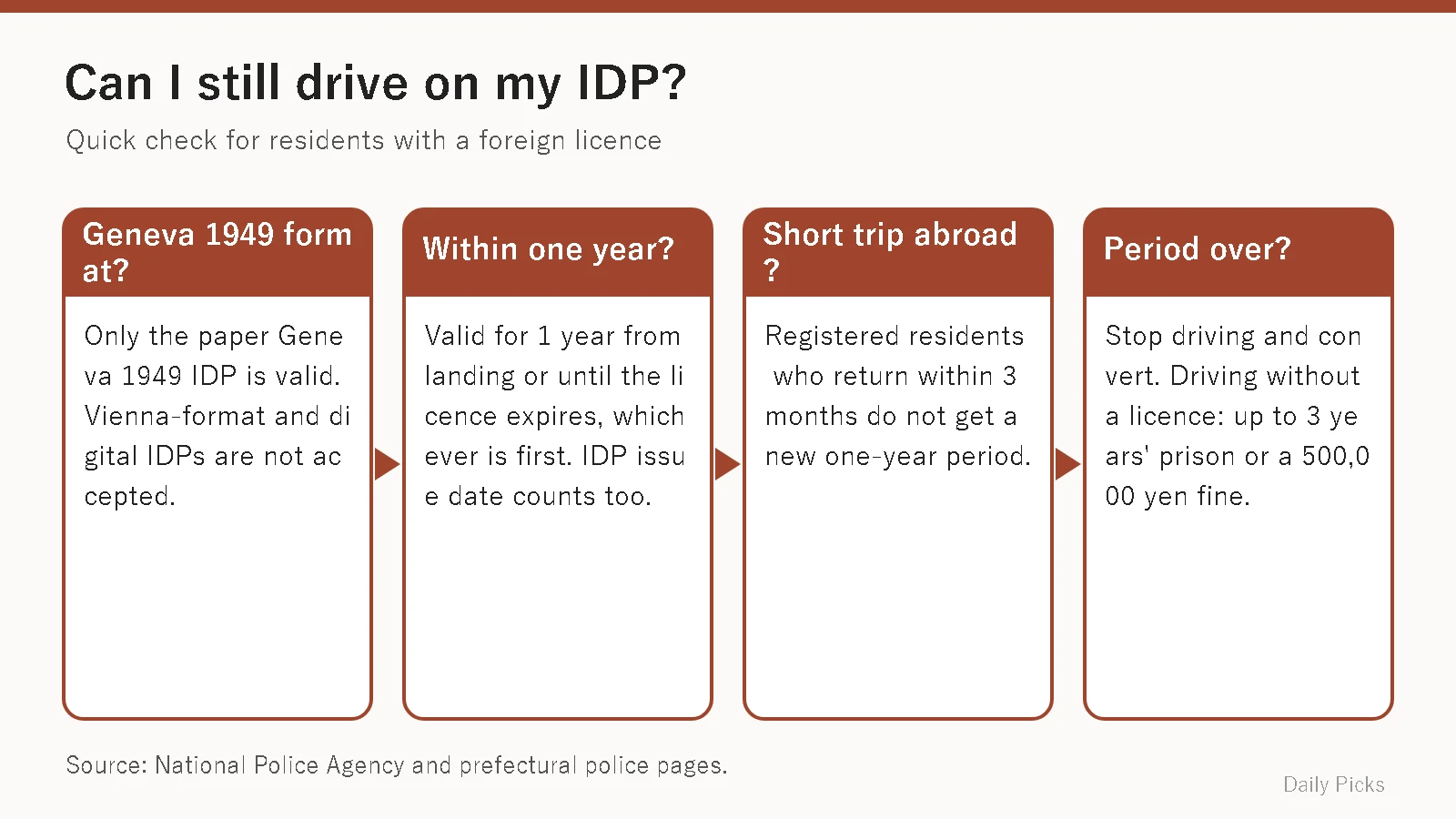
The NPA says an IDP or a foreign licence with translation can be used for one year from the day you landed in Japan, or until the licence itself expires, whichever comes first. Tokyo Metropolitan Police add that the IDP must also be within one year of its issue date.
Not every IDP is accepted. Tokyo Metropolitan Police state that an IDP issued in a format based on another convention, such as the Vienna Convention, cannot be used in Japan, even if the issuing country also signed the Geneva Convention. The NPA also says a digital IDP on a phone is not accepted. Only the paper booklet in the Geneva format counts, and you can drive only the vehicle types stamped in it.
The rule for residents who leave and come back
Many residents think that a short trip abroad “resets” the one year. The NPA says this is not the case for people registered in Japan’s residence system. If you are registered as a resident and you return to Japan less than three months after leaving, the day you come back does not count as a new start date. In practice, a long-term resident usually cannot keep driving on an IDP year after year. Plan the conversion within your first year.
| Your situation | What the official rules say |
|---|---|
| Short trip abroad, back within 3 months (registered resident) | The return date does not restart the one-year period (NPA). |
| IDP issued more than a year ago | Not valid for driving in Japan (Tokyo Metropolitan Police). |
| IDP in Vienna Convention format | Not valid in Japan (Tokyo Metropolitan Police). |
| Digital IDP on a smartphone | Not accepted (NPA Q&A). |
| Licence from Switzerland, Germany, France, Belgium, Monaco or Taiwan | Usable with an official Japanese translation, within the same one-year limit (NPA). |
Licence conversion (gaimen kirikae): who can apply
Licence conversion lets you get a Japanese licence based on your foreign one. You apply in person at a driving licence centre in the prefecture where you live. In Tokyo, the Metropolitan Police accept conversion at the Fuchu, Samezu and Koto test centres, and you must book in advance online or by phone.
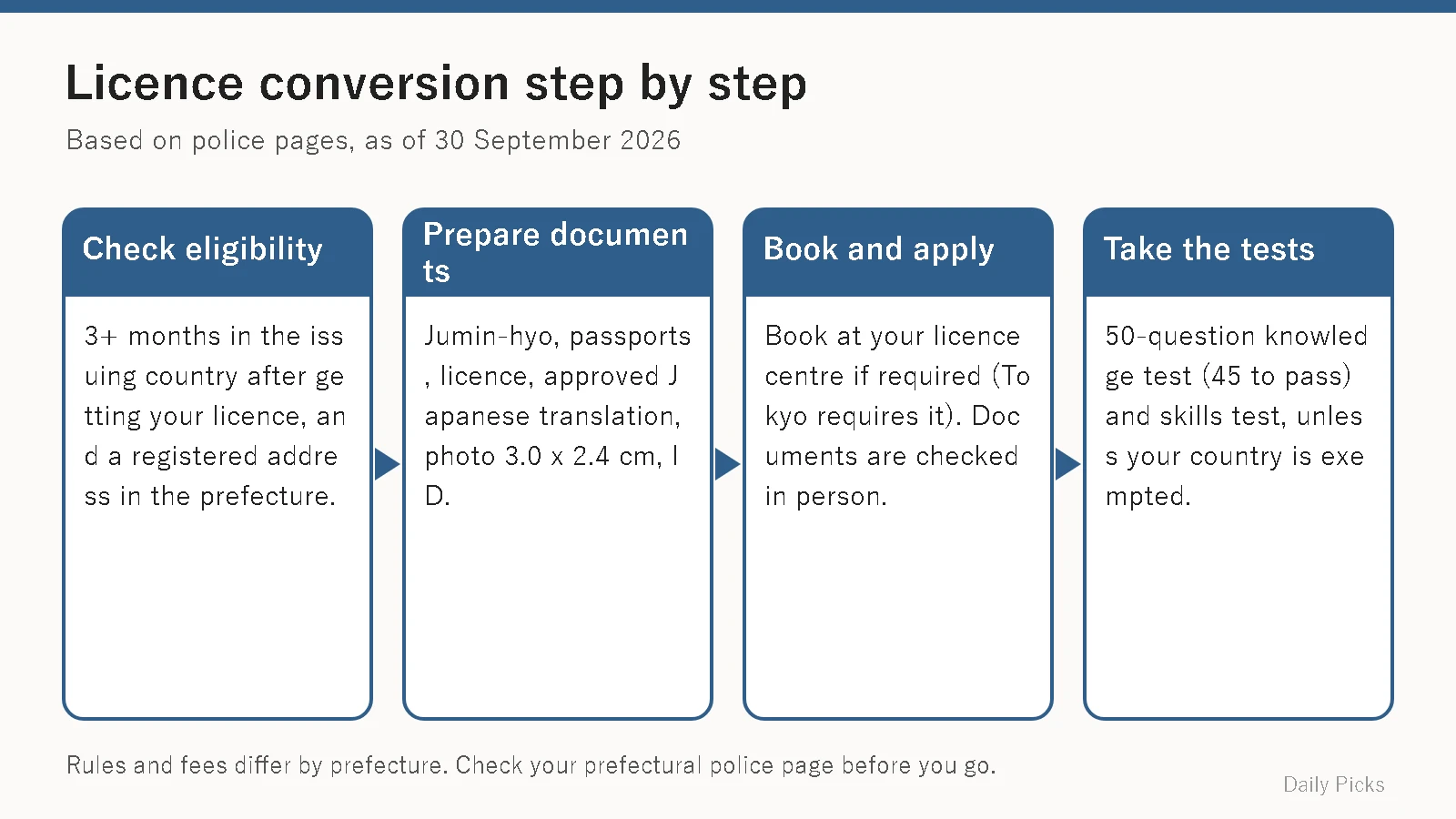
The key condition is the three-month rule. After you received your foreign licence, you must have stayed in the country or region that issued it for a total of three months or more. The NPA says this is checked with documents such as passports with entry and exit stamps. If you got your licence just before moving to Japan, you may not meet this rule.
Since 1 October 2025, you also need a residence certificate. Tokyo Metropolitan Police say foreign residents registered in the residence system must submit a jumin-hyo that includes the special items recorded for foreign residents, and that it must be issued within six months. Chiba Prefectural Police describe it as a residence certificate that includes all the information of your residence card, with no photocopies accepted. People who are not registered as residents are asked for other official proof of address. Ask your prefectural licence centre which document fits your case.
Documents to prepare
Document lists differ by prefecture and by the country that issued your licence. Tokyo publishes country-specific checklists in Japanese, English and Chinese. The list below is based on the NPA English guide and the Chiba Prefectural Police English page. Bring originals unless told otherwise.
- Application form (with the health questionnaire), filled in at the centre.
- Photo, 3.0 cm × 2.4 cm, taken within the last six months.
- Residence certificate (jumin-hyo) with the items your prefecture requires.
- ID such as your residence card, My Number card or passport.
- Your valid foreign driving licence (and old or expired ones, if you have them).
- A Japanese translation of your licence from an approved body, such as JAF or your embassy or consulate.
- Your current passport and older passports, to prove the three-month stay.
- Proof of your driving history if requested, from the issuing authority or embassy.
- Any Japanese licence you held before, even if expired.
Chiba Prefectural Police list these approved sources for translations: your embassy or consulate, JAF, Ziplus Co. Ltd, ALADDIN and ADAC, plus a Taiwanese body for Taiwan licences. Check your own prefecture’s list before ordering.
Getting the JAF translation
JAF (Japan Automobile Federation) accepts translation requests online only. It does not accept applications at its counters or by post. You upload images of both sides of your licence. Some countries also need other documents, such as a passport or residence card.
JAF fees changed on 1 July 2026. As of 30 September 2026, JAF lists these prices:
| Purpose of the translation | JAF fee |
|---|---|
| Japanese translation for licence conversion | 6,600 yen (tax included) |
| Japanese translation for driving in Japan (Switzerland, Germany, France, Belgium, Monaco, Taiwan licences) | 6,000 yen (non-taxable) |
| Chinese translation for use in Taiwan | 7,000 yen (tax included) |
JAF says translations for the six countries above take 2 to 3 business days on average, and other countries take about 5 to 10 business days. You print the translation at a convenience store in Japan or at a JAF branch. JAF states that only the printed paper original is valid.
The tests after October 2025
After your documents are checked, most applicants take a knowledge test and a skills (driving) test. Tokyo Metropolitan Police list the changes that started on 1 October 2025:
- Knowledge test: now 50 questions, and you need 45 or more correct answers to pass. Before, it was 10 questions with 7 or more correct.
- Skills test: a task for passing pedestrian crossings was added, and the scoring became stricter.
- Residence certificate: now required, as explained above.
Chiba Prefectural Police state that the knowledge test has a 30-minute time limit and is offered in 21 languages, including English. Chiba also requires an aptitude (eyesight) test before the driving test and notes that waiting times for appointments have become long because applicant numbers are rising. In Chiba, the document check needs no appointment, but you need one from the knowledge test onward.
Exempted countries and regions
Holders of licences from some countries and regions do not take the knowledge and skills tests. Tokyo Metropolitan Police list 29: Iceland, Ireland, the United States (only Ohio, Oregon, Colorado, Virginia, Hawaii, Maryland and Washington), the United Kingdom, Italy, Australia, Austria, the Netherlands, Canada, South Korea, Greece, Switzerland, Sweden, Spain, Slovenia, the Czech Republic, Denmark, Germany, New Zealand, Norway, Hungary, Finland, France, Belgium, Poland, Portugal, Monaco, Luxembourg and Taiwan. You still need the documents, the three-month proof and the eyesight check.
Fees: an example from Tokyo
Fees are set by each prefecture. The table below is only an example, taken from the Tokyo Metropolitan Police conversion page. It does not include the translation cost or the cost of your photo and jumin-hyo.
| Fee (Tokyo example) | Amount |
|---|---|
| Application fee, standard car (futsu) | 2,500 yen |
| Application fee, moped | 1,600 yen |
| Application fee, large / medium / semi-medium | 3,900 yen |
| Application fee, other types | 2,800 yen |
| Licence issuance fee | 2,350 yen |
| Fee for adding a second licence type | 200 yen |
For a standard car in Tokyo, the application and issuance fees add up to 4,850 yen. If you fail a test and try again, ask the centre about fees for the next attempt.
What happens if you drive without a valid licence
Driving after your IDP period has ended, or with an IDP that is not valid in Japan, counts as driving without a licence. Kagoshima Prefectural Police list these penalties:
| Act | Criminal penalty | Administrative penalty |
|---|---|---|
| Driving without a licence | Up to 3 years of imprisonment or a fine of up to 500,000 yen | Licence cancellation etc. (2-year disqualification, 25 points) |
| Providing a vehicle to an unlicensed driver | Up to 3 years of imprisonment or a fine of up to 500,000 yen | Licence cancellation etc. (2-year disqualification) |
| Riding in a car with an unlicensed driver | Up to 2 years of imprisonment or a fine of up to 300,000 yen | Licence cancellation etc. (2-year disqualification) |
This means a friend or employer who lends you a car can also be punished. Check your dates before you drive.
Before-you-go checklist
- Count one year from your landing date and note the date your IDP was issued.
- Check that your IDP is the paper Geneva 1949 format.
- Confirm you stayed three months or more in the issuing country after getting your licence, and find passports that prove it.
- Check whether your country or state is on the exempted list.
- Order the Japanese translation (JAF: online only, 6,600 yen for conversion).
- Get a new jumin-hyo with the items your prefecture requires.
- Book an appointment at your prefectural driving licence centre early.
- Study for the 50-question knowledge test if you are not exempted.
Japanese words you will see
| Japanese | Reading | Meaning |
|---|---|---|
| 外免切替 | gaimen kirikae | Converting a foreign licence to a Japanese one |
| 国際運転免許証 | kokusai unten menkyo-sho | International Driving Permit |
| 翻訳文 | hon’yaku-bun | Official translation of your licence |
| 住民票 | jumin-hyo | Residence certificate |
| 知識確認 | chishiki kakunin | Knowledge test for conversion |
| 技能確認 | gino kakunin | Skills (driving) test for conversion |
| 運転免許試験場 | unten menkyo shikenjo | Driving licence test centre |
| 無免許運転 | mumenkyo unten | Driving without a licence |
FAQ
Can I get a new IDP from my home country every year and keep driving?
If you are registered as a resident and you come back to Japan less than three months after leaving, the NPA says the return date does not start a new one-year period. Most residents should plan to convert.
I got my licence one month before moving to Japan. Can I convert it?
The official rule is a total stay of three months or more in the issuing country after you got the licence. If you do not meet it, conversion is not possible on that licence. Ask your licence centre about other routes.
Is the knowledge test available in English?
Chiba Prefectural Police say their test is offered in 21 languages, including English. Tokyo also offers tests in foreign languages. Check your own prefecture’s page for the list.
I am from an exempted country. Do I still need a translation and a jumin-hyo?
Yes. The exemption covers the knowledge and skills tests only. The document requirements, including the translation and the residence certificate, still apply.
Is the JAF translation the only option?
No. Police pages accept translations from your embassy or consulate and other approved bodies. Your prefecture lists which ones it accepts.
Related reading
- What changes in Japan in October 2026
- How to get a jumin-hyo at a convenience store
- My Number card expiry: what to do
- Moving house in Japan: address change steps
- Bicycle fines in Japan
- Emergency numbers in Japan
- Opening a bank account in Japan
Sources
- For holders of foreign driving licences (Japanese) – National Police Agency
- Driving in Japan without obtaining a Japanese licence (PDF) – National Police Agency
- For holders of foreign driver’s licenses (PDF) – National Police Agency
- Q&A related to international driver’s licenses (PDF) – National Police Agency
- Driving in Japan with an IDP issued abroad (Japanese) – Tokyo Metropolitan Police Department
- Converting a foreign licence to a Japanese licence (Japanese) – Tokyo Metropolitan Police Department
- Amended rules effective 1 October 2025 (Japanese) – Tokyo Metropolitan Police Department
- Switching a foreign driver’s license to a Japanese license – Chiba Prefectural Police
- How to apply for a licence translation (Japanese) – JAF
- Revision of translation fees (Japanese) – JAF
- Never drive without a licence (Japanese) – Kagoshima Prefectural Police
コメント