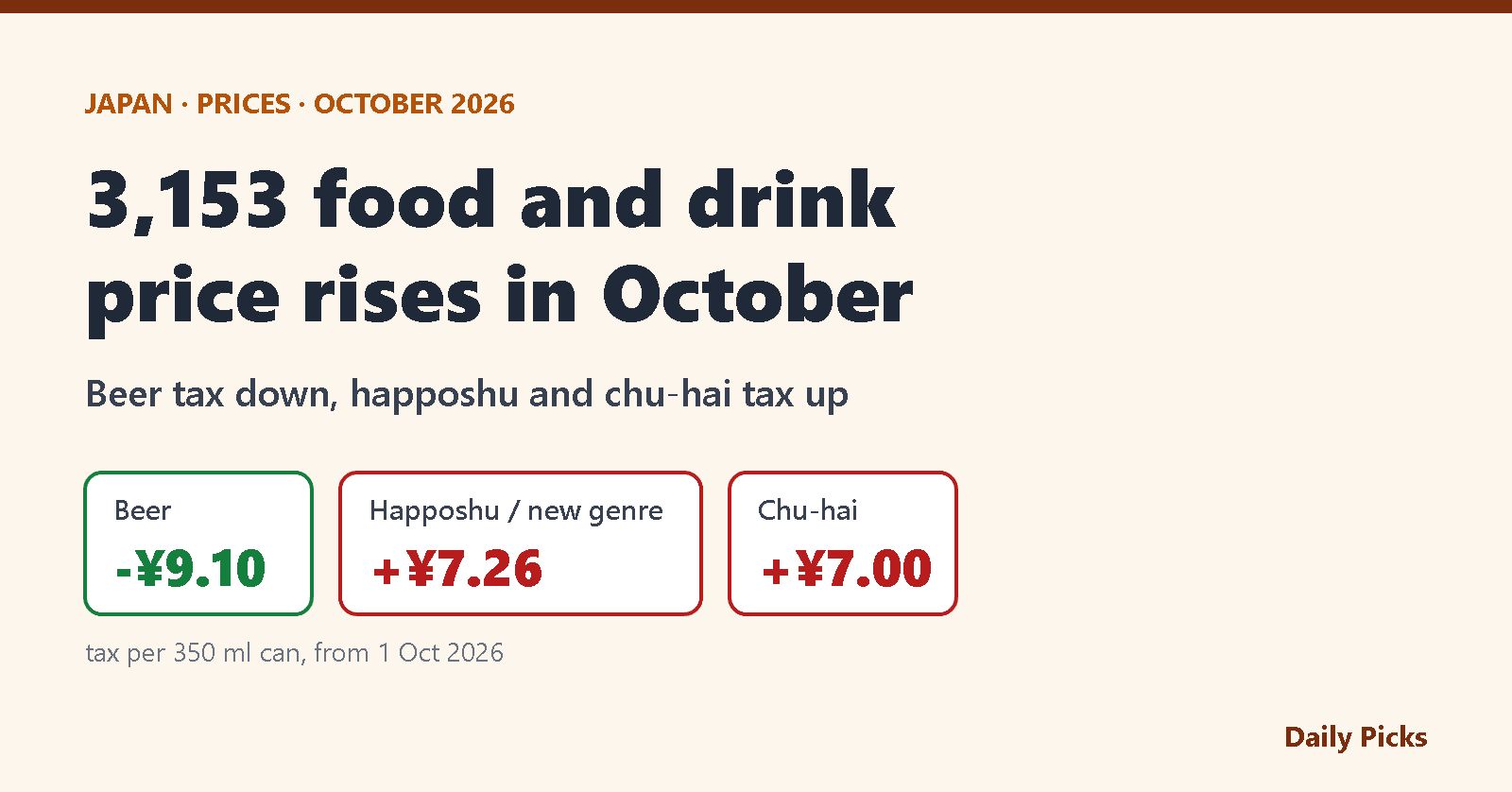
Summary: Japan’s major food makers raised prices on 3,153 products in October 2026, according to the research company Teikoku Databank. Drinks were the biggest group, partly because the liquor tax changed on 1 October: the tax on beer went down, and the tax on happoshu, “new genre” (third beer) and chu-hai went up. September (4,965 products) was the highest month of the year, and only 1,469 rises are confirmed for November so far. Nothing needs to be applied for. What you can do is check unit prices and package sizes, compare drinks again, and watch your utility bills, which also rise this autumn.
What happened in October
Teikoku Databank (TDB) is a private credit research company. Every month it counts the price rises announced by 195 major food makers, mostly for products sold in shops for home use. Its report on 30 September 2026 said:
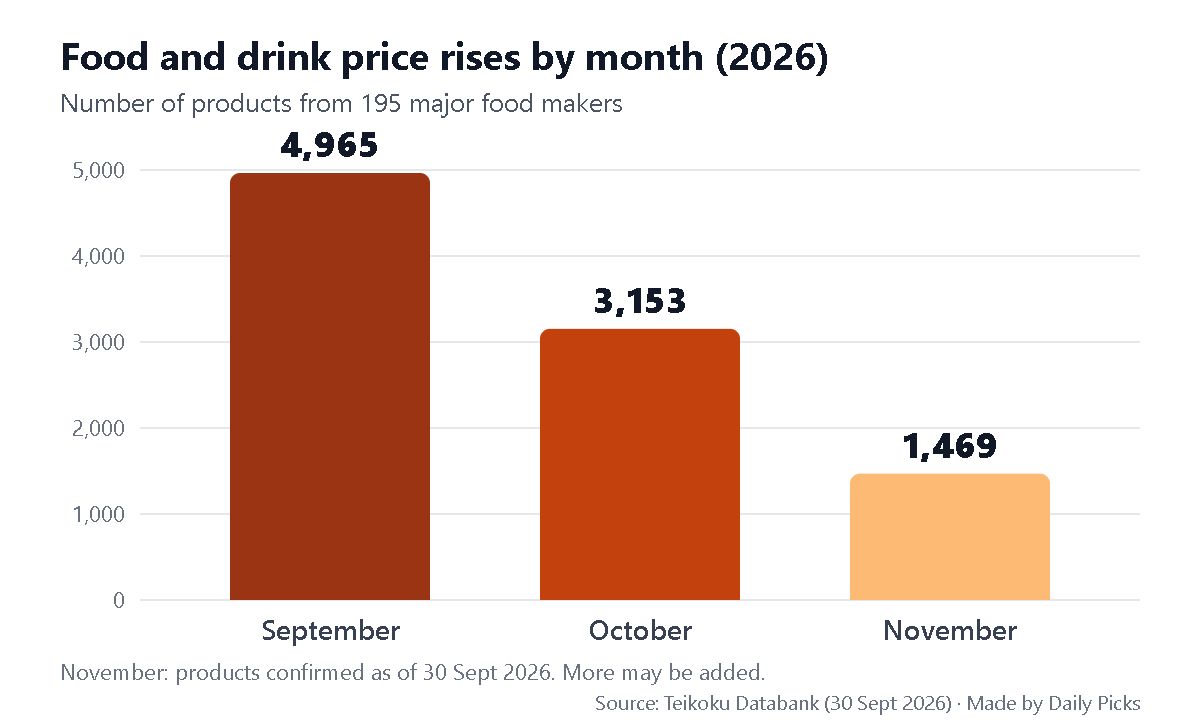
- 3,153 products went up in October 2026. The average rise per price change was about 10%.
- This is the second month in a row above 3,000 products. That last happened in June–July 2023.
- Drinks, including alcohol, were the largest group with 1,399 products. TDB names happoshu and third-beer drinks affected by the tax change, shochu and other alcohol, and soft drinks.
- Seasonings were next with 820 products, mainly mayonnaise, soy sauce and sauces.
- Processed food rises were common in canned food, frozen and chilled food, and baby food.
TDB also counts “hidden” price rises. If a maker keeps the price but puts less food in the pack, that product is in the total too.
The cost pressures behind the rises are wide. Of all price rises in 2026, 91.3% gave raw materials as a reason, 63.8% gave energy, 27.8% gave the situation in the Middle East (through oil and naphtha prices that push up packaging and transport), and 8.1% gave the weak yen. TDB says the yen above 150 to the US dollar keeps import costs high.
The drinks tax change on 1 October
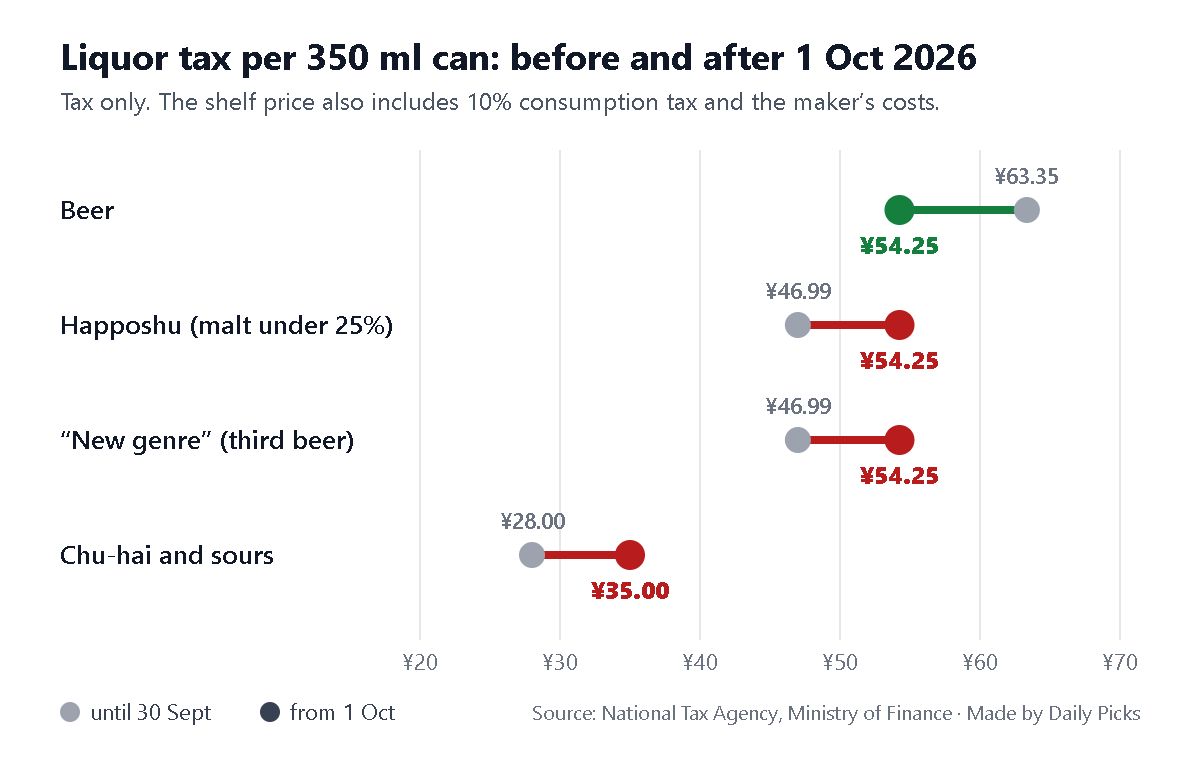
Japan’s liquor tax (shuzei) is a fixed amount per litre, paid by the maker when the drink leaves the factory. Since 2020 the government has been bringing the rates for beer-type drinks together in three steps. The last step was on 1 October 2026. Now beer and happoshu pay the same rate: ¥155,000 per kilolitre, or ¥54.25 for a 350 ml can.
| Drink type | Tax per 350 ml until 30 Sept | Tax per 350 ml from 1 Oct | Change |
|---|---|---|---|
| Beer | ¥63.35 | ¥54.25 | −¥9.10 |
| Happoshu (malt under 25%) | ¥46.99 | ¥54.25 | +¥7.26 |
| “New genre” / third beer | ¥46.99 | ¥54.25 | +¥7.26 |
| Chu-hai, sours and other sparkling drinks | ¥28.00 | ¥35.00 | +¥7.00 |
| Sake and wine | ¥100,000 per kl (no change this time) | — | |
Checked: 2026-10-10. Source: National Tax Agency, liquor tax rate table from 1 October 2026; Ministry of Finance, liquor tax reform materials. “Other sparkling drinks” are those under 11% alcohol in the new table.
For a 500 ml can, multiply by about 1.43. Beer tax falls by about ¥13, and happoshu and third-beer tax rises by about ¥10.
Three points help when you look at shelf prices:
- These are tax amounts, not shop prices. Makers and shops set the price. If their own costs went up, a beer can may get cheaper by less than ¥9.10, or not at all.
- Consumption tax is added on top. Alcohol is taxed at the standard 10% consumption tax, not the 8% food rate. So the change at the till is usually a little larger than the liquor tax change.
- The cheap tier is gone for tax purposes. Third beer used to be much cheaper mainly because of tax. That gap is now zero, so the price difference that remains comes from the products themselves.
What comes next
TDB expects the wave of price rises to calm down after October. As of 30 September, 1,469 rises were confirmed for November. That is about ten times November last year, but far fewer than in September and October. For the whole of 2026, 20,187 rises are confirmed, the second year in a row above 20,000. TDB still expects price rises on and off into 2027.
There is also a planned tax cut for food. On 15 September 2026 the government announced a plan to lower the consumption tax on food and non-alcoholic drinks from 8% to 1% for two years, from 1 April 2027 to 31 March 2029. The National Tax Agency says this will only happen if a bill is passed by the Diet (parliament). The 1% would cover the same food that now gets 8%. Alcohol and eating in at a restaurant stay at 10%. Until then, nothing changes at the till.
What you can do now
- Look at the price and the size. Because smaller packs count as price rises too, compare the weight or volume on the label, not only the price. Many supermarket shelf labels also show a price per 100 g or 100 ml.
- Compare your usual drinks again. If you chose third beer or chu-hai because it was cheap, the gap with beer is smaller now. Check the actual price on the shelf before you buy a case.
- Do not panic-buy. November has far fewer confirmed rises. Buying a lot of frozen or fresh food now needs freezer space and electricity, and the price may not have gone up anyway.
- Check your utility bills, too. The government’s electricity and gas discount ended with September use, so bills that arrive from November are higher. Our guide on how to read your electricity bill in Japan explains each line, including the fuel cost adjustment.
- Keep receipts if you budget by month. A simple monthly total for food and drinks shows quickly whether October and November really cost you more, and by how much.
If you do not drink alcohol
The liquor tax change does not affect you, but the other 1,754 price rises in October do. They include seasonings such as mayonnaise and soy sauce, and processed food such as canned, frozen and baby food. Soft drinks were also in the drinks group, so the 1,399 figure is not only alcohol.
FAQ
Is beer cheaper now?
The tax on a 350 ml can of beer fell by ¥9.10 on 1 October 2026. Whether the shop price fell depends on the maker and the shop. Check the price tag; prices in Japan must be shown including consumption tax.
I bought third beer in September. Do I pay more tax on it now?
No. The liquor tax is paid when the drink leaves the factory, not when you drink it. Cans already in your home are not affected.
Will food become tax-free in 2027?
Not tax-free. The plan is to lower the consumption tax on food from 8% to 1% from 1 April 2027 to 31 March 2029. It still needs a law passed by the Diet. Alcohol and eating in at restaurants would stay at 10%.
Will the October number change?
It can. TDB counts the price rises that companies have announced, and later announcements are added. For example, September grew from 4,923 products (end of August count) to 4,965 (end of September count).
Related reading
- What changes in Japan from October 2026: minimum wage, prices and rules
- Electricity bills rise for October use in Japan: the government discount has ended
- How to read your electricity bill in Japan
日本語で読む:10月の食品値上げは3,153品目、酒税改正でビールは減税・発泡酒と第三のビールは増税
Sources
- Teikoku Databank, “Price revision survey of 195 major food companies – October 2026” (Japanese, 30 Sept 2026): tdb.co.jp
- National Tax Agency, liquor tax rate table from 1 October 2026 (Japanese, PDF): nta.go.jp
- National Tax Agency, “How much is the liquor tax?” (Japanese Q&A): nta.go.jp
- Ministry of Finance, liquor tax materials (Japanese): mof.go.jp and the reform outline (PDF): mof.go.jp
- National Tax Agency, planned two-year consumption tax cut on food (Japanese, from 15 Sept 2026): nta.go.jp, leaflet (PDF): nta.go.jp, Q&A (PDF): nta.go.jp