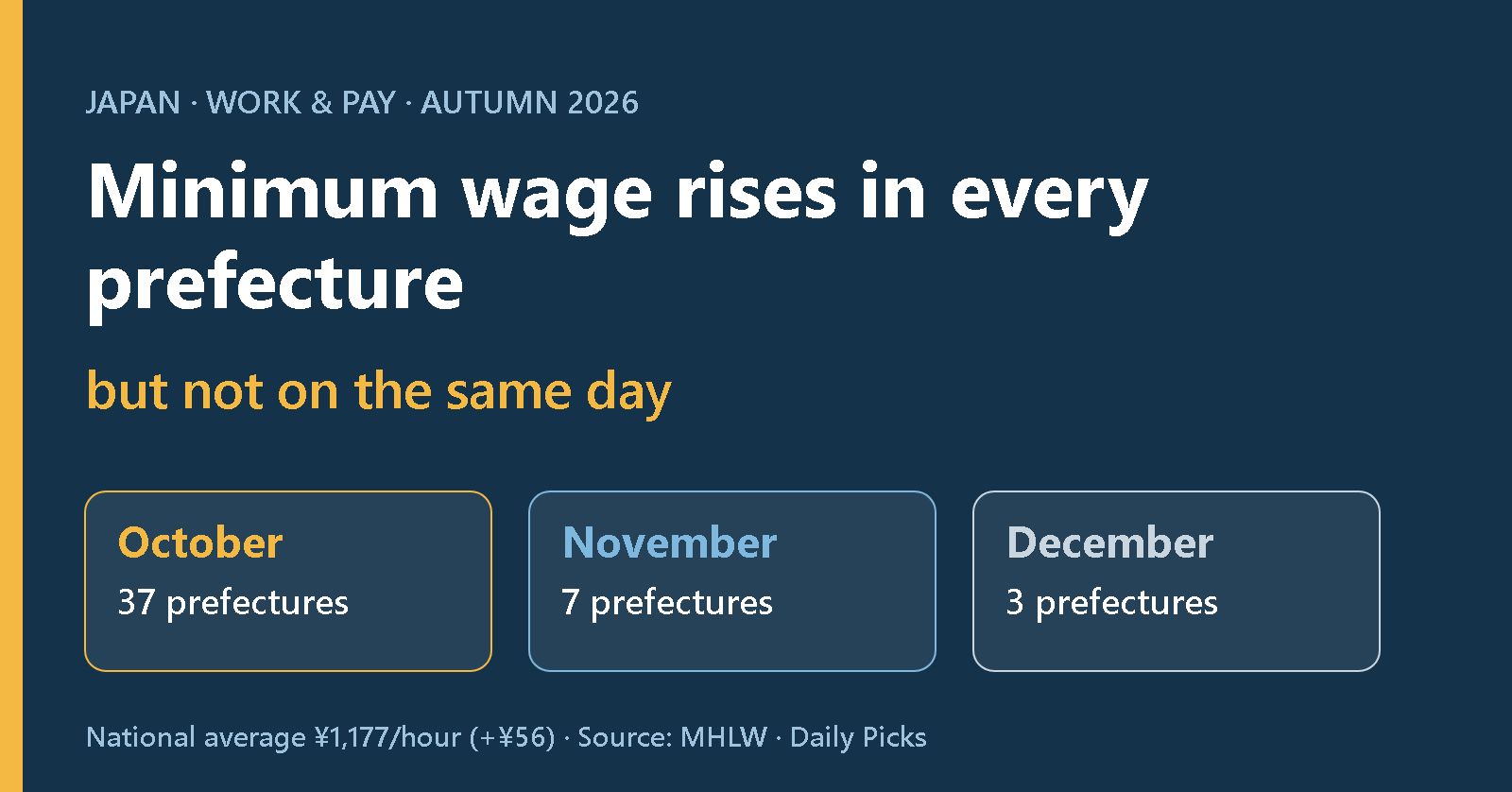
Summary: Japan’s minimum wage is going up in every prefecture this autumn, but not on the same day. The new national weighted average is ¥1,177 an hour (up ¥56). Twenty-five prefectures, including Tokyo, Osaka and Aichi, switched in the first week of October. The other 22 change between 8 October and 2 December 2026. The rate applies to everyone who works at a workplace in that prefecture, including part-time staff and students doing arubaito (part-time jobs). Find your workplace’s date in the table below, then check your hourly rate on your next payslip.
- What is changing
- All 47 prefectures: new rate and start date
- Who is affected
- When you will notice it
- What you can do now
- Where to ask, in your language
- If your prefecture has not changed yet
- FAQ
- I am a student with a part-time job. Does the minimum wage apply to me?
- Does my commuting allowance count towards the minimum wage?
- My employer says the new rate starts from next month. Is that allowed?
- I live in one prefecture and work in another. Which rate applies?
- I work night shifts with a premium. Can the premium cover the gap?
- Related reading
- Sources
What is changing
Japan does not have one national minimum wage. Each prefecture has its own chiiki-betsu saitei chingin (regional minimum wage), set every year by the prefectural labour bureau. For 2026, the Ministry of Health, Labour and Welfare (MHLW) list shows:
- The national weighted average rises from ¥1,121 to ¥1,177 per hour (+¥56, +5.0%).
- The highest rate is Tokyo at ¥1,280, then Kanagawa at ¥1,279 and Osaka at ¥1,231.
- The lowest rate is Miyazaki at ¥1,085. Once every change is in place, all 47 prefectures will be at ¥1,085 or more.
- Every prefecture rises by between ¥54 and ¥65. Some smaller prefectures get the biggest increases (Saga +¥65, Kagoshima +¥64).
The start dates are spread out. The new rate starts in October in 37 of the 47 prefectures. Ten prefectures start in November or December.
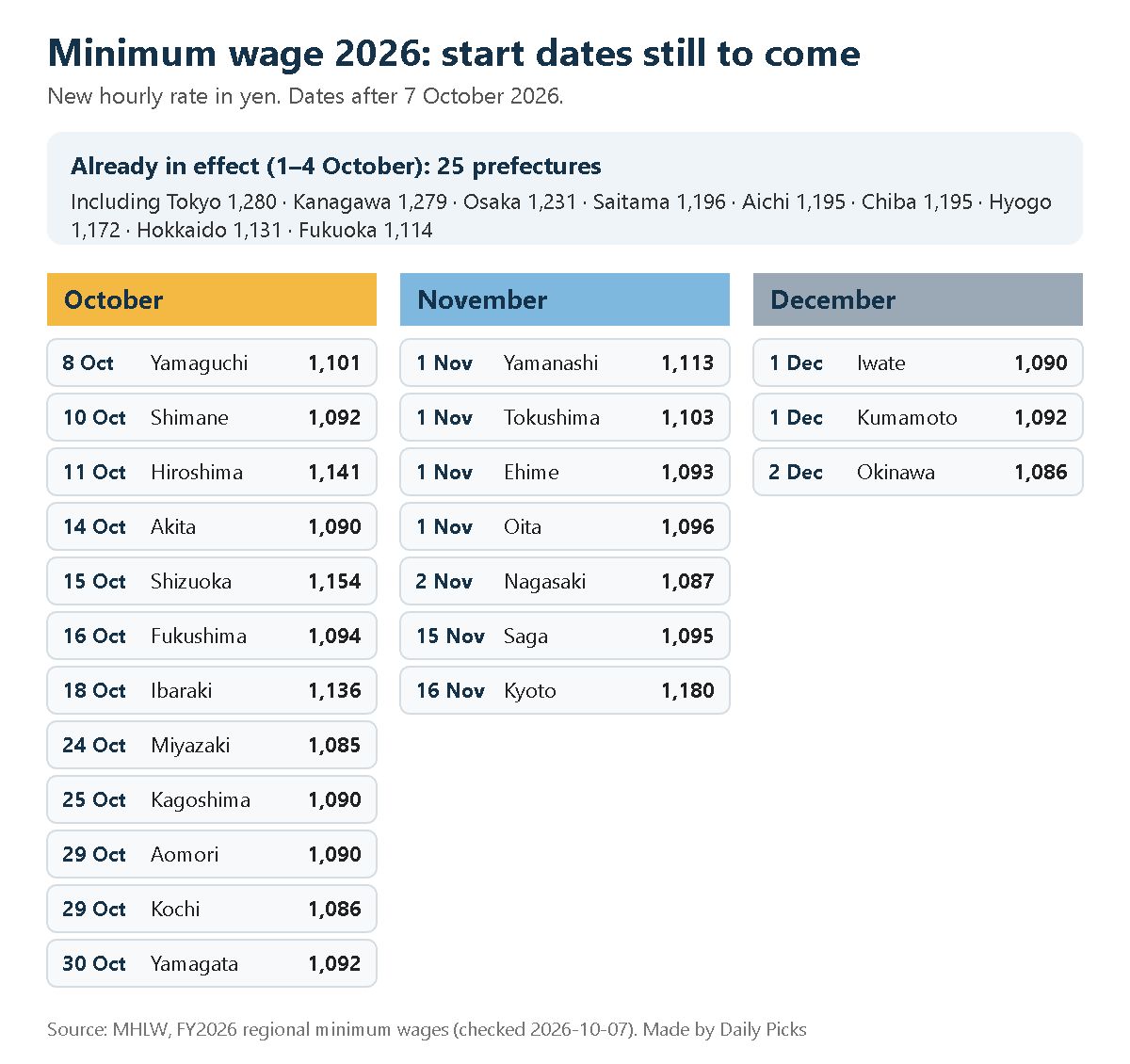
All 47 prefectures: new rate and start date
Sorted by the date the new rate takes effect. The old rate is the 2025 figure that applied until that date.
| Takes effect | Prefecture | New hourly rate | Old rate | Rise |
|---|---|---|---|---|
| 1 Oct 2026 | Tokyo | ¥1,280 | ¥1,226 | +¥54 |
| 1 Oct 2026 | Kanagawa | ¥1,279 | ¥1,225 | +¥54 |
| 1 Oct 2026 | Osaka | ¥1,231 | ¥1,177 | +¥54 |
| 1 Oct 2026 | Saitama | ¥1,196 | ¥1,141 | +¥55 |
| 1 Oct 2026 | Chiba | ¥1,195 | ¥1,140 | +¥55 |
| 1 Oct 2026 | Aichi | ¥1,195 | ¥1,140 | +¥55 |
| 1 Oct 2026 | Hyogo | ¥1,172 | ¥1,116 | +¥56 |
| 1 Oct 2026 | Mie | ¥1,143 | ¥1,087 | +¥56 |
| 1 Oct 2026 | Hokkaido | ¥1,131 | ¥1,075 | +¥56 |
| 1 Oct 2026 | Tochigi | ¥1,125 | ¥1,068 | +¥57 |
| 1 Oct 2026 | Gifu | ¥1,121 | ¥1,065 | +¥56 |
| 1 Oct 2026 | Toyama | ¥1,119 | ¥1,062 | +¥57 |
| 1 Oct 2026 | Niigata | ¥1,108 | ¥1,050 | +¥58 |
| 1 Oct 2026 | Miyagi | ¥1,098 | ¥1,038 | +¥60 |
| 1 Oct 2026 | Kagawa | ¥1,092 | ¥1,036 | +¥56 |
| 2 Oct 2026 | Nagano | ¥1,117 | ¥1,061 | +¥56 |
| 2 Oct 2026 | Okayama | ¥1,104 | ¥1,047 | +¥57 |
| 3 Oct 2026 | Shiga | ¥1,136 | ¥1,080 | +¥56 |
| 3 Oct 2026 | Gunma | ¥1,120 | ¥1,063 | +¥57 |
| 3 Oct 2026 | Ishikawa | ¥1,113 | ¥1,054 | +¥59 |
| 3 Oct 2026 | Wakayama | ¥1,101 | ¥1,045 | +¥56 |
| 3 Oct 2026 | Tottori | ¥1,090 | ¥1,030 | +¥60 |
| 4 Oct 2026 | Fukuoka | ¥1,114 | ¥1,057 | +¥57 |
| 4 Oct 2026 | Fukui | ¥1,112 | ¥1,053 | +¥59 |
| 4 Oct 2026 | Nara | ¥1,107 | ¥1,051 | +¥56 |
| 8 Oct 2026 | Yamaguchi | ¥1,101 | ¥1,043 | +¥58 |
| 10 Oct 2026 | Shimane | ¥1,092 | ¥1,033 | +¥59 |
| 11 Oct 2026 | Hiroshima | ¥1,141 | ¥1,085 | +¥56 |
| 14 Oct 2026 | Akita | ¥1,090 | ¥1,031 | +¥59 |
| 15 Oct 2026 | Shizuoka | ¥1,154 | ¥1,097 | +¥57 |
| 16 Oct 2026 | Fukushima | ¥1,094 | ¥1,033 | +¥61 |
| 18 Oct 2026 | Ibaraki | ¥1,136 | ¥1,074 | +¥62 |
| 24 Oct 2026 | Miyazaki | ¥1,085 | ¥1,023 | +¥62 |
| 25 Oct 2026 | Kagoshima | ¥1,090 | ¥1,026 | +¥64 |
| 29 Oct 2026 | Aomori | ¥1,090 | ¥1,029 | +¥61 |
| 29 Oct 2026 | Kochi | ¥1,086 | ¥1,023 | +¥63 |
| 30 Oct 2026 | Yamagata | ¥1,092 | ¥1,032 | +¥60 |
| 1 Nov 2026 | Yamanashi | ¥1,113 | ¥1,052 | +¥61 |
| 1 Nov 2026 | Tokushima | ¥1,103 | ¥1,046 | +¥57 |
| 1 Nov 2026 | Oita | ¥1,096 | ¥1,035 | +¥61 |
| 1 Nov 2026 | Ehime | ¥1,093 | ¥1,033 | +¥60 |
| 2 Nov 2026 | Nagasaki | ¥1,087 | ¥1,031 | +¥56 |
| 15 Nov 2026 | Saga | ¥1,095 | ¥1,030 | +¥65 |
| 16 Nov 2026 | Kyoto | ¥1,180 | ¥1,122 | +¥58 |
| 1 Dec 2026 | Kumamoto | ¥1,092 | ¥1,034 | +¥58 |
| 1 Dec 2026 | Iwate | ¥1,090 | ¥1,031 | +¥59 |
| 2 Dec 2026 | Okinawa | ¥1,086 | ¥1,023 | +¥63 |
Checked: 2026-10-07. Source: MHLW, “令和8年度 地域別最低賃金 全国一覧” (FY2026 regional minimum wages, national list).
Who is affected
According to MHLW, the regional minimum wage covers all workers at workplaces in the prefecture, whatever the job is called: full-time, part-time, arubaito, temporary or contract. Nationality does not change this. The rate that counts is the one for the prefecture where your workplace is, not where you live. If you live in Saitama and work at a shop in Tokyo, the Tokyo rate (¥1,280) applies.
Some industries also have a tokutei saitei chingin (specific, industry-based minimum wage) that can be higher than the regional one. If your job is covered by one, the higher rate applies. Your employer or the labour bureau can tell you whether your industry has one.
When you will notice it
The new rate applies to work done from the start date. Your payslip may not show it straight away. Many employers close the pay period on a fixed day (for example the 15th or the end of the month) and pay later. So if your prefecture’s date falls in the middle of a pay period, your first payslip after the change may mix the old and new rates. The payslip after that should show the new rate for every hour.
While you have your payslip open, it is a good time to learn the other lines on it, such as income tax and resident tax. Our guide to the resident tax notice (juminzei) explains the tax that is taken from your salary each month, and the guide to year-end adjustment (nenmatsu chosei) covers the forms your employer will hand out in late autumn.
What you can do now
- Find your workplace’s date. Use the table above. If you work in more than one place, check each one.
- Check your hourly rate. If you are paid by the hour, your contract or payslip shows the rate (時給, jikyu). It must be at least the new figure for hours worked on or after the start date.
- If you are paid by the day or month, convert it. MHLW’s method is: daily pay ÷ scheduled hours per day, or monthly pay ÷ average scheduled hours per month. The result must be at least the minimum wage. See the example below.
- Leave out the items that do not count. Overtime, holiday and late-night premiums, bonuses, one-off payments such as a marriage allowance, and the commuting, family and perfect-attendance allowances are not included.
- Ask your employer first. Bring the payslip and the table.
- If it is not fixed, get free advice. Contact your local Labour Standards Inspection Office (rodo kijun kantokusho) or the multilingual phone lines below.
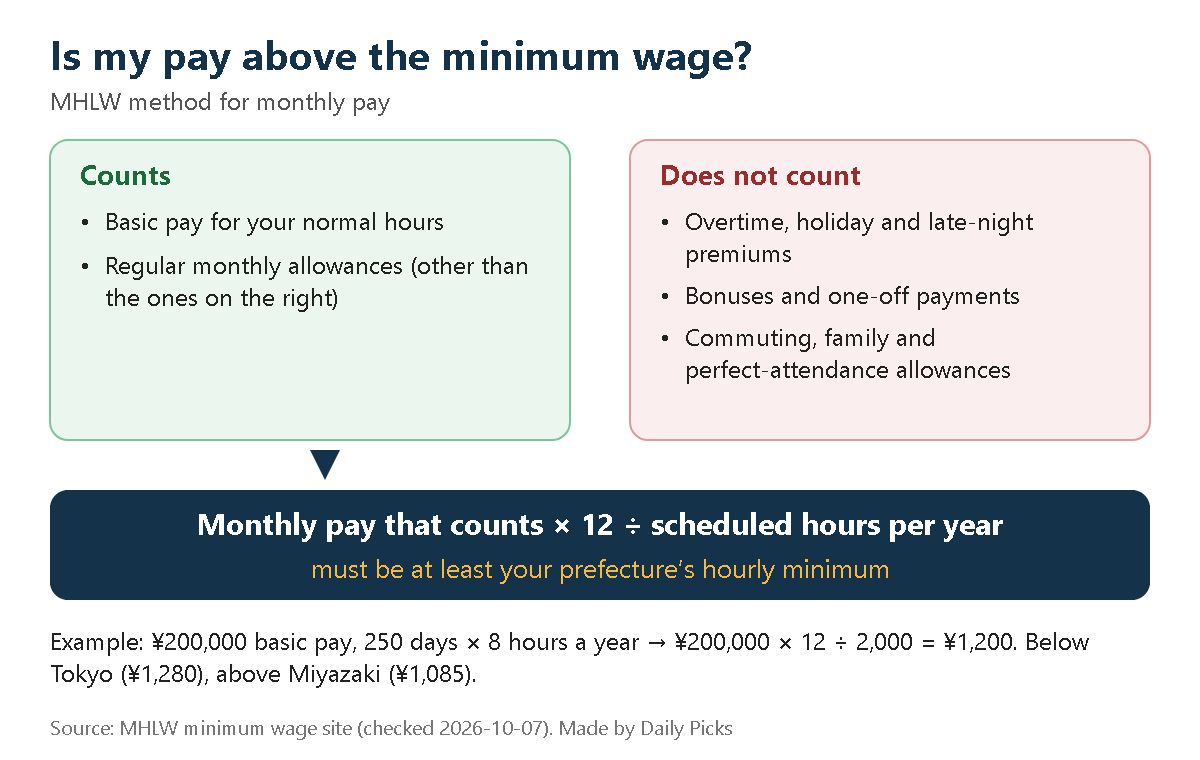
Example: a monthly salary in Tokyo
Say your contract gives you a basic salary of ¥200,000 a month plus a ¥10,000 commuting allowance. You are scheduled to work 250 days a year, 8 hours a day.
- Remove the commuting allowance: ¥200,000 counts.
- Average scheduled hours per month: 250 days × 8 hours ÷ 12 months ≈ 166.7 hours.
- Hourly equivalent: ¥200,000 × 12 ÷ (250 × 8) = ¥1,200.
That is below Tokyo’s new ¥1,280, so this salary would need to rise. The same salary in Miyazaki (¥1,085) would be above the minimum. This is only an example of the method. Your own scheduled hours are in your employment contract or work rules.
Where to ask, in your language
MHLW runs two phone services for foreign workers. They can explain the rules and tell you which office to contact.
| Service | English number | Hours |
|---|---|---|
| Consultation Dial for Foreign Workers (外国人労働者向け相談ダイヤル) | 0570-001-701 | Mon–Fri, 10:00–15:00 (closed 12:00–13:00) |
| Labour Conditions Hotline (労働条件相談ほっとライン), free | 0120-531-401 | Weekdays 17:00–22:00; weekends and holidays 9:00–21:00 |
Checked: 2026-10-07. Source: MHLW “確かめよう労働条件” consultation page. Other languages include Chinese, Portuguese, Spanish, Tagalog, Vietnamese, Nepali, Korean, Thai and Indonesian, on set days. Closed 29 December – 3 January.
Under the Minimum Wage Act, an employer who does not pay at least the minimum wage can be fined up to ¥500,000.
If your prefecture has not changed yet
If you work in, for example, Kyoto (16 November) or Okinawa (2 December), the old rate still applies until that date. Your employer can pay the new rate earlier, but does not have to. Put the date in your calendar and check the first payslip after it.
FAQ
I am a student with a part-time job. Does the minimum wage apply to me?
Yes. MHLW says the regional minimum wage covers part-time, arubaito and temporary workers too. The minimum wage does not change any other conditions attached to your status of residence, such as permitted working hours. For those, check the Immigration Services Agency’s official guidance.
Does my commuting allowance count towards the minimum wage?
No. Commuting, family and perfect-attendance allowances are excluded, as are overtime, holiday and late-night premiums and bonuses. Only the basic pay for your normal hours is compared.
My employer says the new rate starts from next month. Is that allowed?
The new rate applies to work done from the start date in your prefecture. If your pay for those hours is below it, ask your employer to correct it. If that does not work, call one of the lines above or your local Labour Standards Inspection Office.
I live in one prefecture and work in another. Which rate applies?
The rate of the prefecture where your workplace is.
I work night shifts with a premium. Can the premium cover the gap?
No. The late-night premium (for work between 22:00 and 5:00) is excluded. Your base hourly pay must meet the minimum wage on its own.
Related reading
- What changes in Japan from October 2026
- The resident tax notice in Japan: how to read the juminzei letter
- Emergency numbers in Japan: 119, 110, #7119, #9110 and 188
日本語で読む:2026年度の最低賃金は全国平均1,177円|自分の時給が変わる日と相談先