Summary: You can send a parcel inside Japan from a post office, a carrier’s office, some convenience stores, or by booking a pickup. Japan Post, Yamato Transport and Sagawa Express each have their own sizes and rules. Several Japan Post prices change on 1 October 2026, and this guide shows the official figures as of 30 September 2026. It also covers the waybill (okurijo), cash on delivery, banned items and airport delivery.
- Choose the right service by size
- Japan Post options in more detail
- Yamato and Sagawa options
- Sending from a convenience store
- How to fill in a waybill (okurijo)
- Cash on delivery and collect payment
- Items you cannot send or that may be delayed
- Sending luggage to the airport
- Checklist before you send
- FAQ
- Related reading
- Sources
Choose the right service by size
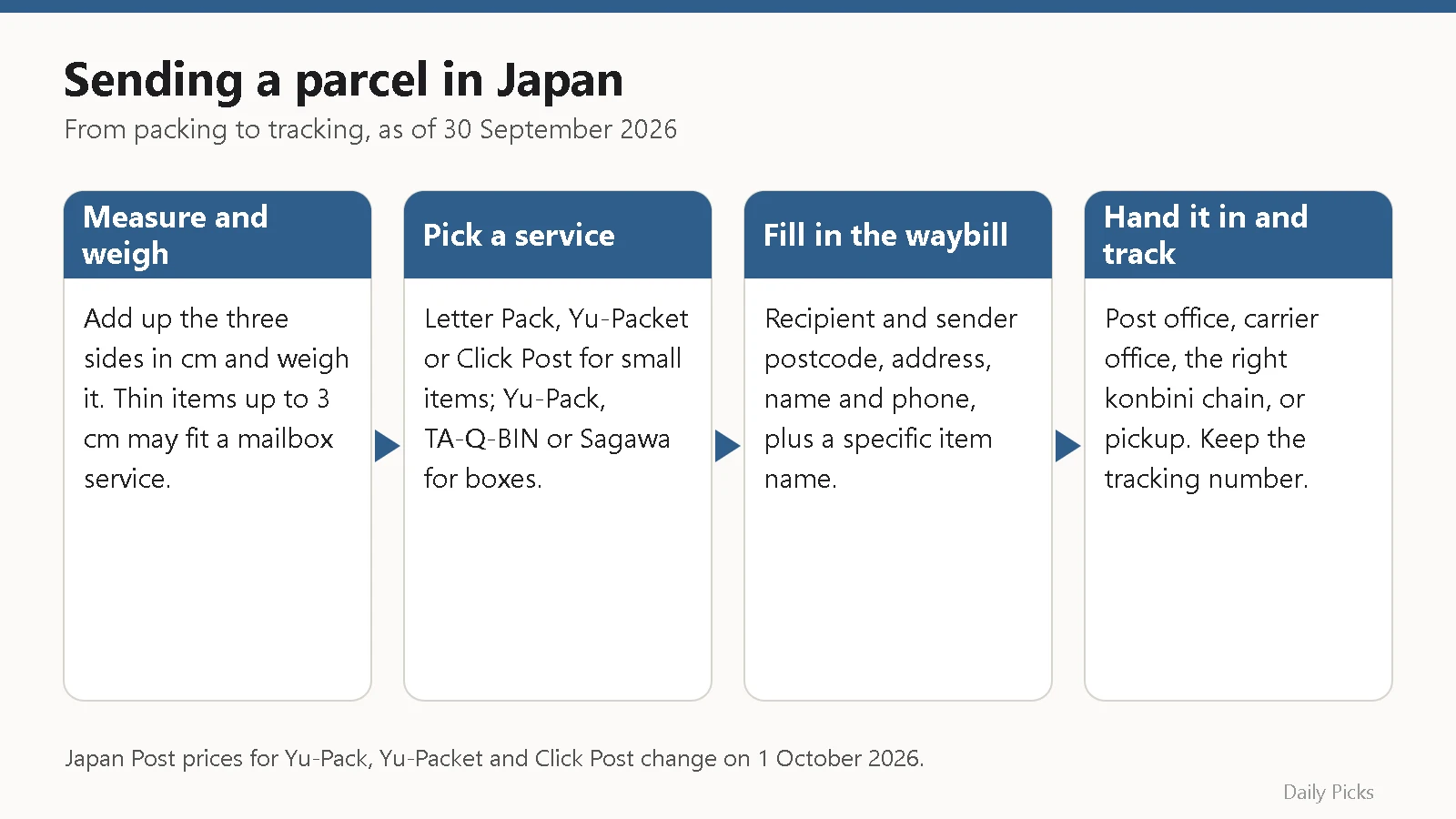
Start with size. Small, flat items can use a mailbox service. Boxes need a parcel service: Yu-Pack (Japan Post), TA-Q-BIN (Yamato’s “Takkyubin”) or Hikyaku Takuhaibin (Sagawa). Parcel size is the total of length, width and height, so “60 size” means the three sides add up to 60 cm or less.
Mailbox services are cheaper but have strict thickness limits. Parcel services take bigger items and are handed over in person.
| Service (carrier) | Size and weight limit | Price shown officially | How it arrives |
|---|---|---|---|
| Letter Pack Light (Japan Post) | A4 envelope, up to 3 cm thick, up to 4 kg | 430 yen | Mailbox |
| Letter Pack Plus (Japan Post) | A4 envelope, up to 4 kg | 600 yen | Hand delivery with receipt |
| Yu-Packet (Japan Post) | Three sides 60 cm, longest side 34 cm, 3 cm thick, 1 kg | 360 yen flat from 1 October 2026 (was 250/310/360 yen by thickness) | Mailbox |
| Click Post (Japan Post) | From 1 October 2026: three sides 60 cm, longest side 34 cm, 2 kg | 240 yen from 1 October 2026 (was 185 yen) | Mailbox |
| Yu-Pack (Japan Post) | Up to 170 cm total and 25 kg (heavy Yu-Pack up to 30 kg) | By size and distance; about 10% higher on average from 1 October 2026 | Hand delivery |
| Koneko-bin 420 (Yamato) | Special envelope 24.8 × 34 cm, 3 cm thick | 420 yen including the material | Mailbox |
| TA-Q-BIN Compact (Yamato) | Special box (box sold for 70 yen) | Fare by distance plus the box | Hand delivery |
| TA-Q-BIN (Yamato) | 60 to 200 size, up to 30 kg | By size and distance | Hand delivery |
| Hikyaku Takuhaibin (Sagawa) | Three sides 160 cm, up to 30 kg | By size and distance | Hand delivery |
Japan Post’s notice of 3 July 2026 says Yu-Pack basic rates rise by about 10% on average from 1 October 2026, differing by size and area. For an exact fare, use the carrier’s online calculator.
Japan Post options in more detail
Letter Pack
Letter Pack is a prepaid A4 envelope with a flat nationwide price and tracking. Letter Pack Light goes into the mailbox; Letter Pack Plus is handed over for a stamp or signature. You can use a street postbox (Plus may not fit some), a post office counter, or pickup. Japan Post says some convenience stores that sell stamps also sell Letter Pack.
Letter Pack can carry “shinsho” (a letter addressed to a specific person). Yu-Pack, Yu-Packet and Click Post cannot, except for an unsealed short note or invoice with the item.
Yu-Packet and Click Post
For Yu-Packet, you attach the Yu-Packet label and stamps, then post it or hand it in.
Click Post is online: pay with Yahoo! Wallet or Amazon Pay (by credit card), print the label and post the item. The Click Post site says payments finished by 23:30 on 30 September 2026 (planned) use the old 185-yen fare.
Yu-Pack
Heavy Yu-Pack (over 25 kg up to 30 kg) is accepted at post offices only. Its surcharge is 560 yen on the basic fare, becoming 620 yen from 1 October 2026.
Discounts listed as of 30 September 2026: 120 yen for bringing the parcel in; 60 yen for the same address as a Yu-Pack in the past year (attach the old receipt); 60 yen each for two or more to one address at once. The last two cannot be combined, and parcels paid by the recipient get no discount.
Yamato and Sagawa options
Yamato’s TA-Q-BIN delivers the next day to most of Japan. Time slots are morning, 14–16, 16–18, 18–20 and 19–21. Yamato says fares were last revised on 1 October 2025, and it lists a drop-off discount (100–150 yen) and a digital label discount (60 yen).
Koneko-bin 420 goes into the mailbox with no date or time choice. Buy the envelope from a Yamato driver, office or online shop, then hand it to a driver or office; convenience stores and lockers do not accept it.
In January 2025 Yamato said it would keep “Nekopos” and offer “Kuroneko Yu-Packet” (delivered by Japan Post’s network in about 3 days to a week) nationwide from 1 February 2025. Nekopos is for businesses with a contract and for individuals using flea-market or auction sites contracted with Yamato.
With Sagawa, individuals can bring a parcel to a Sagawa office or book a pickup online through the “Smart Club” membership.
Sending from a convenience store
Each convenience store chain works with a specific carrier.
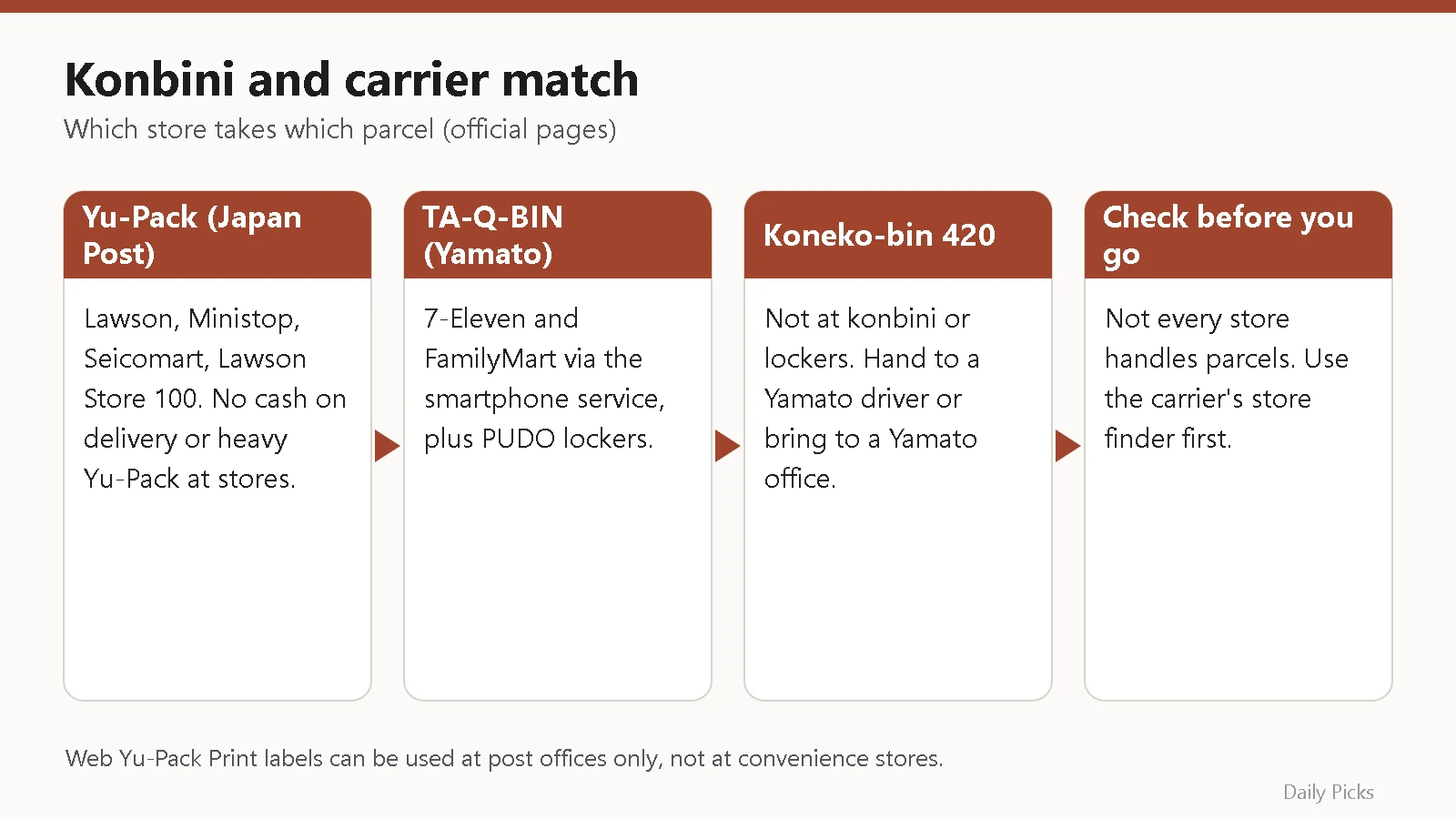
- Yu-Pack: Japan Post lists Lawson, Ministop, Seicomart and Lawson Store 100. Standard Yu-Pack (paid by you or paid by the recipient) and golf, ski and airport Yu-Pack are accepted. Cash on delivery, security service, chilled delivery and heavy Yu-Pack are not available at stores. Japan Post says the 120-yen drop-off discount and the two 60-yen discounts also apply at stores.
- TA-Q-BIN: Yamato’s page for its smartphone sending service lists 7-Eleven and FamilyMart, plus PUDO parcel lockers. You fill in the details on your phone and show a code in the store.
- Labels made online: Japan Post’s free “Web Yu-Pack Print” labels are for post offices only. Japan Post says they cannot be used at convenience stores.
Not every store handles parcels, so use the carrier’s store finder first.
How to fill in a waybill (okurijo)
A waybill is the label on the parcel. It carries the tracking number, and you keep a copy or receipt. Forms differ by carrier, but the main boxes are similar. Japan Post’s airport label example asks you to write firmly with a ballpoint pen so every copy is readable. Use the Japanese address order: postcode first, then prefecture, city, block number, and building name with room number. Add a phone number for both the recipient and yourself.
| Japanese on the form | Reading | What to write |
|---|---|---|
| お届け先 | otodokesaki | Recipient: postcode, address, name, phone |
| ご依頼主 | goirainushi | Sender: your postcode, address, name, phone |
| 品名 | hinmei | Contents, as specific as possible (e.g. “books”, “clothes”) |
| お届け希望日・時間帯 | otodoke kibobi / jikantai | Preferred delivery date and time slot |
| 送り状 / 伝票 | okurijo / denpyo | The waybill itself |
| 元払い | motobarai | You pay when sending |
| 着払い | chakubarai | The recipient pays on arrival |
| 代金引換 / 代引き | daikin hikikae / daibiki | Cash on delivery |
| 持込 / 集荷 | mochikomi / shuka | You bring it in / the carrier picks it up |
| お問い合わせ番号 | otoiawase bango | Tracking number |
Yamato says vague item names such as “miscellaneous goods” may delay a parcel. Japan Post also asks for specific names so staff can check for dangerous goods.
Cash on delivery and collect payment
Two payment options often get mixed up. “Chakubarai” means the recipient pays the shipping fee on arrival. “Daibiki” (cash on delivery) means the carrier collects the price of the goods from the recipient and sends the money to you.
Japan Post’s cash on delivery can be used for sales between individuals, with a special label from the post office. You pay normal postage, a flat 290-yen charge, and a remittance fee that depends on how the money is sent. A revenue stamp charge applies over 50,000 yen (excluding tax).
Yamato’s cash on delivery (“TA-Q-BIN Collect”) is aimed at online shops and starts after a screening.
Items you cannot send or that may be delayed
Yamato and Sagawa both list items they do not accept, including:
- Cash, cheques, promissory notes, share certificates and other securities
- Credit cards, cash cards and similar cards
- Hard-to-reissue documents such as passports
- Pets, poisons, firearms and swords
- Letters (shinsho) and anything against the law
- Fireworks, kerosene, gas cylinders, thinner and other flammable items (Yamato); explosives and flammable items (Sagawa)
Some everyday items cannot go by plane. Yamato lists spray cans, lighters, lithium batteries, perfume, nail polish, camping gas and matches as ground-only. Japan Post says such parcels for air-transport areas go by ground and may take about 1 to 4 days longer. From 31 December 2025, lithium-ion batteries packed with a device must be charged to 30% or less for air transport.
Sending luggage to the airport
Yamato’s Airport TA-Q-BIN: send by the cut-off time 2 days before departure (3 days in some areas) and collect it at the airport’s partner counter on the day. A 660-yen airport fee is added to the fare.
Japan Post’s Airport Yu-Pack label asks for the airport, terminal, counter, recipient name, boarding date and time, airline and flight number. From 1 October 2026 the fare is the Yu-Pack basic fare plus 880 yen. It can also be sent from Yu-Pack convenience stores.
Checklist before you send
- Measure the three sides and weigh the item. Note the thickness for mailbox services.
- Decide if it must be handed over in person. If yes, use a parcel service or Letter Pack Plus.
- Check if it contains a letter. If so, use Letter Pack or normal mail, or leave only an unsealed short note.
- Check the contents against the carrier’s banned list.
- Get the recipient’s postcode, full address and phone number.
- Fill in the waybill with a specific item name and, if needed, a date and time slot.
- Hand it in at the right place and keep the tracking number.
FAQ
Can I send a Yu-Pack from 7-Eleven or FamilyMart?
Not according to Japan Post’s list. It names Lawson, Ministop, Seicomart and Lawson Store 100 for Yu-Pack. Yamato’s page lists 7-Eleven and FamilyMart for TA-Q-BIN.
Can I put a letter inside a parcel?
Only an unsealed short note or invoice. For a real letter, use Letter Pack or normal mail.
What changed at Japan Post on 1 October 2026?
Yu-Pack rises about 10% on average, Yu-Packet becomes 360 yen flat, and Click Post becomes 240 yen with a 2 kg limit. Letter Pack was not in that notice.
Can I send a phone or laptop?
Yes, but air transport is restricted, so parcels to far areas may go by ground and take longer. Write the item name clearly.
How early should I send my suitcase to the airport?
Yamato says 2 days before departure (3 in some areas). Cut-off times differ, so check for your area.
Related reading
- Missed delivery slip: how to get redelivery in Japan
- Moving house in Japan: address change checklist
- Moving out in Japan: deposit and cleaning bill
Sources
- Revision of Yu-Pack and Yu-Packet basic rates, 3 July 2026 (Japanese, PDF) – Japan Post
- Letter Pack (Japanese) – Japan Post
- Is Letter Pack sold at convenience stores? (Japanese) – Japan Post
- Yu-Packet (Japanese) – Japan Post
- Click Post and fare change notice (Japanese) – Japan Post
- Parcels over 170 cm or 25 kg (Japanese) – Japan Post
- Heavy Yu-Pack (Japanese) – Japan Post
- Yu-Pack discounts (Japanese) – Japan Post
- Yu-Pack discounts at convenience stores (Japanese) – Japan Post
- Which convenience stores accept Yu-Pack? (Japanese) – Japan Post
- Yu-Pack types handled at convenience stores (Japanese) – Japan Post
- Web Yu-Pack Print (Japanese) – Japan Post
- Sending shinsho (letters) (Japanese) – Japan Post
- Can letters be sent by Yu-Pack? (Japanese) – Japan Post
- What is cash on delivery? (Japanese) – Japan Post
- Cash on delivery fees (Japanese) – Japan Post
- Contents with aviation dangerous goods (Japanese) – Japan Post
- Sending lithium batteries by Yu-Pack (Japanese) – Japan Post
- Airport Yu-Pack label example (Japanese) – Japan Post
- Services for sending (Japanese) – Yamato Transport
- TA-Q-BIN (Japanese) – Yamato Transport
- TA-Q-BIN Compact (Japanese) – Yamato Transport
- Koneko-bin 420 (Japanese) – Yamato Transport
- Nekopos (Japanese) – Yamato Transport
- Notice on Nekopos and Kuroneko Yu-Packet, January 2025 (Japanese, PDF) – Yamato Transport
- Send TA-Q-BIN with your smartphone (Japanese) – Yamato Transport
- Cash on delivery payment (Japanese) – Yamato Transport
- Items that cannot be sent by TA-Q-BIN (Japanese) – Yamato Transport
- Airport TA-Q-BIN (Japanese) – Yamato Transport
- Services for individuals (Japanese) – Sagawa Express
- Web pickup request (Japanese) – Sagawa Express
- Items that cannot be sent (Japanese) – Sagawa Express

コメント