Summary: In Japan, every bicycle owner has a legal duty to put their bike on the anti-theft register, called bouhan touroku. You do this at a bike shop or other registration point, and in Tokyo it costs 660 yen as of 30 September 2026. This guide explains registration, second-hand bikes, parking and removed bikes, helmets, insurance and how to get rid of a bike, using Tokyo and Shinjuku City as examples. Rules and fees differ by prefecture and city, so check your own local pages as well.
- Anti-theft registration: the legal duty
- How to register a new bike (Tokyo example)
- Buying or receiving a second-hand bike
- Moving house or moving to another prefecture
- Parking rules and removed bikes (Shinjuku example)
- Helmets and bicycle insurance
- Getting rid of a bike
- Checklist: owning a bike in Japan
- Japanese words you will see
- FAQ
- Related reading
- Sources
Anti-theft registration: the legal duty
Bicycle anti-theft registration is based on the Act on Promotion of Safe Bicycle Use and Comprehensive Promotion of Bicycle Parking Measures (in Japanese, 自転車の安全利用の促進及び自転車等の駐車対策の総合的推進に関する法律). Setagaya City explains that Article 12, paragraph 3 of this law makes registration a duty of bicycle users. The Tokyo Metropolitan Police Department page says clearly that people who own a bicycle are required to register it.
Registration links your name and address to the bike’s frame number. You receive a sticker on the frame and a paper copy of the record, the registration card (控え, hikae). If your bike is lost or stolen, the police can use this record to find the owner. The same record helps if the police stop you and ask whose bike you are riding.
Keep the registration card safe. The Tokyo police page notes that it is not reissued. The Tokyo registration association suggests taking a photo of it with your phone as a backup.
How to register a new bike (Tokyo example)
You do not register at a police station or a city office. In Tokyo, registration is handled by the Tokyo Bicycle Dealers Crime Prevention Association (東京都自転車商防犯協力会) through bike shops, supermarkets and home centres that show a sign saying 自転車防犯登録所 (bicycle anti-theft registration point). If you buy a bike at such a shop, the staff can usually register it at the same time.
According to the association and Setagaya City, as of 30 September 2026 you need:
- The bicycle itself.
- An official ID that shows your name and address. The examples given are a driving licence or a health insurance card. If you plan to use your residence card, ask the shop first.
- The registration fee of 660 yen (non-taxable).
- For a bike bought online: the warranty or a sales certificate that shows the shop name, product name and frame number, if you have one.
In Tokyo, a registration is valid for 10 years from the start of the year after you register. After that, you register again. Other prefectures run their own systems, with their own fees and forms, so check with a registration point near you.
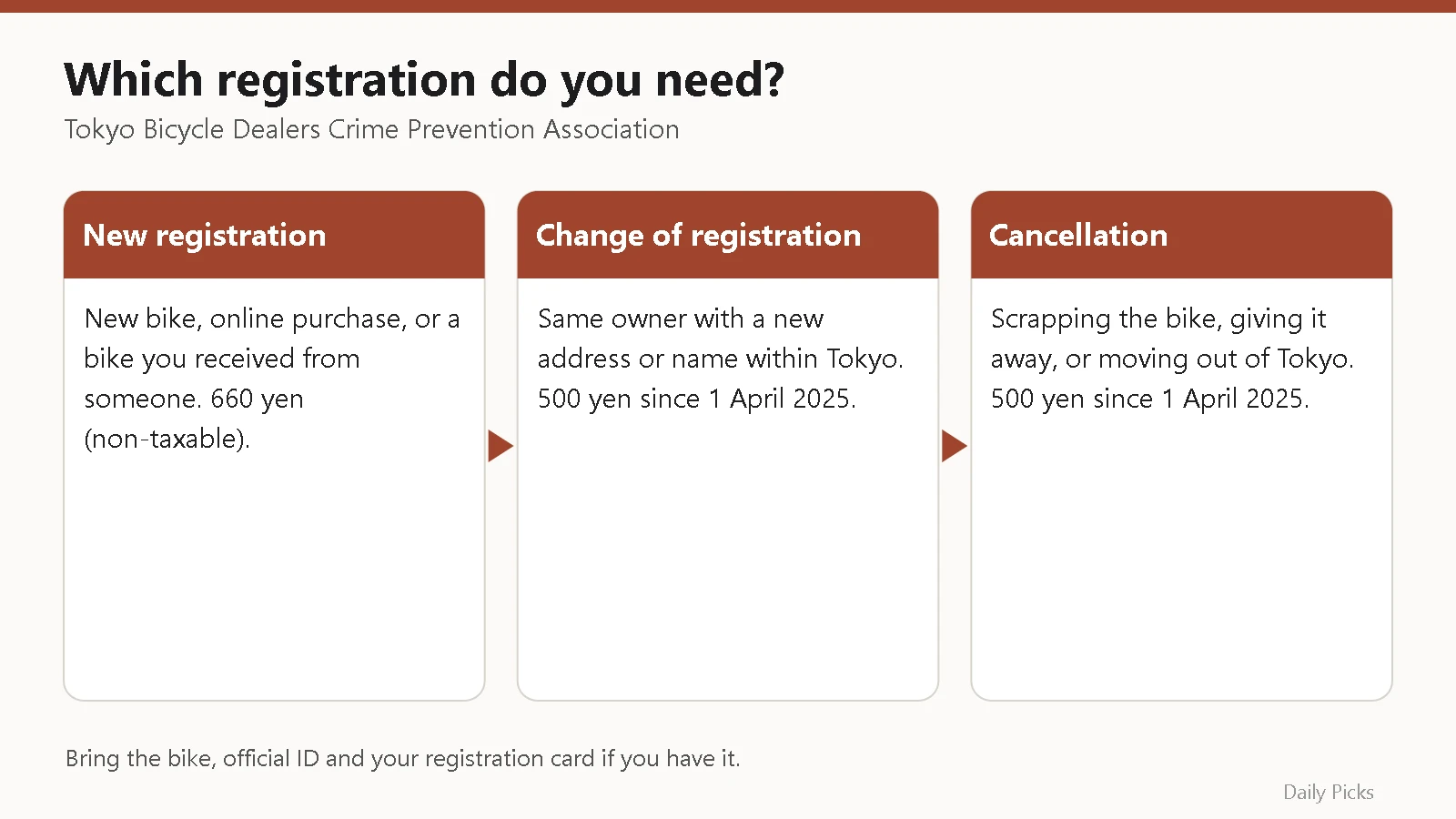
| Procedure (Tokyo) | When you need it | What to bring | Fee (as of 30 September 2026) |
|---|---|---|---|
| New registration (新規登録) | New bike, bike bought online, or a bike you received from someone | Bike, official ID, proof of purchase or transfer certificate if available | 660 yen (non-taxable) |
| Change of registration (変更登録) | Same owner, new address or name within Tokyo | Bike, official ID, registration card if available | 500 yen (tax included, since 1 April 2025) |
| Cancellation (抹消登録) | Scrapping the bike, giving it away, or moving out of Tokyo | Bike, official ID, registration card if available | 500 yen (since 1 April 2025) |
Buying or receiving a second-hand bike
When a bike changes owner, the old registration is not simply updated. The Tokyo association explains that the new owner registers the bike again under a new registration number. This is the same 660 yen new registration in Tokyo.
Shinjuku City’s page for foreign residents describes the steps like this:
- The person giving the bike cancels their registration at a registration point (a shop that sells bicycles).
- They give the new owner the cancellation record, the old registration card and a transfer certificate (譲渡証明書, jouto shomeisho).
- The new owner takes these papers, their own ID and the bike to a registration point and registers it again.
The transfer certificate has no fixed form. Shinjuku City says a note on plain paper is enough, as long as it shows that A gave the bike to B. The Tokyo association also offers a form you can download, and it recommends getting a certificate because it makes the ownership clear. If you buy a used bike from a person you do not know, a clear transfer certificate protects you if questions come up later.
Moving house or moving to another prefecture
If you move within Tokyo and keep the same bike, you use a change of registration (500 yen). If you move out of Tokyo, the association lists this as a reason to cancel the Tokyo registration.
The association’s Q&A also explains that bicycle registration is not shared across Japan. Each prefecture runs its own system. So if you move into Tokyo with a bike registered elsewhere, you register it in Tokyo. If you move from Tokyo to another prefecture, check the rules of the new prefecture. Our guide to moving house and changing your address covers the other offices you need to tell.
Parking rules and removed bikes (Shinjuku example)
Many cities set no-parking zones for bicycles (放置禁止区域), mostly around train stations. Shinjuku City says these zones are shown on signs on site. It also says that removal usually happens after a warning tag is attached, but in no-parking zones bikes may be removed straight away. Use a bicycle parking lot (駐輪場, chuurinjou) or the parking space at your home or shop instead.
If your bike disappears from where you left it, it may have been removed by the city, not stolen. In Shinjuku, as of 30 September 2026:
- You can call the Bicycle Strategy Call Center (03-5273-3896, 24 hours) to check whether your bike was removed and where it is stored.
- A notice may be sent to the address on the registration record.
- The fee to get a bicycle back is 3,000 yen.
- Bring ID that shows your name and address (for example a driving licence or My Number card), the bike key, the fee, and the notice if you received one.
- Removed bikes can be disposed of in as little as 30 days after removal.
- If you reported the bike stolen to the police before it was removed, the fee can be waived if you ask at the storage site.
Fees, storage sites and time limits are different in each city. Search your city’s website for 放置自転車 (abandoned bicycles) to find the local rules.
Helmets and bicycle insurance
Helmets. The National Police Agency says that since 1 April 2023, under the amended Road Traffic Act, all bicycle users must make an effort to wear a helmet. This is a duty to try (努力義務, doryoku gimu). The Tokyo police page adds that riders should also try to make passengers wear helmets, and parents or guardians should try to make children wear one when they ride. The police recommend helmets with a safety mark, such as the SG mark, and a fastened chin strap.
Insurance. Many prefectures require bicycle users to have liability insurance that pays if you injure someone or damage property. The Ministry of Land, Infrastructure, Transport and Tourism (MLIT) reports that, as of 1 April 2024, 34 prefectures had ordinances making this insurance mandatory, and 10 more had ordinances asking people to make an effort to have it. Tokyo made it mandatory from 1 April 2020.
Shinjuku City explains that in Tokyo the duty covers bicycle users, parents or guardians of minors, businesses whose staff use bicycles for work, and rental bike operators. Cover can come from bicycle insurance, or from personal liability cover (個人賠償責任保険) added to car, home or fire insurance, a credit card, a workplace group plan or a school or PTA plan. A TS mark also includes liability cover and is valid for one year. Check whether a policy you already have includes personal liability cover before you buy a new one.
For traffic rules and the fines system for cyclists, see our separate guide to bicycle fines in Japan.
Getting rid of a bike
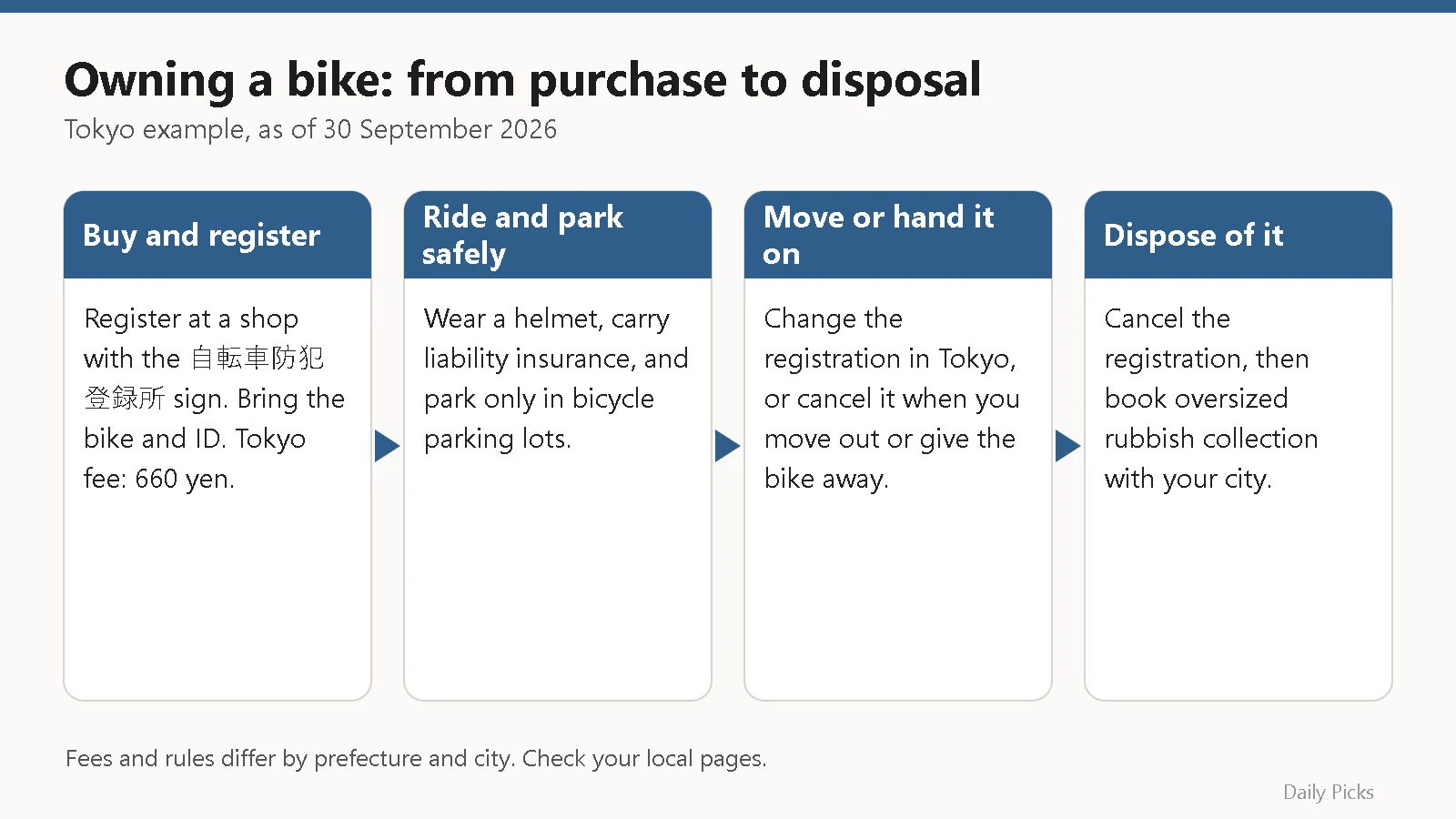
Do not leave an unwanted bike at a station or in your building’s bike area. Cancel the registration, then use your city’s oversized rubbish (粗大ごみ, sodai gomi) collection, or give or sell the bike to someone who will register it again.
In Shinjuku, as of 30 September 2026, the steps and fees are:
- Apply to the Shinjuku Oversized Garbage Reception Center by phone (03-5304-8080, Monday to Saturday, 8:00 to 19:00) or online.
- Buy oversized rubbish tickets (有料粗大ごみ処理券) at a convenience store or other sales point. A bicycle under 16 inches costs 400 yen, 16 inches or more costs 900 yen, and an electric-assist bicycle costs 1,300 yen.
- Write your name or receipt number and the collection date on the ticket, stick it on the bike, and put it out on the morning of the collection day at the place you were told.
For an electric-assist bike, remove the battery first. Shinjuku City says the bike cannot be collected with the battery still attached, and the battery goes to a separate recycling route (JBRC). If you are leaving Japan, add the bike to your list in our leaving Japan checklist.
Checklist: owning a bike in Japan
- When you buy a bike, register it at a shop showing the 自転車防犯登録所 sign. Bring ID and the fee.
- Take a photo of the registration card and keep the paper copy.
- If you buy or receive a used bike, get a transfer certificate and the previous owner’s papers, then register it under your name.
- Check that you have bicycle liability insurance, or personal liability cover on another policy.
- Get a helmet, preferably one with a safety mark, and fasten the chin strap.
- Park only in bicycle parking lots or permitted places, and watch for no-parking signs near stations.
- If your bike vanishes, call your city’s removed-bike line before you report it stolen.
- When you move, change or cancel the registration, depending on your prefecture’s rules.
- When you dispose of the bike, cancel the registration and use your city’s oversized rubbish service.
Japanese words you will see
| Japanese | Reading | Meaning |
|---|---|---|
| 防犯登録 | bouhan touroku | Bicycle anti-theft registration |
| 自転車防犯登録所 | jitensha bouhan tourokujo | Registration point (usually a bike shop) |
| 控え | hikae | Your copy of the registration record |
| 譲渡証明書 | jouto shomeisho | Transfer certificate (proof the bike was given or sold to you) |
| 抹消登録 | masshou touroku | Cancellation of registration |
| 駐輪場 | chuurinjou | Bicycle parking lot |
| 放置禁止区域 | houchi kinshi kuiki | No-parking zone for bicycles |
| 撤去 | tekkyo | Removal (of an illegally parked bike) |
| 個人賠償責任保険 | kojin baishou sekinin hoken | Personal liability insurance |
| 粗大ごみ | sodai gomi | Oversized rubbish |
FAQ
Is bicycle registration really required, or only recommended?
It is required. The Tokyo Metropolitan Police Department states that bicycle owners are obliged to register their bicycles, based on the Act on Promotion of Safe Bicycle Use and Comprehensive Promotion of Bicycle Parking Measures.
Can I register at the police station or city office?
No. In Tokyo, registration is done at bike shops, supermarkets and home centres that display the 自転車防犯登録所 sign. Shinjuku City also notes that registration is done at registration points, not at police stations.
I lost my registration card. What now?
The Tokyo police page says the card is not reissued. For a change or cancellation in Tokyo, the association lists the card as something to bring “if available”, so you can still go with the bike and your ID. Ask the registration point what they need in your case.
My bike is registered in another prefecture. Is that valid in Tokyo?
The Tokyo association explains that registration is run separately by each prefecture and is not shared nationwide, so you register the bike in Tokyo.
Is there a fine for not wearing a helmet?
The helmet rule is a duty to make an effort. The National Police Agency and Tokyo police pages describe it as an effort obligation and do not list a penalty for it. Wearing one is still strongly encouraged for your safety.
Related reading
- Bicycle fines and the traffic safety campaign in Japan
- Moving house in Japan: address change checklist
Sources
- 自転車防犯登録 – Tokyo Metropolitan Police Department
- 自転車の防犯登録について – Setagaya City
- 自転車の防犯登録について – Shinjuku City
- Registering a bike bought online – Tokyo Bicycle Dealers Crime Prevention Association
- Registering a bike received from someone – Tokyo Bicycle Dealers Crime Prevention Association
- Change of registration – Tokyo Bicycle Dealers Crime Prevention Association
- Cancellation of registration – Tokyo Bicycle Dealers Crime Prevention Association
- Q&A – Tokyo Bicycle Dealers Crime Prevention Association
- 防犯登録について~自転車の持ち主が変わるとき – Shinjuku City (life information for foreign residents)
- 新宿区の放置自転車対策について – Shinjuku City
- 自転車・原付を撤去された方 – Shinjuku City
- 頭部の保護が重要です ~自転車用ヘルメットと頭部保護帽~ – National Police Agency
- 自転車用ヘルメットの着用 – Tokyo Metropolitan Police Department
- 自転車損害賠償責任保険等への加入促進について – Ministry of Land, Infrastructure, Transport and Tourism
- 自転車損害賠償保険等への加入義務化について – Shinjuku City
- 粗大ごみの出し方 – Shinjuku City
- 粗大ごみの処理手数料一覧 – Shinjuku City
コメント