Summary: Japan’s government discount on household electricity and city gas ended with September usage. On 29 September 2026 the major regional power companies published their prices for the November bill (October usage), and their model household bills went up by roughly ¥800 to ¥1,600 a month. Most of the rise comes from the end of the discount (¥3.50 per kWh), not from fuel prices. Several companies also add a network-charge revision from 1 November. You do not need to apply for anything or change any setting. The higher price will simply appear on the bill you receive in November. If you want to lower it, the things you can change are your contract size (amperes), your plan and your supplier.
What is changing
From July to September 2026, the government ran a temporary support program for electricity and city gas bills (in Japanese, denki gasu ryokin shien). For ordinary homes on a low-voltage contract, the discount was ¥3.50 per kWh for July and September usage and ¥4.50 per kWh for August usage. City gas was discounted by ¥14.0 per cubic metre (¥18.0 in August). The program’s official website lists September usage as the last month.
That means October usage is charged at the full price again. When the power companies announced their November prices on 29 September, each one showed a clear jump compared with the October bill, which still included the discount. Kyodo News reported that all ten major power companies’ bills rise for October usage.
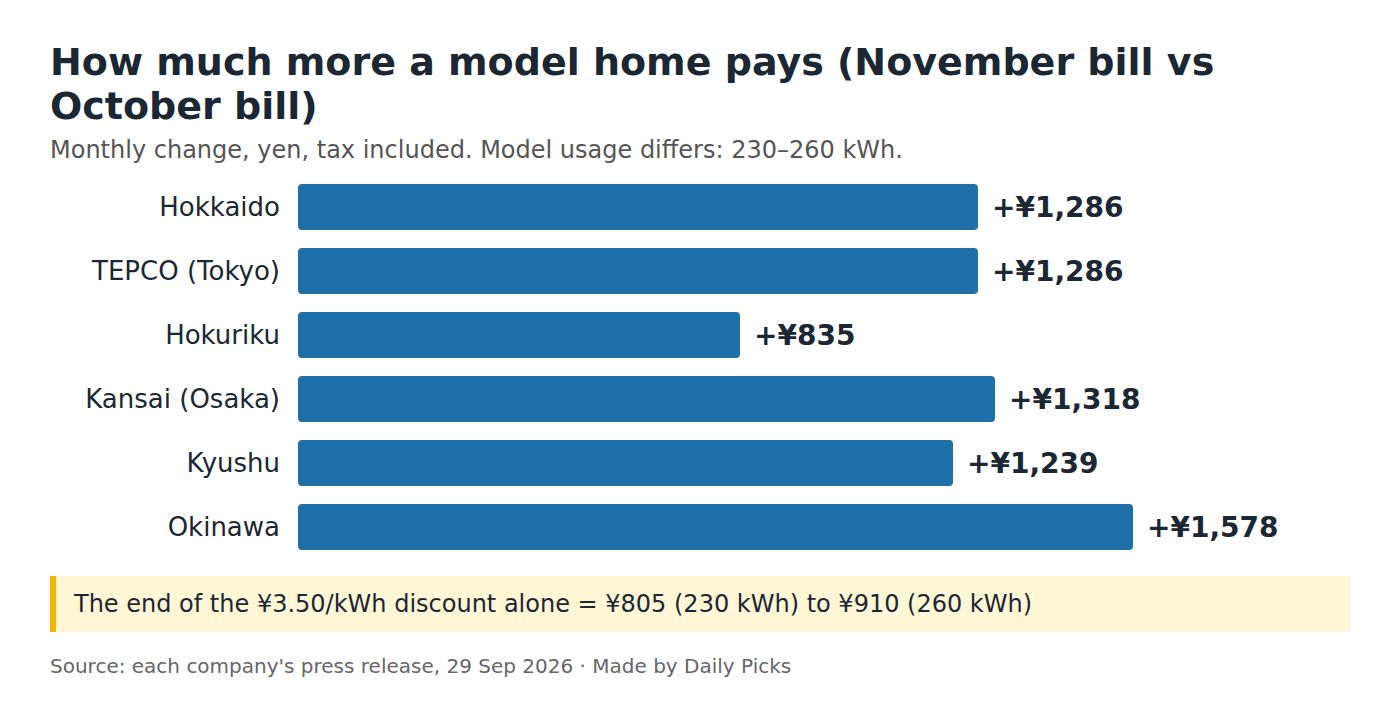
Here are the model household bills from the companies’ own press releases. The usage levels are different by company, so compare the change, not the totals.
| Company (area) | Model household | October bill | November bill | Change |
|---|---|---|---|---|
| Hokkaido Electric | 30A, 230 kWh | ¥9,266 | ¥10,552 | +¥1,286 |
| TEPCO Energy Partner (Tokyo area) | 30A, 260 kWh | ¥8,275 | ¥9,561 | +¥1,286 |
| Hokuriku Electric | 30A, 230 kWh | ¥7,135 | ¥7,970 | +¥835 |
| Kansai Electric (Osaka area) | 260 kWh | ¥6,933 | ¥8,251 | +¥1,318 |
| Kyushu Electric | 30A, 250 kWh | ¥6,876 | ¥8,115 | +¥1,239 |
| Okinawa Electric | 260 kWh | ¥9,174 | ¥10,752 | +¥1,578 |
All figures include consumption tax and the renewable energy surcharge. They are the standard regulated plans (juryo dento), which many apartments use by default.
Why the rise is mostly not about fuel
It is easy to read “electricity prices up” and assume oil or gas became more expensive. This time, most of the change is about rules, not fuel.
- The discount ended. At ¥3.50 per kWh, the lost discount is ¥805 for 230 kWh, ¥875 for 250 kWh and ¥910 for 260 kWh. For TEPCO’s model home, ¥910 of the ¥1,286 rise is simply the discount disappearing. Hokuriku Electric says its ¥835 rise is ¥805 from the end of the discount and only ¥30 from fuel cost adjustment.
- A network-charge revision on 1 November. Power companies pay a fee to use the power lines (takuso ryokin). Several companies are passing a revision of this fee into household prices from 1 November. Kansai Electric says ¥408 of its model rise comes from this change, and Chubu Electric Power Miraiz gives ¥395.
- Fuel cost adjustment is small. TEPCO’s low-voltage fuel cost adjustment moves from minus ¥5.80 to minus ¥5.33 per kWh, a change of less than 50 sen. Kansai and Kyushu Electric both say the average fuel price went over their upper limit, so they calculated with the capped price. Above that limit, higher fuel costs are not passed on to regulated plans.
This matters because you cannot reduce the first two parts by using less power at home. They are fixed changes in price.
Who is affected
Almost every household that pays its own electricity bill will see a higher price per kWh for October usage. This includes people on the major companies’ regulated plans and, in general, people on other suppliers’ plans that showed the government discount on the bill. If your bill or app showed a line for the discount (often written as 国の支援 or 値引き) between August and October, that line will be gone from the November bill.
City gas is also rising. Tokyo Gas says a standard home using 30 cubic metres a month will pay ¥744 more on the November bill, and the other major city gas companies announced increases too. We explained the Tokyo Gas basic charge change in a separate article (see Related reading).
When you will notice it
“October usage” does not mean 1 to 31 October. It means the period between your meter reading date in October and the day before your meter reading date in November. The bill for that period arrives after the November reading. So most people will first see the higher amount in November, and payment by card or bank transfer usually follows later.
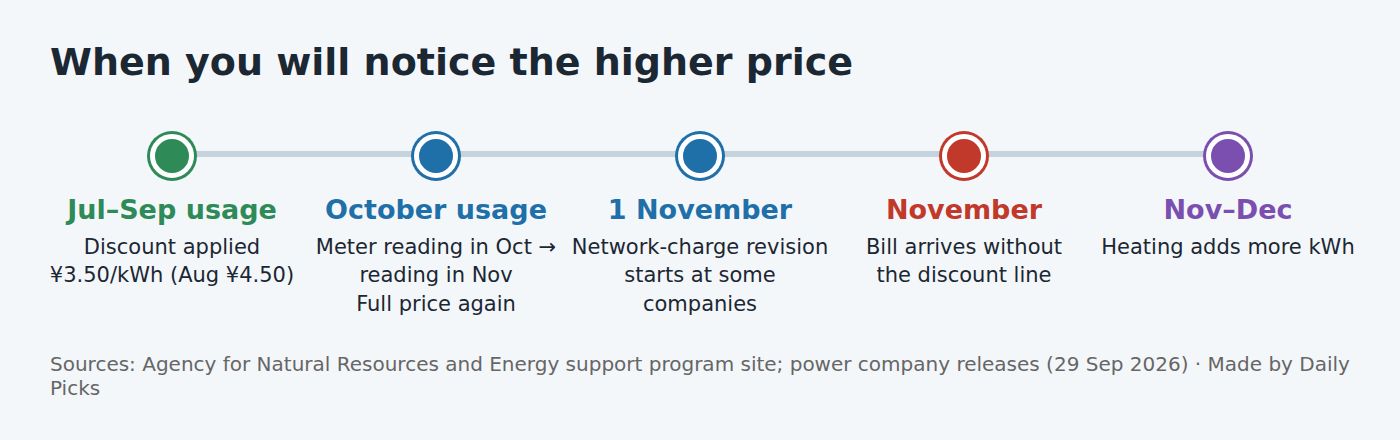
Remember that heating also starts in November and December. Even if prices stayed the same, the bill would grow because you use more power. The two effects arrive at the same time.
What you can do now
- Check your meter reading notice or app. Look for the usage period and the amount of kWh. Your supplier’s app or web account (for example, TEPCO’s “Kurashi TEPCO web” or Kansai Electric’s “Hapi e-miruden”) shows past months, so you can compare the same months.
- Check your contract amperes. On many plans in eastern Japan the basic charge depends on the ampere size (for example 30A or 40A). If you live alone and the breaker never trips, a smaller size may lower the basic charge. The power company can change it; in rented homes, ask your landlord or management company first.
- Look at your plan. If you are on the default regulated plan, your supplier may offer other plans. Compare them using your own kWh usage, not the model household.
- Compare suppliers carefully. Since 2016 you can choose your electricity company. Before switching, read the cancellation fee, the minimum contract period and how the plan handles fuel costs. Some plans are linked to the market price and can rise sharply in winter.
- Plan your heating. Use the room’s heater or air conditioner for the room you are in, close curtains at night and keep doors closed. Our guide to staying warm in a Japanese apartment covers this in more detail.
If you are not sure which company supplies your power
Look at your meter reading slip (kenshinhyo), your bank or card statement, or the papers you signed when you moved in. If electricity is included in your rent (common in some share houses and serviced apartments), the change may not reach you directly. Your landlord pays the bill, and any change to your rent or utility fee is decided under your contract.
FAQ
Do I need to do anything because the discount ended?
No. The discount was applied automatically, and its end is also automatic. There is no form to submit.
Is there another government discount this winter?
As of 30 September 2026, the official support program website lists July to September usage only. We have not found an official announcement of a new discount for winter. Check the program website or your supplier’s news page for updates.
Why does my bill differ from the model amount?
The model uses fixed conditions such as 260 kWh a month. Your bill depends on your own usage, your contract amperes, your plan and your payment method. Use the change per kWh (about ¥3.50 from the discount alone) to estimate your own difference: for example, 150 kWh × ¥3.50 = ¥525.
My supplier is not one of the major companies. Will my price rise too?
If your bill showed the government discount, you will lose it in the same way. Other price changes depend on your supplier’s own plan, so check its news page or your account.
Related reading
- Tokyo Gas raises its basic charge by ¥150: it shows up on the November bill
- Staying warm in a Japanese apartment this winter
日本語で読む:10月使用分の電気代は大手10社すべて値上がり、東京電力は9,561円|上げ幅835〜1,578円の内訳と、請求に出るのは11月
Sources
Checked on 30 September 2026.
- Electricity and gas bill support program, official website (Agency for Natural Resources and Energy, Japanese)
- TEPCO Energy Partner: fuel cost adjustment for the November 2026 bill (29 Sep 2026, PDF, Japanese)
- Hokkaido Electric Power: November 2026 electricity rates (29 Sep 2026, Japanese)
- Chubu Electric Power Miraiz: November 2026 electricity rates (29 Sep 2026, Japanese)
- Hokuriku Electric Power: November 2026 electricity rates (29 Sep 2026, PDF, Japanese)
- Kansai Electric Power: November 2026 electricity rates (29 Sep 2026, PDF, Japanese)
- Kyushu Electric Power: November 2026 fuel cost adjustment (29 Sep 2026, Japanese)
- Okinawa Electric Power: November 2026 electricity rates (29 Sep 2026, PDF, Japanese)
- Tokyo Gas: gas rates for the November 2026 meter reading (29 Sep 2026, Japanese)
- Kyodo News via nippon.com: October electricity bills rise at all companies (Japanese)