Summary: Furusato nozei (“hometown tax donation”) lets you donate to a Japanese prefecture or municipality of your choice and have most of the donation taken off your income tax and resident tax. In principle, the part above 2,000 yen is deducted, up to a limit that depends on your income and family. Many salaried workers can use the One-Stop Special Exception instead of filing a tax return, if they donate to five or fewer municipalities and send the forms by 10 January. This guide explains the rules, the deadlines and the October 2025 change, based on official pages as of 30 September 2026.
What furusato nozei is
Despite the name, furusato nozei is not a tax you pay. It is a donation. The Ministry of Internal Affairs and Communications (MIC) describes it as a system where you choose a local government you want to support and make a donation to it. The tax system then treats most of that donation as a deduction.
According to MIC’s FAQ, there is no limit on which local governments you can donate to. Any prefecture or city, town or village in Japan can receive a donation. You do not need to have lived there. There is also no limit on the number of local governments you donate to, but the One-Stop Special Exception explained below only works for five or fewer.
Because the benefit comes as a reduction in your income tax and resident tax, it only makes sense if you pay those taxes in Japan. If you are not sure whether you pay resident tax, look at your payslip or the resident tax notice you receive each year. MIC’s FAQ also says the donation must be made by the taxpayer and in the taxpayer’s own name. A donation in a spouse’s name does not reduce your own tax.
Since 1 June 2019, a designation system applies. According to MIC’s portal, donations to local governments that are not designated by the Minister are excluded from the tax benefit. Before you donate, it is worth checking that the local government takes part in the system.
How the tax deduction works
MIC’s overview page says that, in principle, the part of your donation above 2,000 yen is deducted in full from your income tax and resident tax. So 2,000 yen is always your own cost. The rest comes back as lower tax, as long as you stay within your limit.
MIC gives one example. A salaried worker with an annual income of 7 million yen, whose only dependant is a spouse, donates 30,000 yen. The part above 2,000 yen, which is 28,000 yen (30,000 yen minus 2,000 yen), is deducted from income tax and resident tax.
The deduction is made of three parts. MIC’s page on tax deductions sets them out as follows.
| Part | How it is calculated | Cap (per MIC) |
|---|---|---|
| Income tax | (Donation − 2,000 yen) × your income tax rate | Donations counted up to 40% of total income |
| Resident tax, basic part | (Donation − 2,000 yen) × 10% | Donations counted up to 30% of total income |
| Resident tax, special part | (Donation − 2,000 yen) × (100% − 10% − your income tax rate) | Up to 20% of your income-based resident tax |
The special part is where the limit comes from. If your donations push it above 20% of your income-based resident tax, the extra is not fully deducted, and you pay more than 2,000 yen yourself. Your limit depends on your income, your family and your other deductions. MIC’s FAQ says the limit differs from person to person and suggests asking the resident tax section of your city office.
Two ways to get the deduction
There are two routes. You either file a final tax return (kakutei shinkoku), or you use the One-Stop Special Exception (wan sutoppu tokurei). The table compares them, based on MIC’s page on the procedure and the MIC FAQ.
| Tax return | One-Stop Special Exception | |
|---|---|---|
| Who can use it | Anyone making a donation | People such as salaried workers who do not need to file a tax return |
| Number of local governments | No limit | 5 or fewer |
| What you send | A tax return with the donation details | An application form to each local government |
| Deadline | 15 March of the next year | 10 January of the next year (arrival) |
| Where the deduction appears | Income tax for that year, plus resident tax for the next fiscal year | All of it as lower resident tax for the next fiscal year |
With the One-Stop Special Exception, MIC explains that no deduction is made from income tax. Instead, the whole amount, including the part that would have come from income tax, is deducted from your resident tax for the following fiscal year.
Using the One-Stop Special Exception
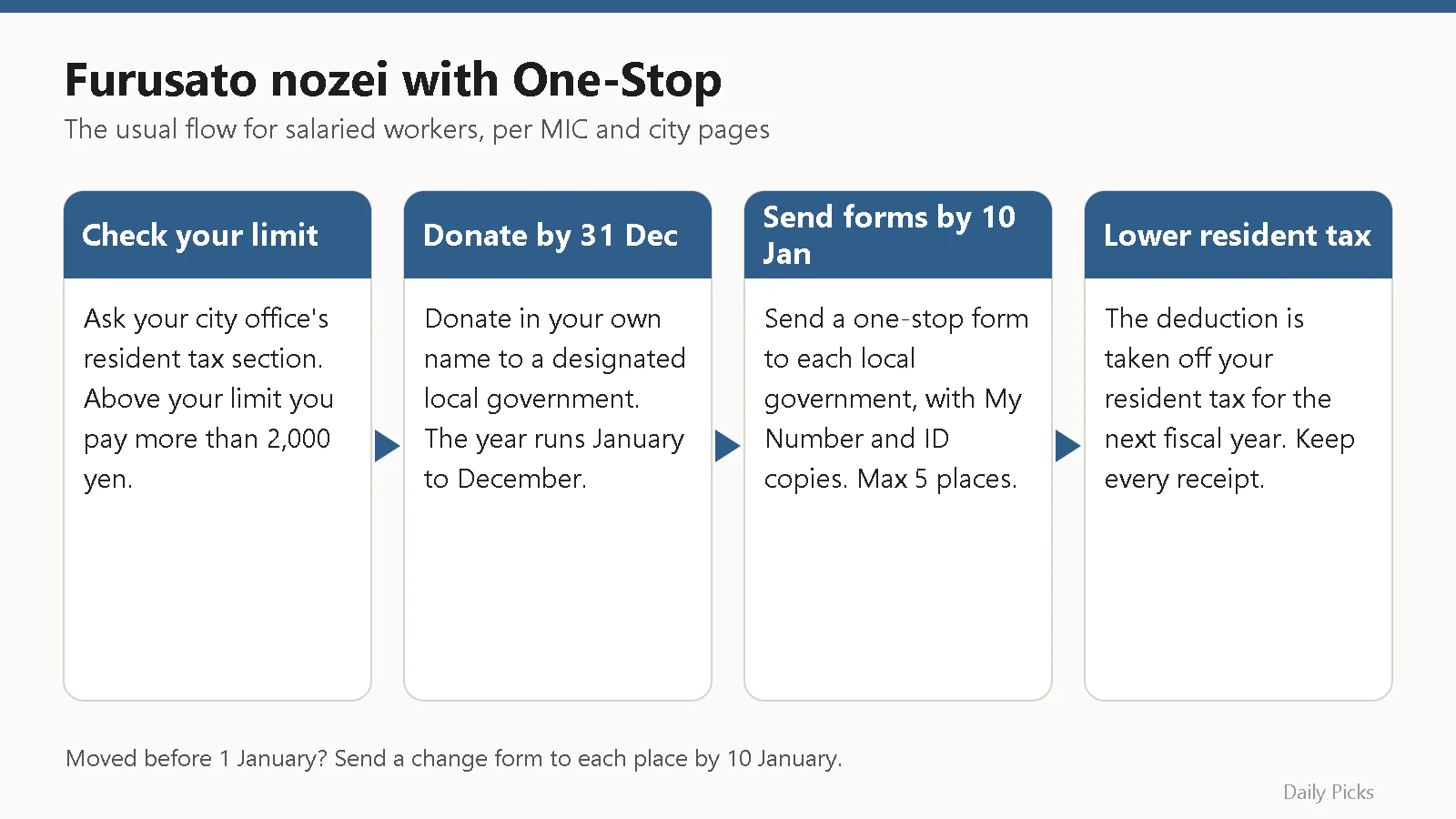
According to MIC and the National Tax Agency (NTA), you can use the One-Stop Special Exception if both of these are true: you do not need to file a tax return (for example, your employer does your year-end adjustment), and you donate to five or fewer local governments in the year.
MIC’s FAQ notes that ticking a box on a payment slip is not enough. You need to send the application form (shinseisho) to each local government. City pages such as Fukui City and Higashihiroshima City say the form must arrive by 10 January of the year after the donation. They ask for a copy of a document showing your My Number and a copy of an identity document. A copy of both sides of a My Number Card covers both. Fukui City also accepts the application online.
When you need a tax return instead
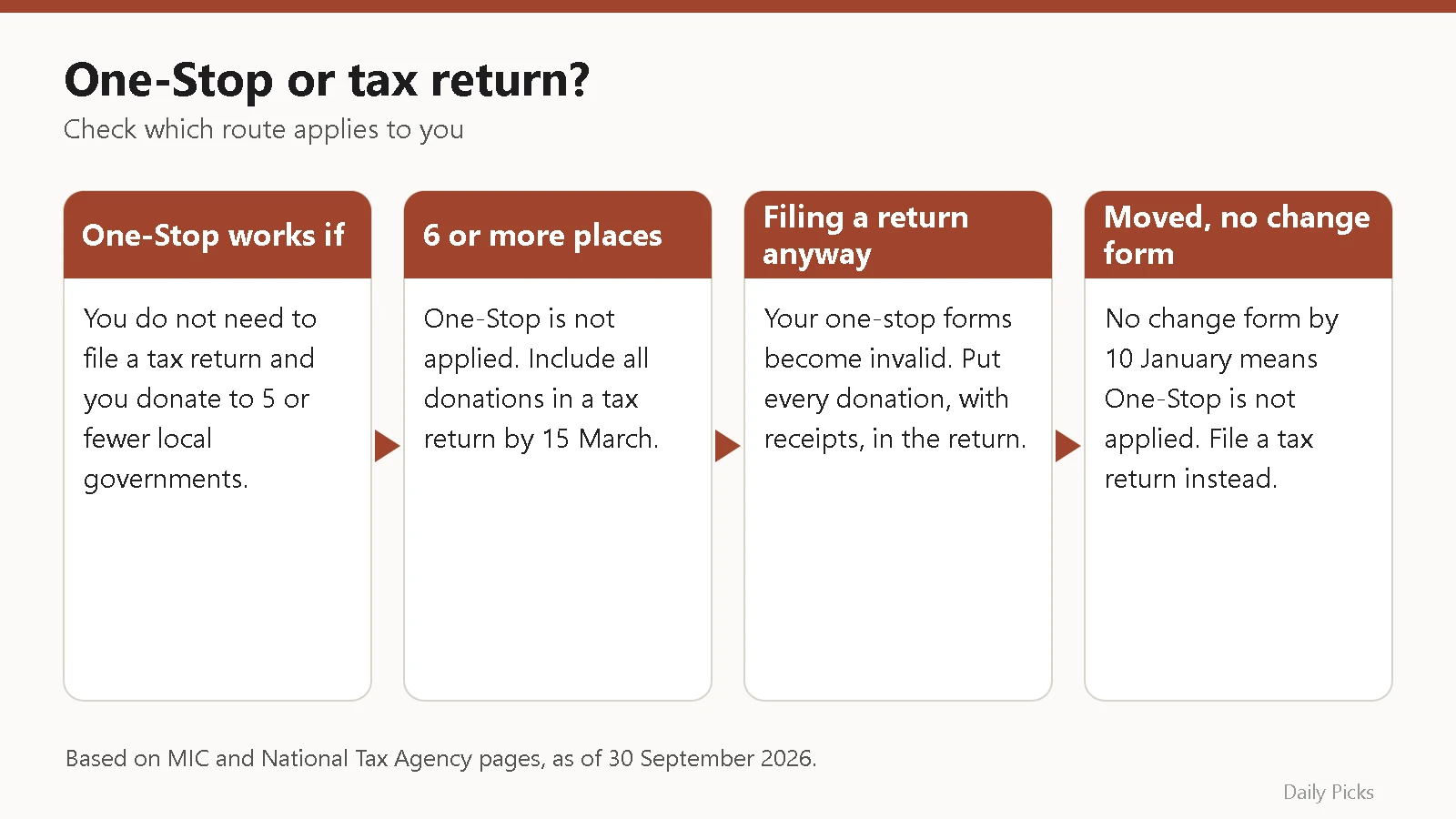
MIC’s one-stop leaflet lists the cases where the exception is not applied. In these cases you need to include your donations in a tax return to get the deduction.
- You file a tax return, or a resident tax return, for any reason.
- You donate to six or more local governments in the year.
- Your address or name changed and you did not send a change notification (henko todokedesho) by 10 January of the next year.
The NTA Tokyo Regional Taxation Bureau makes an important point. If you file a tax return, your one-stop applications become invalid. You then need to include all your donations in the return, including those you applied for under the one-stop route. This matters if you plan to file a return for another reason, such as having income outside your job.
For the tax return route, MIC’s procedure page says to keep the receipt (juryo shomeisho) sent by each local government and to file by 15 March of the year after the donation.
Deadlines for the calendar year
MIC’s FAQ says you can donate at any time, but the tax benefit is counted by calendar year, from January to December. A donation made by 31 December counts for that year. A donation made in January counts for the next year.
- Check your limit with your city office’s resident tax section, or work it out from your income and family.
- Check that the local government is designated for the system.
- Donate in your own name by 31 December.
- If you use the One-Stop Special Exception, send the form to each local government so it arrives by 10 January.
- If your address or name changes before 1 January, send a change notification to each local government by 10 January.
- Keep every receipt.
- If you file a tax return, include all donations and file by 15 March.
- Look for the reduction in your resident tax for the next fiscal year.
Rules on return gifts and portal points
Many local governments send a return gift (henreihin) to thank donors. MIC sets rules that designated local governments follow. According to MIC’s documents, the cost of return gifts is capped at 30% of the donation, a rule set in the Local Tax Act. Return gifts also need to be local products (jibasanpin) that meet MIC’s criteria. MIC also limits the total cost of collecting donations to 50% or less of the donation amount.
A new rule started on 1 October 2025. In a notice dated 24 June 2025, MIC stated that from that date, a local government that collects donations through a business that gives points to donors (for example, a portal site with point rewards) may lose its designation. In MIC’s April 2025 summary, this is described as a ban on collecting donations through portal sites that give points to donors.
Return gifts may also affect your own tax. MIC’s FAQ says return gifts count as occasional income (ichiji shotoku), and can be taxed if your occasional income in a year goes above 500,000 yen.
If you leave Japan
Timing matters if you plan to leave Japan. MIC’s resident tax page says individual resident tax is charged to people who have an address in the municipality on 1 January of that year. City pages such as Edogawa City add that people living abroad on 1 January without a resident registration are, as a rule, not charged resident tax for that year.
Remember that most of the furusato nozei deduction is taken off the resident tax for the following fiscal year. With the One-Stop Special Exception, all of it is. If you will not have an address in Japan on 1 January of the next year, there may be no resident tax for the deduction to reduce. If you are planning to move abroad, ask the resident tax section of your city office before you donate.
Leaving Japan also has its own resident tax steps. Kumagaya City, for example, explains that tax for the current year is still owed to the city where you lived on 1 January, and that you may need to name a tax representative (nozei kanrinin) before you go.
Japanese words you will see
| Japanese | Reading | Meaning |
|---|---|---|
| ふるさと納税 | furusato nozei | Hometown tax donation |
| 寄附金控除 | kifukin kojo | Deduction for donations |
| ワンストップ特例 | wan sutoppu tokurei | One-Stop Special Exception |
| 申請書 | shinseisho | Application form |
| 変更届出書 | henko todokedesho | Change notification form |
| 受領証明書 | juryo shomeisho | Receipt for the donation |
| 確定申告 | kakutei shinkoku | Final tax return |
| 返礼品 | henreihin | Return gift |
| 地場産品 | jibasanpin | Local product |
| 住民税 | juminzei | Resident tax |
FAQ
Is the 2,000 yen always my own cost?
Yes. MIC’s pages say the part above 2,000 yen is deducted in principle. If you go over your limit, you pay more than 2,000 yen yourself.
I donated to six places. Can I still use the One-Stop Special Exception?
No. According to MIC, the exception is only for five or fewer local governments. You need to include all donations in a tax return by 15 March of the next year.
I sent one-stop forms, but now I need to file a tax return. What happens?
According to the NTA, filing a tax return makes your one-stop applications invalid. Include every donation in your return, including those covered by the forms.
I moved after sending the form. Do I need to do anything?
Yes. City pages say that if your address or name changes before 1 January of the next year, you send a change notification to each local government by 10 January. Otherwise the exception may not be applied.
How do I find my exact limit?
MIC does not give one figure for everyone. It shows the formulas and suggests asking the resident tax section of your city office, as the limit depends on your income, family and other deductions.
Related reading
- Resident tax notice in Japan
- Year-end adjustment (nenmatsu chosei) forms
- Moving house in Japan: address change checklist
- Moving out in Japan: deposit and cleaning bill
- Getting a jumin-hyo at a convenience store
Sources
- Furusato nozei portal – Ministry of Internal Affairs and Communications
- Overview of furusato nozei – Ministry of Internal Affairs and Communications
- The furusato nozei procedure – Ministry of Internal Affairs and Communications
- Tax deductions for furusato nozei – Ministry of Internal Affairs and Communications
- Furusato nozei FAQ – Ministry of Internal Affairs and Communications
- Furusato nozei One-Stop Special Exception – Ministry of Internal Affairs and Communications
- To those applying for the One-Stop Special Exception (PDF) – Ministry of Internal Affairs and Communications
- If you submitted a One-Stop Special Exception application – National Tax Agency, Tokyo Regional Taxation Bureau
- No.1155 Furusato nozei (deduction for donations) – National Tax Agency
- Designation criteria for furusato nozei, 25 April 2025 (PDF) – Ministry of Internal Affairs and Communications
- Notice to prefectures on furusato nozei, 24 June 2025 (PDF) – Ministry of Internal Affairs and Communications
- Individual resident tax – Ministry of Internal Affairs and Communications
- Furusato nozei One-Stop Special Exception – Fukui City
- One-Stop Special Exception (furusato nozei) – Higashihiroshima City
- Resident tax if you are abroad on 1 January – Edogawa City
- Resident tax for people leaving Japan – Kumagaya City
コメント