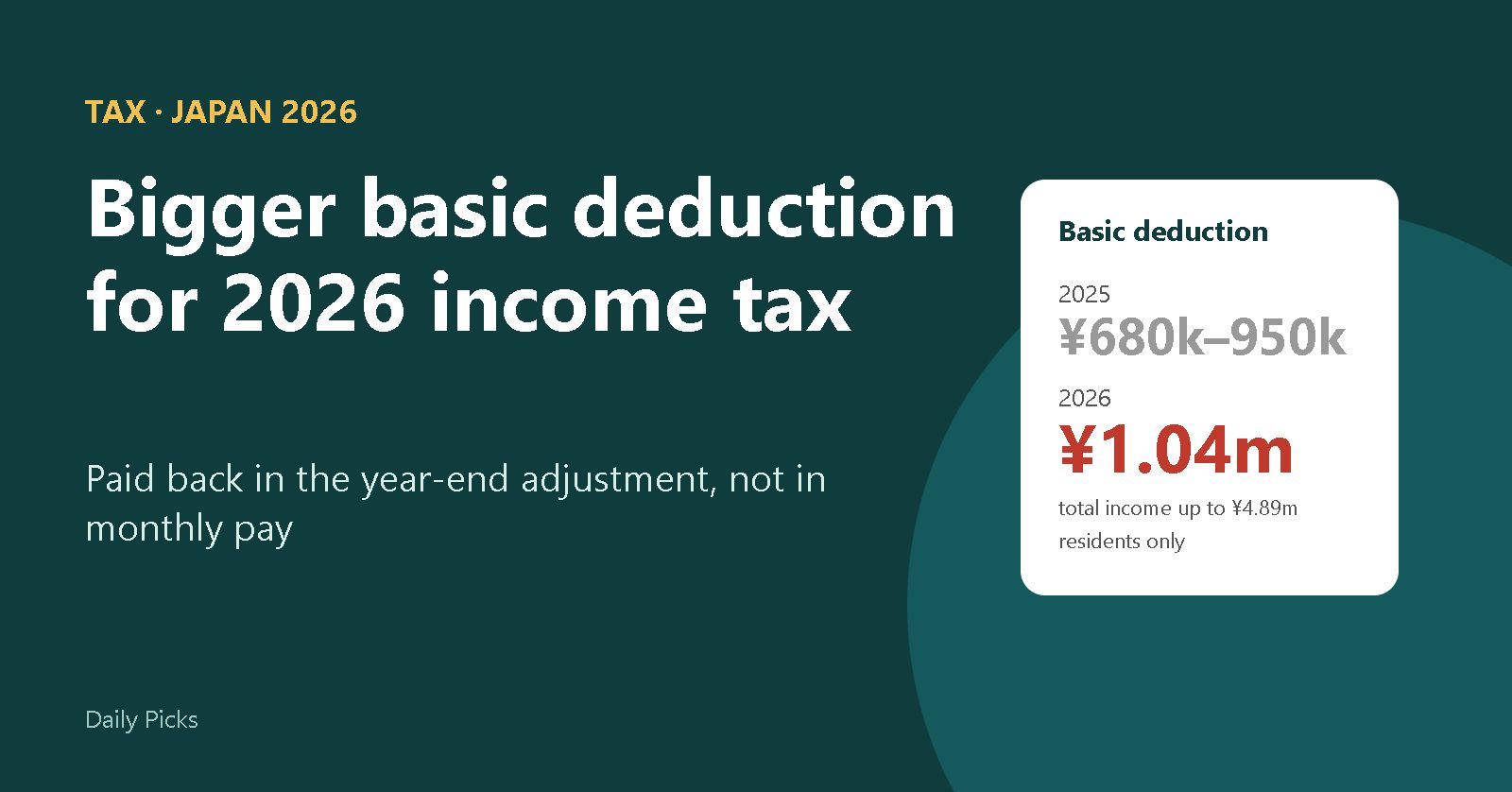
Summary: Japan has raised the basic deduction (kiso kojo) and the minimum employment income deduction for income tax in 2026. For people with “total income” of up to ¥4.89 million, the basic deduction rises to ¥1.04 million (it was ¥680,000–¥950,000 in 2025). The new rules start on 1 December 2026, so monthly tax taken from your pay does not change before then. Instead, the difference is settled in the year-end adjustment (nenmatsu chosei), usually with your December or January pay. What you need to do now: fill in the forms your employer hands out this autumn using the 2026 amounts, and check the new income limit (¥1.36 million salary) if you support a spouse or child.
What is changing
The National Tax Agency (NTA) lists four changes for the 2026 year-end adjustment:
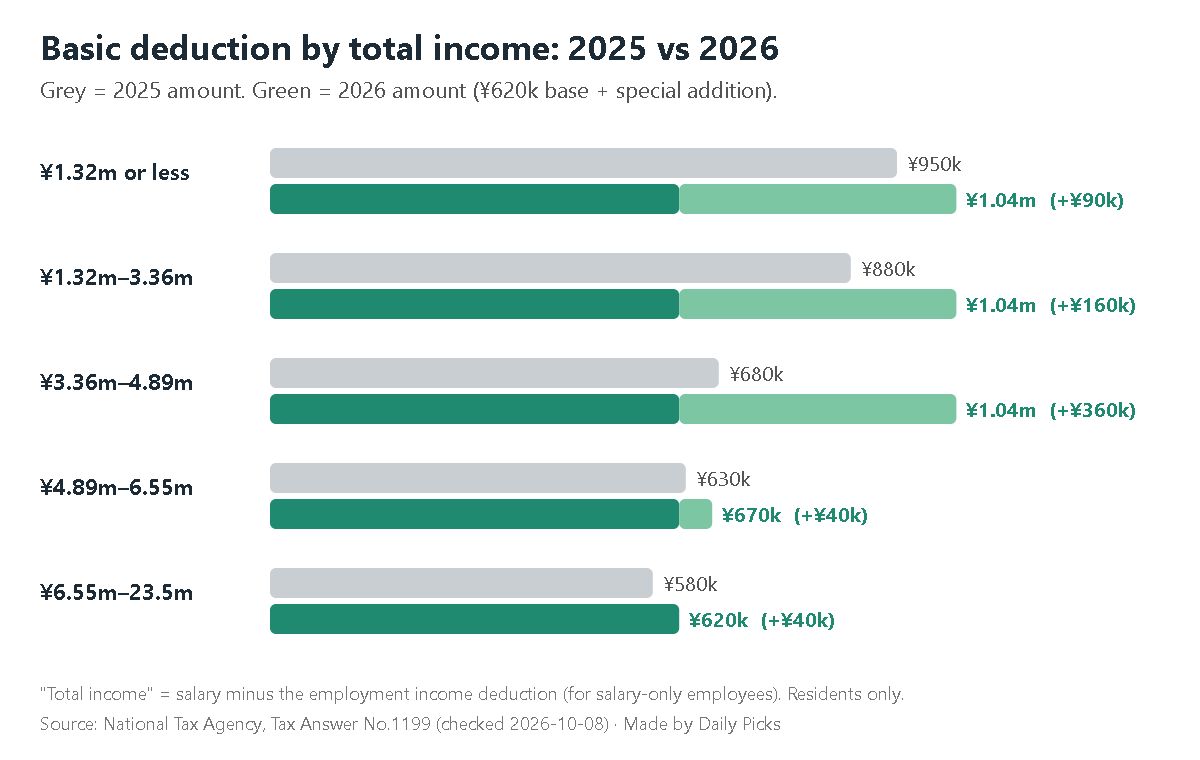
- Higher basic deduction. Everyone who lives in Japan gets a basic deduction. For 2026 it depends on your total income (gokei shotoku kingaku) as shown in the table below.
- Higher minimum employment income deduction. The part of your salary that is not taxed as “employment income” has a floor of ¥740,000 for 2026 (it was ¥650,000).
- Higher income limit for dependants. A spouse, child or other relative can be your dependant if their total income is ¥620,000 or less. For someone who only has a salary, that means ¥1.36 million a year or less (it was ¥1.23 million).
- A larger life insurance deduction for people who have a dependant under 23.
| Your total income for 2026 | Basic deduction 2025 | Basic deduction 2026 | Extra deduction |
|---|---|---|---|
| ¥1.32 million or less | ¥950,000 | ¥1,040,000 | +¥90,000 |
| Over ¥1.32 million to ¥3.36 million | ¥880,000 | ¥1,040,000 | +¥160,000 |
| Over ¥3.36 million to ¥4.89 million | ¥680,000 | ¥1,040,000 | +¥360,000 |
| Over ¥4.89 million to ¥6.55 million | ¥630,000 | ¥670,000 | +¥40,000 |
| Over ¥6.55 million to ¥23.5 million | ¥580,000 | ¥620,000 | +¥40,000 |
| Over ¥23.5 million | No change (¥480,000 / ¥320,000 / ¥160,000 / ¥0) | — | |
Checked: 2026-10-08. Source: National Tax Agency, Tax Answer No.1199 (Basic deduction). “Total income” for an employee with no other income is salary minus the employment income deduction, not your gross pay. From 2028 the amounts change again (¥990,000 for total income up to ¥1.32 million, ¥620,000 above that).
Put together, an employee with only salary income and no other deductions pays no national income tax on pay of up to about ¥1.78 million in 2026 (¥740,000 employment income deduction + ¥1.04 million basic deduction). In 2025 that line was about ¥1.6 million. This is our calculation from the NTA figures; social insurance and other deductions lower your taxable income further.
Who is affected
- Most employees who live in Japan. If you are a “resident” for tax purposes (in general, your home is in Japan, or you have lived here for one year or more), the higher amounts apply. The largest gain is for people with total income between ¥3.36 million and ¥4.89 million: their deduction rises by ¥360,000.
- Part-time workers and students. The higher limits mean you can earn more before income tax starts, and a working student can earn up to ¥1.63 million in salary and still claim the working student deduction (it was ¥1.5 million).
- People who support a family member. If your spouse or child earns ¥1.36 million or less in salary, they can now be your dependant. Between ¥1.36 million and ¥2.07 million, a spouse may still give you the spouse special deduction.
- Non-residents do not get the special addition. Their basic deduction is up to ¥620,000.
These changes are for national income tax (shotokuzei). Resident tax (juminzei) is calculated separately by your city. See how to read your resident tax notice.
When you will notice it
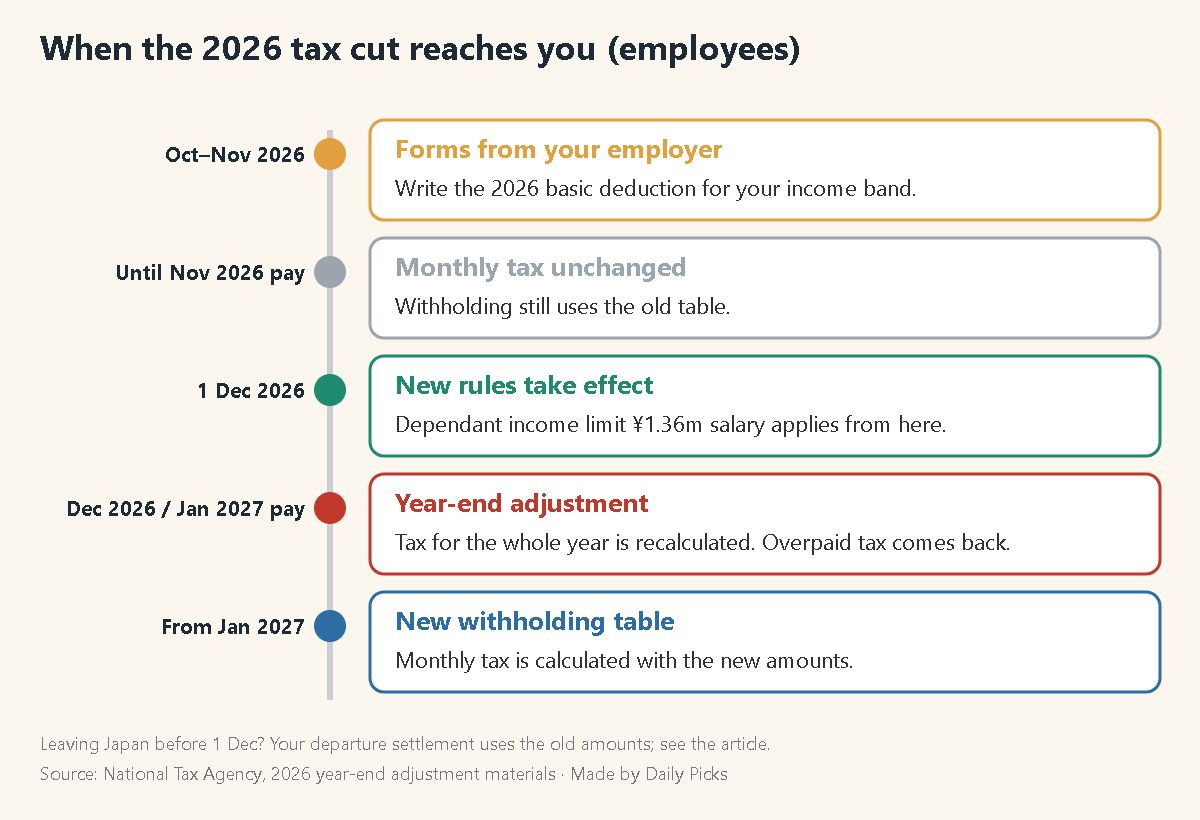
- October–November 2026: your employer gives you the year-end adjustment forms. The 2026 basic deduction form already has the new amounts.
- Pay until November 2026: the monthly withholding is calculated with the old table. The NTA says nothing changes in withholding until November.
- 1 December 2026: the new rules take effect.
- December 2026 (or January 2027) pay: your employer recalculates your tax for the whole year. If more tax was withheld than you owe, the difference is refunded to you, usually added to your pay. Your gensen choshu-hyo (withholding slip) will show the final amount.
- January 2027 onward: a new monthly withholding table is used.
What you can do now
- Return the forms on time. Your employer can only apply the new deduction if you submit the basic deduction form. Our guide to the three year-end adjustment forms explains each box.
- Estimate your total income for 2026. Write the basic deduction that matches your band. If you earn about ¥4.8–5 million in salary, check carefully: the band edge at ¥4.89 million of total income makes a big difference (¥1.04 million vs ¥670,000).
- Check your family members’ income again. A spouse or child who earned too much last year may qualify now (¥1.36 million salary or less). If someone newly qualifies, the NTA Q&A says to submit a new dependants form (fuyo kojo-to shinkokusho) and write “令和8年12月1日 改正” in the change column.
- If your family lives outside Japan, the same income limit applies, but the documents are stricter. You need proof of the relationship and of money you sent. Relatives aged 30–69 qualify only if they are studying abroad, have a disability, or received at least ¥380,000 from you during the year. Ask your employer which documents they need, and get them translated into Japanese.
- If you have a child under 23, keep your life insurance certificate. The general life insurance deduction limit rises to ¥60,000 for 2026 in this case.
If you leave Japan before December
This is the part most likely to catch foreign residents. If your last salary in Japan is paid before 1 December 2026, your employer’s year-end adjustment at departure uses the old amounts. A departure tax return filed on or before 30 November also uses the old amounts. According to the NTA, you can still claim the higher deduction later by filing a request for correction (kosei no seikyu) on or after 1 December. If you will be abroad, you usually need a tax agent in Japan (nozei kanrinin) to handle this. Ask your tax office before you leave.
If you are self-employed or have other income
There is no year-end adjustment for you. You claim the new basic deduction in your final tax return (kakutei shinkoku) for 2026, filed in early 2027. Employees may also need one, for example if their salary is over ¥20 million (no year-end adjustment is done), in some two-job cases, or to claim deductions such as medical expenses.
FAQ
Will my monthly take-home pay go up from October?
No. The NTA says monthly withholding does not change until November 2026. The tax cut for 2026 comes in one go through the year-end adjustment.
How much will I get back?
It depends on your income and other deductions. As a rough guide, multiply the “extra deduction” in the table by your income tax rate (5% or 10% for most employees), then add 2.1% for the reconstruction surtax. For example, an extra ¥160,000 at a 5% rate is about ¥8,000.
I am on a work visa and arrived in 2026. Do I get the new amounts?
If you are a tax resident and work for a Japanese employer at the end of the year, your employer applies the 2026 amounts in the year-end adjustment. Whether you are a resident for tax purposes depends on your situation; the tax office can confirm this. This article does not cover visa or residence status questions.
My spouse works part-time and earned ¥1.3 million. Can I claim them now?
Under the 2026 rules, yes, if their only income is a salary of ¥1.36 million or less and they are not claimed by someone else. Submit or update the dependants form with your employer.
Does this change my resident tax?
This article covers national income tax. Resident tax is calculated by your city using its own rules, and the bill arrives from June. Check your city’s tax office if you are unsure.
Related reading
- Year-end adjustment (nenmatsu chosei) in Japan: the three forms your company gives you
- The resident tax notice in Japan: how to read the juminzei letter
- Minimum wage rises across Japan in autumn 2026
Sources
- National Tax Agency: Tax Answer No.1199, Basic deduction (checked 2026-10-08)
- National Tax Agency: Year-end adjustment page (2026)
- National Tax Agency: What changed from last year (2026 year-end adjustment, PDF)
- National Tax Agency: 2026 tax reform, higher basic deduction
- National Tax Agency: Q&A on the higher basic deduction (PDF)
- National Tax Agency: Outline of withholding tax changes (PDF)
- National Tax Agency: Basic deduction declaration form (2026)
- Minato City: Rules for dependants living outside Japan