Summary: When a train in Japan runs late, railway companies publish a delay certificate (遅延証明書, chien shomeisho) that you can show to your school or employer. JR East posts certificates for about the past 45 days on its website, and Tokyo Metro has issued certificates online only since 1 April 2026, keeping about 35 days. In winter, snow and strong wind can slow or stop trains, and companies may announce planned suspensions in advance. This guide explains how to get a certificate, how to check service status in English, and what refunds are available, as of 30 September 2026.
- What a delay certificate is and what it proves
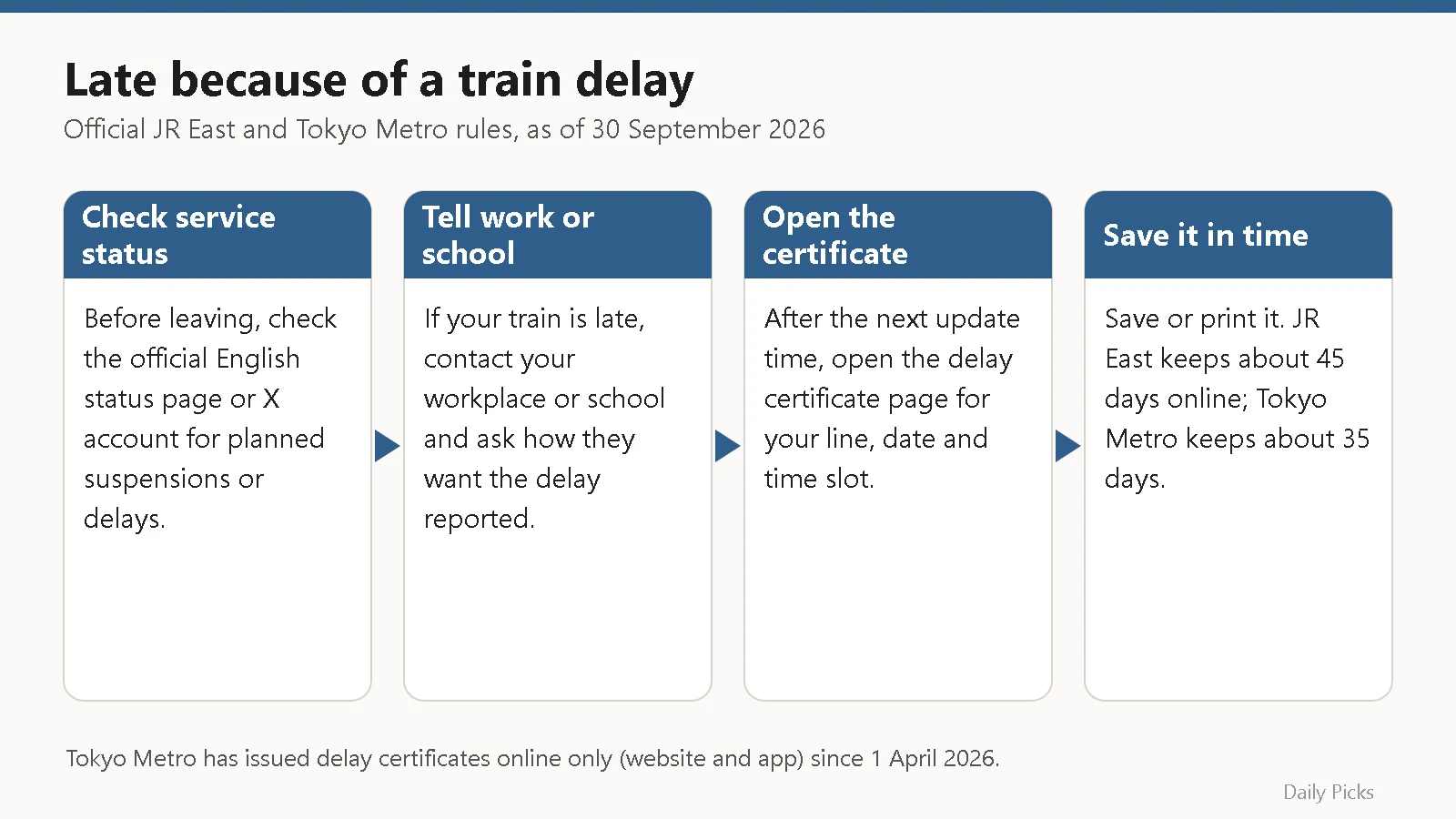
- How to get a certificate: JR East and Tokyo Metro
- Checking service status in English
- Why snow and strong wind stop trains
- Planned suspensions (keikaku unkyu)
- Refunds and alternative routes when trains stop
- If your train stops between stations
- Japanese words you will see
- Winter commute checklist
- FAQ
- Can I still get a paper delay certificate at a Tokyo Metro station?
- My train was 3 minutes late. Will there be a certificate?
- Does the certificate prove I was on that train?
- I forgot to save the certificate last week. Is it too late?
- My local train was 2 hours late. Can I get a refund?
- Can I use alternative transport with my Suica balance?
- Related reading
- Sources
What a delay certificate is and what it proves
A delay certificate is a short record from a railway company. It shows that a line was delayed on a certain day and in a certain time slot.
It is important to understand what the certificate does not say. JR East states that its certificate shows the largest delay that happened on that line. It does not prove the delay of each individual train. It also does not prove that you were on the train. Tokyo Metro shows delays by time slot and rounds them up to 10-minute units.
The railway company does not decide how your workplace or school treats the certificate. That is up to your employer or school. Ask your manager, HR team or school office how they want you to report a late train.
How to get a certificate: JR East and Tokyo Metro
The two largest rail operators in Tokyo now publish delay certificates on their websites. Tokyo Metro announced that it ended paper certificates at stations on 1 April 2026. Since then, it issues them only on its website and in its official app, Tokyo Metro my! app. JR East publishes certificates on its train information website for lines in the Tokyo area. For many other JR East lines, it issues them through a service called DOKOTORE (どこトレ), on the web or in an app, except for some sections.
| Point | JR East (web certificate) | Tokyo Metro |
|---|---|---|
| Where to get it | JR East train information website; DOKOTORE for many other lines | Tokyo Metro website and Tokyo Metro my! app (online only since 1 April 2026) |
| Delays covered | About 5 minutes or more | 5 minutes or more, rounded up to 10-minute units |
| How far back | Past 45 days | Past 35 days |
| Update times | Just after 7:00, 10:00, 16:00, 21:00, and about 2:00 the next day | Time slots: first train to 7:00, 7–8, 8–9, 9–10, 10–17, 17:00 to last train |
| Trains covered | Local trains on conventional lines only (not limited express, special, charter or freight trains) | Nine Tokyo Metro lines |
| English page | Yes | Yes (also Korean, Chinese, Thai, French, Spanish) |
Because the certificate is published only after an update time, a morning delay may not appear right away. On JR East, a delay during the morning rush should appear after the 10:00 update. If you use a through service, such as the Shonan-Shinjuku Line or the Ueno-Tokyo Line, JR East asks you to choose the certificate for the section you actually used.
Other companies have their own systems. For example, JR West runs its own delay certificate website. For other lines, search the company’s official site for 遅延証明書. Both JR East and Tokyo Metro say the information may differ from actual operations, and Tokyo Metro does not allow its certificate to be copied or republished without permission.
Checking service status in English
Official English sources for service status:
- JR East Train Status Information (English): shows actual or expected delays of more than 30 minutes, from 4:00 until 2:00 the next day. JR East says the page does not refresh automatically and parts use AI translation.
- JR East official X accounts in English: separate accounts post delay notices of 30 minutes or more, for example @JRE_Super_Exp_E for Shinkansen, @JRE_Chuo_E for Chuo lines in the Kanto area and @JRE_Tohoku_En for the Tohoku area.
- JR East Infoline: 050-2016-1603, 10:00 to 18:00 every day except the year-end and New Year holidays, in English, Chinese and Korean. It answers questions but does not take reservations.
- Tokyo Metro service information (English): shows actual or expected delays of 5 minutes or more on each line. Press the update button to see the latest information.
Note that the thresholds differ. JR East’s English status page shows only delays of more than 30 minutes, so a 10-minute delay may not appear there even if a delay certificate is later issued.
Why snow and strong wind stop trains
JR East explains several reasons why snow causes delays. Snow can pack into railway switches (points) so they cannot move. Trees can fall onto overhead wires and cut power. Overhead wires can freeze. In the Tokyo area, JR East says it reduces the number of trains when snow settles firmly on the ground. In areas with heavy snow, it reduces trains when there is more snow than normal clearing can handle, and it stops trains when they cannot run safely.
To keep some service running, JR East may fix switches in one position and run fewer trains. It states that when it plans to run fewer trains because of snow, it tells passengers in advance.
For wind, JR East has anemometers at places that are easily affected by wind and windbreak fences at some especially exposed places. When wind gets stronger, trains first slow down and then stop. JR East also notes that even after the wind weakens, trains may continue to run slowly or stay stopped while staff check safety. This is why service can stay suspended when the weather already looks calm.
Planned suspensions (keikaku unkyu)
A planned suspension (計画運休, keikaku unkyu) means the railway decides ahead of time to stop some or all trains before severe weather arrives. JR East says it may cancel services in advance based on information from the Japan Meteorological Agency and private weather services. It announces planned suspensions on its website, in stations and on social media.
JR East also warns that stations may be very crowded right after service restarts, because fewer trains are running at first. If a planned suspension is announced for your line, plan early: leave at a different time, use another route, or ask your employer about other arrangements.
Refunds and alternative routes when trains stop
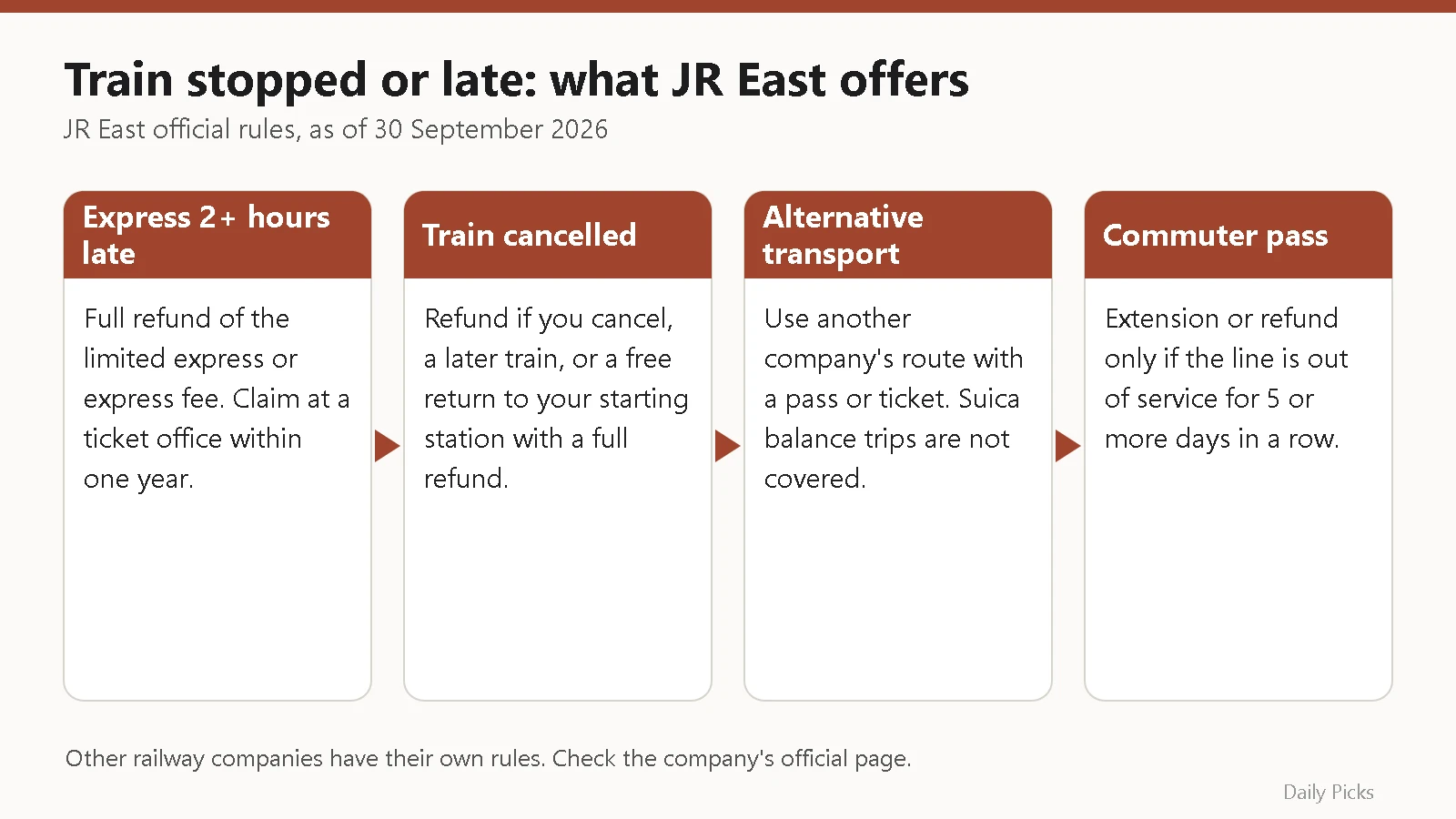
For ordinary local trains, a delay alone does not usually mean you get money back. But JR East has clear rules for limited express trains and for cancelled trains. The table below summarises JR East’s official rules. Other companies may have different rules.
| Situation (JR East) | What JR East offers |
|---|---|
| A limited express or express arrives 2 hours or more late | Full refund of the limited express or express fee (not the base fare) |
| Your train is cancelled before you start | Full refund if you cancel the trip |
| Service stops partway through your trip | Refund of the unused section, a later train, or a free return to your starting station with a full refund |
| A limited express you booked does not run | The limited express fee is refunded in full (with some exceptions in the Tokyo area) |
| Commuter pass (teiki) and the line is out of service | Extension or refund only if service stops for 5 or more days in a row |
| Deadline to claim | Up to one year from the day after the delay or cancellation |
Ask for these refunds at a JR ticket office (Midori no Madoguchi) or a travel agency. JR East states that the JR EAST PASS, a pass for overseas visitors, gets no extension or refund for cancellations or delays once it has been used.
When a line is stopped, railways sometimes offer alternative transport (振替輸送, furikae yuso). This lets you use another company’s route to reach your destination with the ticket you already have. JR East says it covers commuter passes and paper tickets within their sections. It does not cover trips paid with the stored balance on an IC card such as Suica. To use it, show your ticket or pass to staff at a manned gate.
If your train stops between stations
In snow or strong wind, a train may stop between stations and wait. JR East’s safety guide gives this advice:
- Stay on the train and listen to announcements. Do not open the doors or go onto the tracks yourself.
- If evacuation onto the tracks is needed, always follow the crew’s instructions. If a ladder is used, hold the handrails. If you must get down without a ladder, sit on the door edge and lower yourself slowly.
- If someone is sick or there is an emergency in your car, use the SOS button (非常通報装置, hijo tsuho sochi). It lets you talk to the crew.
- On a platform, the emergency stop button tells trains to stop. Never enter the tracks.
Japanese words you will see
| Japanese | Reading | Meaning |
|---|---|---|
| 遅延証明書 | chien shomeisho | Delay certificate |
| 運行情報 | unko joho | Service status information |
| 運転見合わせ | unten miawase | Service suspended (for now) |
| 計画運休 | keikaku unkyu | Planned suspension |
| 徐行運転 | joko unten | Running at reduced speed |
| 間引き運転 | mabiki unten | Running fewer trains |
| 振替輸送 | furikae yuso | Alternative transport on another route |
| 払いもどし | haraimodoshi | Refund |
| 運転再開 | unten saikai | Service resumed |
Winter commute checklist
- Ask your employer or school how they want you to report a late train, and whether they accept an online certificate.
- Bookmark the English service status page and the delay certificate page for each line you use.
- If you use JR East, follow the English X account for your area.
- The evening before snow or a storm, check the railway website for planned suspensions or reduced service.
- In the morning, check service status again before leaving home.
- Know one alternative route, and remember that IC card balance trips are not covered by alternative transport on JR East.
- If you are delayed, open the certificate page after the next update time and save or print the page for your line and time slot.
- Save it within the period it is available: about 45 days for JR East and 35 days for Tokyo Metro.
- If a JR East limited express arrives 2 hours or more late, ask for a fee refund at a ticket office within one year.
FAQ
Can I still get a paper delay certificate at a Tokyo Metro station?
No. Tokyo Metro ended paper distribution on 1 April 2026. Certificates are now issued on its website and in the Tokyo Metro my! app.
My train was 3 minutes late. Will there be a certificate?
Probably not. JR East covers delays of about 5 minutes or more, and Tokyo Metro covers delays of 5 minutes or more. Short delays below that level are not listed.
Does the certificate prove I was on that train?
No. JR East states that its certificate shows the largest delay on the line and does not prove that a passenger was on board. How your employer or school uses it is their decision.
I forgot to save the certificate last week. Is it too late?
Probably not. JR East keeps about 45 days on its website, and Tokyo Metro keeps about 35 days.
My local train was 2 hours late. Can I get a refund?
JR East’s 2-hour rule refunds the limited express or express fee. It applies to limited express and express trains, not to the base fare for local trains. If your trip was cancelled or stopped partway, you can ask about the refund options for cancelled service at a JR ticket office.
Can I use alternative transport with my Suica balance?
On JR East, no. JR East lists IC card stored balance as not eligible for alternative transport. Commuter passes and tickets within their sections are eligible.
Related reading
- Year-end and New Year holidays in Japan: what closes and when
- Staying warm in a Japanese apartment in winter
- Winter heating safety in Japan
- Hazard maps and evacuation shelters in Japan
- Emergency numbers in Japan: 119, 110 and #7119
- Lost property in Japan: police reports and lost cards
- Paid annual leave in Japan: the rules
Sources
- Delay certificate (Japanese) – JR East
- Delay certificate – JR East
- Lines and sections eligible for delay certificates – JR East
- Can past delay information be checked on the website? (Japanese) – JR East FAQ
- Train Status Information – JR East
- Q&A, Train Status Information – JR East
- JR East train status information official X – JR East
- JR East Infoline – JR East
- Handling in case of accidents and delays (Japanese) – JR East
- Ticket changes and refund policy – JR East
- Passenger Service Regulations: service suspension and delay (Japanese) – JR East
- Natural disasters: snow Q&A (Japanese) – JR East
- Natural disasters (snow) Q&A – JR East
- Natural disasters (typhoons) Q&A – JR East
- Natural disasters: wind (Japanese) – JR East
- Emergencies (Japanese) – JR East
- Transport disruptions and alternative transport (Japanese) – JR East
- Change to delay certificate distribution: end of paper issuance (Japanese) – Tokyo Metro
- Delay certificates (Japanese) – Tokyo Metro
- Tozai Line: Delay Certificate – Tokyo Metro
- Tozai Line Service Information – Tokyo Metro
- JR West delay certificate (Japanese) – JR West






コメント