Summary: Foreign children can go to Japanese public elementary and junior high schools if their parents want them to. School is not legally compulsory for foreign nationals, but tuition and textbooks are free, just as they are for Japanese children. You apply through your city, ward or town office or its board of education, and the school year starts in April. Parents still pay for things like school lunch and supplies, and help with Japanese is available in many schools.
- Can foreign children go to Japanese public schools?
- How school stages and grades work
- How to apply: step by step
- Starting first grade: the timeline for next April
- What is free and what parents pay
- Japanese language support at school
- MEXT’s multilingual Guidebook for Starting School
- Other options: international and foreign schools
- Japanese words you will see
- FAQ
- Related reading
- Sources
Can foreign children go to Japanese public schools?
Yes. The Ministry of Education (MEXT) says that the parents of foreign children of school age (6 to 15) are not under the legal duty to send them to school that applies to Japanese nationals. MEXT’s guideline, revised on 28 August 2026, still asks boards of education to make sure foreign children have the chance to go to school. It also asks them to send school guidance in languages that families use in daily life.
MEXT’s English “Guidebook for Starting School” says tuition at public elementary and junior high schools is free, and textbooks are free at these levels. This applies to foreign children who enrol, too. In MEXT’s Q&A, the ministry says a child can apply even without a resident record (juminhyo) if the family actually lives in the area. The family asks the local board of education for permission to enter a public school.
This guide covers the public school system as of 30 September 2026. Details such as deadlines and forms differ by city, so check your own city’s page. This guide does not cover residence status questions. Ask the Immigration Services Agency about those.
How school stages and grades work
MEXT’s guidebook explains that Japanese schools start in April and end in March of the following year. A child enters elementary school in the April after their 6th birthday. Children born from 2 April to 1 April of the following year are in the same school grade. Osaka City puts it simply: a child who turns 6 by 1 April starts elementary school that April.
| Stage | Length | Usual age | Tuition at public schools |
|---|---|---|---|
| Elementary school (shogakko) | 6 years (grades 1 to 6) | 6 to 12 | Free |
| Junior high school (chugakko) | 3 years (grades 1 to 3) | 12 to 15 | Free |
| Senior high school (koko) | 3 years | 15 to 18 | Not part of compulsory education; textbooks are not free |
Your child is normally placed in the grade that matches their age. MEXT’s guidebook says that if a child’s Japanese is not yet strong enough, the child may be placed in a lower grade for a while. MEXT’s guideline adds that this can also happen when the child’s past schooling differs a lot from the Japanese curriculum. In that case the family should get a full explanation first. Talk about grade placement at the school interview.
How to apply: step by step
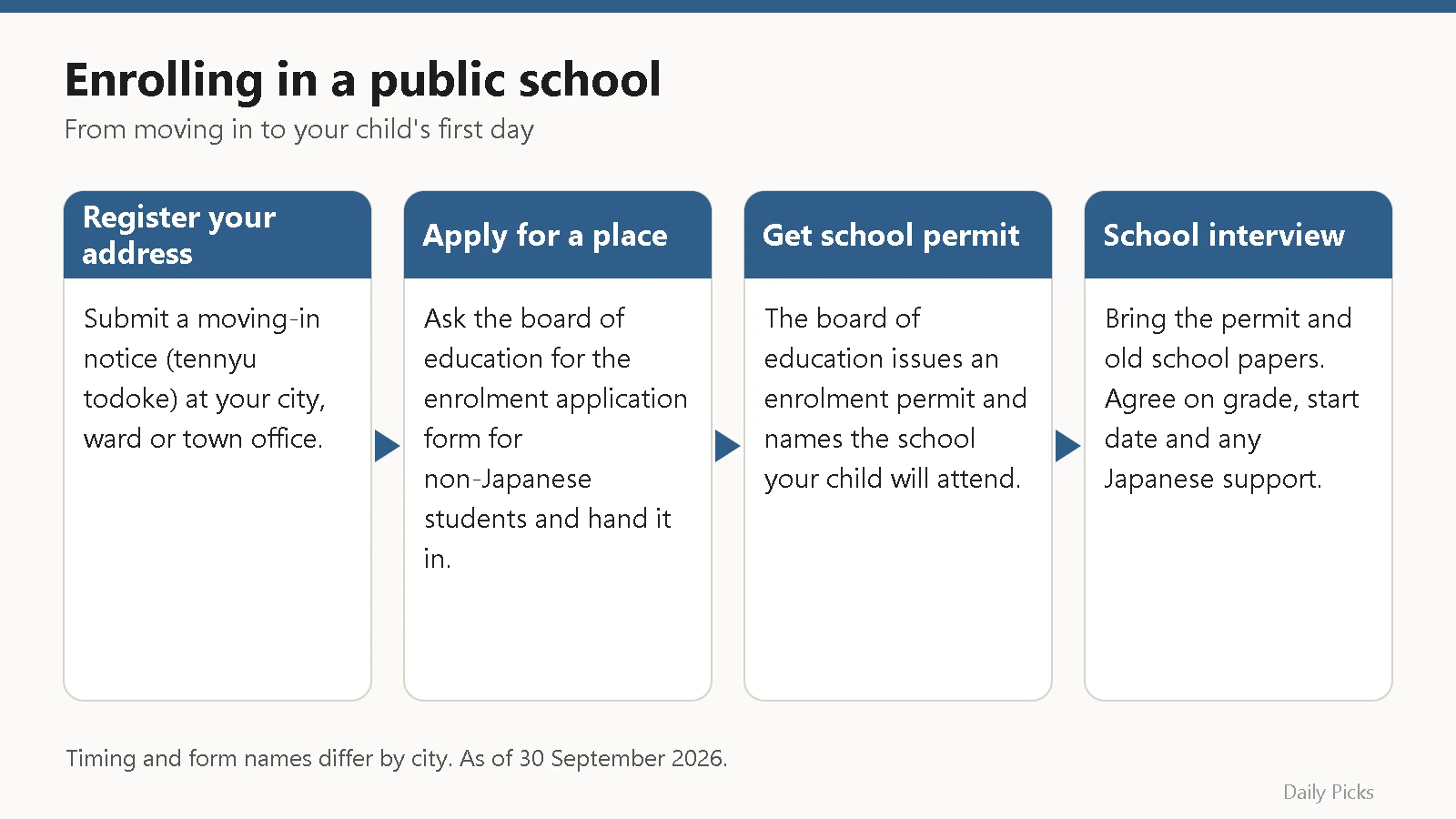
MEXT’s guidebook describes the general process for a child who arrives from abroad or moves in during the year. Your city may use different names for the forms, but the order is usually like this:
- Register your address. Submit a moving-in notice (tennyu todoke) at the resident registration counter of your city, ward or town office.
- Tell the counter or the board of education that your child wants to go to a public school. They give you the “Application Form for Enrollment of Non-Japanese Students”.
- Fill in and hand in the form. The board of education then issues an enrolment permit and tells you which school your child will go to.
- Go to the designated school with the permit and any papers from your child’s previous school, such as a certificate of enrolment and a transcript of records.
- Have an interview at the school. MEXT says it covers your child’s name, nationality, date of arrival, Japanese study, past schooling, medical history and allergies, family and contact details.
- Agree on the start date, the grade and any Japanese support, then ask what your child needs to bring.
City examples show how this works locally. Yokohama City says foreign residents apply at the family registration section (koseki-ka) of their ward office. You bring the school guidance letter or something that shows who your child is, such as the child’s residence card or special permanent resident certificate. Osaka City says that each ward office handles school entry paperwork. If you cannot meet a deadline, or have no resident record yet, Yokohama asks you to talk to your ward office.
Starting first grade: the timeline for next April
Japanese children receive a school entry notice automatically. Foreign families usually receive guidance and then choose to apply. Timing differs by city. Here are two examples from official city pages:
- Yokohama City: foreign residents with a resident record in the city as of mid-August get a school guidance letter (nyugaku annai) in early September if their child starts school the next April. Entry notices sent around 15 October show the school and the date of the health check.
- Osaka City: guidance goes to families of foreign children of the right age in early September. Families who want a place are asked to apply by 30 September. If the guidance does not arrive, contact the school entry desk at your ward office.
If you move to Japan after these dates, you can still apply. Contact your city or ward office as soon as you register your address.
Children who will start first grade also have a school entry health check (shugakuji kenko shindan). Under the School Health and Safety Act, the city board of education runs this check before children start school. The law’s cabinet order says it is held after the school register is made and at least four months before the school year starts. For an April start, that means by the end of November. A child added to the register after the check date should get a check soon afterwards. The notice from your city tells you the date and place. If you applied as a foreign family and have not heard anything, ask your board of education.
What is free and what parents pay
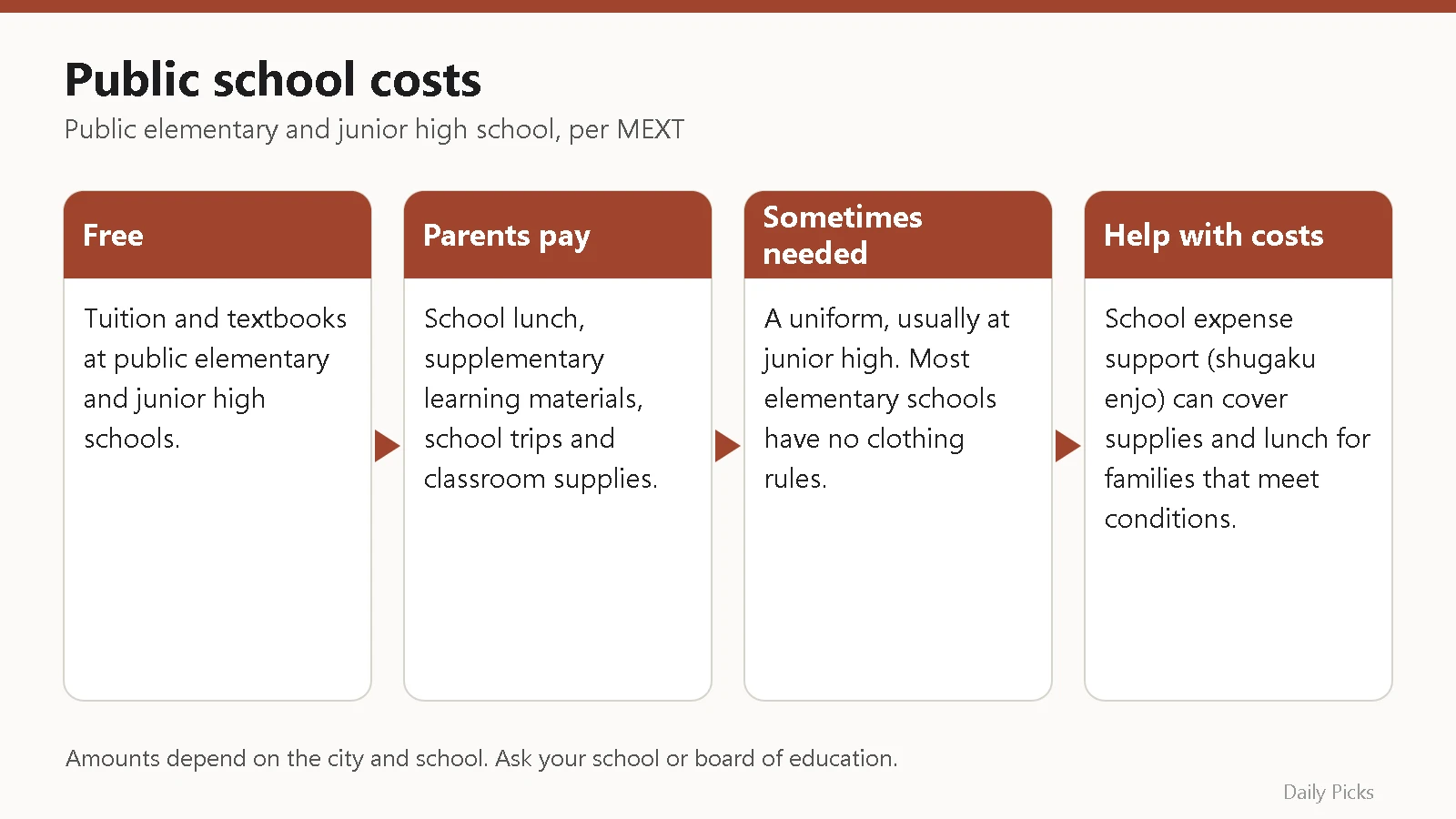
Public elementary and junior high schools do not charge tuition, but school is not completely free. MEXT’s guidebook lists costs that parents usually pay. The amounts depend on the city and the school, so this guide does not give figures.
| Item | Who pays | Note |
|---|---|---|
| Tuition | Free | Public elementary and junior high schools |
| Textbooks | Free | Elementary and junior high; not free at senior high |
| School lunch (kyushoku) | Parents | Tell the teacher about foods your child cannot eat for health or religious reasons |
| Supplementary learning materials | Parents | Workbooks, drills and similar items |
| School trips | Parents | Amounts depend on the school |
| Classroom and personal supplies | Parents | Ask the school what is needed |
| Uniform | Parents, if required | MEXT says most elementary schools have no clothing rules; junior high schools usually have uniforms |
If money is tight, ask about school expense support (shugaku enjo). MEXT’s guidebook says families that meet economic conditions can receive help for school supplies and school lunches. Yokohama City and Osaka City both run this support and have information pages for it. The school or the board of education can tell you how to apply.
Japanese language support at school
MEXT’s guidebook notes that lessons are normally taught in Japanese. Many schools therefore offer Japanese language teaching (nihongo shido). MEXT’s handbook for schools that accept foreign pupils describes several common forms:
- Pull-out lessons (toridashi shido): your child leaves the regular class for some periods to study Japanese in another room.
- Special curriculum (tokubetsu no kyoiku katei): when a school uses this, it makes an individual teaching plan for the child.
- JSL curriculum: MEXT’s curriculum that combines learning Japanese with learning school subjects.
Support depends heavily on the city. Yokohama City, for example, runs a Japanese language support centre called Himawari. It also offers Sakura Classroom, which teaches Japanese before a child starts school, and uses mother-tongue support volunteers. Osaka City lists literacy and Japanese classes and a consultation desk on its page in easy Japanese. Ask your school what your city offers.
MEXT also runs “Casta-net”, a search site with learning materials and translated school documents for children with foreign roots. MEXT also has short introductory videos about Japanese elementary schools in English and many other languages.
MEXT’s multilingual Guidebook for Starting School
MEXT publishes the “Guidebook for Starting School” (gaikokujin jido seito no tame no shugaku gaidobukku) as free PDFs. According to the MEXT page, there is a full version and a short version in eight languages: English, Korean, Vietnamese, Filipino, Chinese, Portuguese, Spanish and Ukrainian. The guidebook explains the school year, how to enrol, school costs and daily school life, such as lunch duty, cleaning, the PTA and school events. It is a good document to read before your school interview.
Some cities have their own guides as well. Yokohama City’s “Welcome to the Yokohama School” provides a parent guide and school letters in many languages and in easy Japanese.
Other options: international and foreign schools
Public school is one choice. Some families choose an international school or a school for a particular nationality instead. MEXT’s guideline separates schools under Article 1 of the School Education Act (the regular Japanese school system) from foreign schools. It asks boards of education to check where foreign children are studying, including at foreign schools. These schools set their own fees, admission rules and curriculum, so contact each school directly. This guide does not recommend any school. If you might later move your child between systems, ask both schools how the grade would be decided.
Japanese words you will see
| Japanese | Reading | Meaning |
|---|---|---|
| 教育委員会 | kyoiku iinkai | Board of education |
| 入学案内 | nyugaku annai | School entry guidance letter |
| 就学通知書 | shugaku tsuchisho | School entry notice |
| 就学時健康診断 | shugakuji kenko shindan | Health check before entering school |
| 転入届 | tennyu todoke | Moving-in notice |
| 給食費 | kyushokuhi | School lunch fee |
| 就学援助 | shugaku enjo | School expense support |
| 日本語指導 | nihongo shido | Japanese language teaching |
| 在留カード | zairyu kado | Residence card |
FAQ
Do I have to send my child to a Japanese school?
MEXT says the legal duty to send children to school does not apply to the parents of foreign children. Public schools accept foreign children whose parents want them to attend.
Is a public school really free?
Tuition and textbooks are free at public elementary and junior high schools. Parents usually pay for school lunch, learning materials, trips and supplies. School expense support (shugaku enjo) may help families that meet the conditions.
My child speaks no Japanese. Will they be put in a lower grade?
Not always. The usual rule is the grade that matches the child’s age. MEXT says a lower grade is possible for a while if the child’s Japanese or past schooling makes it necessary. Discuss it at the school interview.
We have not registered our address yet. Can my child still apply?
MEXT’s Q&A says a child can be allowed into a public school by applying to the local board of education, as long as the family actually lives there. Ask your city or ward office.
We arrived in the middle of the school year. Is that a problem?
No. You can apply when you arrive. Follow the steps above, starting with your moving-in notice at the city office.
Related reading
- Daycare (hoikuen) application in Japan for foreign residents
- Moving house in Japan: address change checklist
Sources
- Guideline on promoting school enrolment of foreign children, revised 28 August 2026 (Japanese) – MEXT
- Guidebook for Starting School for foreign children, eight languages – MEXT
- Guidebook for Starting School (English, PDF) – MEXT
- CLARINET Q&A on school enrolment (Japanese) – MEXT
- Handbook for accepting foreign pupils (Japanese) – MEXT
- Videos on education for foreign children (Japanese) – MEXT
- Casta-net learning support search site – MEXT
- School Health and Safety Act (Japanese) – e-Gov Laws, Digital Agency
- Elementary and junior high school entry procedures (Japanese) – Yokohama City
- Support for pupils who need Japanese language teaching (Japanese) – Yokohama City
- Welcome to the Yokohama School – Yokohama City
- School expense support (Japanese) – Yokohama City
- Entering elementary and junior high school (Japanese) – Osaka City
- Entering elementary and junior high school, easy Japanese – Osaka City
- School information in easy Japanese – Osaka City
- School entry procedures and contacts by ward (Japanese) – Osaka City
コメント