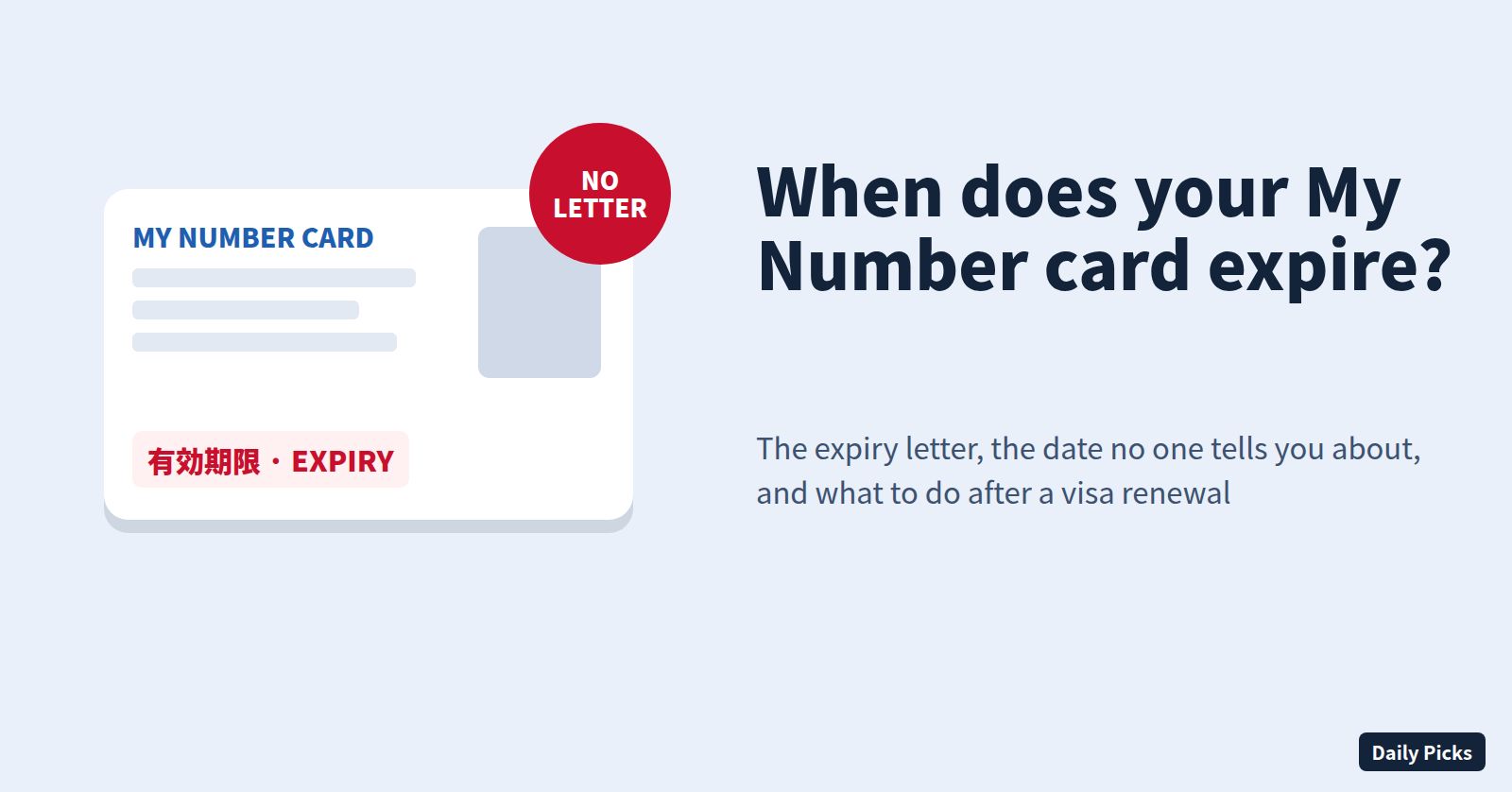
Summary: A My Number card has two expiry dates: one for the card itself and one for the electronic certificate stored on it. Around 2 to 3 months before either one ends, most people receive a letter called a yūkō kigen tsūchisho (有効期限通知書, expiry notice), and renewal is free. But for many foreign residents, the card also ends on the last day of your period of stay, and for that date no letter is sent. Renewing your visa at immigration does not update the card automatically: you must take your new residence card to the city office. This guide explains which date applies to you, what the letter means, and what to do after a visa renewal so your card does not become invalid.
- The two expiry dates on your card
- The third date for foreign residents: your period of stay
- After you renew your visa: update the card at the city office
- The expiry notice letter: what it means
- What stops working if you let it lapse
- How to check your dates now
- Japanese words on the letter and at the counter
- Renewing the card itself: how the application works, step by step
- FAQ
- Related reading
- Sources
The two expiry dates on your card
According to the Digital Agency, the validity periods are:
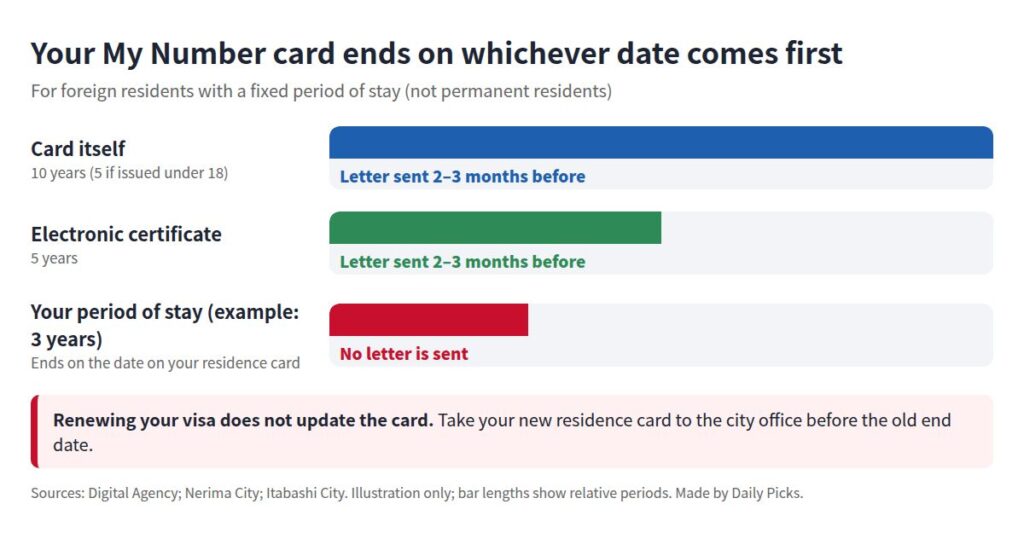
- The card itself: 10 years if it was issued when you were 18 or older (until your 10th birthday after issue); 5 years if issued under 18 (until your 5th birthday after issue).
- The electronic certificate (電子証明書 denshi shōmeisho): 5 years for everyone, until your 5th birthday after issue.
The electronic certificate is the part that lets you use the card online: for e-Tax, for getting certificates at convenience stores, for logging in to Mynaportal, and as your health insurance card. It usually runs out before the card does, so many people renew the certificate once in the middle of the card’s life.
The third date for foreign residents: your period of stay
If you have a status of residence with a fixed period of stay, your card also ends when your period of stay ends. Nerima City explains that the card expires on whichever comes first: the end of your period of stay, or the 10-year (or 5-year) date. This does not apply to special permanent residents, permanent residents, or Highly Skilled Professionals (ii), whose cards follow the normal dates.
Two points catch many people out:
- Nerima City states that no notice is sent when the card is about to expire because your period of stay is ending.
- Itabashi City states that updating your residence card does not automatically change your My Number card’s validity.
So even if you renew your visa on time, your My Number card can quietly become invalid on your old end date unless you visit the city office.
After you renew your visa: update the card at the city office
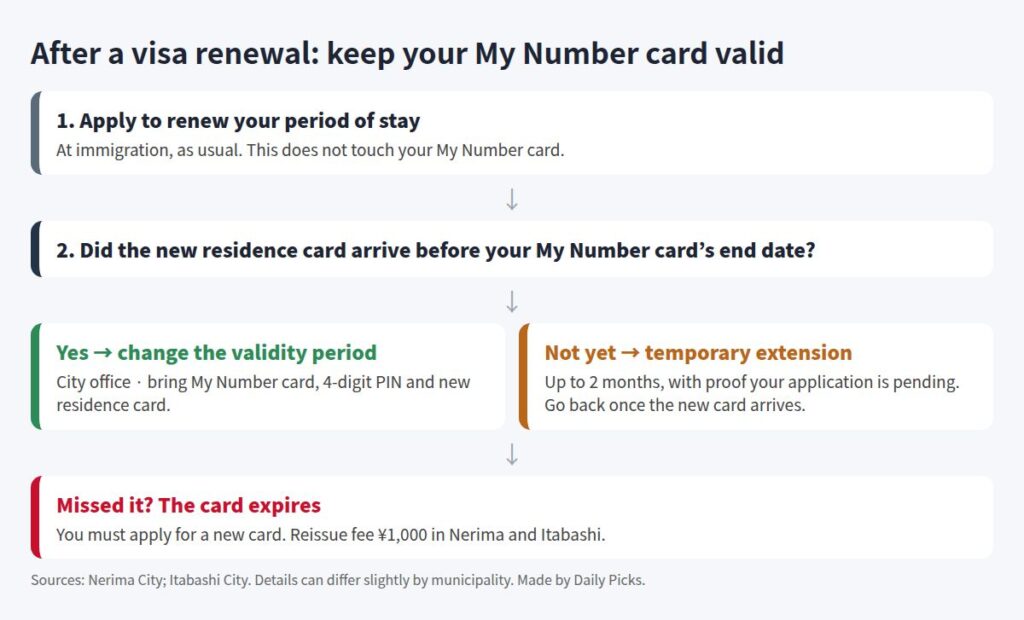
Once you receive your new residence card, go to your city or ward office and ask to change the validity period of your My Number card (有効期間の変更 yūkō kikan no henkō). Itabashi City lists what to bring:
- Your My Number card
- Your 4-digit PIN for the card
- Your new residence card
- The application form (available at the counter)
Do this before your old end date. The new validity cannot go beyond the card’s 10-year (or 5-year) limit.
If immigration has not finished by your old end date
Visa renewals can take time. If your application is still being processed and your new residence card will not arrive before your My Number card expires, Nerima and Itabashi both describe a temporary extension of up to 2 months. You apply at the city office with proof that your renewal application is pending (for example, the stamp or sticker on your residence card showing an application is in progress). Nerima notes that this route needs two visits: one to extend, and another after your new residence card arrives.
If your card has already expired
An expired card cannot be revived. You apply for a new one, which takes time. Nerima and Itabashi both list a reissue fee of ¥1,000 in this case (Nerima: ¥800 without electronic certificates).
The expiry notice letter: what it means
For the 10-year and 5-year dates, the government sends an expiry notice about 2 to 3 months before the date. The Digital Agency explains the next steps:
- If the electronic certificate is expiring: go to your city office (or a designated post office window, where available) with your card, the notice letter and your PINs. There is no fee. Some offices ask you to book first.
- If the card itself is expiring: apply for a new card by smartphone, computer, photo booth or post, much like a first application. It takes about a month and there is no fee.
You can start either renewal from 3 months before the expiry date.
The PINs you need for the certificate renewal are the ones you set when the card was issued: a 4-digit PIN for the user authentication certificate and a 6- to 16-character password for the signature certificate. If you have forgotten them, tell the counter staff; resetting them takes extra time.
What stops working if you let it lapse
- Electronic certificate expired: online services such as e-Tax and convenience store certificates stop working. The card can no longer be used as your health insurance card, although the Digital Agency says there is a grace period of 3 months after expiry for health insurance purposes.
- Card expired: you can no longer use it as ID, and none of its online functions work.
If you use your My Number card at the doctor’s or pharmacy, keep an eye on the certificate date in particular.
How to check your dates now
- Card expiry: printed on the front of the card (有効期限).
- Electronic certificate expiry: the city office may have written it in the blank field on the front of the card when it was issued or renewed. If not, check the expiry notice if you received one, or ask at the city office.
- Your period of stay: printed on your residence card. If it ends before the card’s date, that is the date that matters for you.
A simple habit helps: every time you apply to renew your visa, add a reminder to update your My Number card when the new residence card arrives.
Japanese words on the letter and at the counter
| Japanese | Reading | Meaning |
|---|---|---|
| 有効期限通知書 | yūkō kigen tsūchisho | Expiry notice (the letter) |
| マイナンバーカード(個人番号カード) | mai nanbā kādo (kojin bangō kādo) | My Number card |
| 電子証明書 | denshi shōmeisho | Electronic certificate on the card |
| 有効期限 / 有効期間 | yūkō kigen / yūkō kikan | Expiry date / validity period |
| 有効期間の変更 | yūkō kikan no henkō | Changing the card’s validity period (after a visa renewal) |
| 在留期間の更新 | zairyū kikan no kōshin | Renewal of your period of stay |
| 暗証番号 | anshō bangō | PIN / password |
| 再交付 | sai-kōfu | Reissue (a new card after loss or expiry) |
| 市区町村の窓口 | shikuchōson no madoguchi | City or ward office counter |
At the counter, it is enough to show your card and new residence card and say “Mai nanbā kādo no yūkō kikan no henkō o onegai shimasu” (I would like to change the validity period of my My Number card).
Renewing the card itself: how the application works, step by step
The sections above explain the dates and the letter. This section covers the practical part: how you actually apply for a new card, what photo you need, how long it takes, and what to bring when you collect it. All details below come from the official My Number Card website run by J-LIS (the Japan Agency for Local Authority Information Systems), as of 30 September 2026.
When you can apply, and what it costs
According to the official site, you can start the renewal once there are less than three months left before the card expires. The expiry notice letter is usually sent around two to three months before that date. The official site states that renewal is free of charge.
The official site also says that if you renew within that final three-month window, the new card is valid until your 11th birthday after issue (6th if you are under 18), and the electronic certificate until your 6th birthday after issue. For foreign residents, remember that the card still cannot outlast your period of stay, as explained earlier in this article.
First, look for the application ID on the enclosed form
Open the letter and find the application form inside. The routes you can use depend on one thing: whether the form shows an application ID (shinseisho ID, 申請書ID). The official FAQ explains it like this.
| What your form shows | Routes the official site lists | What you need |
|---|---|---|
| An application ID (and QR code) | Online by smartphone or computer, a street photo booth that accepts applications, or by mail | The form, a suitable photo, and an email address for online routes |
| No application ID | By mail only, according to the official FAQ | Write your 12-digit My Number and the required details on the form, attach a photo, and send only the form in the enclosed return envelope |
The official renewal page also mentions applying at the city office counter when there is no application ID. Rules can differ by city, so if your form has no ID, it is sensible to call your city office and ask which route they want you to use.
The four routes in more detail
- Smartphone: scan the QR code on the form. This opens the application website. You take your photo with the phone camera, enter the required information, and send it.
- Computer: go to the application website and enter the 23-digit application form ID. You register your email address first. You then receive an email with a link, upload a photo taken with a digital camera, and enter your date of birth and other choices, such as whether you want an electronic certificate. A completion email confirms the application.
- Photo booth: some street photo booths can send the application. You pay for the photo, scan the QR code on the form, choose the application option on the screen and follow the guidance. The official site notes that not every booth can do this.
- Mail: write your name on the form, attach your photo, and post it in the return envelope. The official site warns that envelopes past their expiry date cannot be used. If you lost the envelope, or it is too old, you can download a current one from the official site.
Photo rules that often cause problems
A rejected photo means a delay. The official “Check points of your photograph” page lists these rules:
- Taken within the last 6 months.
- Facing the front, no hat, plain background (white or off-white).
- For mail: 4.5 cm high by 3.5 cm wide, with your name and date of birth written on the back.
- For online upload: a JPEG file in RGB colour, 20 KB to 7 MB, and between 480 and 6,000 pixels in width and height.
- No editing with image software. Edited images are not accepted.
- Avoid shadows, blur, a turned head, sunglasses, or an expression very different from your normal face.
Black-and-white photos are allowed. The official page also mentions exceptions for religious, medical and disability-related reasons. If one of these applies to you, ask your city office before you apply.
How long it takes, and how you are told
The official site says it takes about one month from the application until your city office sends a notice of issuance (kōfu tsūchisho, 交付通知書). It is usually a postcard. Timing differs from city to city. The official site also has a page where you can check the status of your application, but it notes that the status may only show two to three days after you apply.
Because it takes time, do not wait until the last week. If your card expires before you collect the new one, the official FAQ says the card can no longer be used as ID or for electronic certificates, such as e-Tax or printing certificates at convenience stores. Some uses, such as the health insurance function, continue for a limited period. Keep the expired card safe, because you need to bring it when you collect the new one.
Collecting the new card: what to bring
When the notice arrives, follow the instructions on it. Many cities ask you to book a time. The official site lists the following items for collection:
- The notice of issuance (交付通知書).
- Your old My Number card. For a renewal, the official site says the old card alone is enough as ID, as long as no more than 6 months have passed since its expiry date.
- If that does not apply, valid ID: one photo ID, or two documents without a photo.
- Your notification card (tsūchi kādo), if you still have one.
At the counter you set your PINs (anshō bangō, 暗証番号). The official site describes two kinds: a 6 to 16 character code using both capital letters (A–Z) and numbers (0–9) for the signature certificate, and a 4-digit number for the other functions. Decide on these before you go, and write them somewhere safe that is not with the card.
Someone else can collect the card for you only when you cannot go because of illness, disability or another unavoidable reason. In that case, check the documents your city office requires before sending anyone.
Renewal checklist
- Check the expiry date on your card and your period of stay on your residence card.
- When the letter arrives, find the application form and check for an application ID.
- Choose your route: smartphone, computer, photo booth, or mail (or ask your city office if there is no ID).
- Prepare a photo that meets the official rules. Taken within 6 months, front view, plain background, no editing.
- Submit the application. If you mail it, use a return envelope that has not expired.
- Wait about one month for the notice of issuance. You can check the status on the official site after a few days.
- Book a collection time if your city asks you to.
- Bring the notice, your old card and, if needed, other ID. Decide your two PINs in advance.
- Collect the new card and check the dates printed on it.
FAQ
Do I have to pay to renew?
Renewing on time is free, both for the card and for the electronic certificate. A reissue after the card has expired, or after you lose it, has a fee.
Can I renew the electronic certificate at a post office?
The Digital Agency says this can be done at designated post office windows as well as at the city office. Check which post offices near you offer it before you go.
I am a permanent resident. Does the period-of-stay rule apply to me?
No. Nerima City lists permanent residents, special permanent residents and Highly Skilled Professionals (ii) as exceptions. Your card follows the normal 10-year (or 5-year) date.
Will changing my visa type affect my My Number card?
If your new status of residence comes with a new period of stay, treat it like a renewal and update the card’s validity at the city office with your new residence card. For questions about your status of residence itself, check the Immigration Services Agency’s official information.
Related reading
- Extending your period of stay in Japan: new fees from 1 October 2026
- Moving house in Japan: the 14-day address change and your cards
- What your National Health Insurance notice means
- Your resident tax notice explained
- Seeing a doctor in Japan: clinic or hospital, what to bring, and the 7,000-yen no-referral fee
Sources
- Digital Agency, check the expiry dates of your My Number card and electronic certificate (Japanese)
- Nerima City, My Number card procedures when foreign residents renew their period of stay (Japanese)
- Itabashi City, changing the validity period of the My Number card after a change in period of stay (Japanese)
- 更新手続きについて (Renewal procedures) | J-LIS My Number Card website
- FAQ: How to renew after receiving the expiry notice letter | J-LIS My Number Card website
- FAQ: Can I use the card if it expires before I receive the new one? | J-LIS My Number Card website
- Application for issuance of the Individual Number Card | J-LIS My Number Card website
- Application by a personal computer | J-LIS My Number Card website
- Application method by mail | J-LIS My Number Card website
- Check points of your photograph | J-LIS My Number Card website
- マイナンバーカードを受け取る (Receiving your card) | J-LIS My Number Card website
Information checked on 28 September 2026. Procedures and fees can differ slightly between municipalities; check your city office’s page.
コメント