Summary: Licensed daycare (hoikuen) in Japan is not first come, first served. You apply to your city, and the city decides placements by giving each family points (shisu) based on how much the child needs care. To apply, parents must have a reason such as work, study or illness. Applications for April entry are usually made in autumn, often in October and November, and fees for ages 3 to 5 at licensed daycare are free under a national program. This guide explains the system and the steps, as of 30 September 2026. The April 2027 dates for Yokohama, Osaka and Setagaya were checked again on 17 October 2026.
- How licensed daycare works in Japan
- Japanese words you will see
- The “need for childcare” requirement
- Types of daycare
- When to apply: April entry and mid-year entry
- Fees: free for ages 3 to 5, income-based for ages 0 to 2
- Documents you usually need
- If your child is not placed
- Step-by-step checklist
- FAQ
- Related reading
- Sources
How licensed daycare works in Japan
For licensed daycare, you usually do not apply to the nursery itself. You apply to your city, ward, town or village office and list the facilities you would like in order of preference. The city then carries out “placement adjustment” (riyo chosei) and decides which child goes where.
For example, Shinjuku City (Tokyo) explains that it turns each household’s situation into points based on its own rules, using the documents submitted by the deadline. It then offers places starting from the highest points. It is not a lottery and not first come, first served. Setagaya City (Tokyo) asks families to report any change that would raise their points, such as starting a job, by the first-round deadline if they want it counted.
The conditions on the city pages cited here are about where you live and why your child needs care. The rules, point tables and deadlines differ from city to city, so always read your own city’s guide. Many cities publish guides in English. For example, Osaka City offers its guide in English, Chinese, Korean and Vietnamese.
Japanese words you will see
| Japanese | Reading | Meaning |
|---|---|---|
| 保育園・保育所 | hoikuen / hoikusho | Daycare centre |
| 認可 | ninka | Licensed (approved under the national system) |
| 認可外 | ninkagai | Unlicensed facility |
| 利用調整 | riyo chosei | Placement decision made by the city |
| 指数 | shisu | Points used to rank applications |
| 保育を必要とする事由 | hoiku o hitsuyo to suru jiyu | Reason the child needs care |
| 就労証明書 | shuro shomeisho | Employment certificate filled in by your employer |
| 保留・不承諾 | horyu / fushodaku | Not placed (on hold / not approved) |
| 一次・二次 | ichiji / niji | First round / second round of applications |
The “need for childcare” requirement
Licensed daycare is for children whose parents cannot care for them at home during the day. To apply, each parent needs a reason the city accepts. For example, Osaka City lists these reasons:
- Work (employment or self-employment)
- Pregnancy or childbirth
- Illness or disability of the parent
- Caring for a family member
- Recovering from a disaster
- Study or training
- Looking for a job
- Other situations the city recognises
The city turns your reason and situation into points. The details, such as how working hours are counted, are set by each city. Check your city’s point table (shisu table) to see how your situation is counted.
Types of daycare
Nagoya City and Yokohama City describe the main licensed types as follows. Unlicensed facilities are outside the city placement system, and you apply to them directly.
| Type | Japanese | Ages | Key points |
|---|---|---|---|
| Licensed daycare centre | 認可保育所 (ninka hoikusho) | 0–5 | Main option; applied for through the city |
| Certified centre for early childhood education and care | 認定こども園 (nintei kodomo-en) | 0–5 | Combines kindergarten and daycare; daycare places go through the city |
| Small-scale childcare | 小規模保育 (shokibo hoiku) | 0–2 | 6 to 19 children; a partner facility supports moving on after age 2 |
| Family-style childcare | 家庭的保育 (kateiteki hoiku) | See city guide | 3 to 5 children in a home-like setting |
| Workplace childcare | 事業所内保育 (jigyoshonai hoiku) | See city guide | At a company facility; also takes local children |
| Unlicensed facility | 認可外保育施設 (ninkagai) | Varies | Apply directly; fees set by the facility |
When to apply: April entry and mid-year entry
The main application round is for entry in April, the start of the school year. It usually takes place in autumn of the year before. Here are examples for April 2027 entry, checked on the city pages on 17 October 2026:
- For example, in Yokohama City: the first-round application period is 1 to 28 October 2026, so it is still open as of 17 October. Applications are in principle made online with a My Number card. People without the card, or not yet registered in Yokohama, apply by post.
- For example, in Osaka City: the first round is 1 to 15 October 2026, with results on 25 January 2027. A second round runs from 8 January to 5 February 2027. Applications are made at your ward’s health and welfare centre. The first round closed on 15 October 2026. If you applied, 16 November 2026 is the deadline for changing your preferred facilities or adding missing documents; if you did not, the second round is your next chance.
- For example, in Setagaya City (Tokyo): the first-round deadline is 5 November 2026 for post or online applications and 10 November 2026 for applications in person. The second-round deadlines are 27 January and 1 February 2027.
You can also apply for entry in other months if places are free. In Osaka City, the deadline is the 5th of the month before the month you want to start. In Hodogaya Ward (Yokohama), for example, applications for May 2026 entry were accepted from 11 March to 10 April 2026. Mid-year entry depends on whether a place is free in the age group you need.
Fees: free for ages 3 to 5, income-based for ages 0 to 2
The Children and Families Agency explains the national free early childhood education and care program:
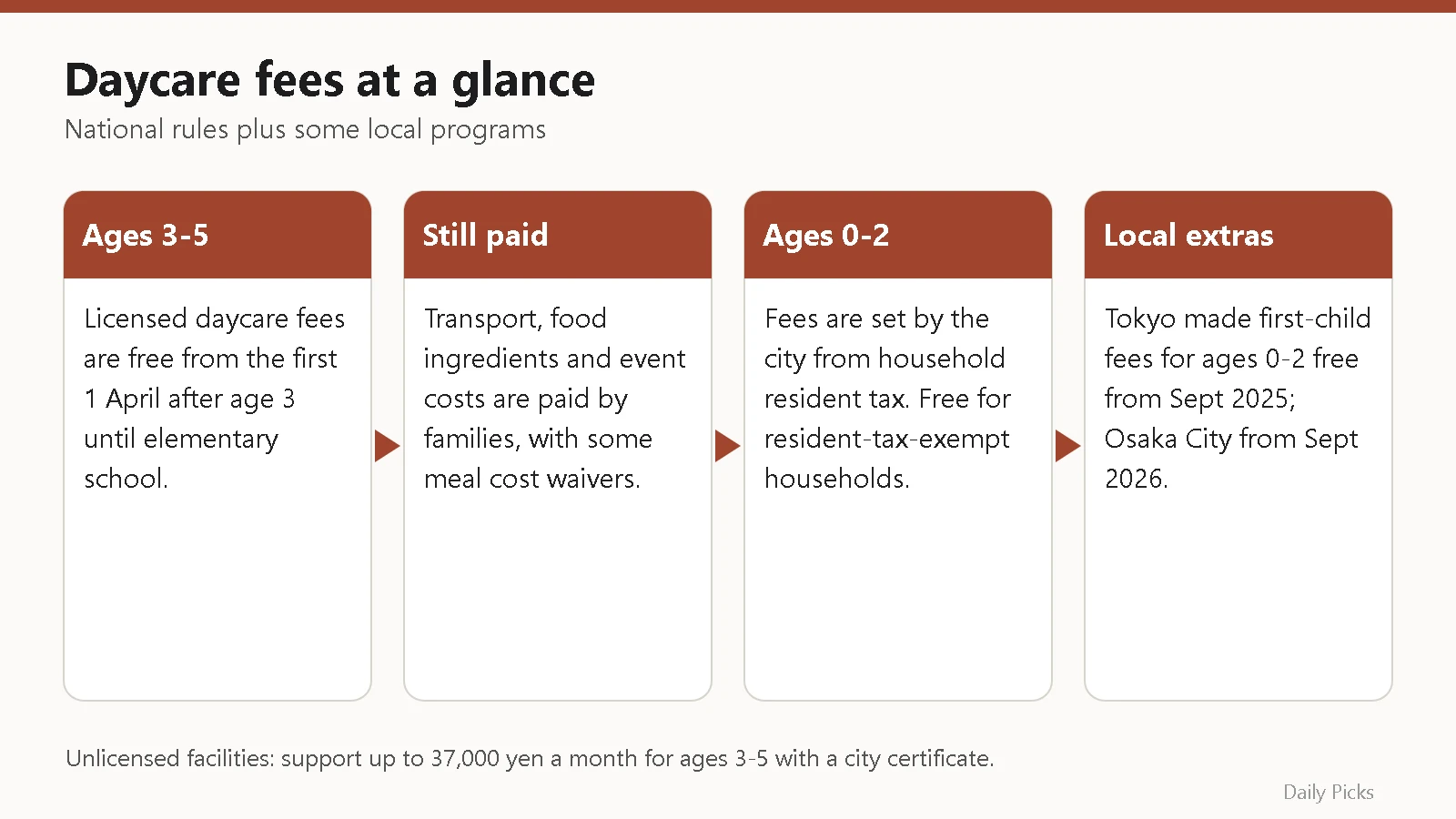
- Ages 3 to 5: Fees at licensed daycare, certified centres and kindergartens are free for three years, from the first 1 April after the child turns 3 until they start elementary school.
- Still paid by families: transport, food ingredients and event costs. Meal costs are waived for households with income under about 3.6 million yen and for third or later children.
- Ages 0 to 2: Free only for households exempt from resident tax. The second child pays half and the third child is free.
- Unlicensed facilities: With a certificate of need for childcare from the city, support is up to 37,000 yen a month for ages 3 to 5, and up to 42,000 yen a month for ages 0 to 2 in resident-tax-exempt households.
For ages 0 to 2, fees are set by the city based on your household’s resident tax. For example, Meguro City (Tokyo) uses the household’s income-based resident tax amount. It uses the previous year’s tax for April to August and the current year’s tax for September to March. This is one reason to file your tax paperwork correctly, even in your first year in Japan.
Some local governments go further. Meguro City and Nerima City say that from September 2025, first-child fees for ages 0 to 2 at licensed daycare became free under a Tokyo program. Osaka City says second-child fees became free in September 2024 and first-child fees become free from September 2026. Check your city’s fee page for the current rules.
Documents you usually need
Each city has its own list, but most applications include:
- The application form, with your preferred facilities in order.
- An employment certificate (shuro shomeisho) for each working parent. Your employer fills it in. Yokohama and Setagaya both ask for this form.
- Documents that prove your reason if it is not work, such as study or illness. Your city’s guide lists which ones it accepts.
- For online applications in Yokohama, a My Number card is used.
Ask your employer for the employment certificate early. Companies can take time to complete it, and a missing form can mean your points are not counted by the deadline.
If your child is not placed
Not getting a place is common in busy areas, and no one can promise a place in advance. Here is what cities say happens next:
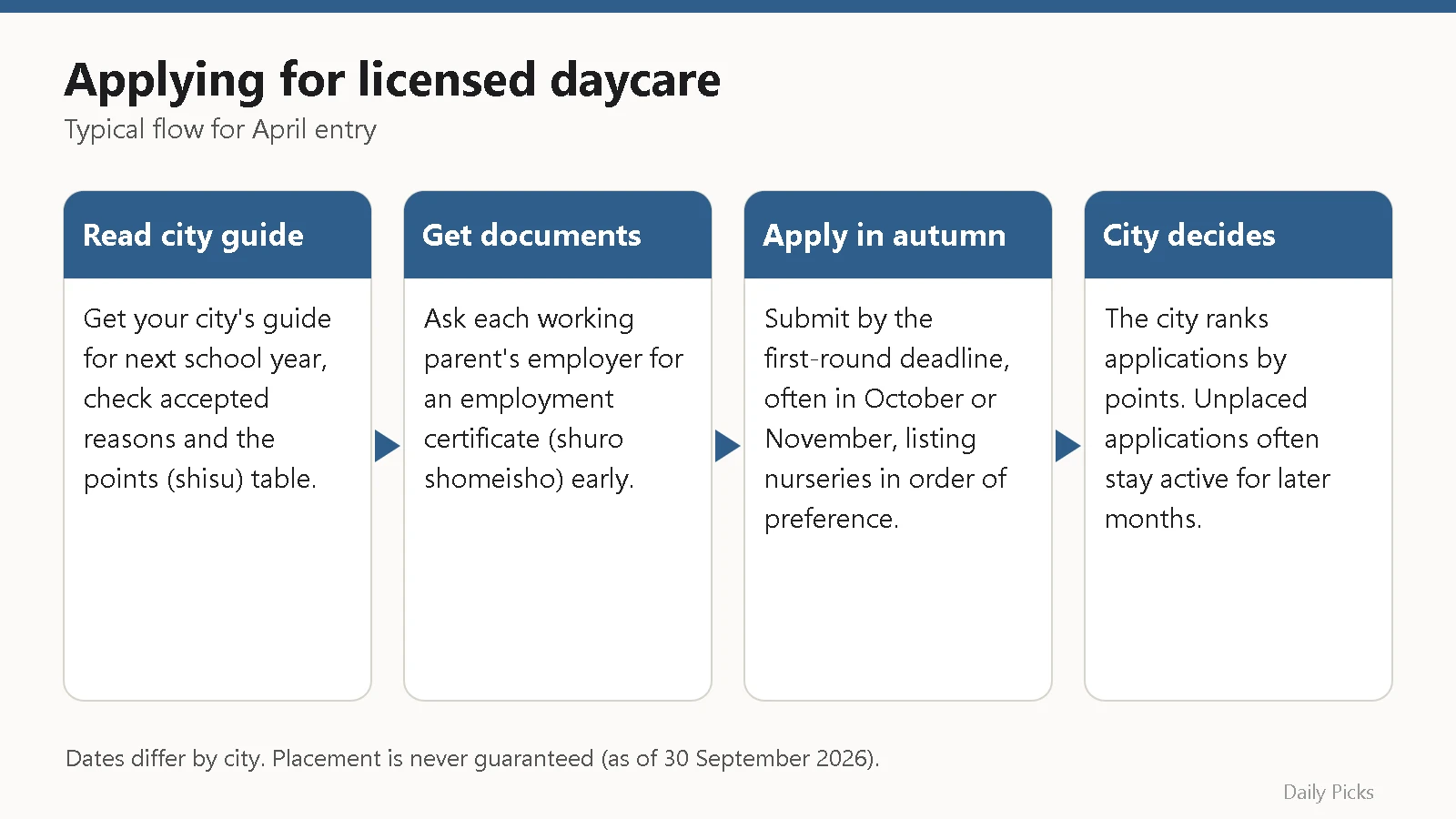
- Your application often stays active. Shinjuku City treats the application as continuing into the next month and keeps checking it for up to 6 months. In Hodogaya Ward (Yokohama), the application is valid until the March entry of that school year unless a place is offered.
- Second rounds and mid-year places. Yokohama runs a second round for April, and unplaced applications can be carried into mid-year placements.
- Tell the city if you stop waiting. Hodogaya Ward asks families who no longer want a place to submit a withdrawal form.
- Look at other options. Consider small-scale childcare or an unlicensed facility while you wait. For ages 3 to 5, the unlicensed facility support described above may apply.
Step-by-step checklist
- Find your city’s daycare guide for the coming school year, in English if available.
- Check the reasons accepted and the point table, and work out your likely points.
- Visit or research facilities near your home or work, including small-scale ones.
- Ask each working parent’s employer for an employment certificate.
- Collect any other documents for your reason (study, illness, pregnancy and so on).
- Submit before the first-round deadline, online or by post, and keep a copy.
- Report any change that raises your points before the deadline.
- When results arrive, accept the place or follow the city’s steps for the second round or waiting list.
- If you stop needing a place, submit a withdrawal to the city.
FAQ
Can foreign residents apply for licensed daycare?
The city pages cited here set conditions based on where you live and why your child needs care, not on nationality. Yokohama explains how people not yet registered in the city can apply by post.
Is daycare free in Japan?
For ages 3 to 5 at licensed facilities, the fee is free nationally, but you still pay costs such as food ingredients and events. For ages 0 to 2, fees depend on resident tax, and some cities add their own free programs.
Can I apply while I am looking for a job?
In cities such as Osaka, job hunting is an accepted reason. How many points it gives depends on your city’s point table.
I missed the autumn deadline. What now?
Many cities, including Osaka, Yokohama and Setagaya, run a second round in January or February for April entry. You can also apply for mid-year entry each month.
Does applying early in the period help?
Shinjuku City says places are decided by points, not by order of application. What matters is that complete documents arrive by the deadline.
Related reading
Sources
- Overview of free early childhood education and care (Japanese) – Children and Families Agency
- For those who want to use daycare in FY2027 (Japanese) – Yokohama City
- Procedures for using daycare (Japanese) – Yokohama City
- Applying for licensed daycare during FY2026 (Japanese) – Hodogaya Ward, Yokohama City
- What is small-scale childcare? (Japanese) – Yokohama City
- FY2027 guide to childcare facilities (Japanese) – Osaka City
- Free childcare for ages 0 to 2 (Japanese) – Osaka City
- April 2027 entry (Japanese) – Setagaya City
- FAQ on licensed daycare applications (Japanese) – Shinjuku City
- Fees for licensed daycare (Japanese) – Meguro City
- Free daycare fees for the first child (Japanese) – Nerima City
- Overview of licensed childcare facilities (Japanese) – Nagoya City
コメント