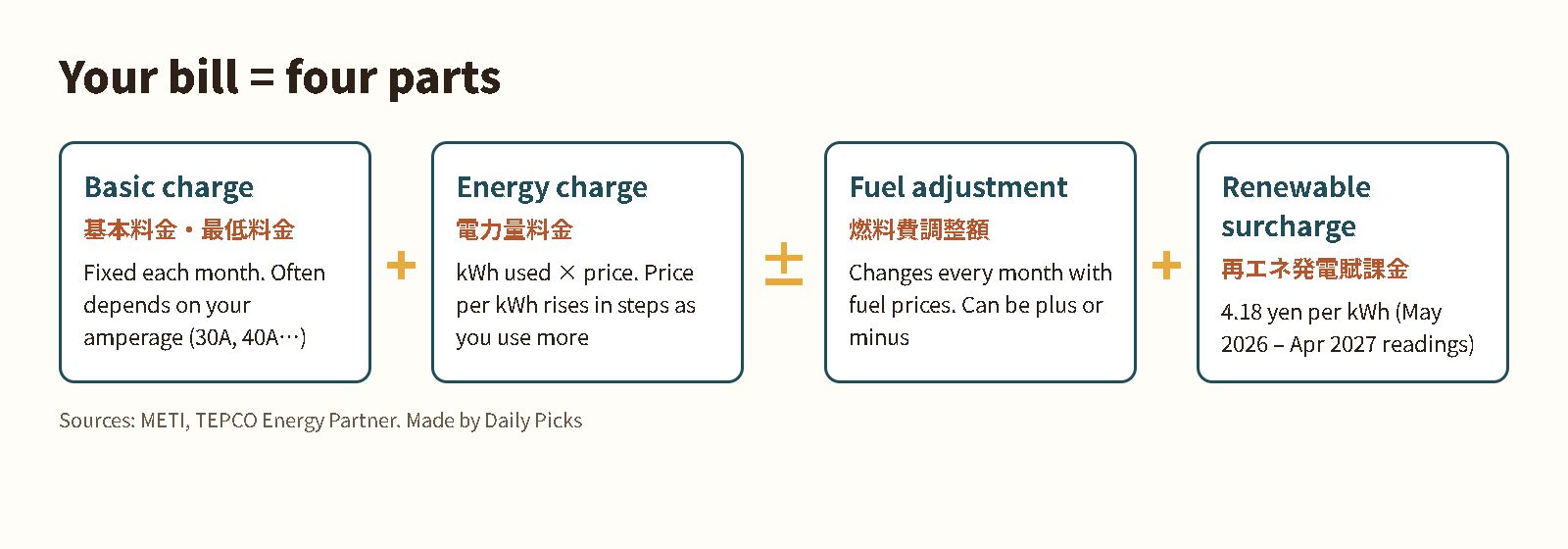
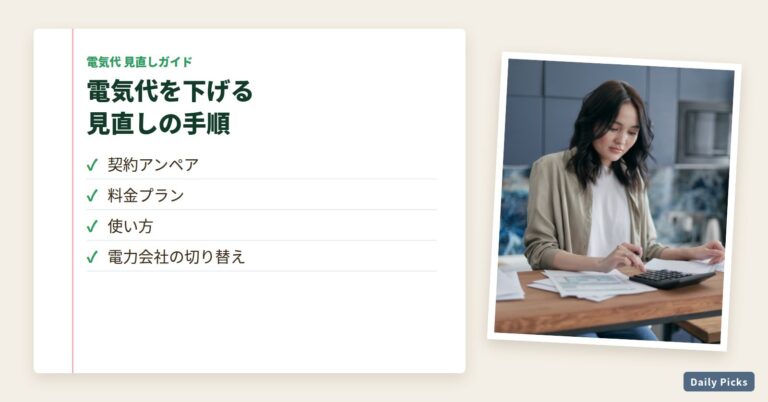
Summary: A Japanese electricity bill (denki shiyoryo no oshirase, or the web statement from your power company) is built from four parts: a basic charge or minimum charge, the energy charge for the kWh you used, a fuel cost adjustment that changes every month, and the renewable energy surcharge, which is 4.18 yen per kWh from the May 2026 reading to the April 2027 reading. Find your usage in kWh first, then check which part changed. If your bill jumped in winter, the usual reasons are more kWh, the end of government subsidies, and a higher fuel adjustment.
Many power companies in Japan no longer post paper slips. You may only get an email or an app notice, and the statement is in Japanese. This guide explains the words you will see, how to check your usage, and what you can do if the amount looks too high.
Where to find your bill
- Paper slip in your mailbox: older contracts may still get a small slip called kenshinhyo (meter reading slip) or denki go-shiyoryo no oshirase.
- Website or app: most companies now show the statement after you log in. Look for a menu like 電気料金・使用量 (electricity charges and usage).
- Your landlord: in some share houses and serviced apartments, electricity is included in rent or charged by the landlord. In that case, ask the landlord how it is calculated.
Your statement shows your customer number (お客さま番号) and supply point ID (供給地点特定番号). Keep both. You need them to change plans, move out, or switch companies.
The words on the statement
| Japanese | Reading | Meaning |
|---|---|---|
| ご使用量 | go-shiyoryo | How much electricity you used, in kWh |
| ご使用期間 / 検針日 | shiyo kikan / kenshinbi | The period covered and the meter reading date. It is usually not the calendar month |
| 契約(アンペア) | keiyaku (ampea) | Your contract size, such as 30A or 40A |
| 基本料金 / 最低料金 | kihon ryokin / saitei ryokin | Fixed monthly part (basic charge or minimum charge, depending on your area and plan) |
| 電力量料金 | denryokuryo ryokin | Charge for the kWh you used |
| 燃料費調整額 | nenryohi chosei-gaku | Fuel cost adjustment. Changes every month with fuel prices |
| 再エネ発電賦課金 | sai-ene hatsuden fukakin | Renewable energy surcharge, the same rate nationwide |
| 請求予定金額 / ご請求金額 | seikyu yotei kingaku | The amount you will pay |
How the amount is calculated
1. Basic charge
On many standard home plans, such as TEPCO’s Juryo Dento B, the basic charge depends on your contract amperage. A larger contract (for example 40A instead of 30A) lets you use more appliances at the same time but costs more each month. In some regions, plans use a minimum charge instead.
2. Energy charge in three steps
Standard plans usually charge more per kWh as you use more. TEPCO’s standard plan, for example, has three steps: up to 120 kWh, from 120 to 300 kWh, and over 300 kWh. So when you use much more in winter, the extra kWh are charged at the highest step.
3. Fuel cost adjustment
This line moves every month with the price of oil, gas and coal a few months earlier. It is multiplied by your kWh. It can be a plus or a minus. When the government ran electricity subsidies, the discount per kWh appeared on the statement as a separate discount line, so the end of a subsidy makes the bill rise even if you used the same amount.
4. Renewable energy surcharge
Every household pays this to support renewable power. According to the Ministry of Economy, Trade and Industry (METI), the rate for fiscal 2026 is 4.18 yen per kWh, applied from the May 2026 meter reading to the April 2027 meter reading. For a typical household using 400 kWh a month, METI estimates 1,672 yen a month.
Why your winter bill is higher
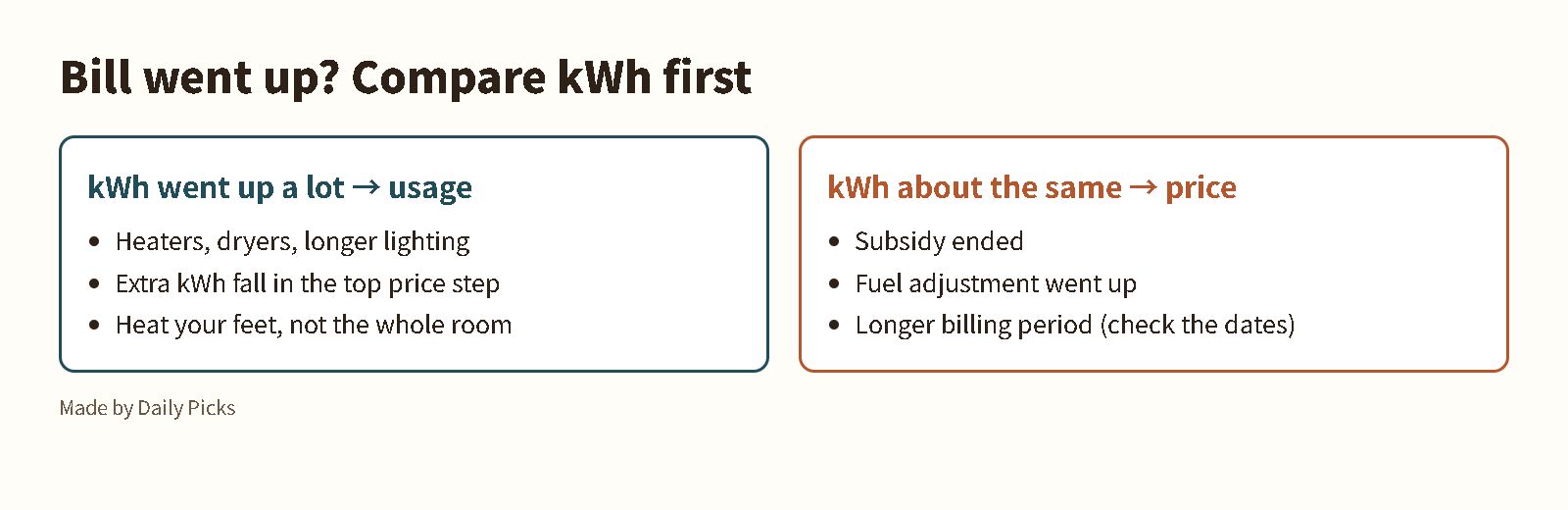
- More kWh. Heaters, heated toilet seats, dryers and longer lighting hours all add up, and extra kWh fall into the most expensive step.
- Subsidy ended. Government discounts on electricity have been temporary. When they stop, the same usage costs more. See our note on the end of the electricity and gas subsidy.
- Fuel adjustment changed. Compare this line with last month’s statement.
- Longer billing period. A period of 33 days costs more than one of 28 days. Check the dates, not only the total.
What you can do
- Compare kWh, not yen. Look at the usage for the same month last year in your app. If kWh went up a lot, the cause is your usage. If kWh is similar, the cause is price.
- Heat the person, not the room, when you can. An electric blanket or a small panel heater near your feet uses much less power than heating a whole room, and an air conditioner is usually more efficient than a ceramic heater. Our guide to staying warm in a Japanese apartment compares options.
- Check your contract amperage. If the breaker never trips, you may not need a large contract. If it trips often, do not run the heater, microwave and dryer at the same time.
- Review your plan. Power companies offer plans for different lifestyles. Before switching, check cancellation fees and whether the plan also has fuel adjustment and the renewable surcharge (almost all do).
When you move
Contact your power company to stop the service at your old address and start it at the new one, usually a few days before the move. Have your customer number ready. The final bill is sent after the last meter reading. For the other steps, see moving house in Japan.
FAQ
Why does the bill cover strange dates, like the 12th to the 11th?
Most bills follow the meter reading date, not the calendar month. With smart meters the reading is automatic, but the cycle stays the same.
Can I avoid the renewable energy surcharge?
Almost every household pays it, whichever company you use. The rate is set nationally each year.
I received a bill for a company I never signed up with. What should I do?
Check whether the previous resident or your landlord arranged it. If you think someone switched your contract without permission, contact the company on the number from its official website and talk to the consumer hotline 188.
Is there an English statement?
Some companies offer English pages or support lines, but most statements are Japanese only. The table above covers the lines you need.
Related reading
日本語で読む:冬の電気代はいくら上がる?

コメント