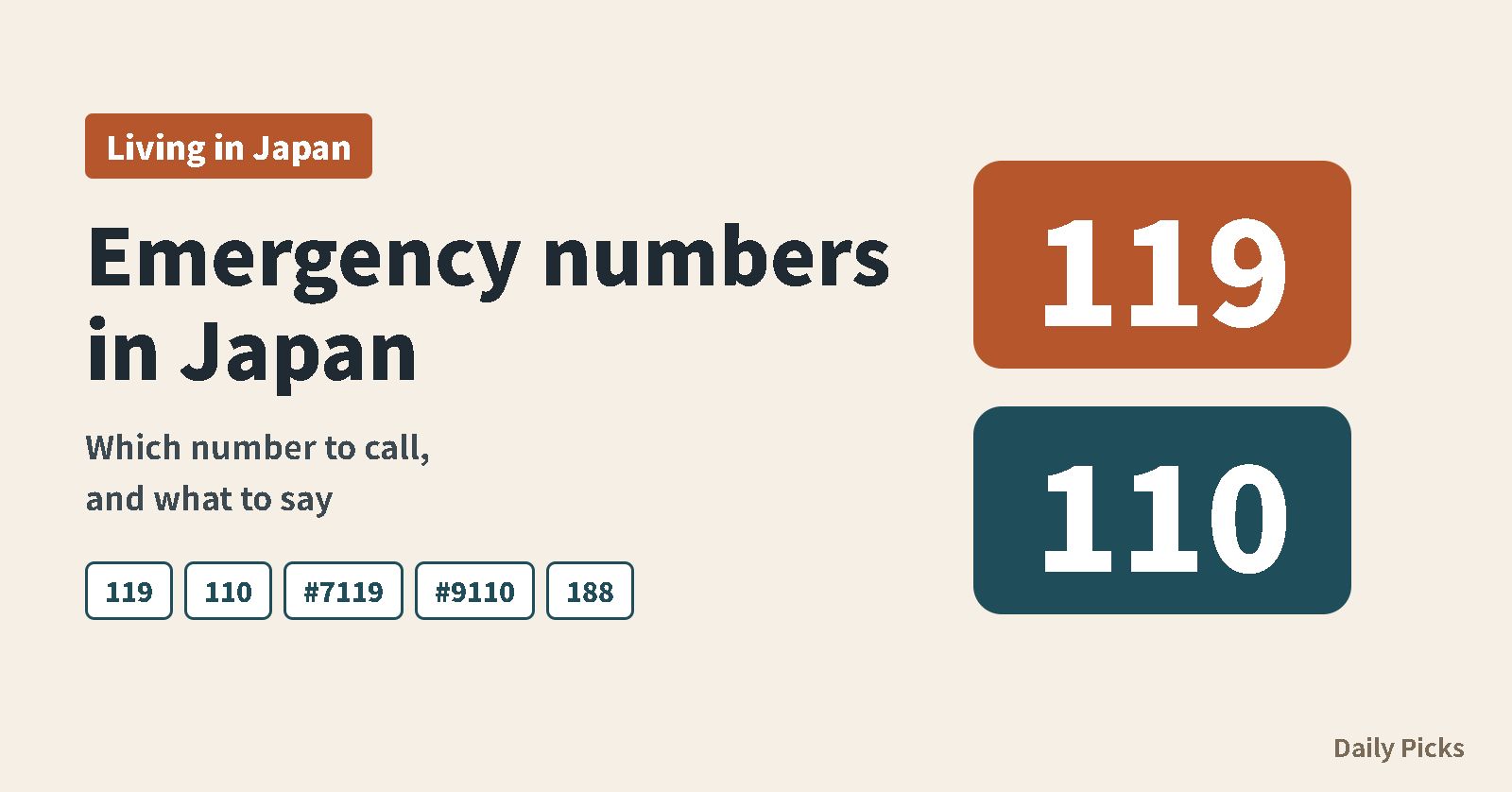
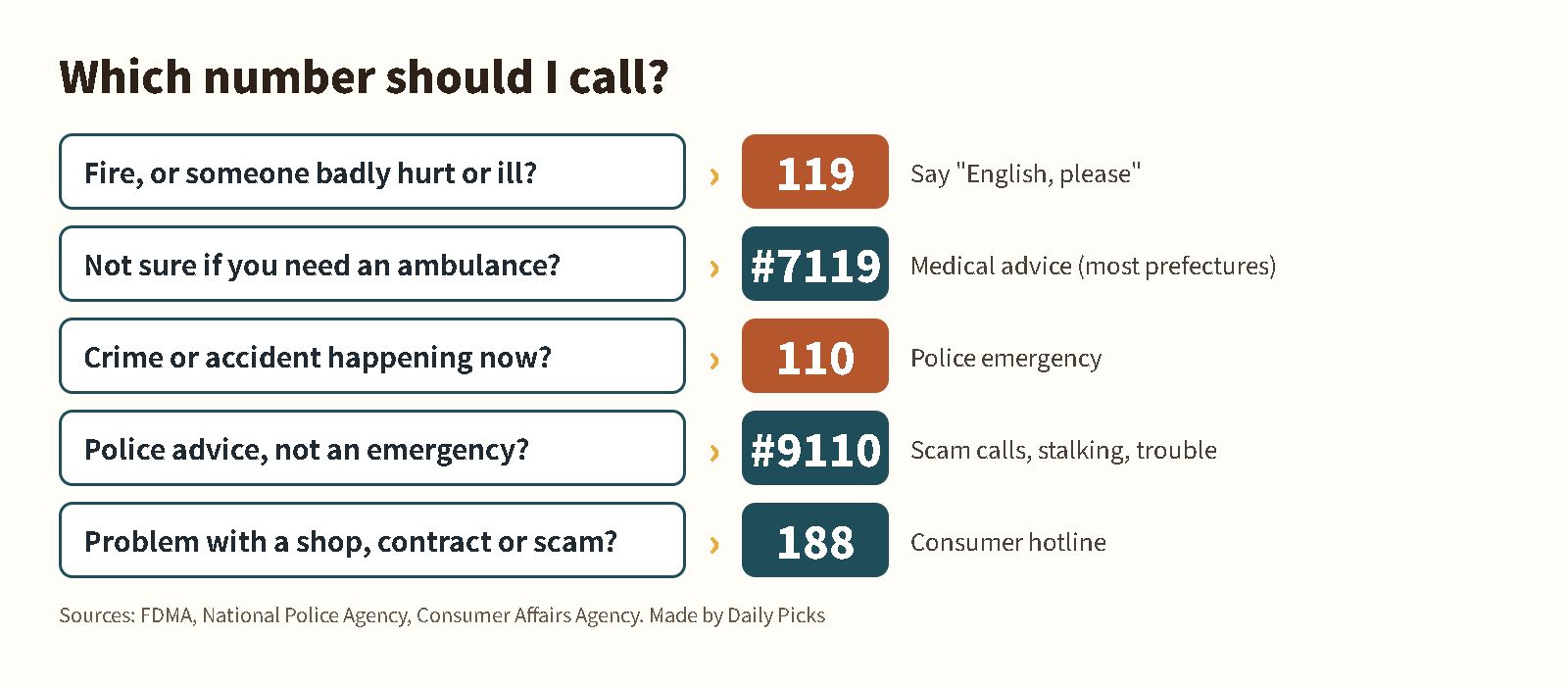
Summary: In Japan, call 119 for a fire or an ambulance and 110 for the police. If you are not sure whether you need an ambulance, many areas have #7119, where nurses and doctors give advice by phone. For non-urgent police matters, call #9110. For problems with shops, contracts or scams, the consumer hotline is 188. Most fire departments can add an interpreter to a 119 call. Save these numbers in your phone today.
Japan uses different numbers for different kinds of help, and several of them are short codes that start with “#”. This guide explains which number to call, what to say, and what to do if you cannot speak Japanese. Everything here is based on official pages from the Fire and Disaster Management Agency (FDMA), the National Police Agency and the Japan National Tourism Organization (JNTO).
The numbers at a glance
| Number | What it is for | Hours |
|---|---|---|
| 119 | Fire, ambulance, rescue | 24 hours |
| 110 | Police emergencies: crime, traffic accidents, danger right now | 24 hours |
| #7119 | Medical advice: “Do I need an ambulance?” and which hospital is open (not available in every area) | Depends on the area; many are 24 hours |
| #9110 | Police consultation for things that are not emergencies (stalking, scam calls, neighbour trouble) | Mainly weekday daytime (varies by prefecture) |
| 188 | Consumer hotline: problems with shops, contracts, online shopping and scams (connects you to a local consumer centre) | Depends on the local centre |
| 050-3816-2787 | JNTO Japan Visitor Hotline in English, Chinese and Korean (mainly for visitors, but anyone can call) | 24 hours |
119: fire and ambulance
Calls to 119 are free and work from mobile phones and landlines. The dispatcher will first ask whether it is a fire (kaji) or an emergency (kyukyu). Then they ask where you are, what happened, and the age and condition of the person who needs help.
If you cannot speak Japanese, say the name of your language clearly, for example “English, please.” According to the FDMA, 673 of Japan’s 720 fire departments (as of January 1, 2025) have introduced three-way interpretation, where an interpretation centre joins the call. The service runs 24 hours a day in major languages. Paramedics can also use a translation app called “Kyukyu VoiceTra” at the scene.
The most important thing is your location. In an apartment, give the building name and room number. If you do not know the address, look for a utility pole plate, a vending machine sticker, or a shop name nearby, or read the address from the map app on your phone.
#7119: not sure if you need an ambulance?
#7119 is a medical consultation line run by local governments. The FDMA explains that doctors, nurses and paramedics give advice by phone: whether you should call an ambulance, which hospital to go to, and basic first aid. If the situation sounds serious, they transfer you to 119.
The service is not available everywhere yet. The FDMA lists it across most prefectures, including Tokyo, Kanagawa, Saitama, Chiba, Osaka, Kyoto, Hyogo and Fukuoka, with partial coverage in some areas. Check your prefecture or city website, or simply try dialling #7119. Most lines are in Japanese, so have a Japanese speaker help you if you can. For children, there is also #8000, an advice line for parents that works in every prefecture, mainly in the evening and at night.
Do not wait if someone is unconscious, not breathing normally, has sudden chest pain, sudden weakness on one side of the body, or heavy bleeding. Call 119 straight away.
110 and #9110: police
Use 110 when something is happening now: a crime, a traffic accident, someone following you, a fight. Tell them what happened and where. If you are in danger and cannot talk, stay on the line if it is safe to do so.
Use #9110 for police matters that are not emergencies, such as repeated scam calls, stalking you want advice about, or trouble with a neighbour. The National Police Agency lists #9110 as its consultation number together with the consumer hotline 188.
A warning: scammers in Japan pretend to be police officers. Real police do not tell you by phone that you are under investigation, do not contact you on messaging apps, and do not send pictures of police IDs or arrest warrants. If a “police officer” calls you about your bank account, hang up and call your local police station or #9110 yourself. We explain this scam in our guide to fake police calls in Japan.
188: problems with shops, contracts and scams
188 connects you to your local consumer affairs centre (shohi seikatsu center). Call it when an online shop does not send your order, you signed a contract you did not understand, a door-to-door seller pressured you, or you paid money to a suspicious website. The line is mainly in Japanese. Before calling, prepare the name of the company, dates, amounts and screenshots.
What to say on the phone
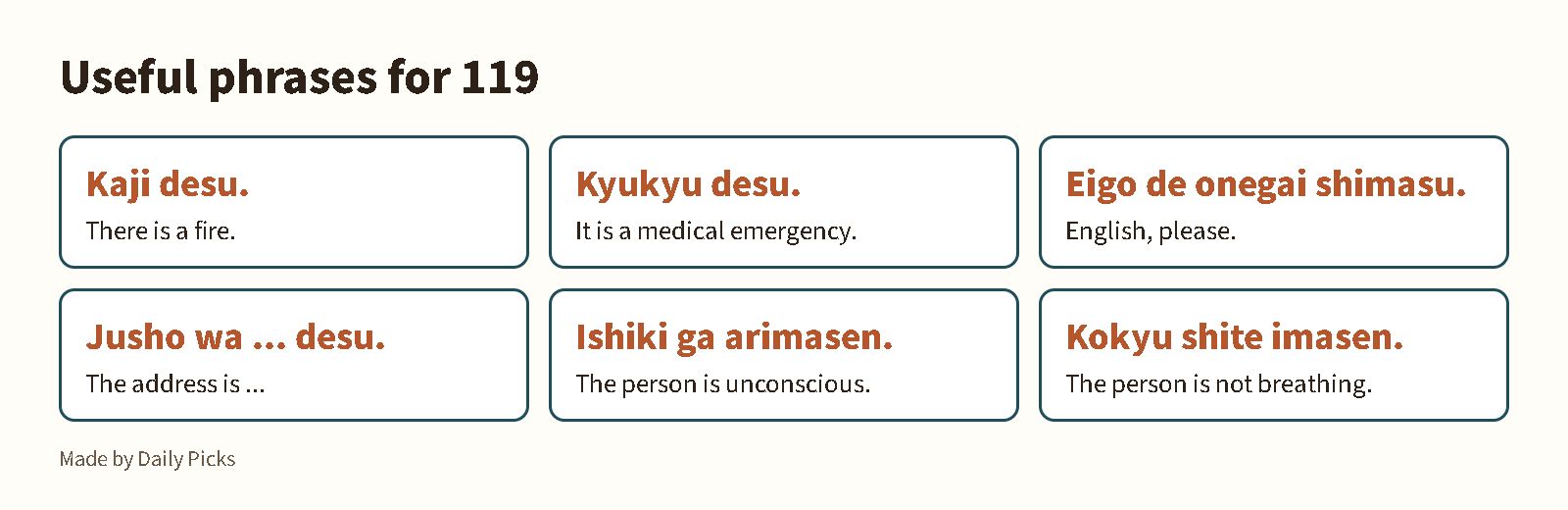
These short Japanese phrases help, even if an interpreter joins later.
- Kaji desu. – There is a fire.
- Kyukyu desu. – It is a medical emergency.
- Eigo de onegai shimasu. – English, please.
- Jusho wa … desu. – The address is …
- Ishiki ga arimasen. – The person is unconscious.
- Kokyu shite imasen. – The person is not breathing.
What you can do today
- Save 119, 110, #7119, #9110 and 188 in your phone contacts with English names.
- Write your home address in Japanese and keep it on your fridge and in your phone notes. Include the building name and room number.
- Check whether your area has #7119 on your city or prefecture website.
- Set up Medical ID (iPhone) or emergency information (Android) with allergies, medicines and an emergency contact.
- Tell family members and flatmates where the list is.
For earthquakes and typhoons, NTT’s Disaster Emergency Message Dial 171 lets you record a voice message that family can play back when phone lines are busy. Our earthquake emergency kit guide covers what to prepare at home.
FAQ
Is an ambulance free in Japan?
Public ambulances called through 119 do not charge for the ride. You still pay for treatment at the hospital as usual. A few areas have started asking non-urgent ambulance patients to pay an extra hospital fee, so use #7119 when you are unsure. Bring your health insurance card or My Number card if you can.
Can I call 119 in English?
Say “English, please” at the start. Most fire departments (673 of 720 as of January 2025, according to the FDMA) can add an interpreter to the call. Still try to say “kaji” or “kyukyu” and your address in Japanese, because it saves time.
What if my area does not have #7119?
Check your prefecture’s medical information website, which lists hospitals open at night and on holidays. If you think it may be serious, call 119. Dispatchers would rather come than have you wait.
Do these numbers work from a data-only SIM?
No. Emergency calls need a phone number that can make voice calls. If you only have a data SIM, make sure someone in your home has a voice line. See getting a Japanese phone number as a new resident.
Related reading
- Earthquake emergency kit (bosai bag) for foreign residents in Japan
- Getting a Japanese phone number as a new resident
コメント