Summary: If you come home in Japan and find a small slip of paper in your mailbox instead of your parcel, that is a fuzai renraku-hyō (不在連絡票), an “attempted delivery notice.” It means the driver came while you were out and took the parcel back. You do not lose it straight away. Japan Post and Yamato Transport both keep a missed item for about one week, and you can ask for it to be brought again at a time that suits you, or collect it yourself. This guide shows how to read the slip, which number to use, how to book a redelivery without speaking Japanese, what to bring if you collect it at the counter, and how to tell a real notice from the fake “missed delivery” text messages that are common in Japan.
- What the slip is, and why you get one
- Japanese words you will see on the slip
- How long they keep your parcel
- Booking a redelivery
- Collecting it yourself
- Real notice or scam? The text-message trap
- Going away? Hold your mail first
- Ways to miss fewer deliveries
- Parcels from overseas: customs duty, tax and the notices you may receive
- FAQ
- Related reading
- Sources
What the slip is, and why you get one
Most parcels in Japan need to be handed to someone at the door. Registered mail, cash-on-delivery items, anything that needs a signature, and many larger parcels cannot simply be left outside. If nobody answers, the driver leaves a notice and takes the item back to the local post office or depot.
The slip is small, usually printed in Japanese, and easy to mistake for an advert. Each company uses its own design. Yamato Transport (the “Kuroneko” black-cat company) uses a yellow notice. Japan Post and Sagawa Express use their own formats. Whatever it looks like, it will have three things you need:
- The company name (日本郵便 Japan Post, ヤマト運輸 Yamato Transport, 佐川急便 Sagawa Express, or another carrier).
- A number that identifies your item: a tracking number (お問い合わせ番号 otoiawase bangō) or a notice number.
- The date and time of the attempted delivery. The keeping period is counted from around this date.
Yamato’s slip also shows the name the parcel was addressed to, the reason it was not delivered, the type of parcel, the driver’s direct phone number, and a customer service number with foreign-language support.
Japanese words you will see on the slip
You do not need to read the whole slip. These are the words that matter:
| Japanese | Reading | Meaning |
|---|---|---|
| ご不在連絡票 | go-fuzai renraku-hyō | Attempted delivery notice (the slip itself) |
| お問い合わせ番号 / 追跡番号 | otoiawase bangō / tsuiseki bangō | Tracking number: the number you enter or read out |
| 再配達 | sai-haitatsu | Redelivery |
| 保管期限 / 保管期間 | hokan kigen / hokan kikan | Keeping deadline / keeping period |
| 配達希望日・時間帯 | haitatsu kibō-bi, jikantai | Preferred delivery date and time slot |
| 午前中 | gozen-chū | Morning slot (until noon) |
| 窓口受取 / 営業所受取 | madoguchi uketori / eigyōsho uketori | Pick up at the counter / at the depot |
| 本人確認書類 | honnin kakunin shorui | ID documents |
| 書留 | kakitome | Registered mail (must be handed over in person) |
| 代金引換(代引き) | daikin hikikae (daibiki) | Cash on delivery: you pay when you receive it |
| クール便 | kūru-bin | Chilled or frozen delivery (shorter keeping period) |
If the slip says 書留 (kakitome), it is registered mail. That often means an official document, such as a new card from your bank or a letter from the city office, so do not let it go back. If it says 代引き (daibiki), have the amount ready in cash or check which payment methods the driver accepts.
How long they keep your parcel
This is the most important thing to act on. If nobody collects the item in time, it goes back to the sender.
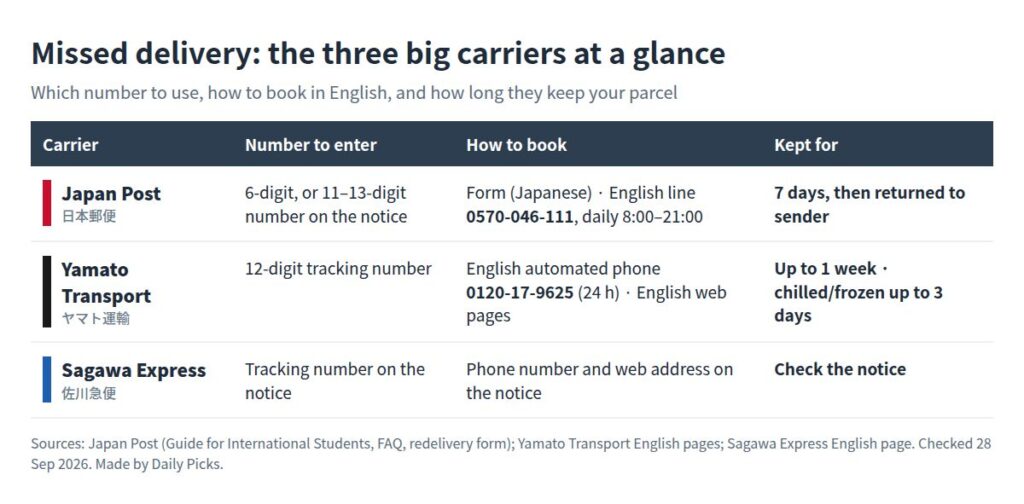
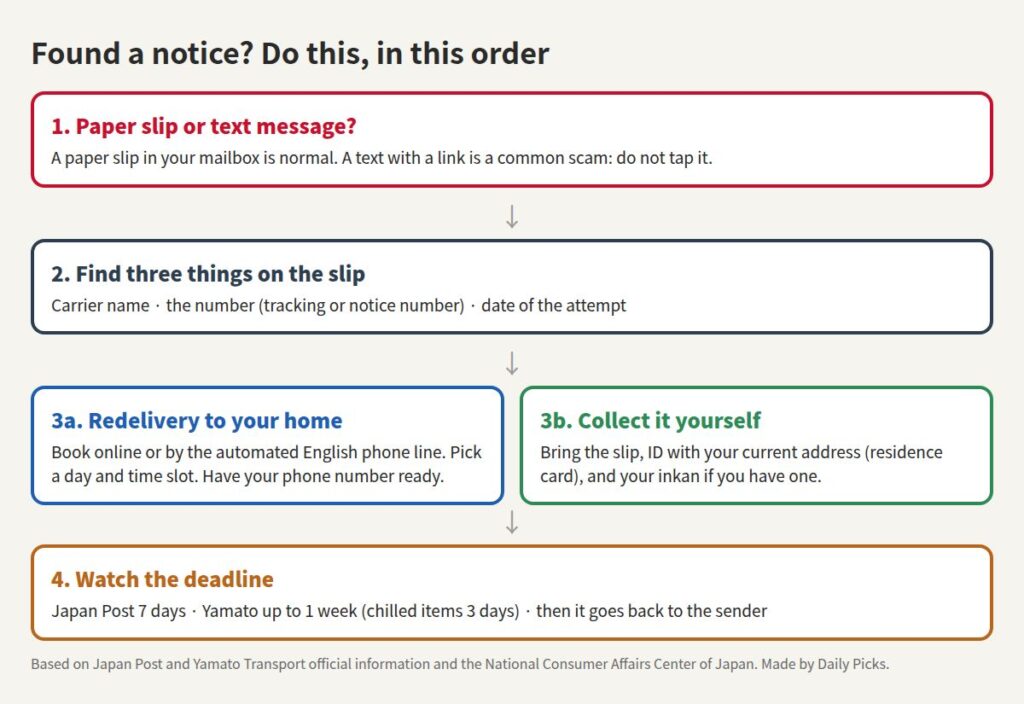
- Japan Post: 7 days. Japan Post’s FAQ says that if the item cannot be delivered within 7 days, it is returned to the sender.
- Yamato Transport: up to 1 week from the date written on the notice, for ordinary parcels. Refrigerated or frozen parcels (Cool TA-Q-BIN) are kept for only up to 3 days, and perishables and food are handled separately.
- Sagawa Express and others: check the notice or the company’s website. Do not assume you have a full week.
If you ordered food, flowers or anything chilled, treat the notice as urgent and book the earliest slot you can.
Booking a redelivery
You can almost always choose a new day and a time slot. You do not need to speak to anyone if you use the automated services.
Japan Post (日本郵便)
- Online: the redelivery form asks for “the 6-digit or 11 to 13-digit number shown on the delivery notice.” The form is in Japanese. Online requests are only for redelivery to the address on the notice; for anything else, call.
- English phone line: Japan Post’s guide for international students lists an English inquiry line, 0570-046-111, open daily 8:00 to 21:00.
- Phone, mail or fax: the number printed on the notice (in Japanese).
Yamato Transport (ヤマト運輸)
- Automated phone service in English (24 hours): 0120-17-9625. If it is hard to connect, Yamato lists 0783-30-4348 as an alternative.
- Online: Yamato has an English page for redelivery and receiving parcels.
- Time slots: for ordinary parcels, morning, 14:00–16:00, 16:00–18:00, 18:00–20:00 and 19:00–21:00. Small “Nekopos” items have no morning slot.
Cut-off for same-day redelivery. Ask for the parcel by these times and Yamato brings it the same day:
| Delivery slot you want | Request by (same day) |
|---|---|
| Morning | 7:00 |
| 14:00–16:00 | 12:40 |
| 16:00–18:00 | 12:40 |
| 18:00–20:00 | 17:40 |
| 19:00–21:00 | 17:40 |
Nekopos is different: the cut-off is 12:00 for the afternoon slots and 16:00 for the evening slots. If you are past the cut-off, ask for the next day instead.
You will need the waybill number printed on the attempted delivery notice. Yamato keeps the parcel for up to 1 week from the date written on the notice. Perishables and food products are not kept that long.
Sagawa Express (佐川急便)
- The notice lists a phone number and a web address for redelivery. Sagawa’s English page for individual customers links to the redelivery request. If you get stuck, the driver’s phone number on the notice is often the quickest way.
Tip: when you book, the system usually asks for your phone number. Have your Japanese mobile number ready. If you do not have one yet, see our guide to getting a Japanese phone number.
Collecting it yourself
If you are rarely home, going to the counter can be easier. With Japan Post, you pick up at the post office that handles deliveries to your address (it is written on the notice). With Yamato, you can ask for the parcel to be held at a TA-Q-BIN sales office when you book.
Japan Post’s guide for international students says to bring:
- The delivery notice itself.
- Identification that shows your current address, such as your residence card (zairyū card) or a driving licence.
- Your personal seal (inkan), if you have one.
Your residence card is the ID most foreign residents carry. Make sure the address on the back is up to date; if you moved recently and have not updated it, the counter may not be able to hand over the item. Check opening hours before you go, because the parcel counter at a large post office may keep different hours from the main counter.
Real notice or scam? The text-message trap
Fake “we tried to deliver your parcel” messages are one of the most common scams in Japan. They arrive by SMS or email, look like they come from Japan Post, Yamato or Sagawa, and include a link. The link leads to a fake website that asks for your ID and password, card details, or asks you to install an app. The National Consumer Affairs Center of Japan has recorded cases where victims were charged for international SMS messages and for digital purchases on their phone bill.
Japan Post warns about fake emails and SMS that use its name. The only delivery SMS it lists as its own group’s is one sent by a separate subsidiary that sells goods (Yūbinkyoku Buppan Service), when you were out for one of its own deliveries. In practice:
- A paper slip in your mailbox is the normal way Japan Post tells you about a missed delivery.
- Do not tap links in unexpected delivery messages. If you are expecting something, open the carrier’s website or app yourself and enter the tracking number from the shop’s order confirmation.
- Never enter passwords or card numbers on a page you reached from a text message.
- If you already entered details, change your passwords straight away and contact your bank or phone company. The consumer hotline is 188, and the police advice line is #9110.
Going away? Hold your mail first
If you will be away for a while, you can ask Japan Post in advance to hold your mail instead of trying to deliver it. Japan Post says it can hold mail for up to 30 days when you submit this notice beforehand. This avoids a pile of slips and items going back to senders while you are away.
If you are moving within Japan, you can also ask Japan Post to forward mail sent to your old address for one year. Forwarding does not work to addresses outside Japan.
Ways to miss fewer deliveries
- Choose a time slot when you order. Many online shops let you pick a delivery window at checkout.
- Use a delivery locker or convenience store. Many shops and carriers let you collect from a locker or a convenience store instead of home delivery.
- Check your building’s delivery box (takuhai box). Some apartment buildings have lockers by the entrance where drivers can leave parcels that do not need a signature.
- Register with the carriers’ member services if you get many parcels. They can notify you before a delivery and let you change the time in advance. Their apps and sites are largely in Japanese.
Parcels from overseas: customs duty, tax and the notices you may receive
A parcel from abroad can come with one more piece of paper: a customs notice. This is different from the absence slip. It tells you that tax is due, or that customs needs more information before the parcel can be released. This section explains how that works for items sent by international mail through Japan Post. It is based on Japan Customs and Japan Post pages, checked as of 30 September 2026. Rules can change, so check the official pages before you pay a large amount.
Who pays, and the 10,000 yen rule
In Japan, customs duty and consumption tax on an imported item are normally paid by the person who receives it. Tokyo Customs explains that this applies to personal items and gifts too, not only to goods bought for business. The recipient has to pay the tax shown on the notice before taking the parcel.
There is one important exemption. Japan Customs says that goods with a total customs value of 10,000 yen or less are exempt from customs duty and consumption tax. For parcel post, the value of everything inside one package is added together. If a sender splits one order into several parcels on purpose, customs may add them all together.
Some items are not covered by this exemption, even when cheap. According to Japan Customs, these include:
- Alcohol and tobacco (liquor tax and tobacco tax still apply)
- Leather bags, handbags and gloves
- Knitted clothing such as T-shirts and sweaters
- Leather shoes, shoes with leather soles, and ski boots
For many parcels with a customs value of 200,000 yen or less, a simpler flat rate is used instead of the full tariff. Japan Customs lists rates such as 3%, 5%, 10%, 15% and 20%, depending on the type of goods. Consumption tax is added on top.
How you are told: the usual cases
Japan Customs describes several paths for international mail. Which one applies depends on the value of the item and the amount of tax.
| Your situation | What usually happens | Where you pay |
|---|---|---|
| No tax is due | Japan Post delivers the parcel as normal. | Nothing to pay |
| Tax of 10,000 yen or less | The parcel comes with a tax notice and a payment slip. | At the door, or at the post office if you missed the delivery |
| Tax of 10,001 to 300,000 yen | Japan Customs says you are contacted by phone. You can ask for delivery and pay then. | At the door, or at the post office using the notice |
| Tax over 300,000 yen | The parcel is not delivered. A notice is sent to you. | Get a payment slip at the named post office, pay at a bank or post office, then collect |
| Customs value over 200,000 yen | A normal import declaration is needed. You get a clearance notice from Japan Post. | You, a customs broker, or Japan Post (on request) handles the declaration; you pay after the tax is set |
The Japanese name of the tax notice is 国際郵便物課税通知書 (kokusai yūbinbutsu kazei tsūchisho). Japan Customs calls it the Notice of Assessment for International Mail. It shows the item, its value, the tax rates used and the total amount due.
Paying at the door
When the tax is paid on delivery, Japan Customs says Japan Post also collects a handling charge of 200 yen per parcel. So the amount at the door can be a little more than the tax itself. If you missed the delivery, the parcel goes back to the post office with the tax still due. You then book a redelivery or collect it in the same way as any other parcel.
If you think the tax is wrong, do not simply refuse the parcel. Tokyo Customs suggests asking the post office to hold it and contacting the customs office for overseas mail shown on your notice. Keep your order receipt or invoice ready. Customs sets the tax from the declaration and price documents, so these help.
If customs asks you for information
Sometimes you receive a Notice of Customs Clearance Procedure instead. This means customs cannot finish clearance yet, and the parcel is being held. Tokyo Customs explains that the notice lists questions in the box marked 連絡事項欄 (renraku jikōran). Common questions are about the price, the postage, what the item is, or papers needed for restricted goods such as medicines.
- Find the notification number (通知番号, tsūchi bangō) on the notice.
- Read the questions in the 連絡事項欄 box.
- Prepare your receipt, invoice or order screen showing the price and shipping cost.
- Contact the customs office printed on the notice by phone, fax, post, or email (call first for email). Always give the notification number, your name and your phone number.
Parcels sent by courier companies
International courier services work differently. Japan Customs explains that a customs broker clears the goods for you. You pay the duty and tax, and usually a broker fee as well. The courier or broker tells you how to pay. Japan Customs advises checking these costs with the broker in advance.
Is the customs message real? A quick check
Japan Post warns about fake emails and text messages that use its name. Its examples include messages asking you to pay delivery fees or customs charges, and messages that say delivery will be cancelled if you do not pay within a few hours. Real customs notices for mail are paper documents from Japan Post or Japan Customs. Before you pay anything, go through this list.
- Did you actually order or expect something from abroad? If not, be careful.
- Is the request a paper notice with the parcel, a slip in your mailbox, or a phone call about a real parcel? A link in a text message is a warning sign.
- Enter the tracking number from your order (for example, AA123456789JP) on Japan Post’s own tracking page. Type the address yourself. Do not use a link from the message.
- Compare the sender and item on the notice with your order.
- If you are still unsure, call the Japan Post Customer Service Center. Japan Post lists 0120-23-28-86. For police advice, Japan Post also lists #9110.
- Do not enter card details on a page you reached from a text message.
A planned change for low-value imports
The Ministry of Finance’s outline of the FY2026 tax reform says that sales of low-value imported goods of 10,000 yen or less, sold by cross-border mail order, will be brought into consumption tax. The outline page does not give a start date. If you often buy cheap items from overseas shops, the 10,000 yen exemption may not apply to them in future. Check Japan Customs for the latest rules before relying on it.
FAQ
I found the slip after the keeping period ended. Is my parcel gone?
It has probably been sent back to the sender. Contact the shop or the sender and ask them to send it again. Some shops charge for re-sending.
The slip has a different name on it. What should I do?
Check whether the name matches someone in your household. If it is for a previous resident, contact the carrier using the number on the slip and tell them that person no longer lives there.
Can someone else collect my parcel at the post office?
This depends on the type of item. For registered mail and similar items, ask Japan Post before sending someone, because they may need a letter of authorisation and their own ID.
Is there a charge for redelivery?
Booking a redelivery using the notice does not normally cost you anything. Ask the carrier if you are unsure, especially for cash-on-delivery items.
I do not have a Japanese phone number. Can I still book?
You can use the online forms, but most ask for a contact number. The easiest option without one is often to collect the item at the counter with your notice and residence card.
Related reading
- Getting a Japanese phone number as a new resident
- Moving out in Japan: your deposit and the cleaning bill
Sources
- Japan Post, Practical Guide for International Students (English)
- Japan Post FAQ: how long a missed item is kept at the post office (Japanese)
- Japan Post, redelivery application form (Japanese)
- Yamato Transport, When Receiving an Attempted Delivery Notice (English)
- Yamato Transport, Receiving (English)
- Sagawa Express, For Individuals (English)
- Japan Post, warning about fake emails and websites using its name (Japanese)
- National Consumer Affairs Center of Japan, fake “missed delivery” SMS warning (Japanese)
- 1006 Duty exemption for goods at a total customs value of 10,000 yen or less (FAQ) | Japan Customs
- 1001 Simplified tariff applicable to goods at a total value of 200,000 yen or less (FAQ) | Japan Customs
- 6101 Outline of Customs Procedures for International Postal Items (FAQ) | Japan Customs
- 6103 How to Interpret the Assessment Notice of International Mail (FAQ) | Japan Customs
- 1301 Payment of Customs Duty (FAQ) | Japan Customs
- 3002 Import Clearance Procedures for Personal Import (FAQ) | Japan Customs
- Customs Procedures for Private Import Cargo | Japan Customs
- Why were duties and taxes assessed on my parcels? | Tokyo Customs
- For those who received a Notice of Customs Clearance Procedure | Tokyo Customs
- Individual Search by Item Number | Japan Post
- 令和8年度税制改正の大綱の概要 | 財務省
Information checked on 28 September 2026.
コメント