日本語版:日本語で読む(Japanese version) →
The first winter in a Japanese apartment surprises most people who move here. Not because it is colder outside than at home — for many arrivals it is milder — but because it is cold inside. There is no central heating. There are no radiators under the windows. Each room has its own machine, and the hallway, the toilet and the bathroom usually have nothing at all.
Then the January electricity bill arrives, and it is much higher than the summer one.
This article explains why Japanese rentals are built this way, what the heating appliances in the shop actually do, what each one costs per hour, and which safety points matter. Every number here comes from the manufacturer’s own specification, a government survey or an official safety notice, and each source is listed at the end. All the yen-per-hour figures use the same electricity price so that they can be compared.
- The short version
- Why a Japanese apartment feels cold indoors
- The cold hallway is a real safety issue, not just discomfort
- What you will actually see in the shop
- What each one costs per hour
- Per hour is only half the story
- Kerosene heaters: check your lease before you buy
- Choosing: match the appliance to the space and the hours
- Safety: the features that matter are the ones that switch it off
- Cutting the bill
- Questions people ask
- In short
- Sources
- Also on Daily Picks
The short version
- Japan heats rooms, not buildings. Buy for the room and the hours you are actually in it
- Insulation only became compulsory for newly built homes in April 2025. Your rental is almost certainly older than that
- About 60% of the heat that leaves a Japanese home in winter goes out through the windows
- At the standard reference price of 31 yen per kWh, one hour costs roughly: electric blanket 1 yen, kotatsu 5 yen, aircon in a 6-jo room 14 yen, ceramic fan heater on high 36 yen, oil-filled radiator 37 yen
- An aircon is the cheapest way to heat a whole room, but it runs for months. Over one heating season a 6-jo model typically uses 486 kWh — about 15,100 yen, roughly 2.4 times what the same machine uses for cooling all summer
- Kerosene and gas heaters are banned in many leases. Check your contract before you buy one
- The safety feature that matters is not how well it heats. It is whether it switches itself off
Why a Japanese apartment feels cold indoors
Three things combine, and none of them is about the weather.
1. Heating is per room, by design
In much of Europe and North America, one boiler or furnace heats the whole dwelling, and the hallway and bathroom come along for free. Japan generally uses kobetsu danbō (個別暖房, individual heating): you heat the room you are sitting in, when you are sitting in it. Whole-home heating exists here, but in ordinary rental apartments it is the exception rather than the norm.
This is why the wall-mounted air conditioner in your main room is also your heater, and why the rest of the apartment stays at whatever temperature the outside air dictates.
2. Insulation rules are new, and they only apply to new buildings
Japan did not require homes to meet an energy-saving insulation standard until recently. The Ministry of Land, Infrastructure, Transport and Tourism (MLIT) made compliance mandatory for buildings on which construction starts in or after April 2025. The standard is due to be raised again to “ZEH level” by 2030.
Read that carefully, because it explains your apartment. The rule applies to new construction and extensions. Ordinary renovation of an existing building is not covered, and nothing obliges a landlord to bring an older block up to the new standard. Unless your building was started in 2025 or later, it was put up under the earlier regime, when the insulation standard was something a builder could choose to meet rather than something they had to.
This is not a reason to be alarmed about the building. It is a reason to expect the room to lose heat faster than you are used to, and to plan your heating around that.
3. Most of the heat leaves through the windows
The Agency for Natural Resources and Energy puts a number on it: when you are heating in winter, about 60% of the heat that escapes the room goes out through windows and other openings. (In summer the same openings let in about 70% of the heat that comes in.)
A window’s performance comes from the glass and the frame together. The agency’s stated ideal is an insulating sash of wood or plastic fitted with double glazing; a single pane in an aluminium sash is the opposite of that, because aluminium conducts heat readily. If you see condensation running down the inside of your glass on a cold morning, that is the room’s warmth meeting a cold surface, and it tells you which kind of window you have.
You cannot replace a rental’s windows. You can cover them, and the agency notes that fitting an inner window (a second pane inside the existing one) gives roughly the same insulation as double glazing and is a practical retrofit for apartments — though that is a job for an owner, not a tenant. What a tenant can do is cheaper and still worth doing: thick or thermal curtains that reach below the window sill, and bubble-type insulating sheet on the glass itself. Both are sold in every home centre from October onwards.
The cold hallway is a real safety issue, not just discomfort
This part is worth knowing before you decide where to put your heater.
Because only the living room is heated, the gap between your warm room and the unheated datsuijo (脱衣所, the changing area next to the bath) can be very large. You undress in a cold room, then get into a hot bath. Your blood pressure swings sharply. In Japan this is commonly called “heat shock”.
The Consumer Affairs Agency published the scale of it in December 2025, using the Ministry of Health, Labour and Welfare’s 2024 vital statistics:
- 7,776 people died in 2024 from drowning in, or falling into, a bathtub
- 7,363 of them — about 95% — were aged 65 or over
- For that age group, this is more than three times the number of traffic deaths (2,103)
The agency’s advice is directly about temperature: warm the changing room and the bathroom before you bathe, use a thermometer so you can actually see the gap between rooms, drink water beforehand, avoid very hot or very long baths, and do not bathe straight after a meal, after drinking alcohol, or after taking medication.
Practically, this is the strongest argument for owning a small, fast heater in addition to your aircon. A ceramic fan heater run in the changing room for five minutes before a bath costs about three yen and does something an aircon in another room cannot do.
What you will actually see in the shop
Walk into a Yamada Denki, Nojima or a home centre in November and the seasonal aisle will have all of these. They are not competing products — they do different jobs.
| Type | Japanese | What it heats | Best for |
|---|---|---|---|
| Air conditioner, heating mode | エアコン暖房 (eakon danbō) | The whole room’s air | Hours at a time in one room |
| Ceramic fan heater | セラミックファンヒーター | A small area, instantly | Changing room, toilet, desk, kitchen |
| Oil-filled radiator | オイルヒーター | The room, slowly, with no draught | Bedroom, study; dry air or dust is a problem |
| Kotatsu | こたつ | The space under a quilted table | Sitting still at home; very cheap to run |
| Electric blanket / throw | 電気毛布・電気ひざ掛け | Your body only | Sleeping, working at a desk |
| Electric heated carpet | ホットカーペット | The floor you sit on | Floor-level living; pairs with a kotatsu |
| Kerosene fan heater | 石油ファンヒーター | The room, powerfully and fast | Often banned in rentals — see below |
If you have never met a kotatsu
A kotatsu is a low table with an electric heating unit bolted to the underside of the tabletop. A thick quilt is laid over the frame, and the tabletop goes on top of the quilt to hold it down. You sit on the floor and put your legs underneath.
It works because it heats a small enclosed volume instead of a room, and because once that space is warm the heater only has to maintain it. The heating units themselves are rated 500 W or 600 W — Metro Denki Kogyo, one of the main makers of replacement units, lists a 500 W carbon type and 600 W halogen and quartz types — but they do not draw that continuously.
Metro publishes a measured average of about 4.9 yen per hour for its kotatsu against about 16.2 yen per hour for a typical air conditioner. Their test conditions are specific and worth knowing: room at 20°C, a cotton quilt about 5 cm thick, nobody sitting in it, averaged over five hours of running, on a table roughly 80 × 80 × 34 cm, with electricity at 31 yen per kWh. Your own figure will differ, but the order of magnitude is right: a kotatsu is one of the cheapest heated things you can own.
The honest drawbacks: it takes up floor space all winter, it only heats you while you are in it, and it is famously difficult to leave.
What each one costs per hour
There is only one formula, and it is the same for every electric appliance:
Cost = power (kW) × hours × price per kWh
Power is printed on the appliance and in its specification, usually in watts. Divide by 1,000 to get kilowatts. A 1,200 W heater run for one hour is 1.2 kW × 1 h × 31 yen = 37.2 yen.
Where 31 yen comes from
Your actual price depends on which retailer you buy electricity from, so Japanese manufacturers use a common reference figure. It is set by the Japan Electric Home Appliances Fair Trade Conference (家電公取協), which calculates it from the sales volumes and revenues of all electricity retailers as published by the government’s Electricity and Gas Market Surveillance Commission.
The current figure is 31 yen per kWh including tax, raised from 27 yen on 22 July 2022.
A trap in the catalogue figures
When a box says “about ¥31.6 per hour”, check which price it used. Not every manufacturer has updated to 31 yen, and some government material still uses 27.
Two Panasonic ceramic fan heaters make this obvious. The DS-FS1200 and the DS-FTX1200 both draw 1,170 W on high at 50 Hz. Panasonic’s published running cost is about 36.3 yen per hour for one and about 31.6 yen for the other. The machines are equally efficient; the first figure was calculated at 31 yen per kWh and the second at 27.
So do not compare the yen figures on two boxes. Compare the watts, then apply one price. Everything below uses 31 yen per kWh.
The comparison
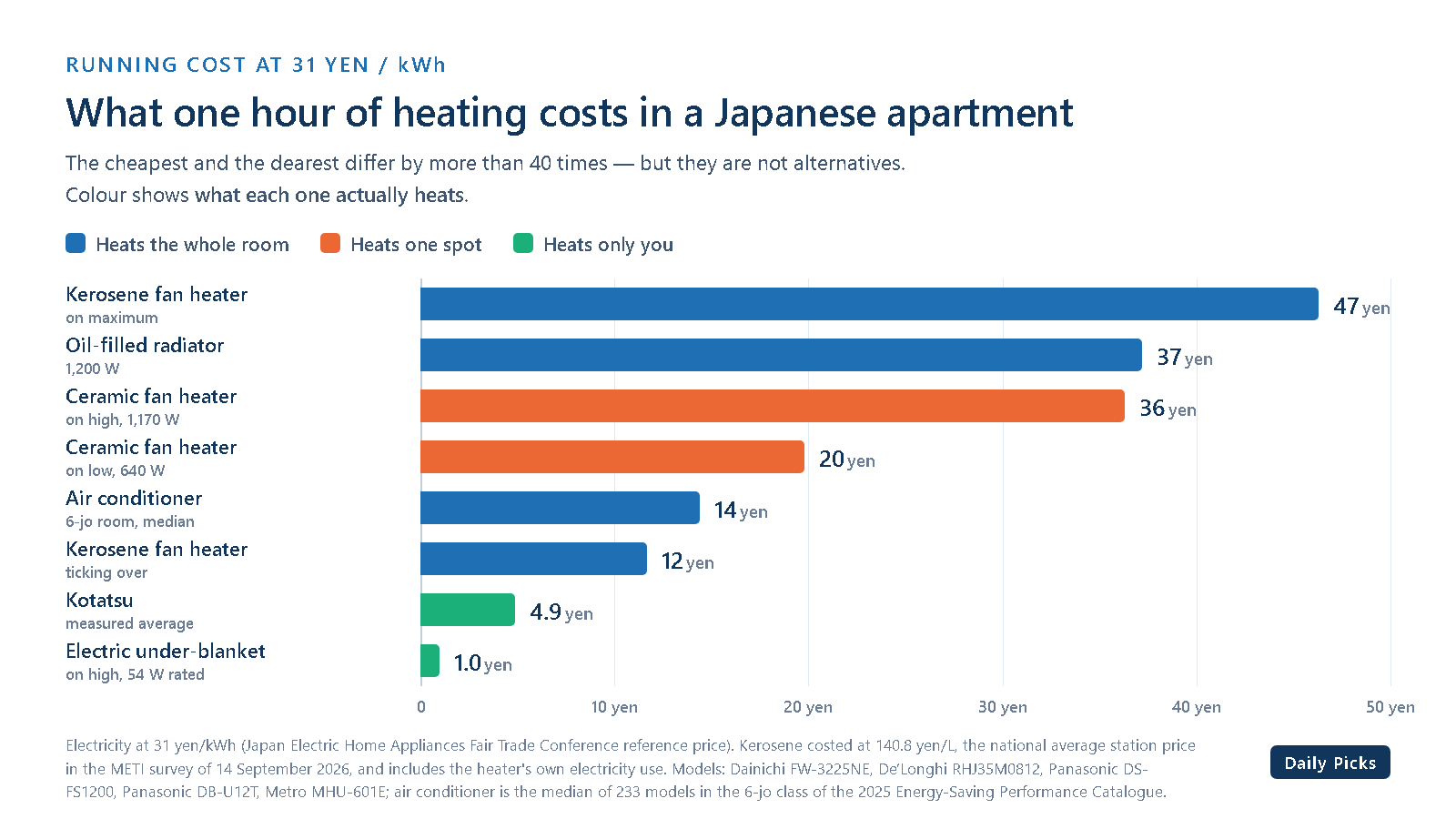
| Appliance | Power | Per hour | 6 hours a day, 30 days |
|---|---|---|---|
| Kerosene fan heater, maximum | 0.311 L/h fuel + 98 W | about 47 yen | about 8,400 yen |
| Oil-filled radiator | 1,200 W | 37.2 yen | about 6,700 yen |
| Ceramic fan heater, high | 1,170 W | 36.3 yen | about 6,500 yen |
| Ceramic fan heater, low | 640 W | 19.8 yen | about 3,600 yen |
| Air conditioner, 6-jo room | 415–620 W (median 465 W) | 12.9–19.2 yen (median 14.4 yen) | about 2,300–3,500 yen |
| Kerosene fan heater, minimum | 0.072 L/h fuel + 52 W | about 12 yen | about 2,100 yen |
| Kotatsu | 500–600 W rated | about 4.9 yen measured average | about 880 yen |
| Electric under-blanket | 54 W rated | about 1.0 yen on high | about 180 yen |
The top and bottom of that table differ by more than forty times. But it would be wrong to conclude that an oil heater is “forty times worse than an electric blanket”, because a blanket does not raise the room temperature by a single degree. These appliances are not alternatives to each other. They are in the same table only because they all plug into the wall.
One more caveat. These are the figures for running at that wattage continuously. A ceramic fan heater really does draw its rated power the whole time it is on. An air conditioner, an oil-filled radiator and a kotatsu do not: they push hard at first, then throttle back once the target temperature is reached. An aircon starting in a freezing room will briefly exceed its rated figure, then drop well below it. Real averages sit somewhere either side of the table.
Per hour is only half the story
At 14.4 yen an hour the air conditioner looks unbeatable, and for heating a whole room it is. But it is also the appliance you leave on for months, which is why it dominates the winter bill.
Japanese air conditioners publish a seasonal figure, the kikan shōhi denryokuryō (期間消費電力量, period electricity consumption), calculated to a fixed standard: heating season 8 November to 16 April, room set to 20°C, running 06:00 to 24:00, Tokyo weather, an average wooden house facing south, in a room matched to the unit’s capacity.
Totalling the models listed in the 2025 catalogue gives this:
| Class | Heating season | At 31 yen/kWh | vs cooling season |
|---|---|---|---|
| 6-jo (2.2 kW), 233 models | 408–518 kWh (median 486) | about 12,600–16,100 yen (median 15,100 yen) | about 2.4× |
The right-hand column is the one to remember. The same air conditioner uses roughly two and a half times as much electricity heating your room in winter as it does cooling it all summer. If your bill jumps in January and you had assumed August was the expensive month, this is why.
And 15,100 yen over a season feels very different from “14 yen an hour”, even though both are true. Eighteen hours a day for 160 days adds up regardless of the hourly rate.
Why an aircon can heat a room on less than 1,000 W
Every other appliance in the table turns electricity into heat. One kilowatt in, one kilowatt of heat out. That is the ceiling.
An air conditioner is a heat pump. It does not make heat, it moves heat that already exists in the outdoor air into your room. Moving heat takes far less energy than creating it, which is how 465 W can warm a room that a 1,200 W radiator struggles with.
The trade-off: the colder it is outside, the less heat there is to move, so both output and efficiency fall on the coldest days. Units also pause to defrost the outdoor coil. This is normal, not a fault.
Kerosene heaters: check your lease before you buy
Kerosene fan heaters (sekiyu fan hītā, 石油ファンヒーター) are powerful, heat a room fast, and are genuinely popular in Japanese houses. In rented apartments they are frequently forbidden.
UR, the public housing agency, states the position plainly: some heating appliances are prohibited by the tenancy contract, and the ones most often prohibited are kerosene fan heaters, kerosene stoves and gas fan heaters — anything that burns kerosene or gas. The reasoning is that heating appliances run for long stretches, unlike a gas hob, which brings fire and carbon-monoxide risk. Their advice, and ours: read your lease before you buy one.
This is a contract matter, not a national ban — the rule varies by building and by landlord. If the lease or the building rules (nyūkyosha no shiori, 入居者のしおり) say no, using one anyway can put you in breach and expose you to repair costs when you leave. Burning kerosene also releases a lot of water vapour, which in an airtight concrete building means condensation and then mould on the walls — a classic dispute at move-out time.
If you live somewhere they are permitted, the running costs are straightforward. A typical 9-jo class unit, the Dainichi FW-3225NE, burns 0.311 litres per hour at full output and 0.072 L/h at minimum, and additionally draws 98 W of electricity (370 W briefly at ignition). At the national average station price of 140.8 yen per litre — surveyed by METI on 14 September 2026 — that is about 47 yen per hour flat out and about 12 yen ticking over. Kerosene is sold at filling stations and delivered by truck; the delivered average was 150.9 yen per litre. The price moves week to week, and METI publishes it every Wednesday.
Two non-negotiable rules come straight from the manufacturer’s manual:
- Ventilate one to two times every hour, for one to two minutes, while it is running. Opening two windows or doors, or running an extractor fan, works better than one. Never use one where you cannot ventilate. Without oxygen the burn becomes incomplete and produces carbon monoxide
- Never dry laundry on it. NITE has investigated house fires caused by washing hung above a kerosene heater falling onto it
Also: refuel outdoors or over a sink with the heater switched off, keep kerosene in a proper kerosene container (red or blue polyethylene, not a petrol can), never put petrol in it by mistake, and do not use last winter’s leftover kerosene — degraded fuel burns abnormally and produces more carbon monoxide.
Choosing: match the appliance to the space and the hours
Hunting for the cheapest machine is the wrong move. Deciding what you are heating and for how long will cut your bill more than any product choice.
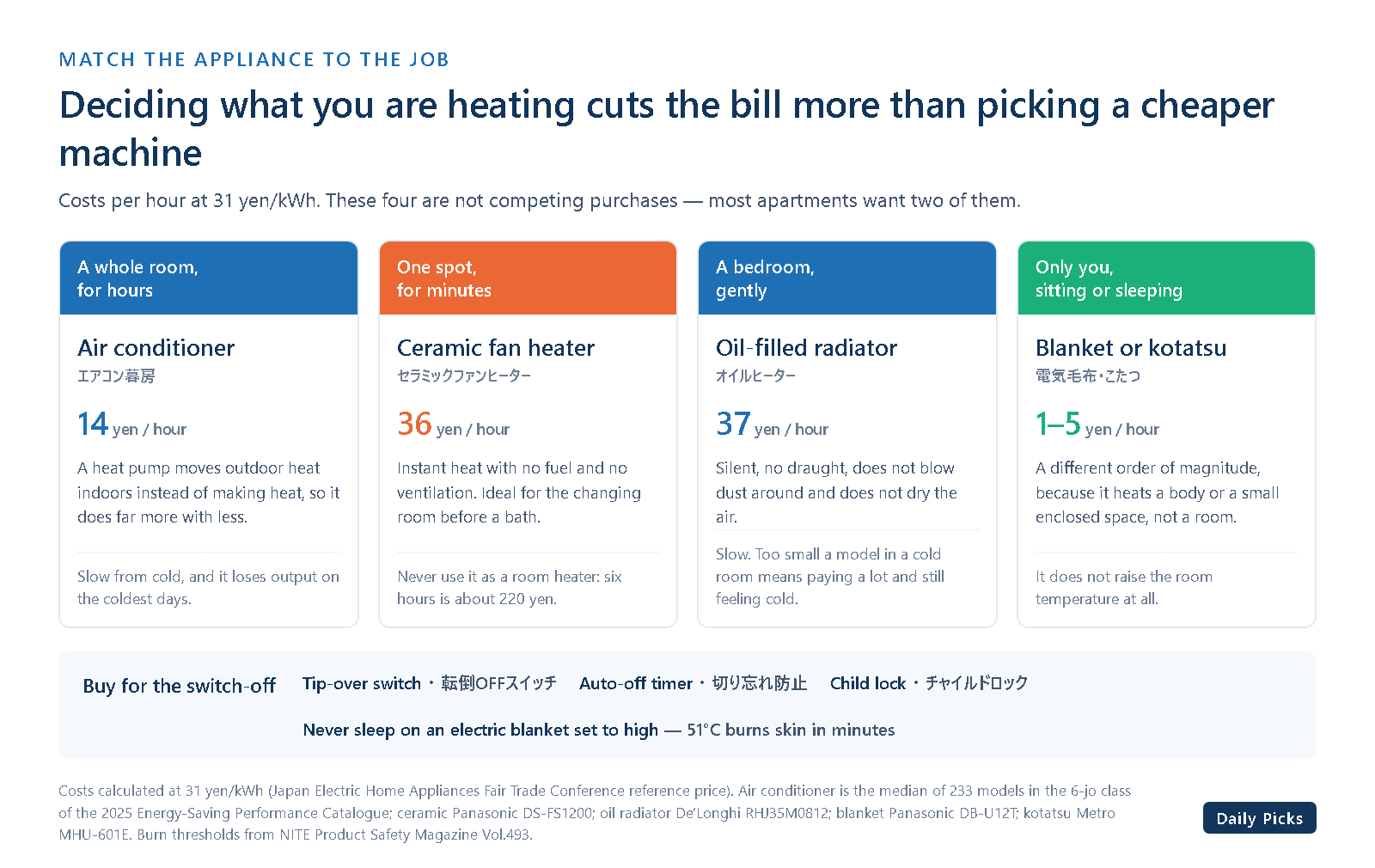
- A whole room, for hours → air conditioner. Nothing electric beats a heat pump for this. Weaknesses: slow to warm up from cold, and useless for a room you will be in for four minutes
- Feet, changing room, toilet, for minutes → ceramic fan heater. Instant, no fuel, no ventilation. The one thing you must not do is use it as a room heater all evening: 36 yen an hour becomes about 220 yen over six hours
- Bedroom or study, no draught, no dry air → oil-filled radiator. Silent and gentle, and it does not blow dust around. But it is slow, and at 1,200 W in an under-insulated room you can end up paying a lot to still feel cold
- Only you → electric blanket, throw, or kotatsu. Different order of magnitude entirely
The cheapest realistic setup for most single-occupant apartments is a combination: the aircon holds the main room at 20°C while you are up; a small ceramic heater handles the changing room for five minutes before a bath; and at night the aircon goes off and an electric blanket or kotatsu takes over. These are not competing purchases.
Room-size labels are not all measured the same way
Japanese heaters are labelled in jō (畳), the size of a tatami mat, as a room-size guide. Be careful: the same appliance can carry two different numbers.
De’Longhi’s product page for the Amicaldo RHJ35M0812 is unusually transparent about it. Up to 10 jo by De’Longhi’s own test (new energy-conservation standard, outside temperature 5°C, five surfaces enclosed) — and about 8 jo under the voluntary standard of the Japan Electrical Manufacturers’ Association. Same machine, two-mat difference, and shops naturally display the larger number.
In a poorly insulated or north-facing room, assume the smaller figure. Note also that kerosene heaters are rated separately for wooden houses and concrete buildings — the FW-3225NE is 9 jo wooden but 12 jo concrete — because concrete blocks hold heat differently.
Ceramic fan heaters usually carry no jo rating at all, or a very small one. That is not a defect. They were never meant to heat a room.
Safety: the features that matter are the ones that switch it off
Electric heaters have no flame, and that is precisely the problem: people treat them as though they cannot start a fire.
NITE, the National Institute of Technology and Evaluation, recorded 582 accidents involving heating appliances over the five years 2019–2023. Electric heaters and kerosene heaters together accounted for about 80% or more of them every single year. In an earlier campaign NITE named the two recurring patterns: zero-distance fires (ゼロ距離火災), where something flammable touches or rests against the heating element, and left-running fires (ほったらかし火災), where the user walks away without switching off, or ignores a damaged power cord.
Their documented cases are ordinary domestic moments: a blanket over the knees slipping down onto a fan heater; laundry hung above a kerosene stove falling; a power cord repeatedly bent at the base of the plug until a strand broke and sparked.
Before you buy
- Tip-over switch (転倒OFFスイッチ) — cuts the element if the unit falls. Essential in an earthquake country, and standard on Panasonic’s DS-FS1200, DS-FTS1200 and DS-FTX1200
- Auto-off timer (切り忘れ防止) — the DS-FTX1200 and DS-FTS1200 stop eight hours after the last button press
- Child lock (チャイルドロック) — on the De’Longhi Amicaldo among others
- Overheating plug protection — De’Longhi’s safety plug cuts power if the plug itself exceeds about 80°C, which protects against a worn or dusty wall socket rather than the heater
- Room and occupancy sensors — these save money and improve safety at the same time
While you use it
NITE’s pre-season checklist is short: confirm the model is not subject to a recall; inspect the cord and plug for cracks, discolouration or melting, especially right at the base; keep the specified clearance from walls, furniture, curtains and bedding; switch it off when you leave the room or go to sleep; and physically test that the tip-over switch works by tilting the unit while it is on.
Those clearance distances are not advice. Under Article 9 of the Fire Service Act, handling of heating appliances is regulated by municipal ordinance, with nationally standardised categories and minimum separation distances set out in national regulations. The model ordinance also carries a specific line for electrically heated appliances: do not leave them energised and unattended. The exact rules are set by your city, so they differ slightly depending on where you live.
Separately, every home in Japan is legally required to have residential smoke alarms under Article 9-2 of the same Act. In a rental these are usually already fitted on the ceiling. Before winter, check that yours has not passed its replacement date and that the battery still responds to the test cord.
To check a recall, NITE runs a search tool called NITE SAFE-Lite and the Consumer Affairs Agency runs a recall information site. Both are in Japanese; searching by model number works without much reading.
Electric blankets have a different risk
Blankets rarely cause fires. They cause low-temperature burns (低温やけど, teion yakedo), which is a different injury: it happens at temperatures that feel merely pleasant, so you do not pull away.
NITE’s January 2026 bulletin gives the accepted thresholds: 44°C over three to four hours, 46°C over thirty minutes to an hour, and 50°C in two to three minutes. Pressure on the contact point — your knee resting against it, your own body weight — shortens all of these. Unlike an ordinary burn, a low-temperature burn reaches deep tissue and can require serious treatment.
Now put that next to a real specification. Panasonic’s DB-U12T under-blanket has a standard surface temperature at a room temperature of 20°C of 51°C on “high” and 37°C on setting 3. Compare 51°C with the two-to-three-minute threshold above and the conclusion is unavoidable: the “high” setting was never designed to be slept on.
NITE’s guidance matches. Use the blanket to warm the bed before you get in, then turn it down to a low setting — or switch it off altogether and sleep without it. The same applies to an anka (電気あんか, electric foot warmer): warm the bed, then take it out. Wrapping one in a thick towel does not remove the risk.
Cutting the bill
The Agency for Natural Resources and Energy publishes measured savings for a 2.2 kW air conditioner. Converted at 31 yen per kWh:
| Change | Conditions | Per year | Saving |
|---|---|---|---|
| Aim for 20°C, not 21°C | Outside 6°C, 9 hours a day | 53.08 kWh | about 1,650 yen |
| Heat one hour less per day | Set to 20°C | 40.73 kWh | about 1,260 yen |
| Clean the filter once or twice a month | vs a clogged filter | 31.95 kWh | about 990 yen |
Four more things that are worth doing:
- Move the air around. Warm air collects at the ceiling and your feet stay cold. A circulator or fan pointed upward mixes it. Set the aircon’s louvre to blow downward in heating mode — the opposite of what you want in summer
- Deal with the windows, since that is where roughly 60% of the heat goes. Thermal curtains long enough to pass below the sill, and insulating sheet on the glass
- Put the spot heater near the window if you are running one alongside the aircon. Cold air pools at the glass and the aircon then circulates it around the room
- Check your contracted amperage before you plug in a second 1,200 W appliance. Single-occupancy rentals are commonly contracted at 20 A or 30 A, and exceeding it trips the main breaker. You can ask your retailer to raise it, but the basic monthly charge rises too. In the Kansai, Shikoku, Chugoku and Okinawa areas there is often no amperage-based contract at all
If the bill still looks wrong after all that, the problem may be the contract rather than the heating. The government discount on electricity and city gas ends with September 2026 usage, and grid charges rise on 1 November — both land on the bills you receive during the heating season. We covered what changes, and how to read a Japanese electricity statement line by line, in Electricity and gas subsidies end with September usage.
Questions people ask
What is the cheapest way to stay warm?
The question has no answer until you say what you are heating. For a whole room it is the air conditioner; for one person it is an electric blanket or a kotatsu. Because those two do not compete, owning both and switching between them is cheaper than either alone: aircon at 20°C while you are up, blanket on and aircon off when you go to bed.
Can I use a kerosene heater in my apartment?
Check the lease and the building rules; many prohibit kerosene and gas heaters, and UR names them as the most commonly banned appliances. If you cannot find the clause or cannot read it, ask the management company in writing before buying — a short email gives you a record. Do not rely on “the previous tenant had one”.
Is an oil-filled radiator really that expensive?
While it is drawing its full 1,200 W, yes — 37.2 yen an hour is the top of the electric range. But it has a thermostat and cycles off once the room reaches temperature, so the average is lower. The real risk is not the price. It is buying one that is too small for an under-insulated room, which produces the worst outcome of all: expensive and still cold. Check which standard the jo rating uses.
Should I leave the aircon on all day or switch it off?
The only figure the agency actually publishes is that heating one hour less per day saves 40.73 kWh — about 1,260 yen — a year. It does not claim that leaving it on is cheaper. Its two pieces of advice are “heat only when you need it” and “avoid switching on and off constantly; let the unit’s automatic control do the work”. In practice: stepping out for a few minutes, leave it; going out properly, turn it off.
My breaker keeps tripping when I turn the heater on
Almost certainly your contracted amperage. A 1,200 W heater is 12 A on its own, and a microwave, a hairdryer or a rice cooker on top of it will pass 20 A quickly. Your current contract is printed on your bill and shown on the main breaker in the distribution board. Your retailer can change it; expect the basic charge to go up.
How do I convert these figures to my own bill?
Find your price per kWh on your statement, then multiply every figure here by (your price ÷ 31). At 25 yen the numbers become about 0.81 times these; at 40 yen, about 1.29 times.
In short
- Your apartment is cold because Japan heats rooms rather than buildings, and because insulation only became compulsory for new builds in April 2025
- Roughly 60% of the heat leaves through the windows, so curtains and window film are worth more than they look
- The formula is always power (kW) × hours × price. Use 31 yen per kWh; do not trust the yen figures printed on different boxes
- Per hour: blanket about 1 yen, kotatsu about 5 yen, aircon about 14 yen, ceramic heater about 36 yen, oil radiator 37 yen
- Over a season, a 6-jo aircon uses about 486 kWh heating — around 2.4 times its cooling use
- Kerosene and gas heaters are banned under many leases. Check before buying
- Buy for the tip-over switch, the auto-off timer and the child lock. Never sleep on an electric blanket set to high
- Warm the changing room before you bathe. The temperature gap between rooms is a documented and serious hazard
Sources
- Japan Electric Home Appliances Fair Trade Conference, FAQ — reference electricity unit price of 31 yen/kWh, revised 22 July 2022: https://www.eftc.or.jp/qa/
- MLIT, “Raising the energy-saving standard” — compliance mandatory for construction starting April 2025: https://www.mlit.go.jp/shoene-jutaku/
- METI Agency for Natural Resources and Energy, energy-saving housing — about 60% of winter heat loss through openings: https://www.enecho.meti.go.jp/category/saving_and_new/saving/general/housing/
- METI Agency for Natural Resources and Energy, Energy Saving Portal, “air conditioning” — measured savings for temperature, running time and filter cleaning: https://www.enecho.meti.go.jp/category/saving_and_new/saving/general/howto/airconditioning/index.html
- METI Agency for Natural Resources and Energy, Energy-Saving Performance Catalogue 2025 — air conditioner seasonal consumption and calculation conditions: https://seihinjyoho.go.jp/frontguide/pdf/catalog/2025/catalog2025.pdf
- METI, Petroleum Product Price Survey — kerosene 2,535 yen/18 L at the pump, surveyed 14 September 2026: https://www.enecho.meti.go.jp/statistics/petroleum_and_lpgas/pl007/results.html
- Consumer Affairs Agency, “Watch out for accidents among older people over the new year” (23 December 2025) — bathtub drowning statistics and bathing advice: https://www.caa.go.jp/policies/policy/consumer_safety/caution/caution_084/
- NITE, Product Safety Magazine Vol.464 (12 November 2024) — 582 heating-appliance accidents 2019–2023 and inspection points: https://www.nite.go.jp/jiko/chuikanki/mailmagazin/2024fy/vol464_241112.html
- NITE, press release “Danbō, tenken, yoshi!” (31 October 2024) — the five pre-season checks: https://www.nite.go.jp/jiko/chuikanki/press/2024fy/prs241031.html
- NITE, press release of 24 November 2022 — “zero-distance” and “left-running” fires: https://www.nite.go.jp/jiko/chuikanki/press/2022fy/pr221124.html
- NITE, Product Safety Magazine Vol.493 (27 January 2026) — low-temperature burn thresholds and electric blanket advice: https://www.nite.go.jp/jiko/chuikanki/mailmagazin/2025fy/vol493_260127.html
- FDMA National Research Institute of Fire and Disaster, “Handling of fire appliances” — Fire Service Act Article 9, municipal ordinances, clearance distances, mandatory smoke alarms: https://nrifd.fdma.go.jp/news/caution/heat_generator/index.html
- UR rental housing, “Choosing heating appliances when living alone” — appliances prohibited by tenancy contracts, contracted amperage: https://www.ur-net.go.jp/chintai/college/202205/000889.html
- Panasonic DS-FS1200 specification — 1,170 W on high, about 36.3 yen/hour, tip-over switch: https://panasonic.jp/danbo/products/DS-FS1200/spec.html
- Panasonic DS-FTX1200 specification — same 1,170 W, about 31.6 yen/hour at the older unit price: https://panasonic.jp/danbo/products/DS-FTX1200/spec.html
- Panasonic DB-U12T specification — rated 54 W, surface 51°C on high at a room temperature of 20°C: https://panasonic.jp/danbo/products/DB-U12T/spec.html
- De’Longhi Japan, Amicaldo RHJ35M0812-DG — 1,200 W, the two room-size standards, safety plug, child lock: De’Longhi product page
- Metro Denki Kogyo — replacement kotatsu heater units rated 500 W and 600 W: https://www.kotatsu.metro-co.com/general_product_cat/replacement-heater/
- Metro Denki Kogyo, “Metro no kotatsu” — about 4.9 yen/hour measured average and the test conditions: https://www.kotatsu.metro-co.com/our-kotatsu/
- Dainichi NE TYPE 2025 — FW-3225NE output, fuel consumption and electricity draw: https://www.dainichi-net.co.jp/products/fanheater/lineup/ne2025/
- Dainichi instruction manual (FW-2522NE / FW-3222NE) — ventilate one to two times per hour for one to two minutes: https://www.dainichi-net.co.jp/uploads/manual/fanheater/fw-2522ne_3222ne.pdf
Prices and specifications were checked on 20 September 2026. The yen figures are estimates calculated at 31 yen per kWh unless stated otherwise; your actual cost depends on your electricity retailer’s unit price, your building’s insulation, the outside temperature and how long you run the appliance. Tenancy rules on heating appliances vary by building — your own contract is the authority. This article is general information, not legal advice.