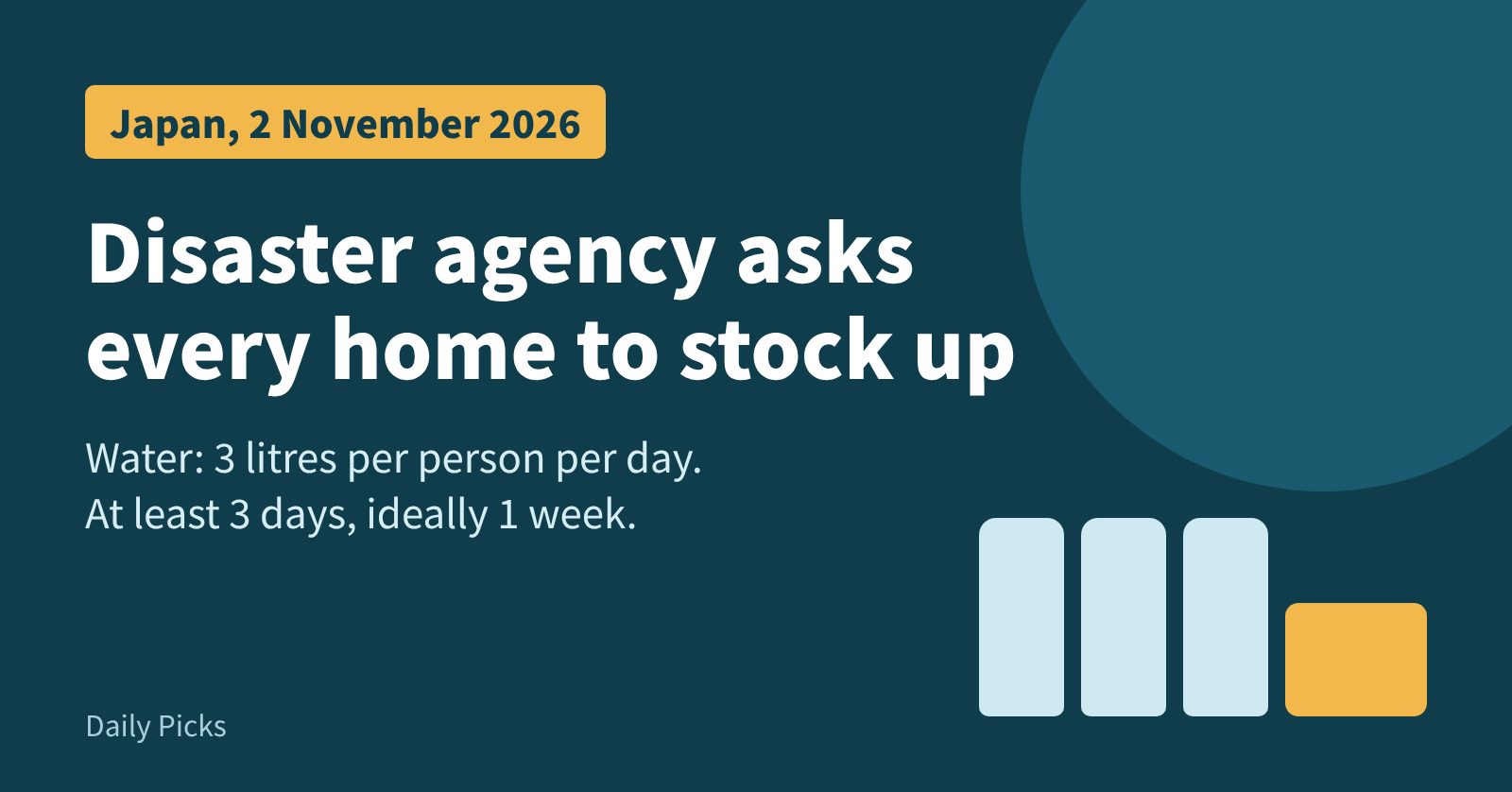
Summary: On 2 November 2026, the day Japan’s new Disaster Management Agency (Bosai-cho, 防災庁) began work, the government published an “urgent request” asking everyone in Japan to prepare for a major disaster at home. It is not a warning that a disaster will happen on a certain date, and the message to residents mentions no penalties. It asks for five things: make your home safer in an earthquake, store water, food and portable toilets for at least 3 days and ideally 1 week, check hazard maps and evacuation sites, pack an emergency bag, and join local drills. A good first step is to count the drinking water you have today.
This is based on the agency’s official page and the minister’s message to residents, both in Japanese (checked 2 November 2026). The message is addressed to the people of Japan in general and has no separate rules for foreign residents, so the same advice applies to you.
What was announced
The message comes from Disaster Management Minister Goshi Hosono. It says major disasters are a concern, naming the Kuril and Japan Trench earthquakes, an earthquake directly under the Tokyo area, a Nankai Trough earthquake, and an eruption of Mt. Fuji. It says each person needs to take steps to protect their own life.
The agency sent separate requests to prefectures and government ministries. Prefectures and ministries report their progress at the end of the year. Progress by residents and companies will be checked through surveys, including a public opinion survey on disaster preparedness.
Who this is for
Everyone living in Japan. What you should do first depends on your home:
- Older buildings: the message asks people in homes built in Showa 56 (1981) or earlier to get an earthquake safety check (taishin shindan, 耐震診断). You can find the build year in your rental papers or ask your management company.
- Near the coast or a river: check tsunami and flood risks and your route to an evacuation site first.
- Every home: stored supplies and fixing furniture apply to all of us.
How much to store
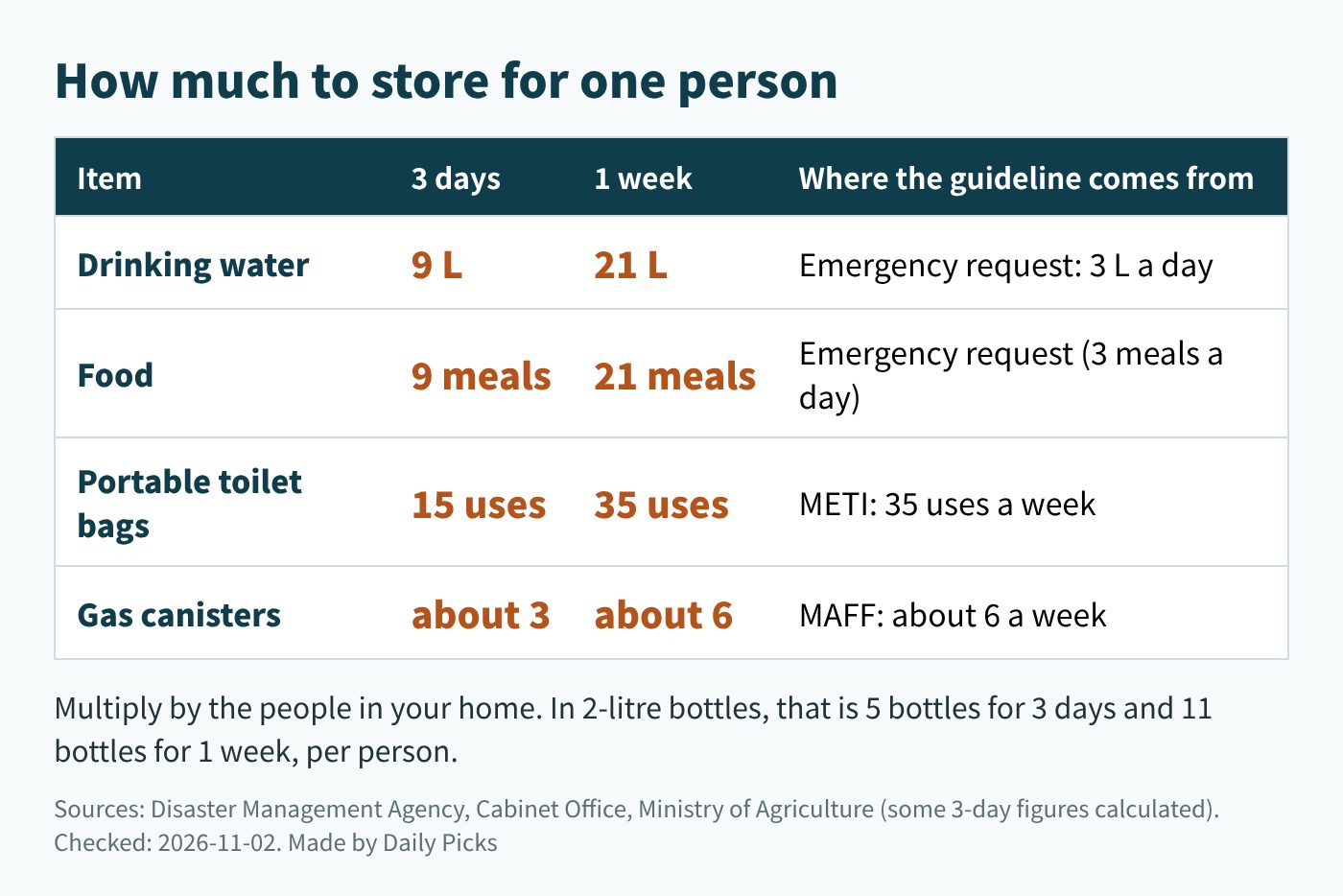
| Item (per person) | Guideline | 3 days | 1 week |
|---|---|---|---|
| Drinking water, including for meals | 3 litres a day | 9 L | 21 L |
| Food | At least 3 days, ideally 1 week | 9 meals (at 3 a day) | 21 meals |
| Portable toilet bags (keitai toire, 携帯トイレ) | 35 uses a week | 15 uses (calculated) | 35 uses |
| Gas canisters for a camping stove | About 6 a week | About 3 (calculated) | About 6 |
Checked: 2026-11-02. Water and food: the emergency request. Toilets: the METI guideline in the Cabinet Office magazine Bosai. Gas canisters: Ministry of Agriculture, Forestry and Fisheries.
In 2-litre bottles, that is 5 bottles for 3 days and 11 bottles for 1 week, per person. A couple needs 22 bottles for a week. If you have little storage space, buy a little more of what you normally eat and drink, and replace it as you use it. The message recommends this habit too. It also lists everyday items such as tissues and toilet paper.
What you can do now
- Count your water. Compare what you have with the table above, and add the difference on your next shopping trip.
- Check your toilet supplies. If the water is cut off, you may not be able to flush. Search for 携帯トイレ at a drugstore, home centre or online shop.
- Look at the hazard maps. The national Hazard Map Portal (Japanese) shows tsunami and flood risks. Your browser’s translate function can help. Your city or ward office can tell you which evacuation site to use and whether it has maps in other languages.
- Fix your furniture. The message says to assume that unfixed furniture will fall in a big earthquake. Start with what is near your bed, and fix it or move it. In a rental, ask your management company before drilling into walls.
- Pack an emergency bag. Put what you would need right after evacuating in a backpack, and keep it near the door. Our earthquake emergency kit guide lists what to include.
- Get alerts in your language. The Japan Tourism Agency’s Safety Tips app has alerts in 15 languages. Tokyo residents can also use the Tokyo Disaster Prevention app.
- Join a drill. Your city, ward or neighbourhood association will announce local drills. They are a good way to meet neighbours, which the message also encourages.
FAQ
Does this mean a big earthquake is coming soon?
The message does not say a disaster will happen at a specific time. It asks people to prepare for disasters that are a concern.
Is it mandatory?
The message to residents is written as a request. It does not mention obligations or penalties.
Is there a deadline, or do I need to buy everything today?
No deadline is given. You can add what is missing a little at a time.
Who pays for an earthquake safety check?
Some municipalities offer subsidies, such as Nagoya. Conditions differ by city. If you rent, talk to your landlord or management company first.
Who do I call in an emergency?
See our guide to emergency numbers in Japan and save them in your phone now.
Related reading
Sources
- Disaster Management Agency: urgent request for stronger pre-disaster preparedness, 2 Nov 2026 (Japanese)
- Minister Hosono: message to the public (Japanese, PDF)
- Ministry of Agriculture, Forestry and Fisheries: home stockpile basics (Japanese)
- Cabinet Office, Bosai no. 108: disaster toilets (Japanese)
- Ministry of Land, Infrastructure, Transport and Tourism: Hazard Map Portal (Japanese)
- Nippon.com: preparedness apps and information in English and other languages