日本語版:日本語で読む(Japanese version) →
This article reflects information as of September 20, 2026. Please check official sources for the latest. Checked again on September 27, 2026: the changes listed below were still scheduled as described. The Immigration Services Agency notice on residence permission fees is dated for October 1, 2026, and the electricity and city gas discount has not been extended, so September 2026 usage remains the last discounted month.
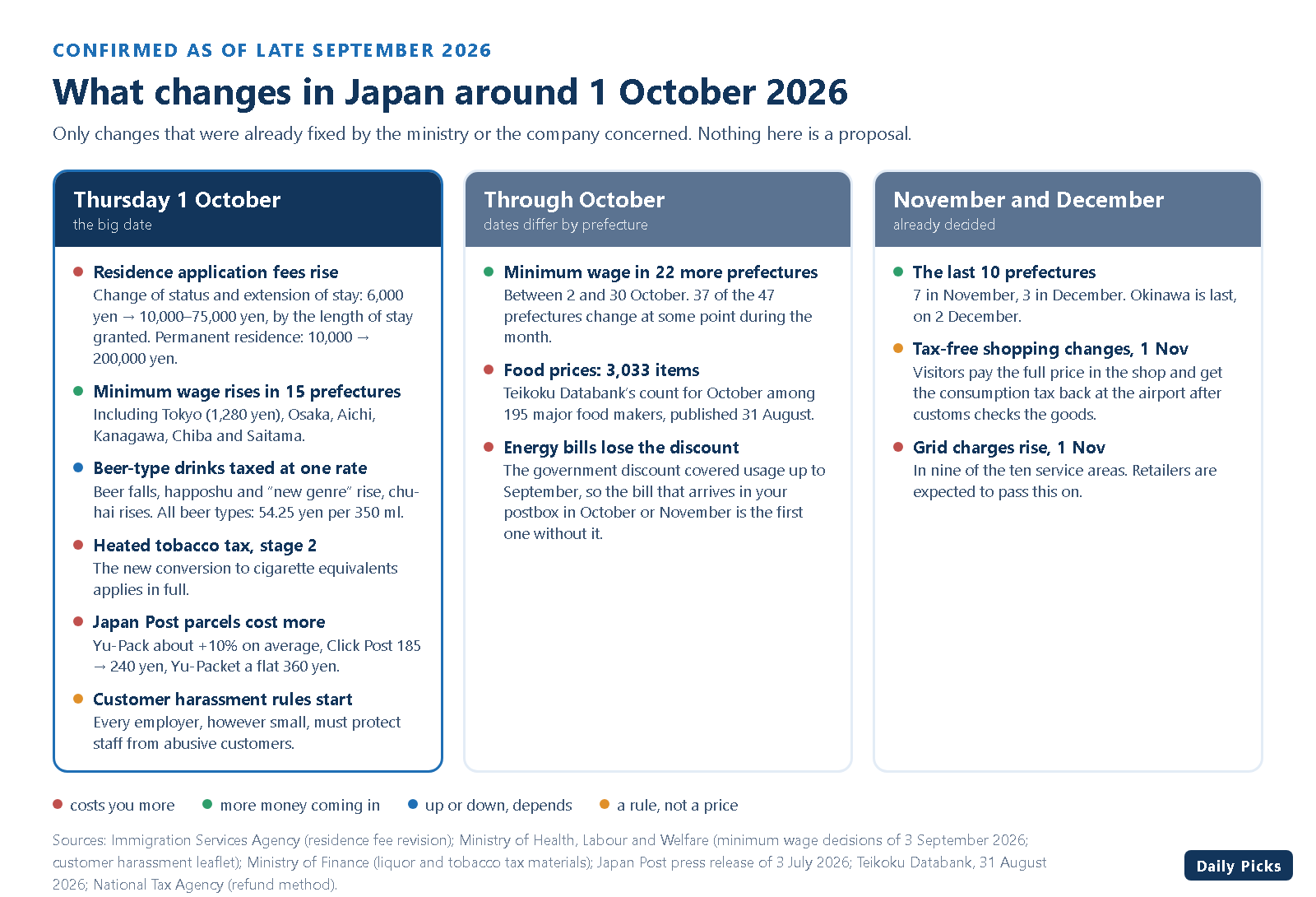
Every year, a lot of things in Japan change on October 1. 2026 is a heavy year. The minimum wage goes up in every prefecture, the fee for a residence application rises sharply, the tax on beer-type drinks is finally made equal, sending a parcel costs more, and thousands of food products get a new price.
This article lists only the changes that were already decided as of late September 2026, with the ministry or the company that decided them. Ideas that are still being discussed are not here. For each one: what changes, when, who it affects, and what you need to do.
- The short version
- 1. Residence application fees rise a lot on October 1
- 2. The minimum wage: everyone gets a rise, but on different days
- 3. Food: 3,033 products go up in October
- 4. Beer gets cheaper. Happoshu and chu-hai get more expensive
- 5. Heated tobacco: the second tax step
- 6. Sending a parcel with Japan Post costs more
- 7. A new rule that protects you at work
- 8. Your energy bill loses its discount
- 9. Part-time work: the 88,000 yen a month rule disappears
- For visitors: tax-free shopping changes on November 1
- Your October checklist
- Sources
- Also on Daily Picks
The short version
- Residence applications get much more expensive on October 1. A change of status or an extension of stay goes from 6,000 yen to between 10,000 and 75,000 yen, depending on how long a stay you are granted. Permanent residence goes from 10,000 yen to 200,000 yen
- The minimum wage rises in all 47 prefectures, but not on the same day. Only 15 prefectures change on October 1. The rest follow between October 2 and December 2
- Food prices: 3,033 products from major food makers are scheduled to go up in October
- Drinks: beer gets cheaper, happoshu and “new genre” beer-like drinks get more expensive, and chu-hai goes up
- Parcels: Japan Post raises Yu-Pack by about 10% on average, and Click Post from 185 to 240 yen. Ordinary letters and postcards are not part of this change
- At work: from October 1, every employer in Japan must protect staff from abusive customers. This is a new legal duty, not a guideline
- For visitors: tax-free shopping changes on November 1. You will pay the full price in the shop and get the tax back at the airport
1. Residence application fees rise a lot on October 1
This is the change that matters most to foreign residents, and it is a big one.
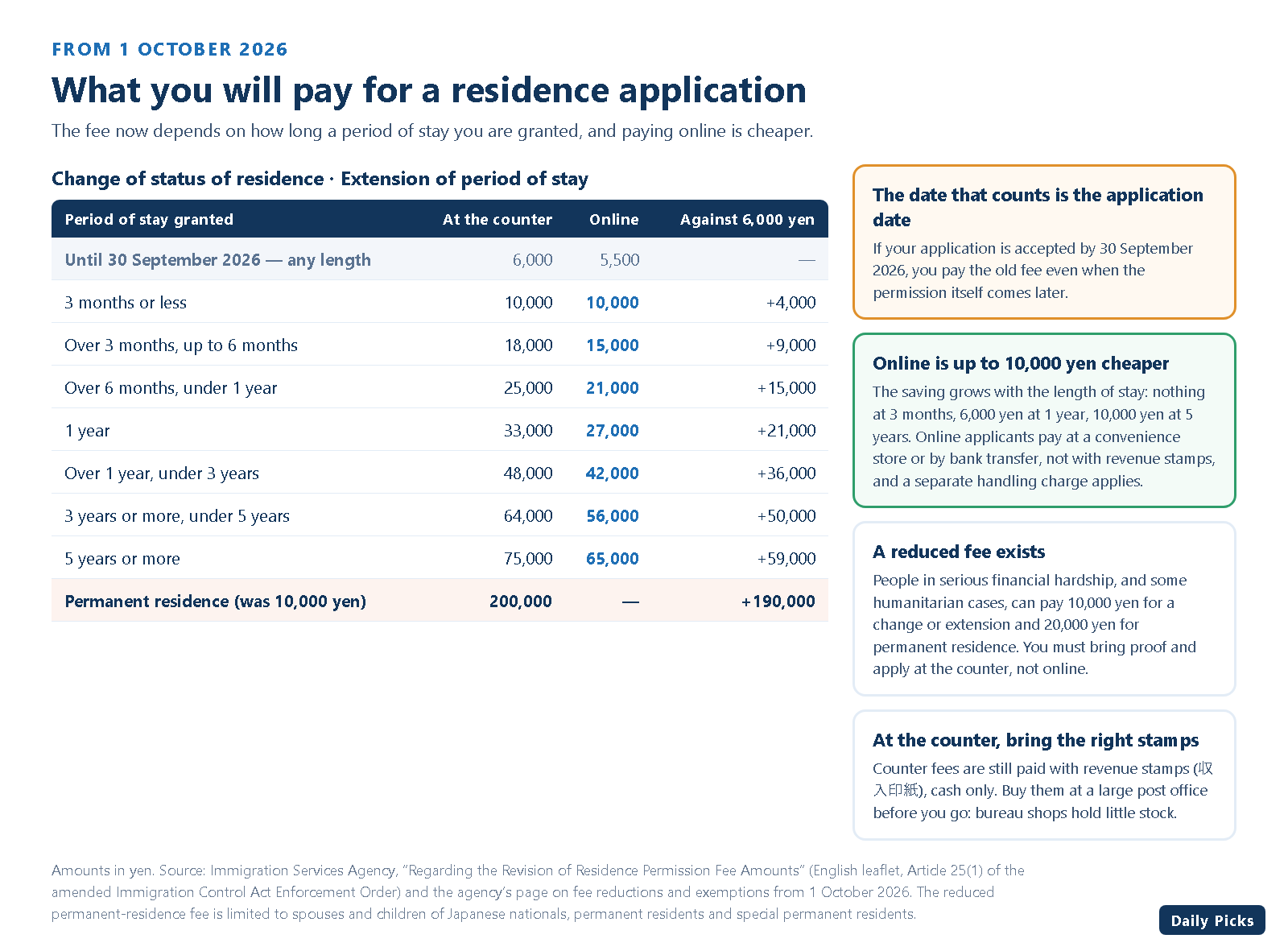
Until now, a change of status of residence (zairyu shikaku henko) or an extension of period of stay (zairyu kikan koshin) cost a flat 6,000 yen at the counter. From October 1, 2026, the fee depends on how long a period of stay you are granted. The longer the period, the more you pay. Permanent residence (eijuken) goes from 10,000 yen to 200,000 yen.
| Period of stay granted | At the counter | Online |
|---|---|---|
| Now, until September 30, 2026 | 6,000 yen | 5,500 yen |
| 3 months or less | 10,000 yen | 10,000 yen |
| Over 3 months, up to 6 months | 18,000 yen | 15,000 yen |
| Over 6 months, under 1 year | 25,000 yen | 21,000 yen |
| 1 year | 33,000 yen | 27,000 yen |
| Over 1 year, under 3 years | 48,000 yen | 42,000 yen |
| 3 years or more, under 5 years | 64,000 yen | 56,000 yen |
| 5 years or more | 75,000 yen | 65,000 yen |
| Permanent residence | 200,000 yen | — |
Four points from the agency’s own notice are worth knowing.
- The date that counts is the date your application is accepted, not the date the permission is issued. If the immigration bureau accepts your application by September 30, 2026, you pay the old fee even if the result comes in November
- Online is cheaper for every period except the shortest. The gap is 6,000 yen at a 1-year stay and 10,000 yen at 5 years. Online applicants pay at a convenience store or by bank transfer; a separate handling charge is added
- Counter payments still use revenue stamps (shunyu inshi, 収入印紙), and stamps are sold for cash only. The agency asks people to buy them at a large post office in advance, because shops inside the bureaus hold limited stock. The postcard you receive tells you the amount
- A reduced fee exists. People who are in financial hardship at a level comparable to public assistance, and certain humanitarian cases, can pay 10,000 yen for a change or extension and 20,000 yen for permanent residence. You need documents proving it, and you must apply at a counter — the online system does not handle the reduction. For permanent residence, the reduction is limited to spouses and children of Japanese nationals, permanent residents and special permanent residents
One caution. We can tell you what the fees are, because the Immigration Services Agency has published them. We cannot tell you anything about your own status, eligibility or timing — that is not something an article can answer. For questions about your case, use the agency’s own pages, or the Foreign Residents Support Center (FRESC) helpline on 0570-011000, which handles enquiries in several languages.
The new fees now apply. If you are preparing an extension of your period of stay, our step-by-step guide covers the documents, timing and how to pay: Extending Your Period of Stay in Japan: New Fees from 1 October 2026, Timing and Documents.
2. The minimum wage: everyone gets a rise, but on different days
The minimum wage (saitei chingin, 最低賃金) is the lowest hourly rate an employer may legally pay. It applies to everyone working in Japan — full-time, part-time, arubaito, dispatch workers, students with a work permit. Your nationality and your status of residence make no difference to it.
Each prefecture sets its own rate. On September 3, 2026, the Ministry of Health, Labour and Welfare announced that all 47 local councils had decided their new figures. The national weighted average goes from 1,121 to 1,177 yen, a rise of 56 yen — the second largest since the current system started in 1978.
The part people miss is the date. The new rate does not start on October 1 everywhere. It starts on the day your prefecture set, somewhere between October 1 and December 2.
| Prefecture | New | Old | Rise | Starts |
|---|---|---|---|---|
| Tokyo | 1,280 yen | 1,226 | +54 | Oct 1 |
| Kanagawa | 1,279 yen | 1,225 | +54 | Oct 1 |
| Osaka | 1,231 yen | 1,177 | +54 | Oct 1 |
| Saitama | 1,196 yen | 1,141 | +55 | Oct 1 |
| Chiba | 1,195 yen | 1,140 | +55 | Oct 1 |
| Aichi | 1,195 yen | 1,140 | +55 | Oct 1 |
| Kyoto | 1,180 yen | 1,122 | +58 | Nov 16 |
| Hyogo | 1,172 yen | 1,116 | +56 | Oct 1 |
| Shizuoka | 1,154 yen | 1,097 | +57 | Oct 15 |
| Hiroshima | 1,141 yen | 1,085 | +56 | Oct 11 |
| Hokkaido | 1,131 yen | 1,075 | +56 | Oct 1 |
| Fukuoka | 1,114 yen | 1,057 | +57 | Oct 4 |
| Miyagi | 1,098 yen | 1,038 | +60 | Oct 1 |
| Kumamoto | 1,092 yen | 1,034 | +58 | Dec 1 |
| Okinawa | 1,086 yen | 1,023 | +63 | Dec 2 |
| Miyazaki (lowest) | 1,085 yen | 1,023 | +62 | Oct 24 |
| National weighted average | 1,177 yen | 1,121 | +56 | — |
Across the country: 15 prefectures change on October 1, another 22 later in October, 7 in November and 3 in December. The highest rate is Tokyo at 1,280 yen, the lowest Miyazaki at 1,085 yen. The lowest is now 84.8% of the highest, up from 83.4% — the twelfth year in a row that this gap has narrowed.
What to do
- Look up your prefecture’s start date and its new rate in the ministry’s table, then check the hourly rate on your payslip for the month after that date
- The rate that applies is the one for the prefecture where you work, not where you live. If you live in Saitama and work in Tokyo, Tokyo’s rate applies
- Some allowances do not count towards the minimum wage — commuting allowance, family allowance, overtime pay and bonuses are excluded from the comparison
- If your pay is below the new rate after the start date, the difference is legally owed to you. Your prefecture’s Labour Standards Inspection Office (rodo kijun kantoku sho) handles this, and many prefectural labour bureaus offer consultations for foreign workers in several languages
3. Food: 3,033 products go up in October
Teikoku Databank tracks the price announcements of 195 major food makers each month. In its report of August 31, 2026, it counted 3,033 items scheduled for a price rise in October, after 4,923 in September — the biggest single month of 2026 so far. Two months over 3,000 in a row had not happened since mid-2023.
The average rise per item has been running around 11%. Across 2026 as a whole, processed foods (frozen food, packaged rice, chilled products) have seen the most increases, followed by confectionery. The company points to three causes: raw material costs, energy, and the knock-on effect of higher oil and naphtha prices on packaging, film and trays.
Nothing here needs any action from you, but if your grocery bill jumps in October, this is why. Note that Teikoku Databank is a private research company, not a government body; these are its counts of company announcements, and the October figure was a forecast at the time of publication.
4. Beer gets cheaper. Happoshu and chu-hai get more expensive
If you have shopped for drinks in a Japanese supermarket, you have seen three tiers of beer-like cans at three different prices: beer (biiru), happoshu (発泡酒, low-malt beer) and the cheapest tier sold as “new genre” or daisan no biiru (third beer). The price difference was mostly tax, not ingredients.
That ends on October 1, 2026. This is the final step of a reform decided back in 2017 and carried out in three stages from October 2020. From that date all beer-type drinks are taxed at the same rate: 155,000 yen per kilolitre, which is 54.25 yen on a 350 ml can.
| Drink | Tax now, per 350 ml | From October 1 | Change |
|---|---|---|---|
| Beer | 63.35 yen | 54.25 yen | −9.10 yen |
| Happoshu (malt under 25%) and “new genre” | 46.99 yen | 54.25 yen | +7.26 yen |
| Chu-hai and other sparkling drinks under 10% ABV | 28.00 yen | 35.00 yen | +7.00 yen |
Shelf prices are set by makers and shops, so they will not move by exactly these amounts. But the direction is clear: the cheap “third beer” tier loses the advantage it was built on, real beer becomes relatively better value, and canned chu-hai gets dearer. Sake and wine are not affected — their rates were unified back in October 2023.
5. Heated tobacco: the second tax step
Heated tobacco products (IQOS, Ploom, glo and similar) have been taxed more lightly than cigarettes. The government is closing that gap by changing how a heated tobacco stick is converted into a “cigarette equivalent” for tax. The change is being applied in two steps, in April 2026 and again on October 1, 2026, when the new method applies in full: 0.35 g counts as one cigarette for stick-type products, and 0.2 g for other types.
Makers set their own retail prices, and several have already filed increases taking effect on October 1. Cigarette tax itself then rises by 0.5 yen per stick in each of April 2027, 2028 and 2029.
6. Sending a parcel with Japan Post costs more
Japan Post announced on July 3, 2026 that parcel prices change on October 1. It gives rising costs and wages as the reason.
| Service | What changes |
|---|---|
| Yu-Pack (ゆうパック) | Base rates up about 10% on average, with the exact change depending on the size of the parcel and where it is going. Under the new table, a 60-size parcel from the Kanto area to Kansai costs 1,090 yen and an 80-size one 1,440 yen |
| Yu-Packet (ゆうパケット) | A single rate of 360 yen for anything up to 3 cm thick. The cheaper 1 cm (250 yen) and 2 cm (310 yen) tiers are abolished |
| Click Post (クリックポスト) | 185 yen → 240 yen. In exchange the limits get better: up to 2 kg instead of 1 kg, and total of three sides up to 60 cm |
| Packaging supplies | Boxes and covers sold at post offices go up. A 60-size box goes from 100 to 110 yen |
If you send things regularly — parcels home, items sold on Mercari or Yahoo! Auctions — the cheap thin-envelope options are the ones that change most. The Yu-Packet increase hits small flat items hardest, because the 250 yen tier disappears entirely.
This announcement covers parcels only. Ordinary letters and postcards are not part of it, and neither is international post.
7. A new rule that protects you at work
This one costs you nothing and is easy to miss, but if you work in a shop, restaurant, hotel, convenience store, call centre, hospital or station, it matters.
From October 1, 2026, dealing with customer harassment (kasutama harasumento, usually shortened to kasuhara) becomes a legal duty for every employer in Japan. There is no exemption for small companies. The law behind it was passed in June 2025, and the Ministry of Health, Labour and Welfare issued the detailed guideline in February 2026.
The law defines customer harassment as behaviour by a customer, a business partner or a facility user that goes beyond what is socially acceptable and harms the working environment of a member of staff. The ministry’s examples include demands unrelated to the product or service, demands that are impossible to meet, unreasonable compensation claims, physical attacks, threats, insults and defamation, intimidating behaviour, persistent or repeated behaviour, and refusing to leave or confining someone. Abuse by phone or over social media counts too.
From October 1 your employer must, among other things: state clearly that it will protect staff and act firmly against such behaviour; tell staff in advance what to do (ask a manager, avoid handling it alone, call the police for anything criminal); set up a consultation desk and tell staff where it is; check the facts quickly when something happens; look after the person affected; and prevent it happening again. Your employer also may not treat you badly for reporting it.
If nothing has been announced at your workplace by October, it is reasonable to ask where the consultation desk is. Prefectural labour bureaus (todofuken rodo kyoku) also take these consultations directly.
8. Your energy bill loses its discount
The government discount on electricity and city gas covered July, August and September 2026 usage only. September was the last month, so the bill you receive around October or November is the first one with no discount on it. Separately, grid charges rise on November 1 in nine of Japan’s ten areas, and retailers plan to pass that on.
We covered this in detail, including how to read each line of a Japanese electricity bill: Electricity and gas subsidies end with September usage.
9. Part-time work: the 88,000 yen a month rule disappears
If you work part-time and have been keeping your hours down to stay off your employer’s health insurance and pension, the rule you were working around goes away in October 2026. This is the change Japanese media call the 106万円の壁 (hyaku-roku-man-en no kabe, the 1.06 million yen wall).
Today a short-time worker is enrolled in kenko hoken (health insurance) and kosei nenkin (employees’ pension) only if all of these are true: 20 or more scheduled hours a week, regular monthly wages of 88,000 yen or more (about 1.06 million yen a year), a contract longer than two months, not a student, and an employer with 51 or more insured employees. The Japan Pension Service states that the 88,000 yen wage requirement is abolished in October 2026. The other conditions stay as they are for now; the employer-size threshold falls to 36 employees in October 2027, 21 in October 2029 and 11 in October 2032.
So from October the practical test is the 20 hours a week line, not the money. Someone working 20 hours a week at a wage that kept them just under 88,000 yen a month becomes eligible. That cuts your take-home pay, because you start paying premiums; it also buys you employees’ pension on top of the basic pension, and health insurance through work instead of National Health Insurance. Your payroll department decides whether you are in scope, so ask them rather than working it out from your payslip.
One thing not to confuse: 106万円 and 130万円 are social-insurance lines, while 103万円, 150万円 and 160万円 are income-tax and spousal-deduction lines. They are different systems and they are not changing together.
For visitors: tax-free shopping changes on November 1
Not October, but close enough that it is worth planning around if you are visiting Japan this autumn.
From November 1, 2026, Japan’s tax-free shopping system moves to a refund method. Today a tax-free shop simply sells you the goods without consumption tax. From November 1 you pay the full price including tax in the shop, then get the tax back after customs at the airport or seaport confirms that you are taking the goods out of the country. You show your passport at a terminal set up for the purpose, and the purchase has to be within 90 days.
Some restrictions disappear at the same time: the split between general goods and consumables, the 500,000 yen purchase ceiling, and the sealed-packaging requirement for consumables all go. The National Tax Agency publishes an English leaflet explaining the change.
Your October checklist
- If you have a residence application coming up, check the Immigration Services Agency’s fee page and its Q&A so the amount and payment method do not surprise you at the counter
- Find the start date for your prefecture’s minimum wage, then check the hourly rate on the payslip for the month after it
- If you send parcels regularly, compare Yu-Packet and Click Post against the other carriers under the new rates
- If you work with the public, find out where your employer’s harassment consultation desk is
- Expect your first undiscounted energy bill, and a second increase on usage from November 1
- If you work part-time near the 88,000 yen a month line, ask payroll whether you come into health insurance and employees’ pension from October
Sources
- Immigration Services Agency, Revision of residence permission fee amounts from October 1, 2026 (with English poster and leaflet) and reductions and exemptions from October 1, 2026
- Immigration Services Agency, Residence permission fees and revenue stamps (Japanese)
- Ministry of Health, Labour and Welfare, All prefectures have decided their FY2026 minimum wage (September 3, 2026) and the table of amounts and start dates (PDF)
- Ministry of Health, Labour and Welfare, Harassment measures are strengthened from October 1, 2026 (PDF, guideline summary)
- Teikoku Databank, Food price revision survey, September 2026 (August 31, 2026)
- Ministry of Finance, Materials on the liquor tax and materials on the tobacco tax
- National Tax Agency, Liquor tax rate table, October 1, 2023 to September 30, 2026 (PDF)
- Japan Post, Revision of Yu-Pack and Yu-Packet base rates (July 3, 2026)
- National Tax Agency, Shift of the tax-free shopping system to the refund method (includes an English leaflet)
- Japan Pension Service, Expansion of health insurance and employees’ pension coverage for short-time workers (abolition of the 88,000 yen wage requirement in October 2026) and the current enrolment conditions and the employer-size timetable
Figures and dates were checked against the sources above on September 20, 2026. Start dates for the minimum wage can still change if a formal objection is filed with a prefectural labour bureau. This article explains published rules; it is not legal, tax or immigration advice. For anything about your own residence status, contact the Immigration Services Agency or FRESC.