Summary: If you live in Japan and you are not on your company’s health insurance, your city hall mails you a National Health Insurance premium notice once a year, usually in June. It is addressed to the head of your household, not to each insured person. It shows one annual amount, then splits it into instalments with separate due dates. This guide translates the Japanese words printed on the form, explains how the number was calculated, lists the ways to pay, and tells you exactly who to call if you cannot pay. Formats and amounts differ from city to city, so treat the examples here as examples.
- What the kokumin kenko hoken (National Health Insurance) envelope is
- Who gets one, and when
- How to read the notice, line by line
- Why the number is so big
- If you arrived in Japan, or moved city, after January 1
- How to pay
- If you cannot pay
- Three things people get wrong
- One scam to know about
- Where to find help in English
- Checklist
- Sources
- Also on Daily Picks
What the kokumin kenko hoken (National Health Insurance) envelope is
The document is called 国民健康保険料 納入通知書 (kokumin kenkō hoken-ryō nōnyū tsūchisho), the National Health Insurance premium payment notice. “National Health Insurance” is usually shortened to NHI in English, and to kokuho (国保) in Japanese.
It is not a request for a donation, and it is not junk mail. It is the bill for your public health insurance for the fiscal year that runs from April to the following March.
Two different form names are used, and they look different:
| Japanese name | When it is used |
|---|---|
| 国民健康保険料納入通知書 nōnyū tsūchisho |
The first determination for the year, sent in June. |
| 国民健康保険料決定(更正)通知書兼納入通知書 kettei (kōsei) tsūchisho ken nōnyū tsūchisho |
Sent at any other time: when you enroll mid-year, or when your premium is recalculated. |
One thing is changing in your favour. Japanese municipalities are moving their core systems onto a national standard, and that standardises the layout of these forms. Shibuya City switched on February 24, 2026. As more cities migrate, the same words appear in the same places, so the vocabulary below travels better than it used to.
Who gets one, and when
You must be enrolled in some form of public health insurance while you live in Japan. NHI is the one your municipality runs, and it covers everyone who is not covered by something else: self-employed people, freelancers, part-timers below their employer’s threshold, students, people between jobs, and retired people under 75.
You do not enroll in NHI if you are on your employer’s health insurance, on the medical system for people aged 75 and over, or receiving public assistance.
Foreign residents are included. Yokohama City states the rule plainly: non-Japanese residents staying in Japan for more than three months are required to sign up. Shibuya City applies the same test, with narrow exceptions such as people who entered Japan on a “designated activities” status for medical treatment.
Timing, using real 2026 examples: Shibuya mailed its fiscal 2026 notices on June 12, 2026. Minato City sends its payment slips in June. Your city may differ by a week or two, but June is the norm.
Finally, the address on the envelope: the notice goes to the head of the household (世帯主, setainushi). Under Article 76 of the National Health Insurance Act, the head of household is the person legally required to pay, for everyone in the household who is enrolled. This holds even when the head of household is personally on company insurance and not an NHI member at all. Japanese has a word for that person: 擬制世帯主 (gisei setainushi), a “deemed” head of household. So if the bill has your partner’s name on it and lists your premium, nothing has gone wrong.
How to read the notice, line by line
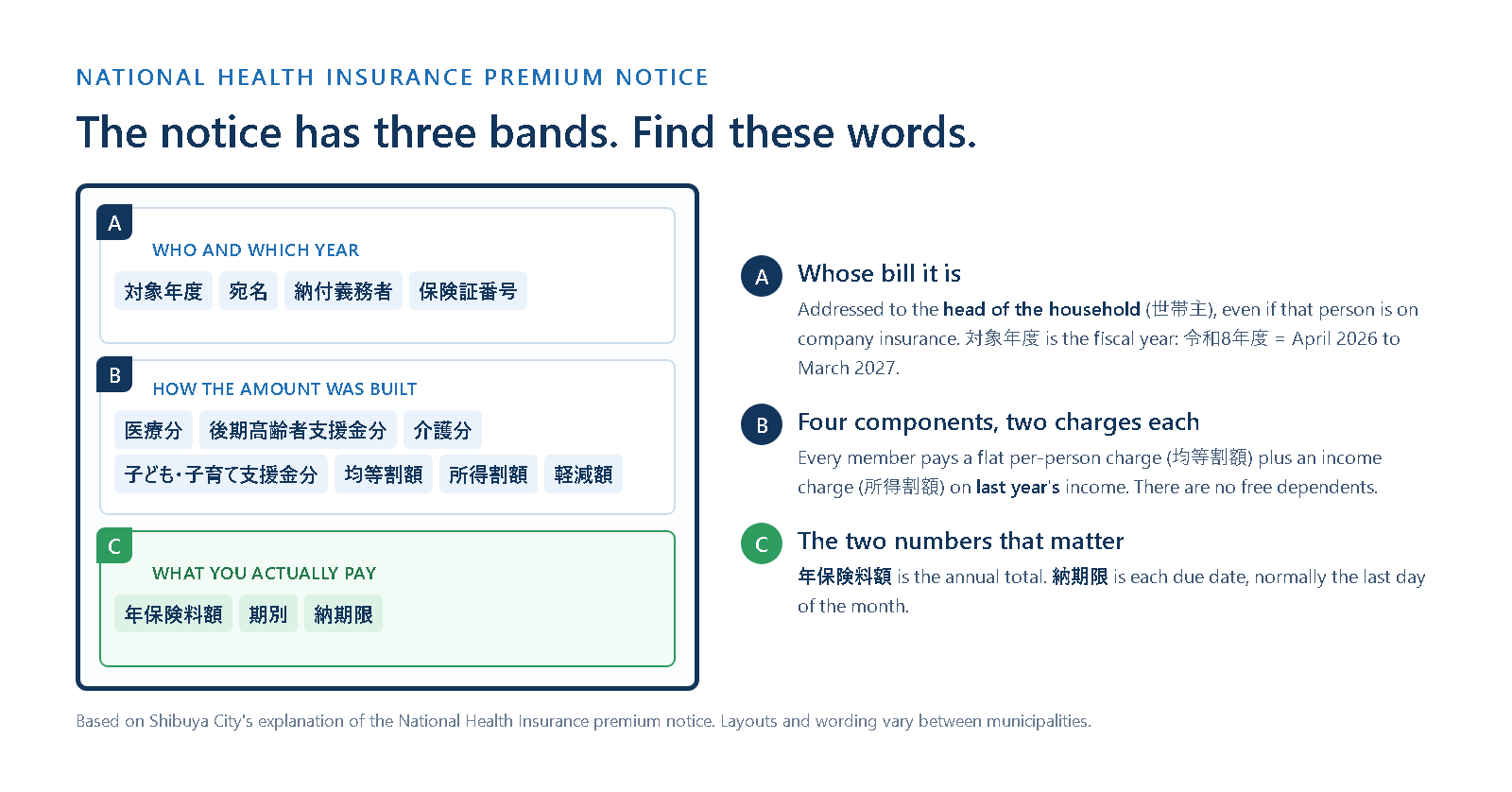
The form has three bands: who and what year at the top, how the amount was built in the middle, and when to pay at the bottom. Here is the vocabulary for each band. Your form may not have every row.
Top band: whose bill is this
| Japanese | Reading | What it means |
|---|---|---|
| 対象年度 | taishō nendo | The fiscal year this bill covers. “令和8年度” is fiscal 2026, meaning April 2026 to March 2027. |
| 宛名 | atena | Addressee. Normally the head of the household. |
| 納付義務者 | nōfu gimusha | The person legally obliged to pay. Same person as above. |
| 保険証番号 | hokenshō bangō | Your household’s NHI number. Have it ready when you phone; in Shibuya it starts with 13. |
| 記号番号 | kigō bangō | The number printed on the payment slips. It is the same number as 保険証番号. |
| 口座情報 | kōza jōhō | The bank account registered for direct debit, if you have set one up. |
Middle band: how the amount was built
Your premium is assembled from up to four components, and each component is itself the sum of a flat per-person charge and an income-based charge.
| Japanese | Reading | What it means |
|---|---|---|
| 医療分 | iryō-bun | Medical portion. Everyone enrolled pays this. |
| 後期高齢者支援金分 | kōki kōreisha shienkin-bun | Support portion for the medical system covering people aged 75 and over. Everyone pays it. |
| 介護分 | kaigo-bun | Long-term care portion. Charged only for members aged 40 to 64. |
| 子ども・子育て支援金分 | kodomo kosodate shienkin-bun | Child and childcare support portion. New from fiscal 2026. It is charged from the fiscal year you turn 19, and you pay it whether or not you have children. |
| 均等割額 | kintōwari-gaku | Per-person flat charge. Number of insured people multiplied by a fixed amount. |
| 所得割額 | shotokuwari-gaku | Income-based charge, calculated on last year’s income. |
| 基準額 | kijun-gaku | The income figure the percentage is applied to: last year’s income minus the ¥430,000 basic deduction. |
| 軽減額 | keigen-gaku | Automatic reduction. Low-household-income reductions of 70%, 50% or 20% on the per-person charge, plus reductions for preschool children and for maternity periods. |
| 減免額 | genmen-gaku | Reduction granted on application, for example after a disaster. |
| 限度超過額 | gendo chōka-gaku | The part above the annual household cap, which is subtracted. |
| 増減調整額 | zōgen chōsei-gaku | Adjustment for members joining or leaving during the year. |
| 年保険料額 | nen hokenryō-gaku | The annual total. This is the number that matters. |
Shibuya’s own arithmetic, which is typical: each component equals the per-person charge plus the income charge, minus reductions, minus anything over the cap, plus adjustments. Add the four components and you get the annual premium.
Bottom band: when to pay
| Japanese | Reading | What it means |
|---|---|---|
| 普通徴収 | futsū chōshū | Ordinary collection: you pay, using slips or direct debit. This is most people. |
| 特別徴収 | tokubetsu chōshū | Special collection: deducted from a pension. Applies to some households where the head is aged 65 to 74. |
| 期別 | kibetsu | By instalment. 第1期 is instalment 1, 第10期 is instalment 10. |
| 納期限 | nōkigen | Due date. Normally the last day of the month, moved to the next business day if banks are closed. |
| 個人明細 | kojin meisai | Per-person breakdown. An asterisk marks the months each person was counted. |
| 全期前納 / 一括納付書 | zenki zennō / ikkatsu nōfusho | Paying the whole year at once, using the single annual slip. |
An instalment is not one month of premium. Shibuya divides the twelve-month annual premium into ten instalments, June through March, so each instalment is about 1.2 months’ worth. The number of instalments is a local decision, so check your own form rather than assuming ten.
Why the number is so big
Two features surprise people who have only had company insurance.
There are no dependents in NHI. Company health insurance covers a spouse and children at no extra premium. NHI has no such concept. Every enrolled person, including a baby and including someone with zero income, generates a per-person charge. A family of four generates four per-person charges.
It is based on last year. The income-based part uses the income you earned in the previous calendar year, not what you are earning now. Someone who quit a well-paid job in March can receive a large bill in June while unemployed. That situation has a specific remedy, described further down.
To give a sense of scale, here are Shibuya City’s actual fiscal 2026 figures. Every municipality sets its own, so do not reuse these numbers for your city.
| Component | Per person, per year | Income rate | Annual household cap |
|---|---|---|---|
| Medical | ¥47,600 | 7.51% | ¥670,000 |
| Support for the 75+ system | ¥17,600 | 2.80% | ¥260,000 |
| Child and childcare support | ¥1,873 | 0.27% | ¥30,000 |
| Long-term care (ages 40–64) | ¥17,800 | 2.43% | ¥170,000 |
| Total for a member aged 40–64 | ¥84,873 | 13.01% | ¥1,130,000 |
The income rate is applied to last year’s income after subtracting the ¥430,000 basic deduction. Premiums are charged by month of enrollment, with no daily proration.
If you arrived in Japan, or moved city, after January 1
This catches almost every newcomer, and it is worth planning for.
Your new city calculates the income-based charge from records held by the municipality where you were registered on January 1. If that was another city, or another country, your new city does not have your income data in June. Shibuya explains what it does in that case: the June notice is calculated with the per-person charge only, the city queries your previous municipality, and then sends a revised notice with the income-based charge added.
In plain terms: your first bill may be pleasantly small, and a bigger one is coming. Do not treat the June figure as final.
The flip side is a reduction you have to ask for. Shibuya’s English guidance sets out four conditions, and if you meet all of them the notice should show 7割 or 7割軽減, a 70% reduction of the per-person charge:
- You are a single-person household.
- You were not living in Japan as of January 1 of the year the premium is calculated for.
- You had no income in Japan during the previous year.
- You have submitted the declaration on income conditions to the NHI division.
If “7割” is missing, the most likely reason is that the declaration was never filed. The reduction is not granted from thin air: the city has to be told, on paper, that your income was zero. If you were in Japan on January 1 with no income, the equivalent step is filing a residence tax declaration with the municipality where you were registered that day. Either way, filing a zero is what unlocks the reduction.
How to pay
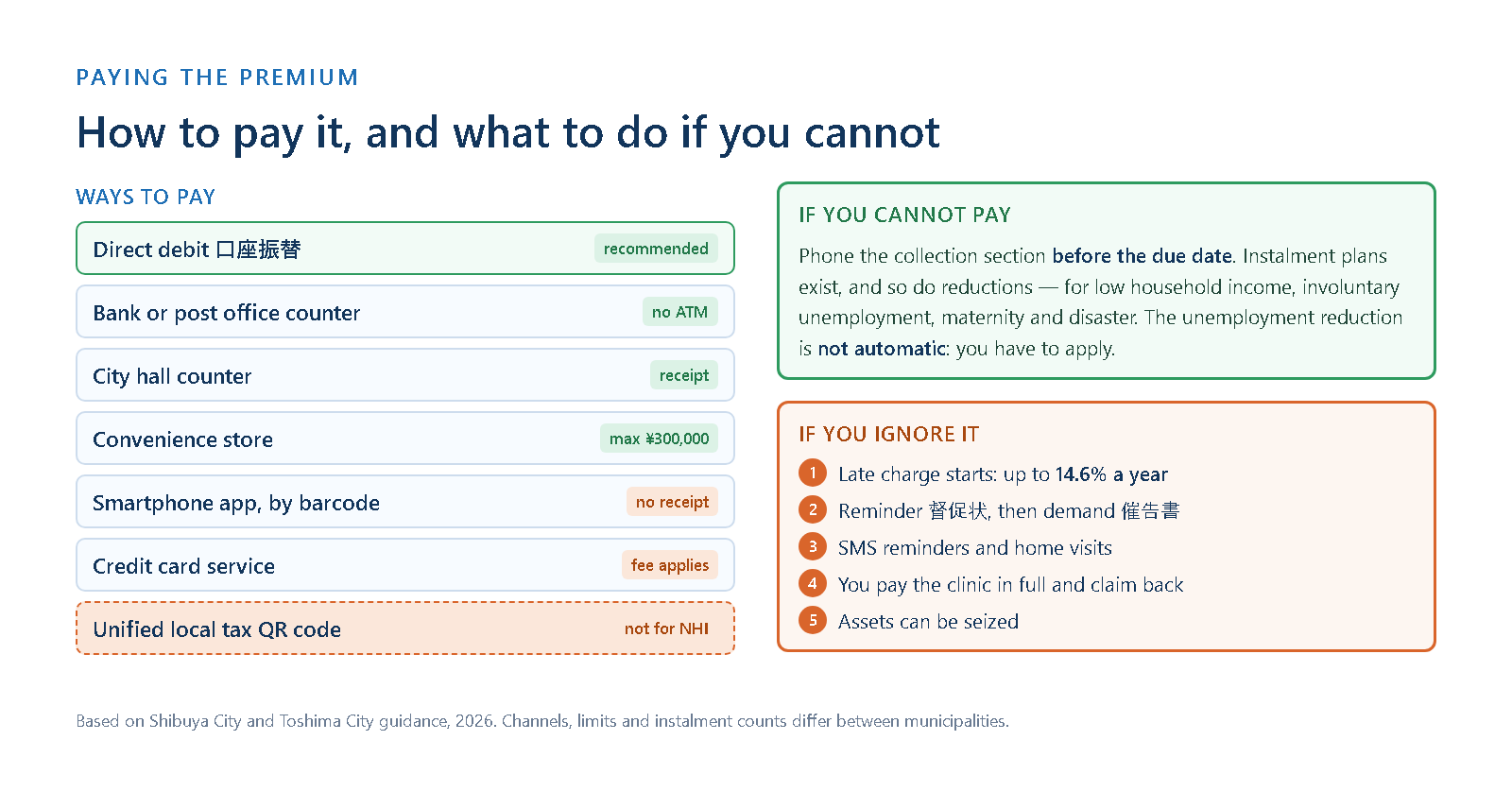
Slips arrive with the notice. Shibuya, for example, encloses ten instalment slips plus one annual slip, and sends the notice alone to people already on direct debit or pension deduction. Here are the channels, with the traps.
| Method | Notes |
|---|---|
| Direct debit (口座振替, kōza furikae) | The method cities actively recommend. It is taken automatically on the due date, so you cannot forget. You apply once, at a bank or at city hall; Minato asks for the application form, your NHI card or payment slip, your bankbook and your registered seal. |
| Bank or post office counter | Banks, shinkin banks and credit unions. For Japan Post, Shibuya’s slips are only usable at branches in Tokyo, Yamanashi and the Kanto prefectures, and ATMs are not accepted. |
| City hall and branch offices | Over the counter. In Shibuya, the NHI counter is on the third floor. |
| Convenience stores | Only if the slip has a barcode, and only up to ¥300,000 per slip. Seven-Eleven, Lawson, FamilyMart, MINISTOP, Daily Yamazaki, Poplar, Seicomart and others, plus shops with an MMK terminal. |
| Smartphone payment apps | You scan the barcode on the slip. Toshima City’s list as of April 1, 2026 is PayPay, Rakuten Pay, J-Coin Pay, au PAY and d-Barai. Limit ¥300,000. No receipt is issued, and you cannot use the app at a convenience store counter. |
| Credit card | Through a designated service such as F-REGI or Mobile Regi, with a handling fee you pay yourself. |
Four things that go wrong:
- The unified local tax QR code does not work for NHI. The eL-QR code and the “local tax payment site” cover residence tax and light vehicle tax. National Health Insurance premiums are excluded. Use the barcode instead.
- Do not pay twice. You get instalment slips and an annual slip. Use one or the other. If you are on direct debit, do not also pay a slip.
- Keep the receipt. It is your proof of payment. Smartphone payments do not produce one.
- A damaged, altered or expired barcode may be refused at the register. Photocopies and screenshots of the barcode are not accepted.
One more piece of admin worth knowing: NHI premiums are deductible as social insurance premiums on your tax return. Who may claim them depends on how they were paid. For slip and app payments it is the person who actually paid; for direct debit it is the account holder; for pension deduction it is the pensioner.
If you cannot pay
Call before the due date, not after. Every city has a collection section whose job includes arranging alternatives, including paying in instalments. Shibuya publishes a direct line for exactly this, 03-3463-1794, and asks people struggling with unemployment or illness to get in touch early. Toshima’s own demand notice says the same thing: contact us as soon as possible.
Then check whether you qualify for a reduction. Some are automatic; the important ones are not.
| Scheme | Who it is for | Application needed? |
|---|---|---|
| Low household income reduction (70% / 50% / 20%) | Households below income thresholds. Judged on April 1, or on your enrollment date. | No, but everyone’s income must be declared or it cannot be assessed. |
| Involuntary unemployment reduction | People under 65 laid off or made redundant, holding a Hello Work unemployment benefit certificate with a qualifying reason code. | Yes. |
| Maternity exemption | Around childbirth: four months for a single birth, six for multiples. | Yes. |
| Preschool children | Per-person charge halved for children below school age. | No. |
| Disaster or fire | Damage to property, generally 30% or more, evidenced by a disaster certificate. | Yes. |
The involuntary unemployment reduction is the one people miss. If you qualify, your previous year’s employment income is counted at 30% for the calculation, and the relief runs from the day after you left the job until the end of the following fiscal year. It is not applied automatically. You have to take the Hello Work certificate to the city and file.
And if the bill is simply ignored, this is the sequence: a late payment charge accrues, a reminder (督促状) is issued, then a demand letter (催告書), then SMS reminders and visits from contracted collection staff. Toshima states the late charge rate as 14.6% a year, reduced to 7.3% for the first three months after the due date, with a lower reference rate applied in some years; it applies from the June instalment of fiscal 2026. Prolonged non-payment without a valid reason can move you onto “special medical expense benefit” treatment, which in practice means paying the full cost at the clinic and claiming it back later. At the end of the road, assets can be seized. None of this is triggered by being poor. It is triggered by silence.
Three things people get wrong
1. This is not your residence tax
Both bills land in June, both come from city hall, and both are split into instalments, so they get confused constantly. They are separate, handled by different sections, and paid by different means.
| NHI premium notice | Residence tax notice | |
|---|---|---|
| Japanese name | 国民健康保険料納入通知書 | 特別区民税・都民税 納税通知書 |
| Addressed to | The head of the household | The individual taxpayer |
| Instalments | 10 in Shibuya (June to March) | 4 (June, August, October, January) |
| Sent | Mid-June (June 12, 2026 in Shibuya) | Early-to-mid June (June 10, 2026 in Nerima) |
| Payable by eL-QR code | No | Yes |
| If your income is zero | You still pay the per-person charge | You are not taxed, and no notice is sent |
That last row is the one that generates angry phone calls. Being exempt from residence tax does not exempt you from NHI.
2. After leaving a job, you have three options and a 20-day clock
People assume NHI is the only route. The national health insurance association (Kyokai Kenpo) lists three, and the deadlines differ sharply.
| Voluntary continuation (任意継続) | National Health Insurance | Family member’s insurance | |
|---|---|---|---|
| Where to apply | The Kyokai Kenpo branch for your prefecture | Your city hall’s NHI section | Your family member’s employer |
| Deadline | Within 20 days of the day after your last day of employment | Within 14 days | Ask the employer |
| Conditions | Two or more continuous months of coverage before leaving | Not covered by another scheme | You must meet the dependency test |
| Premium | Roughly double what was deducted from your salary, because you now pay the employer’s share too, subject to a cap | Based on household size and last year’s income; reductions available | None |
| Duration | Up to 2 years | Until you leave | While you qualify |
Twenty days is short, and postal applications must arrive within it. Work out both premiums before you decide: for a single person with a high previous-year income, voluntary continuation is often cheaper; for a low earner, or someone eligible for the involuntary unemployment reduction, NHI often wins.
3. Nobody cancels your NHI for you
When you start a job and join company insurance, your NHI membership does not end automatically. Toshima City spells it out on its demand notice: neither the city nor your employer will process the withdrawal. You must notify city hall yourself, within 14 days, taking proof of your new coverage. Skip it and the NHI bills keep coming, the unpaid balance keeps growing, and you end up sorting out a year of overlap.
One scam to know about
Shibuya City warns residents about refund fraud built on this very system. Callers claiming to be from the ward or the government say there is a refund of insurance premiums or medical costs, and direct the victim to an ATM. Genuine refunds and high-cost medical benefits are notified by letter. City staff and their contractors do phone and visit about unpaid premiums, and they identify themselves and show ID, but they will never ask you to operate an ATM. If a phone call ends with instructions for an ATM, it is a scam. Hang up and call the police or your city office.
Where to find help in English
More municipalities publish English NHI pages than people realise. These are live and worth reading even if you live elsewhere, because the system is national and only the numbers change:
- Shibuya City publishes an English page specifically about this notice, as well as a general NHI page.
- Minato City has an English page on premiums, payment methods and non-payment.
- Shinjuku City runs a full foreign-language site with NHI and premium sections.
- Toshima City has an English NHI page and even an English translation of its demand notice.
- Setagaya City publishes its Guide to National Health Insurance in English, Chinese and Korean.
- Yokohama City covers joining and leaving in English, with guidebooks in five languages.
For your own city, search its name together with 国民健康保険 and 英語, or look for a “Foreign Language” or “Multilingual” link on its top page. When you visit the counter, bring your residence card, your passport, the notice itself, and, if you have just left a job, the certificate of loss of eligibility (健康保険資格喪失証明書) from your employer.
Checklist
- The envelope arriving in June with 国民健康保険料 on it is your annual health insurance bill.
- It is addressed to the head of the household, even if that person is not in NHI.
- Find 年保険料額 for the annual total, and 納期限 for each due date.
- Everyone enrolled pays a per-person charge, regardless of income. There are no free dependents.
- Arrived after January 1? Expect a revised, larger notice later, and file the income declaration to get the 70% reduction.
- Pay by direct debit if you can. Use the barcode, not the eL-QR code, and never pay both the annual slip and the instalment slips.
- If you cannot pay, phone the collection section before the due date. Instalments and reductions exist; ignoring the bill leads to a 14.6% late charge and eventually seizure.
- Laid off? Ask about the involuntary unemployment reduction. It is not automatic.
- Joined company insurance? Tell city hall within 14 days, or the bills keep coming.
Two related letters are explained in the same way here: the National Pension payment slips, which arrive in a similar envelope and have their own exemption system, and the NHK fee letter, which is a different thing entirely and is often mistaken for a public bill.
Sources
- Shibuya City: Why You received the Notification of NHI, and how to read it (English)
- Shibuya City: How to read the National Health Insurance premium notice, field by field (Japanese)
- Shibuya City: Fiscal 2026 National Health Insurance premium notices have been sent, with FAQs (Japanese)
- Shibuya City: How premiums are calculated, with the fiscal 2026 rates and caps (Japanese)
- Shibuya City: Paying the premium, instalments, and what happens if you do not pay (Japanese)
- Shibuya City: Payment methods for city taxes and insurance premiums, including the eL-QR exclusion (Japanese)
- Shibuya City: Premium reduction and exemption schemes (Japanese)
- Shibuya City: Premium reduction for involuntary unemployment (Japanese)
- Shibuya City: Warning about National Health Insurance refund fraud (Japanese)
- Shibuya City: National Health Insurance, who must join and what to bring (English)
- Minato City: National Health Insurance (NHI) Premiums (English)
- Toshima City: Your household’s National Health Insurance premiums are overdue — translated demand notice, PDF (English)
- Toshima City: National Health Insurance (NHI) (English)
- City of Yokohama: Joining and leaving the National Health Insurance scheme (English)
- Shinjuku City: National Health Insurance (Kokuho), foreign language site (English)
- Setagaya City: Guide to National Health Insurance in English, Chinese and Korean
- Japan Health Insurance Association: Health insurance after leaving a job, and the voluntary continuation system (Japanese)
- Nerima City: Fiscal 2026 residence tax notices, dispatch date and instalments (Japanese)
The Shibuya City premium rates, per-person charges and household caps in this article were checked against the city’s page on 17 October 2026. Every city sets its own figures and revises them each fiscal year.
コメント