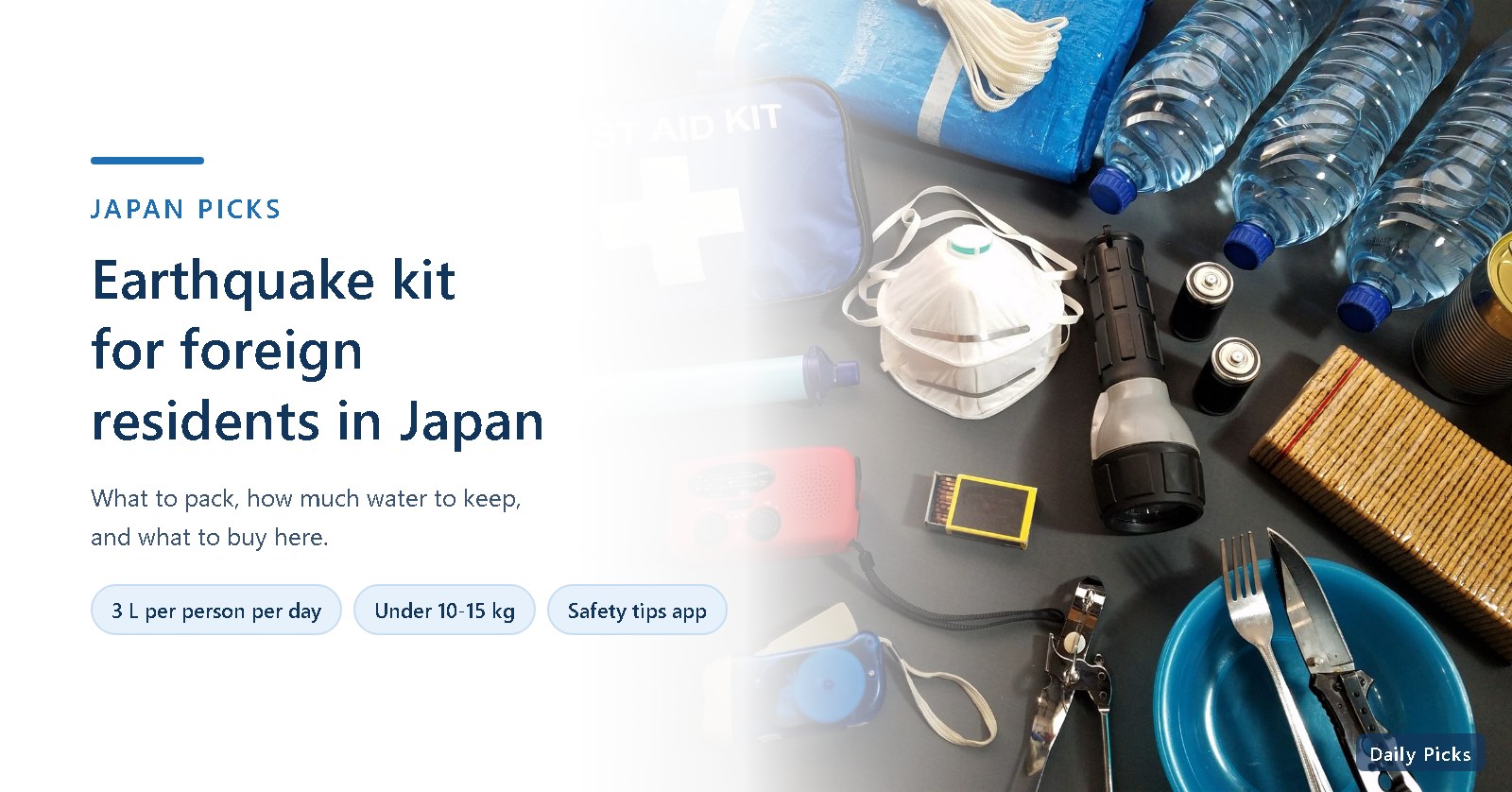
日本語版:日本語で読む(Japanese version) →
This article contains affiliate links. If you buy through one of them, Daily Picks earns a commission at no extra cost to you.(本記事にはアフィリエイト広告が含まれます。)
Japan has earthquakes. You already know that. What is harder to find, if you do not read Japanese, is a straight answer to three practical questions: how much should I keep at home, what should be in the bag I carry out, and where do I buy it?
This guide answers those three questions using the figures the Japanese government actually publishes. It also covers the things a Japanese checklist will never mention, because they only matter if you are a foreigner living here — your residence card, your family abroad, and how to get information when the TV is in Japanese.
Nothing here is urgent. You can do the whole thing in one afternoon, and most of it once a year after that.
- First, two Japanese words that are not the same thing
- How much water and food to keep: the official numbers
- How heavy your emergency bag (bosai bag) is allowed to be
- Think in three layers, not one list
- Eight things in a foreign resident’s bag that Japanese lists do not mention
- How to get earthquake information in English
- What to buy in Japan, and how to choose it
- A 30-minute plan for this weekend
- Frequently asked questions
- In short
- Sources
- Also on Daily Picks
- Also on Daily Picks (in Japanese)
First, two Japanese words that are not the same thing
This is the single most useful thing to learn before you buy anything. Japan has two different kinds of places to go, and they have similar names.
| Japanese | Romaji | What it is |
|---|---|---|
| 指定緊急避難場所 | shitei kinkyu hinan basho | Designated emergency evacuation site. An open place you run to during the disaster, to survive it. Often a park, a school ground, or high ground. |
| 指定避難所 | shitei hinanjo | Designated evacuation shelter. A building you stay in afterwards, if your home is not safe or you cannot go back. Usually a school gym or a community centre. |
The Geospatial Information Authority of Japan (GSI) puts it bluntly: when a disaster happens, go to the hinan basho, not the hinanjo. They are often the same address — a school with a playground and a gym — but not always.
There is one more trap. An emergency evacuation site is designated per hazard type. A site that is fine for an earthquake may not be designated for tsunami or for flooding. If you live near the coast or a river, check which hazards your nearest site covers, not just where it is.
How to find yours
- Open the national Hazard Map Portal (disaportal.gsi.go.jp) and type your address. It shows flood, landslide, storm surge and tsunami risk for that exact spot. Since July 2026 it also shows designated shelters. The site is in Japanese only, so use your browser’s translate function, or ask a Japanese-speaking friend to look once and write the answer down.
- Or go to your city or ward office and ask for the bousai map (防災マップ, disaster prevention map). Many offices hand these out free, and larger cities have versions in other languages.
- Write the name and address of your site on paper, in Japanese, and put it in your bag. Do not rely on your phone for this.
Tokyo publishes its Disaster Preparedness Guidebook in English, Chinese (simplified) and Korean as free PDFs. If you live in Tokyo, download the English one now — it is the single best English-language reference on this topic. Other prefectures and cities publish their own versions; search your city name plus “防災 多言語” (bousai tagengo) to see what yours has.
How much water and food to keep: the official numbers
The Prime Minister’s Office publishes a household stockpile guideline. It is short, and it has not changed in years:
| Item | Standard | Note |
|---|---|---|
| Drinking water | 3 days × 3 litres per person per day | So 9 litres per person for three days. That is six 1.5-litre bottles. |
| Food | 3 days per person | Rice (alpha-rice / instant rice), canned food, dried food, crackers. |
| For a major disaster | 1 week | The guideline says one week’s stock is desirable. That is 21 litres of drinking water per person. |
| Non-drinking water | Separate from the above | For the toilet and washing. Keep a water container filled, or keep water in your bathtub. |
| Other | Per person | Toilet paper, tissues, portable/simple toilets, matches, candles, a portable gas stove. |
Two things surprise most people here. The first is how heavy 9 litres is — about 9 kg. The second is the non-drinking water line. If the water supply stops, your toilet stops too. A common habit in Japan is to leave the bathtub full between baths for exactly this reason.
The 3-day and 1-week stock is for your home, not your back. You are not supposed to carry a week of water. Which brings us to the bag.
How heavy your emergency bag (bosai bag) is allowed to be
Government Public Relations Online (the Cabinet Office’s public information service) publishes an assumed carrying weight for an emergency take-out bag:
| Who | Assumed weight you can carry |
|---|---|
| Adult man | about 15 kg |
| Adult woman | about 10 kg |
| Children and older people | about 6 kg |
These are ceilings, not targets. A ready-made one-person kit sold in Japan typically weighs around 5 kg packed, which leaves room for your own clothes, medicine and documents.
Do this once, today: put your bag on your bathroom scale. Then put it on and walk for 15 minutes. A bag that feels fine in the hallway feels very different after ten minutes of stairs. If it is too heavy, the first things to take out are water and food beyond one day’s worth — those belong in your home stock, not on your back.
Daily Picks covers the weight question in more detail in Japanese: 防災リュックの重さ目安は男性15kg・女性10kg.
Think in three layers, not one list
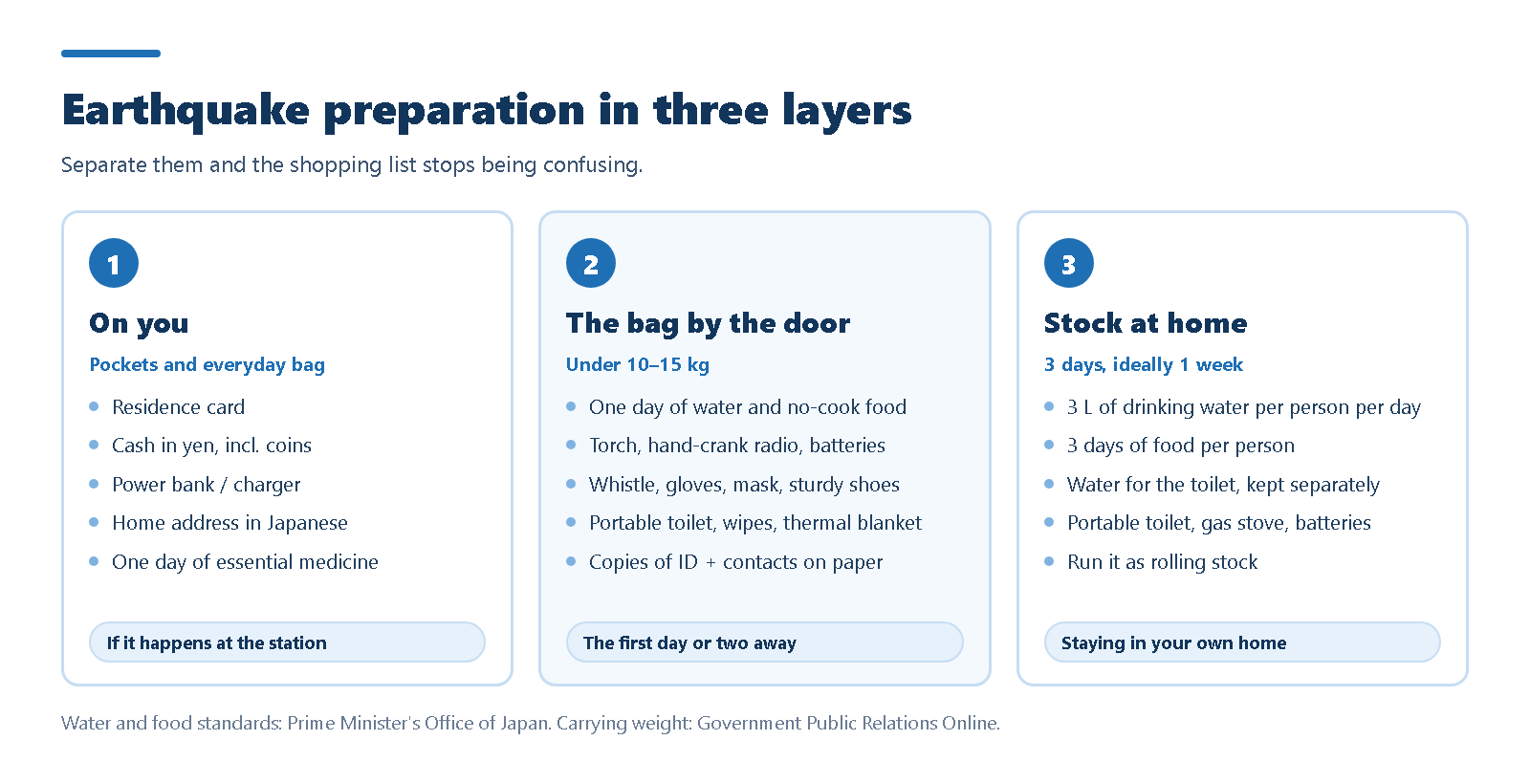
Most checklists fail because they mix three different problems into one shopping list. Separate them and the whole thing gets easier.
Layer 1: what is on you right now
This is what you have if the earthquake happens while you are at the station or at work. It has to fit in your pockets or your everyday bag.
- Your residence card (see the next section — this is a legal requirement, not just advice)
- A small amount of cash in yen, including 100-yen coins for public phones and vending machines
- A phone charger or a small power bank
- A card in your wallet with your home address written in Japanese, and one emergency contact
- Any medicine you cannot skip for a day
Layer 2: the bag by the door
This is the bag you grab on the way out, to survive the first day or two away from home. Keep it near the entrance or the bedroom — somewhere you can reach even if furniture has fallen.
- Water for about one day, and food that needs no cooking
- A torch, and a radio (a hand-crank model keeps working when batteries run out)
- Spare batteries, and a power bank you actually keep charged
- A whistle — cheap, weighs nothing, and works when you cannot shout
- Work gloves, a mask, and shoes you can walk in over broken glass
- A portable toilet kit, wet wipes, and a thermal blanket
- Copies of your residence card, passport and health insurance card, in a plastic bag
- Your contact list, on paper
Layer 3: the stock in your kitchen
This is the 3-day to 1-week supply from the table above. It stays at home. In most Japanese earthquakes, the majority of people are not evacuated to a shelter — they stay in their own apartment with no water, no gas and possibly no electricity. That situation is what this layer is for.
The efficient way to run it is what Japan calls rolling stock (ローリングストック, rooringu sutokku): buy a little more of the food you already eat, eat the oldest first, and replace what you ate. Nothing expires unnoticed, and you never have to eat food you dislike on the worst day of your year.
Eight things in a foreign resident’s bag that Japanese lists do not mention
1. Your residence card — and copies of it
If you are a mid- to long-term resident, you are required by law to carry your residence card (在留カード, zairyu kaado) at all times, and to show it when a competent official asks. The Immigration Services Agency also notes that if you are carrying your residence card, the separate obligation to carry your passport does not apply to you. Special permanent residents are treated differently.
For preparedness purposes, that means two things. Carry the card — you should be doing this anyway. And keep a photocopy, plus a photo on your phone and one in cloud storage, in case the original is lost in a collapsed building. A copy is not a substitute for the card, but it makes everything that comes afterwards much easier.
Do the same for your passport’s photo page, your health insurance card, and your residence certificate if you have one.
This article does not give advice on visas, residence status, permanent residence or naturalisation. For anything about your status, use the Immigration Services Agency’s own information and contact points.
2. Contacts on paper, including your family abroad
Phone batteries die and mobile networks get congested. Write on a card, and keep it in the bag:
- Two or three people in Japan, with their phone numbers
- Your family abroad, with the country code written out
- Your embassy or consulate in Japan
- Your workplace or school
- Your landlord or building management company
Add one line that Japanese guides take for granted: agree in advance with your family abroad on how you will tell them you are safe, and agree that no news for a few hours is normal. International news coverage of a Japanese earthquake is often far more alarming than the situation in your particular neighbourhood.
3. A printed multilingual phrase card
The Japan Tourism Agency’s Safety tips website has a free Helpful Phrases section: point-and-show phrases for asking whether a place is safe, asking for help after evacuating, and explaining a medical problem. It is designed to be shown to a Japanese person standing next to you.
Print it. A phrase card that only exists on a dead phone is not a phrase card. Two sheets of A4 in a plastic sleeve weigh almost nothing.
4. Cash, in yen, in small notes
Card readers and IC-card payment need electricity and a network. After a large earthquake, convenience stores often sell on a cash-only basis, and ATMs may be down. Keep a small amount of physical yen in the bag, in 1,000-yen notes and coins rather than 10,000-yen notes.
5. Medicine, with the names written down
Carry a few days of anything you take regularly. Then write down, on the same card as your contacts, the generic drug name (not only the brand name sold in your home country) and the dose. Brand names differ between countries; generic names usually do not. If you have a okusuri techou (お薬手帳, medicine notebook) from a Japanese pharmacy, photograph its pages.
Also write down any allergies, in English and, if you can, in Japanese.
6. Your own dietary needs
Emergency food distributed at shelters is Japanese emergency food: rice, crackers, canned fish. If you are halal, vegetarian, vegan, or have a serious food allergy, assume the shelter cannot accommodate you for the first few days and stock your own. Some Japanese manufacturers do make allergen-considerate emergency rice; check the individual product page, because contents vary within the same brand.
7. A way to charge your phone
Your phone is your translator, your map and your contact list. A power bank that has been sitting uncharged in a drawer for two years is not a power bank. Charge it when the clocks change, or on the same day you check your food dates.
8. Information saved offline
Before you need it: screenshot your evacuation site’s location, save an offline map of your area, and save your embassy’s emergency contact page. Downloads do not work well when everyone in the city is trying to download at once.
How to get earthquake information in English
Install Safety tips
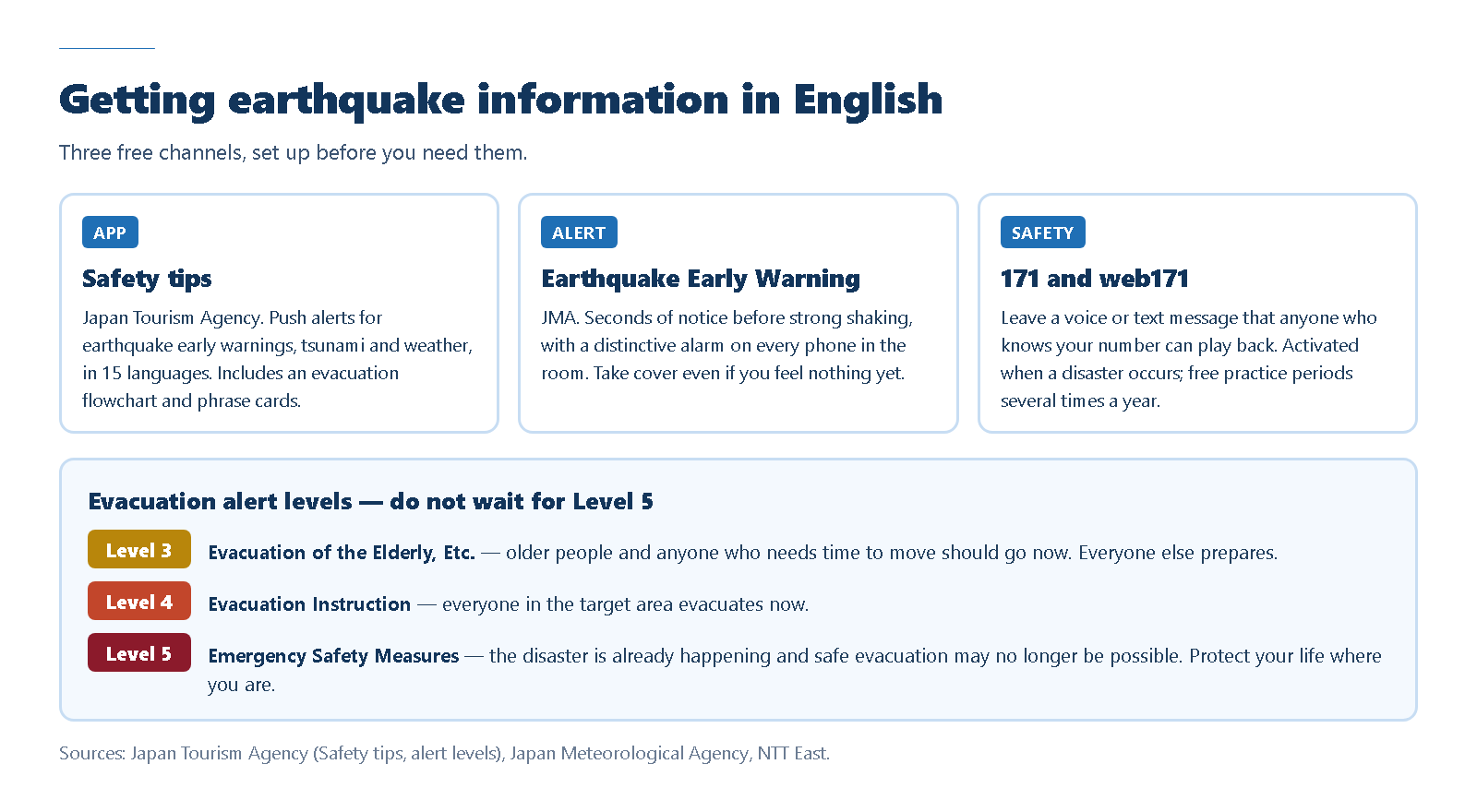
Safety tips is the app run by the Japan Tourism Agency. It pushes earthquake early warnings, tsunami warnings and weather warnings in 15 languages — English, Japanese, Korean, Traditional Chinese, Simplified Chinese, Vietnamese, Spanish, Portuguese, Thai, Indonesian, Tagalog, Nepali, Khmer, Burmese and Mongolian. It also includes an evacuation flowchart and the phrase cards mentioned above.
The Tourism Agency describes it as useful for “both foreign tourists and residents in Japan”. It is free. Install it today; it takes two minutes and it is the highest-value item in this whole article.
Understand the Earthquake Early Warning
The Japan Meteorological Agency (JMA) issues an Earthquake Early Warning (緊急地震速報, kinkyu jishin sokuho) that arrives seconds before strong shaking. It comes with a distinctive alarm sound on TV, radio and phones — every phone in the room goes off at once.
Two things to know. You may get the warning without feeling anything; that is normal and you should still take cover. And it can be only a few seconds’ notice, so decide in advance what you will do: get under a desk, get away from windows and tall furniture, and do not run outside.
Know the evacuation alert levels
When a local government issues evacuation information, it comes with a numbered level. In English, via the Japan Tourism Agency:
| Level | Name | What it means for you |
|---|---|---|
| Level 5 | Emergency Safety Measures | The disaster is already happening. Safe evacuation may no longer be possible. Protect your life where you are. |
| Level 4 | Evacuation Instruction | Everyone in the target area evacuates now. |
| Level 3 | Evacuation of the Elderly, Etc. | Older people, people who need help moving, and anyone with them should evacuate. Everyone else prepares. |
Tell people you are safe: 171 and web171
Mobile networks get congested after a large earthquake, but Japan operates a disaster message service that is designed for exactly that moment:
- 171 (saigai-you dengon daiyaru) — dial 171 from any phone and record a voice message. Anyone who knows your phone number can call 171 and play it back.
- web171 (web171.jp) — the same thing, in text, on the web.
These are activated when a disaster occurs, not available all the time. NTT runs free trial periods several times a year, including Disaster Prevention and Volunteer Week in mid-January, so you can practise. Try it once with a friend; the menu is in Japanese and you do not want to meet it for the first time in an emergency.
English-language news during a disaster
NHK WORLD-JAPAN broadcasts in English and carries disaster information. The JMA also publishes earthquake and tsunami information in English on its own site, and the Safety tips website mirrors the JMA warnings. Between the app and NHK WORLD, you do not need to understand a Japanese news broadcast to know what is happening.
What to buy in Japan, and how to choose it
You can build a kit item by item, and it will be cheaper. But most people who try never finish. A reasonable compromise is: buy one ready-made set to get to 80% today, then add the personal items from the list above yourself. Prices and contents below were checked on the manufacturers’ own pages on 20 September 2026; they change, so confirm before you buy.
A ready-made one-person set, to start in one purchase
A packed one-person set gets you a backpack, light, radio, water and food in a single box. The LA·PITA SHELTER Premium one-person set is a typical example of the category: a 30-litre backpack (640 g empty), a hand-crank radio-light that also charges a phone, a dimmable lantern, and 500 ml × 4 of long-life water with a shelf life of five years or more. The whole set weighs about 5.0 kg.
That 5 kg figure is the point. It sits well under the 10–15 kg ceiling, so there is room left for your documents, your medicine and a change of clothes — the things no set can include for you.
Where to buy: the LA·PITA SHELTER Premium one-person set described above. The product cards in this article are Japanese retail listings; their buttons go to Amazon.co.jp, Rakuten and Yahoo! Shopping.
Emergency food: check three things, not the price
Japanese emergency food is good and there is a lot of it. Before you compare prices, compare these:
- Shelf life. Five years is the common figure for alpha-rice and preserved water. Some heating kits last longer than the food in the same box.
- Does it need water or heat? Alpha-rice (アルファ米, arufa mai) is dried rice that you rehydrate in the bag. Onisi Foods’ spec sheet lists 160 ml of water per 100 g pack, and its FAQ says it takes 15 minutes with hot water (longer with cold). That is fine — as long as you remember that water is in addition to your 3 litres of drinking water. Retort pouches and canned food need neither.
- Number of actual meals. A “21-point” set is not 21 meals. Count the food items, not the total item count, and divide by three meals a day.
The Iris Ohyama one-person set (HSS1-21) is a useful example because its official page lists all of it: alpha-rice in five varieties, seven retort pouches including nikujaga and pork soup, 2 litres × 2 of preserved water, plus plates, chopsticks, a heating kit for three uses and a disaster manual. Shelf life is 5 years for the food and 6 years for the heating kit. Iris Ohyama describes it as a set for staying in your own home — which, as noted above, is what most people actually end up doing.
Where to buy: the Iris Ohyama HSS1-21 one-person set, with the five-year food and the 2 litres × 2 of preserved water in the same box.
If you would rather have food you will actually eat
Onisi Foods’ three-day long-life set is built the other way round: variety first. It contains alpha-rice in four flavours, a portable salmon rice ball, a curry rice set supervised by the CoCo Ichibanya curry chain, two soft breads, rice cookies, and 500 ml × 4 of long-life water. One of the four rice flavours is Onisi’s gomoku rice, which the company states uses none of the 28 designated allergen ingredients — useful if you are buying for someone with an allergy. Allergen information varies by item within the set, so check each product page. Onisi also runs an English-language global site.
This is the kind of set that works well with rolling stock, because the contents are close enough to normal food that you will not mind eating a bag on an ordinary Tuesday and buying a replacement.
Where to buy: Onisi Foods’ three-day long-life set for one person — the variety-first option described above.
Water, separately
Preserved water with a 5-year date is convenient but costs more per litre. Ordinary bottled mineral water from a supermarket is perfectly acceptable stock as long as you rotate it. Nine litres per person is six 1.5-litre bottles — that fits under a bed. Buy a case, put the oldest at the front, and drink it.
More on choosing emergency food sets, in Japanese: 一人暮らし向け非常食セットおすすめ5選.
A toilet for when the water stops
The government table above lists portable toilets alongside toilet paper and matches, which undersells them. If the water supply is cut, the toilet in your flat stops being usable, and unlike food this is not a problem you can postpone to day two. An emergency toilet kit is simply a cover for the bowl, a waste bag, and a sachet of powder that turns the liquid into gel so the bag can be tied and stored until rubbish collection restarts.
Where to buy: BOS’s 100-use emergency toilet set — 100 waste bags, 100 sachets of coagulant, five bowl covers and 100 of the odour-blocking BOS bags the company is known for, about 4.6 kg in total, which the maker’s own shop rates at roughly five days for a household of four at five uses per person per day.
A 30-minute plan for this weekend
If you do nothing else in this article, do these six things. They cost almost nothing and they are the ones that matter.
- Install Safety tips and set your language. (2 minutes)
- Look up your designated emergency evacuation site and write the address on paper, in Japanese. (10 minutes)
- Photograph your residence card and passport page, save them to cloud storage, and put one paper copy in a bag. (5 minutes)
- Write a contact card: two people in Japan, family abroad with country code, your embassy, your allergies and your medicine names. (5 minutes)
- Count the water in your apartment. If it is under 9 litres per person, buy a case on your next shopping trip. (2 minutes)
- Fix your tall furniture to the wall, or at least move it so it cannot fall across your bedroom door. (6 minutes, and more valuable than anything you can buy)
Then put a reminder in your calendar for the same date next year: weigh the bag, check the dates, charge the power bank.
Frequently asked questions
I am only in Japan for a year. Is this worth doing?
The cheap parts are, yes. The app, the contact card, the document copies and the furniture take one afternoon and cost nothing. Whether you buy a full 5 kg kit for a one-year stay is your call; a torch, a power bank, some water and a few days of food is a reasonable minimum at any length of stay.
Can I go to a shelter if I am not a Japanese citizen?
Designated evacuation shelters are for residents of the area. The Japan Tourism Agency’s own guidance explains shelters to foreign visitors, and municipalities plan for foreign residents. What varies is language support and food, which is why the personal items in this article matter: bring your own documents, your own medicine, and food that suits you.
How much does a decent emergency kit cost?
A packed one-person set from a specialist maker was around 15,000 yen including tax on the manufacturer’s own store when this article was written. Food-only sets are less. Building it yourself from a home centre is cheaper still. The most valuable items — the app, the paper contact card, the document copies, the furniture brackets — are nearly free.
Where do I keep the bag?
By the front door or in the bedroom, where you can reach it if furniture has fallen. Not at the back of a closet behind the winter coats. Japan’s own guidance suggests spreading it: one bag by the entrance, one in the car if you have one, assuming the house itself may be damaged.
Do I need to speak Japanese to get help?
It helps enormously, and you should learn some. But for the specific case of a disaster, the Safety tips app, the printed phrase cards and a written copy of your address in Japanese will carry you a long way. The phrase cards exist precisely because this situation was expected.
In short
- Learn the difference between hinan basho (where you run to) and hinanjo (where you stay). Look up yours today.
- Home stock: 3 litres of water per person per day, for 3 days; a week is better. Plus non-drinking water for the toilet.
- Bag: under about 10–15 kg, and you should be able to walk 15 minutes with it.
- Foreigner-specific: residence card and copies, contacts on paper with country codes, a printed phrase card, cash, medicine names, and food that suits your diet.
- Install Safety tips. It is free and it is the single best thing in this article.
Sources
- Prime Minister’s Office of Japan — Bousai no tebiki: preparing at home (Japanese) — 3 days of drinking water at 3 litres per person per day, 3 days of food, 1 week desirable for a major disaster, non-drinking water, 171 and web171
- Government Public Relations Online — disaster preparedness feature (Japanese) — assumed carrying weight of an emergency take-out bag: about 15 kg for an adult man, 10 kg for an adult woman, 6 kg for children and older people; carry identification at all times
- Geospatial Information Authority of Japan — designated emergency evacuation sites and designated evacuation shelters (Japanese) — the difference between the two, designation by hazard type, the 2013 amendment to the Basic Act on Disaster Management in force from April 2014
- MLIT Hazard Map Portal Site (Japanese) — address search for flood, landslide, storm surge and tsunami risk; designated shelters added 13 July 2026
- Japan Tourism Agency — Safety tips app (English) — 15 supported languages, earthquake early warnings, tsunami and weather warnings, evacuation flowchart, useful for tourists and residents
- Japan Tourism Agency — Helpful Phrases (English) — point-and-show phrase cards for disasters
- Japan Tourism Agency — when evacuation information is issued (English) — Alert Levels 3, 4 and 5 and their English names
- Japan Tourism Agency — Safety tips for travelers (English) — definition of a Designated Evacuation Shelter, earthquake early warning and tsunami warning behaviour
- Japan Meteorological Agency — Earthquake Early Warning System (English) — the warning system, in service since 1 October 2007
- Immigration Services Agency of Japan — carrying a passport etc. (Immigration Control Act Article 23) (Japanese) — mid- to long-term residents must carry and present their residence card; the passport-carrying obligation does not apply while carrying it
- Tokyo Metropolitan Government — Tokyo Disaster Preparedness Guidebook (Japanese page; guidebook in Japanese, English, Chinese and Korean)
- NTT East — Disaster Emergency Message Dial (171) (Japanese) — how the service works and when it is activated
- Ministry of Agriculture, Forestry and Fisheries — Food Stock Guide for Disasters (Japanese) — choosing food for stockpiling and the rolling stock method
- LA·PITA — SHELTER Premium one-person disaster set (Japanese) — contents, 30-litre backpack, set weight about 5.0 kg, price as of 20 September 2026
- Iris Ohyama — emergency food set HSS1-21 (Japanese) — contents, 5-year food shelf life, 6-year heating kit shelf life
- Onisi Foods — three-day long-life food set (Japanese) — contents including gomoku rice and 500 ml × 4 of long-life water
- Onisi Foods — product specifications (Japanese) — 160 ml of water per 100 g pack of alpha-rice, 5-year shelf life
- Onisi Foods — FAQ (Japanese) — alpha-rice takes 15 minutes with hot water
- Onisi Foods — allergen-considerate gomoku rice (Japanese) — uses none of the 28 designated allergen ingredients
- About NHK WORLD-JAPAN (English) — NHK’s international service in English
- BOS (Kurilon Chemicals) — emergency toilet sets (Japanese) — contents and weight of the 100-use set, and the five-uses-per-person-per-day sizing
Product contents, prices, shelf life and availability change. Check the manufacturer’s page and the retailer’s listing before you buy.
Also on Daily Picks
- Emergency numbers in Japan: 119, 110, #7119 and the others, explained
- Staying warm in a Japanese apartment this winter: heaters, kotatsu and running costs
コメント