Summary: Resident tax (住民税, jūminzei) is a local tax you pay to the city, ward, town or village where you lived on 1 January. It is charged on last year’s income, so it arrives late and it does not stop when your job or your address does. There are two different letters. If you are a company employee, your employer hands you a tax determination notice in May and the tax comes out of your salary in twelve pieces. If you are self-employed, between jobs, or not on a payroll, your city hall mails you a tax payment notice in June with payment slips and four due dates. This guide translates the Japanese printed on both forms, explains why the amount is what it is, and covers what happens when you change jobs, stop working, or leave Japan.
- Two letters, two systems
- Where the juminzei (resident tax) number comes from
- Why there was no bill in your first year
- Reading the notice, line by line
- What changed for fiscal 2026
- Changing jobs, quitting, and leaving Japan
- How to pay
- If you cannot pay
- Five things people get wrong
- Getting help in English
- Checklist
- Related reading
- Sources
Two letters, two systems
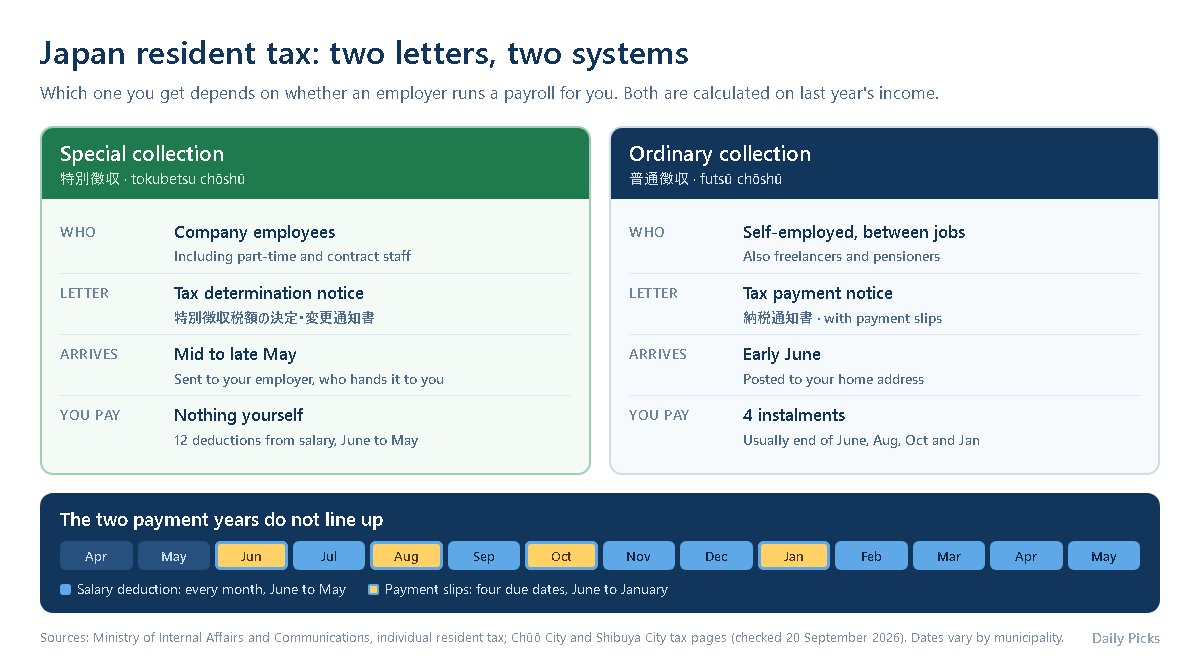
Almost every confusion about resident tax comes from not knowing which of the two collection systems you are in. They have different letters, different timing and different due dates.
| Special collection (特別徴収) | Ordinary collection (普通徴収) | |
|---|---|---|
| Japanese reading | tokubetsu chōshū | futsū chōshū |
| Who is in it | Company employees, including part-timers and contract staff | Self-employed people, freelancers, people between jobs, pensioners |
| The letter | 特別徴収税額の決定・変更通知書 tokubetsu chōshū zeigaku no kettei/henkō tsūchisho “Notice of determination and change of the special collection tax amount” | 納税通知書 nōzei tsūchisho “Tax payment notice” |
| How it reaches you | Sent to your employer, who gives it to you. Some cities now deliver it as a data file instead of paper. | Posted to your home address. |
| When | Mid to late May | Early June |
| How you pay | Deducted from twelve monthly salaries, June through May of the next year. You do nothing. | You pay it yourself, usually in four instalments, using the slips in the envelope. |
Some real 2026 dates: Chūō City in Tokyo sent the special collection notices to employers on 20 May 2026 and the ordinary collection notices to residents on 10 June 2026. Adachi City issues its employer notices around 14 May. Your city will be within a week or two of these.
Two things surprise people. First, special collection is not optional. An employer that withholds income tax is legally required to deduct resident tax from salaries and pay it to the municipality, and this applies to foreign employees exactly as it does to Japanese ones. Second, if you owe no tax at all, no letter arrives. Municipalities do not send a notice to people who are below the taxable line. Silence is not an error, and it is not permission to ignore anything.
Where the juminzei (resident tax) number comes from
Resident tax has two parts, and the notice shows them separately.
- 所得割 (shotokuwari), the income-based amount. The standard rate is 10% of taxable income, split 6% to the municipality and 4% to the prefecture. In the twenty designated major cities (Yokohama, Osaka, Nagoya, Fukuoka, Sapporo and so on) the split is 8% and 2% instead, but the total is still 10%.
- 均等割 (kintōwari), the per capita amount. A flat charge that does not depend on income: ¥3,000 municipal plus ¥1,000 prefectural, so ¥4,000 as standard.
On top of that sits 森林環境税 (shinrin kankyō zei), the forest environment tax. It is a national tax of ¥1,000 a year, charged since fiscal 2024, but it is collected together with the per capita amount and printed on the same notice. That is why the flat part of most bills reads ¥5,000, and why the form is now titled “municipal tax, prefectural tax and forest environment tax”.
The flat part is not the same everywhere, because prefectures and municipalities may set their own rates. Yokohama is a clear example: the per capita amount there is ¥3,900 municipal and ¥1,300 prefectural, which with the forest environment tax makes ¥6,200. The extra comes from two local surcharges — Yokohama’s own Yokohama Midori-zei greenery tax of ¥900 a year, and Kanagawa Prefecture’s water source conservation tax, which adds ¥300 to the flat amount and 0.025% to the income rate. If your flat amount is not ¥5,000, this is usually why.
The timing rule that explains everything
Two dates decide your bill, and neither is the date the letter arrives:
- Your income from 1 January to 31 December of the previous year sets the amount.
- Where you were registered as a resident on 1 January sets who charges you.
The second rule is absolute. If you were living in Nagoya on 1 January and moved to Tokyo in March, you pay the whole year to Nagoya. Tokyo charges you nothing until the following year. Moving does not split the bill, and it does not cancel it.
Why there was no bill in your first year
This is the single most common surprise for people who move to Japan, and it is not a mistake in your favour.
Suppose you arrive in April 2026 and start work. On 1 January 2026 you were not a registered resident of any Japanese municipality, so no municipality can charge you for fiscal 2026. You also had no previous-year Japanese income. So through your whole first year, nothing is deducted and nothing arrives.
On 1 January 2027 you are a resident. Your April-to-December 2026 income becomes the base. From June 2027, resident tax starts coming out of your salary — and this is the month where take-home pay drops for no visible reason. Nothing was taken away from you. The charge simply started.
Your second full year is usually the expensive one, because it is the first year calculated on twelve months of income rather than nine. Budget for the June increase in your third calendar year in Japan, not just your second.
And why a bill can arrive after you have gone home
The same rule runs the other way. If you were a registered resident on 1 January and you leave Japan in February, you still owe the full year of resident tax on the previous year’s income. Leaving the country does not end the liability, and the Ministry of Internal Affairs and Communications states this plainly: the obligation is the same “even if you leave Japan on or after 2 January”.
There is also a consequence people do not expect. Unpaid resident tax can be taken into account when you apply to renew or change your residence status. The ministry’s own guidance for foreign workers warns that a renewal application may not be approved while resident tax is left unpaid. This is worth knowing before you decide a final bill is somebody else’s problem.
Reading the notice, line by line
Forms differ between cities, and many municipalities redesigned theirs in January 2026 when they moved onto a national standard system — Chiyoda City and Chūō City both did. The wording below is the vocabulary that is common to nearly all of them. Your form will not have every row.
Top band: who, and for which year
| Japanese | Reading | What it means |
|---|---|---|
| 令和8年度 | Reiwa hachi-nendo | Fiscal 2026: April 2026 to March 2027. Calculated on your 2025 income. |
| 納税義務者 | nōzei gimusha | Taxpayer. The person legally required to pay — you. |
| 宛名番号 | atena bangō | Your reference number at that city hall. Quote it when you phone. |
| 特別徴収義務者 | tokubetsu chōshū gimusha | On the salary version: your employer, who is obliged to collect and remit the tax. |
| 口座振替 | kōza furikae | Direct debit. If this shows a bank account, the money is taken automatically and you should not also pay at a counter. |
Middle band: how the amount was built
| Japanese | Reading | What it means |
|---|---|---|
| 給与収入 | kyūyo shūnyū | Gross salary received last year, before anything is subtracted. Compare it with your 源泉徴収票 (gensen chōshūhyō, withholding slip). |
| 給与所得 | kyūyo shotoku | Employment income: gross salary minus the standard employment income deduction. This, not gross salary, is what the calculation uses. |
| 総所得金額等 | sō-shotoku kingaku tō | Total income from all sources. |
| 所得控除 | shotoku kōjo | Income deductions: basic, dependants, spouse, social insurance premiums, life insurance, medical expenses and so on. |
| 課税標準額 / 課税総所得金額 | kazei hyōjungaku | Taxable base: total income minus deductions. The 10% is applied to this. |
| 税額控除前所得割額 | zeigaku kōjo mae shotokuwari-gaku | Income-based amount before tax credits. |
| 税額控除額 | zeigaku kōjo-gaku | Tax credits subtracted from the tax itself: the adjustment credit, mortgage credit, and donation credit including furusato nōzei. |
| 所得割額 | shotokuwari-gaku | The income-based amount after credits. |
| 均等割額 | kintōwari-gaku | The flat per capita amount. Usually ¥4,000. |
| 森林環境税額 | shinrin kankyō zei-gaku | Forest environment tax, ¥1,000. A national tax collected with the local one. |
| 摘要 | tekiyō | Remarks. Credit breakdowns and any mid-year change are explained here. Read it — this is where a surprise is usually explained. |
Bottom band: what to pay, and by when
| Japanese | Reading | What it means |
|---|---|---|
| 年税額 | nen zeigaku | The annual total. If you read only one number, read this one. |
| 第1期・第2期・第3期・第4期 | dai-ichi ki … | Instalments 1 to 4 on the ordinary collection notice. |
| 納期限 | nōkigen | Due date for that instalment. |
| 全期前納 | zenki zennō | Paying the whole year at once at the first due date. |
| 特別徴収税額 | tokubetsu chōshū zeigaku | On the salary version: the annual total to be taken from your pay. |
| 月割額 | tsukiwari-gaku | The monthly deduction. June is often a few hundred yen higher than the other eleven months, because the annual total is rounded and the remainder is loaded onto June. |
| 年金特別徴収 | nenkin tokubetsu chōshū | Deduction from a public pension, for people aged 65 and over. |
Typical ordinary collection due dates are the end of June, August, October and January. Chūō City uses 30 June, 31 August, 31 October and 31 January, rolling to the next working day at a weekend. Musashino City’s fiscal 2026 dates are 30 June, 31 August, 2 November and 1 February — the last two shifted because the month ends fell on a weekend. Read your own slips rather than assuming the 31st.
One more thing worth knowing: in most cities the notice cannot be reissued. If you lose it and later need proof of your income — for a visa application, a loan, a nursery place — you request a 課税証明書 (kazei shōmeisho, tax certificate) instead, which costs a few hundred yen.
What changed for fiscal 2026
The fiscal 2026 notice is the first to reflect Japan’s “income wall” reforms, applied to income earned during 2025. Three changes matter to ordinary employees:
- The minimum employment income deduction rose from ¥550,000 to ¥650,000 for salaries up to ¥1.9 million. For resident tax purposes, a single person with salary only is now untaxed up to ¥1.1 million of annual salary, up from ¥1.0 million.
- The income limit for someone to count as your dependant rose from ¥480,000 to ¥580,000 of total income, which is ¥1.23 million of salary.
- A new 特定親族特別控除 (tokutei shinzoku tokubetsu kōjo), a special deduction for relatives aged 19 to 22 — typically a university-age child. Where the young person’s income lands between ¥580,000 and ¥1.23 million, the parent keeps a deduction that tapers off gradually instead of vanishing at a cliff edge. For resident tax the amount starts at ¥450,000.
Note one thing that did not change: the basic deduction for resident tax was not increased, even though the income tax basic deduction was. If you read that “the basic deduction went up” and expected your resident tax to fall, that is why it did not.
Changing jobs, quitting, and leaving Japan
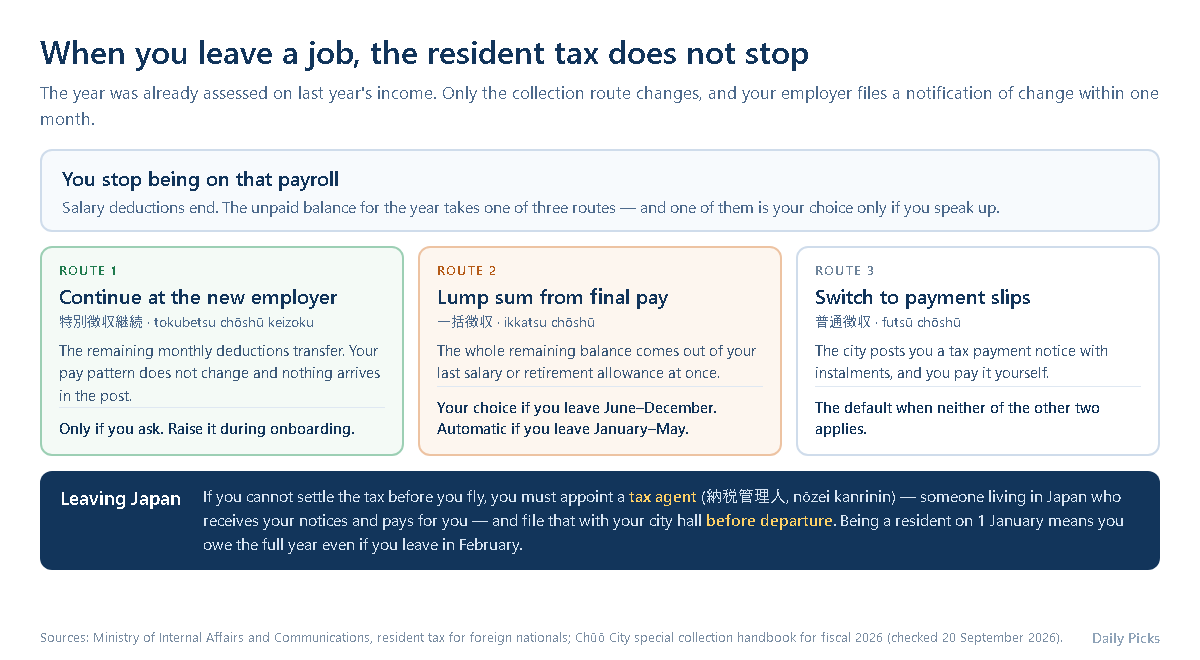
This is the part general guides skip, and it is where money actually goes wrong. When you stop being on a payroll, the tax already assessed for the year does not shrink — it just needs a new route. Your employer files a 給与所得者異動届出書 (kyūyo shotokusha idō todokedesho, notification of change for a salaried taxpayer) within a month, and the balance takes one of three routes.
You move straight to another employer
Ask your new employer to continue special collection (特別徴収継続). The remaining monthly deductions transfer, your pay pattern stays the same, and nothing arrives in the post. This only happens if you ask. Say it during onboarding, ideally in the same conversation as your pension and health insurance paperwork.
You leave between June and December
You choose. Either the whole remaining balance is deducted at once from your final salary or retirement allowance (一括徴収, ikkatsu chōshū, lump-sum collection), or it switches to ordinary collection and the city posts you payment slips. The lump sum is cleaner, but a departure in July can mean ten months of tax taken out of one pay packet. Ask your HR department for the figure before you decide.
You leave between January and May
Here you do not get a choice. The ministry’s guidance is that for a departure in this window the lump-sum deduction is applied whether or not you request it, so long as your final pay covers it. Municipal handbooks draw the branch as January to April, because May is the twelfth and final month of the cycle and leaves no balance behind. Either way: if you are resigning in the new year, expect your last payslip to be much smaller than usual.
You are leaving Japan
Settle the tax before you go if you can. If you cannot — and you often cannot, because the June notice has not been issued yet when you leave in spring — you must appoint a 納税管理人 (nōzei kanrinin, tax agent) and file that appointment with your city hall before departure. The tax agent is a person living in Japan who receives your notices and pays on your behalf. It can be a friend, a colleague, a partner or a company. Who is eligible and which forms they may file varies by municipality, so ask yours directly.
Do this even if you have paid everything you know about. A final bill can still be issued after you go, and without a tax agent it will be posted to an address where nobody lives.
How to pay
If you are on special collection, you do nothing. For everyone else, the slips in the June envelope can be used in several ways:
- Bank or post office counter. Take the slip to a financial institution.
- Convenience store. Only if the slip carries a barcode, only if the amount is ¥300,000 or less, and only before the due date. Overdue slips are refused at the till.
- Direct debit (口座振替). The method every city recommends. Apply well ahead of the instalment you want it to start from: in Chūō City the deadline for each instalment is the 15th of the previous month if you apply by post, or the 10th of the month the instalment falls due if you apply in person with a cash card.
- Smartphone payment apps. Scan the eL-QR code printed on the slip with your payment app. Slips issued from January 2026 carry this nationwide standard code.
- Credit card or internet banking. Go to the Local Tax Payment Site (地方税お支払サイト) run by the Japan Agency for Local Authority Information Systems, and scan the same eL-QR there.
Two warnings. Electronic payments do not produce a paper receipt, so if you need one — some visa and loan procedures ask — pay at a counter. And keep your receipts for five years; municipalities specifically advise this.
If you cannot pay
Phone your city hall’s tax collection section before the due date. This is not a formality. Municipalities run real schemes, and every one of them is easier to enter before you are in arrears:
- Instalments within the fiscal year. Spread the balance over monthly payments to the end of March. Nakano City takes this request online, by post, by phone or at the counter.
- Grace of collection (徴収猶予, chōshū yūyo) under the Local Tax Act, where illness, job loss, disaster or a sharp fall in income makes payment impossible. It can also reduce the late charge.
- Reduction or exemption (減免, genmen). Rare and means-tested — Nakano grants it where household income is below the public assistance standard with no prospect of recovery for two years — but it exists.
What happens if you say nothing: a 督促状 (tokusokujō, demand letter), then repeated notices, then seizure of salary, bank accounts or property. Yokohama’s English guidance sets out that sequence bluntly. Meanwhile the late charge accrues. For calendar 2026 the rate is 2.8% a year for the first month after the due date and 9.1% a year after that. It is not catastrophic on a small balance — but it is far more than any Japanese savings account pays you, so there is no reason to let it run.
Five things people get wrong
- “I moved, so I will pay my new city.” No. The municipality where you lived on 1 January bills you for the entire year.
- “I quit, so the tax stops.” No. The year was already assessed. Quitting only changes how it is collected, and can make it arrive all at once.
- “This is my health insurance bill.” It is not. National Health Insurance premiums are a separate notice with its own instalments — see our guide to the National Health Insurance notice — and National Pension contributions are a third letter again, covered in National Pension payment slips. All three arrive around the same time of year and all three quote last year’s income.
- “No letter came, so I owe nothing.” Usually true, and it may simply mean you are below the taxable line. But it can also mean the notice went to an old address. If your income was well above ¥1.1 million and nothing arrived, phone and check.
- “I can sort it out after I fly home.” Appoint a tax agent before you leave. Afterwards it is far harder, and unpaid tax can follow you into a future visa application.
Getting help in English
Your own city hall is the only place that can see your actual assessment, and it is the place every official source points you to. Many wards and cities publish material in English and other languages:
- Yokohama publishes a multilingual explanation of the resident tax notice itself in English, Chinese, Korean, Nepali, Vietnamese, Portuguese and Spanish.
- The Ministry of Internal Affairs and Communications has a leaflet for foreign workers in English, Chinese, Vietnamese and Portuguese, including a question-and-answer section on lump-sum collection and tax agents.
- Shinjuku, Shibuya and Yokohama all run English pages on resident tax, including the procedure before leaving Japan.
One point from the ministry’s English leaflet is worth repeating, because it is easy to miss: Japan has tax treaties with a number of countries, and some international students and others who meet treaty conditions may not have to pay resident tax at all. This is decided case by case. If you are studying in Japan on income from your home country, ask your municipal office rather than assuming either way.
Checklist
- Work out which system you are in. Salary deduction, or paper slips?
- Find 年税額 on the notice. That is the year’s total.
- Check the due dates on your own slips. They are not always the 31st.
- Set up direct debit if you are paying by slip.
- Starting a new job: ask HR to continue special collection.
- Leaving a job between January and May: expect a large deduction from your final pay.
- Leaving Japan: appoint a tax agent at the city hall before you fly.
- Struggling to pay: phone the tax collection section before the due date, not after.
Amounts, form layouts and deadlines differ between municipalities, and this article describes the general system with examples from specific cities. For your own case, the figures that count are the ones on your own notice, and the only authority on them is the city hall that issued it.
Related on Daily Picks: When does your My Number card expire? The expiry notice letter, the period-of-stay date no one tells you about, and what to do after a visa renewal
Related on Daily Picks: Year-end adjustment (nenmatsu chosei) in Japan: the three forms your company gives you and what to write in them
Related reading
- Daycare (hoikuen) in Japan: how foreign residents apply, points and fees — fees for ages 0 to 2 are based on your resident tax
- National Health Insurance notice in Japan
Sources
- Ministry of Internal Affairs and Communications: Resident tax for foreign nationals — the 1 January rule, leaving an employer, leaving Japan, tax agents (Japanese)
- Ministry of Internal Affairs and Communications: “Don’t forget to pay resident tax!” leaflet for foreign residents, with the Q&A on lump-sum collection, tax agents and tax treaties (English, PDF)
- Ministry of Internal Affairs and Communications: Individual resident tax — per capita and income-based amounts, rates, the forest environment tax, ordinary and special collection (Japanese)
- City of Yokohama: Details about Municipal and Prefectural Residents Tax in Multiple Languages, including the English explanation of the notice (English PDF)
- City of Yokohama: Municipal tax — paying, what happens if you delay, and leaving the country (English)
- City of Yokohama: Individual municipal and prefectural tax in detail — the ¥6,200 flat amount, the Yokohama greenery tax and the Kanagawa water source tax (Japanese)
- Shinjuku City: Resident’s Tax — who pays, who does not, and procedures before leaving Japan (English)
- Shibuya City: Taxes — June notices, four instalments, twelve salary deductions, leaving Japan (English)
- Musashino City: How to read the fiscal 2026 resident tax notices, with field-by-field PDFs for both collection methods (Japanese)
- Chiyoda City: How to read the notice, and the January 2026 change of form (Japanese)
- Chūō City: Fiscal 2026 tax payment notices mailed on 10 June 2026, and no notice for non-taxable residents (Japanese)
- Chūō City: Fiscal 2026 special collection notices sent to employers on 20 May 2026 (Japanese)
- Chūō City: How to pay — due dates, convenience store limits, direct debit deadlines, eL-QR and card payment (Japanese)
- Chūō City: Special collection handbook for fiscal 2026, with the three routes for an unpaid balance after leaving a job (Japanese, PDF)
- Chūō City: Main changes to individual resident tax from fiscal 2026 — employment income deduction, dependant limits, the new deduction for relatives aged 19 to 22, and the unchanged basic deduction (Japanese)
- Adachi City: How to read the special collection notice, and the mid-May issue date (Japanese)
- Nakano City: Consultations on instalment payment, grace of collection and reduction for taxpayers in difficulty (Japanese)
- Jōetsu City: Late payment charge rates for local taxes from 1 January 2026 — 2.8% and 9.1% (Japanese)
- eLTAX: Cashless payment of local taxes with the eL-QR code (Japanese)