日本語版:日本語で読む(Japanese version) →
Some time between October and early December, someone from your company hands you a small pile of paper, or sends you a link to a web form, and asks you to fill it in by a date about two weeks away. The sheets are dense, printed in small Japanese, and full of boxes. This is nenmatsu chosei (年末調整) — the year-end adjustment.
It is not a tax return. It is your employer finishing your income tax for you, so that most employees in Japan never have to file anything. If you fill the forms in, you usually get money back in your December pay. If you leave them blank, you do not.
This guide explains which paper is which, gives you the Japanese-to-English wording for the boxes you actually have to fill, tells you what to attach, and covers the rules that changed for 2026. The figures here are the 2026 (令和8年分) ones, taken from the National Tax Agency (国税庁, Kokuzeicho). Links to every source are at the end.
What nenmatsu chosei actually is
Every month your employer takes income tax out of your salary before paying you. That is gensen choshu (源泉徴収), withholding at source. The monthly amount is only an estimate, taken from a table. It does not know that you paid life insurance in August, or that your spouse stopped working in June.
In December, your employer adds up what you really earned for the year, subtracts the deductions you told them about on these forms, works out the real tax, and compares it with the total already taken from your twelve pay slips. Almost always the estimate was too high, so the difference comes back to you — usually inside your December or January pay, not as a separate payment.
That is why the forms matter. Your employer cannot guess. Anything you do not write down does not get deducted.
The three forms and how to tell them apart
Do not try to read the whole sheet. Read only the title line printed across the top. There are three forms, and the title tells you which one you are holding.
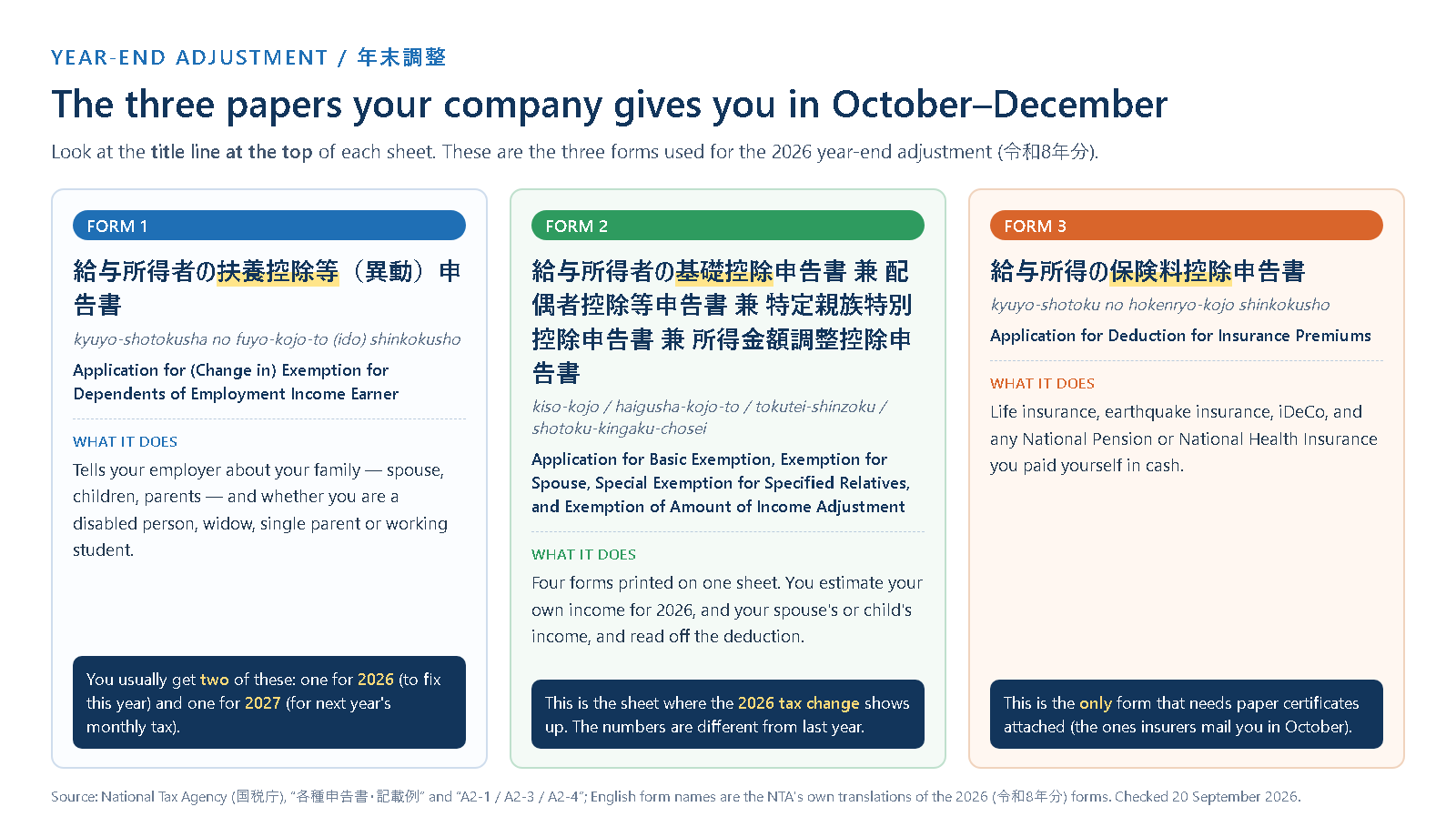
Form 1 — the dependants form (扶養控除等申告書)
Japanese title: 給与所得者の扶養控除等(異動)申告書
Romaji: kyuyo-shotokusha no fuyo-kojo-to (ido) shinkokusho
NTA English name: Application for (Change in) Exemption for Dependents of Employment Income Earner
This is the form about your family. It tells your employer who lives on your income — spouse, children, parents — and whether you yourself are a disabled person, a widow, a single parent or a working student.
You will normally be given two of these at the same time, and this confuses almost everybody. One says 令和8年分 (for 2026) and is used to settle this year. The other says 令和9年分 (for 2027) and is used to set your monthly withholding from January. Check the year printed at the top left before you write anything.
Everyone who is employed has to hand this in, even if you have no dependants at all. If you do not, your employer cannot run a year-end adjustment for you, and a higher monthly tax table is used. The form itself says so: if you have nobody to list, just fill in your own details at the top and submit it.
| Japanese on the form | Romaji | What to write |
|---|---|---|
| 所轄税務署長 | shokatsu zeimusho-cho | Leave it. Your employer fills this in. |
| あなたの氏名 | anata no shimei | Your name, as it appears on your residence record. |
| フリガナ | furigana | Your name in katakana. |
| あなたの個人番号 | kojin bango | Your 12-digit My Number. Many companies already hold it and tell you to leave this blank — ask before writing it. |
| あなたの住所又は居所 | jusho matawa kyosho | Your address as registered at the city office on 1 January of the following year. |
| 世帯主の氏名/あなたとの続柄 | setainushi / zokugara | The head of your household and their relationship to you (本人 = yourself, 夫 = husband, 妻 = wife). |
| 配偶者の有無 | haigusha no umu | Circle 有 (yes) or 無 (no). This just means “are you married”, not whether you claim a deduction. |
| 源泉控除対象配偶者 | gensen-kojo-taisho haigusha | Your spouse, if their income is low enough to reduce your monthly tax. |
| 源泉控除対象親族(16歳以上) | gensen-kojo-taisho shinzoku | Relatives aged 16 or over whom you support. New wording for 2026 — this box used to say 控除対象扶養親族. |
| 特定扶養親族/特定親族 | tokutei fuyo shinzoku / tokutei shinzoku | Tick box for relatives born between 2 Jan 2004 and 1 Jan 2008 (aged 19–22). |
| 老人扶養親族/同居老親等 | rojin fuyo shinzoku / dokyo rooshin-to | Relatives aged 70 or over; the second box is for a parent or grandparent who lives with you. |
| 令和8年中の所得の見積額 | shotoku no mitsumorigaku | Your estimate of that person’s income for 2026. See the income-versus-salary note below — this is the box people most often get wrong. |
| 非居住者である親族 | hikyojusha de aru shinzoku | Tick if that relative lives outside Japan. Extra paperwork applies — see below. |
| 生計を一にする事実 | seikei o itsu ni suru jijitsu | How much you sent that overseas relative during the year. |
| 異動月日及び事由 | ido geppi oyobi jiyu | Date and reason for any change during the year — a birth, a marriage, a relative who started earning too much. |
| 障害者、寡婦、ひとり親又は勤労学生 | shogaisha, kafu, hitori-oya, kinro-gakusei | Disabled person, widow, single parent, working student. Tick only if it applies to you. |
| 住民税に関する事項 | juminzei ni kansuru jiko | The bottom band, for children under 16. They give no income tax deduction, but they do affect your residence tax, so write them here. |
Form 2 — the basic deduction and spouse form (基礎控除申告書 ほか)
Japanese title: 給与所得者の基礎控除申告書 兼 給与所得者の配偶者控除等申告書 兼 給与所得者の特定親族特別控除申告書 兼 所得金額調整控除申告書
Romaji: kiso-kojo shinkokusho ken haigusha-kojo-to shinkokusho ken tokutei-shinzoku-tokubetsu-kojo shinkokusho ken shotoku-kingaku-chosei-kojo shinkokusho
NTA English name: Application for Basic Exemption of Employment Income Earner and Application for Exemption for Spouse of Employment Income Earner and Application for Special Exemption for Specified Relatives of Employment Income Earner and Application for Exemption of Amount of Income Adjustment
The word 兼 (ken, “combined with”) is the clue: this is four separate forms printed on one sheet, divided into blocks. That is why it looks so crowded. You only fill in the blocks that apply to you.
| Block on the sheet | Who fills it in | What it gives you |
|---|---|---|
| 基礎控除申告書 kiso-kojo |
Everyone. Even with no family and no insurance. | The basic deduction — up to ¥1,040,000 for 2026. |
| 配偶者控除等申告書 haigusha-kojo-to |
Married people whose own total income is ¥10m or less and whose spouse earns little. | Spouse deduction up to ¥380,000, or spouse special deduction. |
| 特定親族特別控除申告書 tokutei-shinzoku-tokubetsu-kojo |
Anyone supporting a relative aged 19–22 who earns too much to be a normal dependant. | Up to ¥630,000, tapering as their income rises. |
| 所得金額調整控除申告書 shotoku-kingaku-chosei-kojo |
People paid over ¥8.5m who have a child under 23, or a severely disabled family member, or who are severely disabled themselves. | (salary capped at ¥10m − ¥8.5m) × 10%, up to ¥150,000. |
The mechanics are the same in each block. You write a 収入金額 (shunyu kingaku, gross pay) figure, convert it to a 所得金額 (shotoku kingaku, income after the employment income deduction) using the table printed on the back of the sheet, then read your deduction off a grid and copy the result into the 控除額 box.
| Japanese on the form | Romaji | English (NTA) |
|---|---|---|
| 収入金額 | shunyu kingaku | Earnings amount — your gross pay, before tax and social insurance |
| 所得金額 | shotoku kingaku | Amount of income — after the employment income deduction |
| 給与所得 | kyuyo shotoku | Employment income |
| 給与所得以外の所得の合計額 | kyuyo-shotoku igai no shotoku | Total amount of incomes other than employment income |
| あなたの本年中の合計所得金額の見積額 | gokei shotoku kingaku no mitsumorigaku | Estimated total amount of your income this year |
| 判定 | hantei | Determination — tick the band your figure falls into |
| 区分Ⅰ/区分Ⅱ | kubun ichi / kubun ni | Category I / Category II — letters you carry across to the grid |
| 控除額の計算 | kojogaku no keisan | Calculation of deduction |
| 基礎控除の額 | kiso-kojo no gaku | Amount of basic exemption |
| 配偶者控除の額/配偶者特別控除の額 | haigusha-kojo / haigusha-tokubetsu-kojo | Amount of exemption for spouse / of special exemption for spouse |
| 老人控除対象配偶者 | rojin kojo taisho haigusha | Elderly spouse covered by exemption — born on or before 1 Jan 1957 |
Form 3 — the insurance form (保険料控除申告書)
Japanese title: 給与所得の保険料控除申告書
Romaji: kyuyo-shotoku no hokenryo-kojo shinkokusho
NTA English name: Application for Deduction for Insurance Premiums
This is the one where money you already spent comes back to you, and it is the only form that needs certificates stapled to it. It has four blocks:
| Block | Romaji | What goes in it | Maximum |
|---|---|---|---|
| 生命保険料控除 | seimei hokenryo kojo | Life insurance, medical and nursing care insurance, private pension insurance | ¥120,000 in total |
| 地震保険料控除 | jishin hokenryo kojo | Earthquake insurance (part of most home and contents policies) | ¥50,000 |
| 社会保険料控除 | shakai hokenryo kojo | National Pension or National Health Insurance you paid yourself in cash — not the amounts already taken from your pay slip. Also premiums you paid for a family member. | The full amount |
| 小規模企業共済等掛金控除 | shokibo kigyo kyosai-to kakekin kojo | iDeCo and similar schemes | The full amount |
Inside the life insurance block you will see 新契約 (shin keiyaku, new contract) and 旧契約 (kyu keiyaku, old contract). The dividing line is 1 January 2012. You do not have to work out which is which — the certificate your insurer mails you says 新 or 旧 on it. Copy what the certificate says.
The gap most often missed is 社会保険料控除. If you arrived in Japan partway through the year, or were between jobs, and paid National Pension or National Health Insurance bills yourself at a convenience store or by bank transfer, those payments are deductible and nobody will enter them for you. We cover those bills separately in our guides to the National Pension payment slip and the National Health Insurance notice.
What you need to attach
Only two of the deductions need proof, but without the paper the deduction is refused.
| Deduction | Document | When it arrives |
|---|---|---|
| Life insurance | 生命保険料控除証明書 (seimei hokenryo kojo shomeisho) | Mailed by your insurer around October |
| Earthquake insurance | 地震保険料控除証明書 | Around October, or printed on your policy renewal notice |
| National Pension paid in cash | 社会保険料(国民年金保険料)控除証明書 | Japan Pension Service, early November. Required — the deduction is refused without it. |
| iDeCo | 小規模企業共済等掛金払込証明書 | Around October |
| Housing loan, second year onwards | 住宅借入金等特別控除申告書 from the tax office, plus the bank’s 残高証明書 | Tax office in October; bank in October–November |
Two things are not needed. National Health Insurance premiums you paid yourself need no certificate — you simply write the amount, so keep your receipts or check your payment record at the city office. And social insurance already deducted from your monthly pay needs nothing at all, because your employer has the figures.
If a certificate has gone missing, contact the insurer or the Pension Service for a reissue as soon as you notice. It usually takes one to two weeks, which is why the company deadline is in November and not December.
If your family lives outside Japan
You can claim a dependant who lives in another country, but the National Tax Agency asks for documents, and the rules are stricter for relatives aged 30 to 69. Everything below comes from the NTA’s own English leaflet, which is linked in the sources. It is worth reading in full before you start collecting papers.
Two kinds of document are involved:
- 親族関係書類 (shinzoku kankei shorui) — “Documents concerning relatives”. A family register extract, birth certificate or marriage certificate issued by a government, or a copy of their passport together with a Japanese government document. It must show their name, date of birth and address.
- 送金関係書類 (sokin kankei shorui) — “Documents concerning remittances”. Bank transfer records, or credit card statements for a family card they used.
| Age of the relative | With Form 1 | At the year-end adjustment |
|---|---|---|
| 16–29, or 70 and over | Documents concerning relatives | Documents concerning remittances |
| 30–69, studying abroad | Documents concerning relatives, plus proof of their student status abroad | Documents concerning remittances |
| 30–69, disabled | Documents concerning relatives | Documents concerning remittances |
| 30–69, and you sent them ¥380,000 or more during the year | Documents concerning relatives | Documents showing the total reached ¥380,000 |
| 30–69, none of the above | Not eligible for the dependant deduction | |
Three details catch people out:
- Documents in another language need a Japanese translation. The NTA says so explicitly. You can translate them yourself.
- You must send money to each person separately. The NTA’s own example: if your spouse and child both live abroad and you send everything to your spouse, that money counts as a remittance to the spouse only, not to the child.
- Cash handed over through a friend does not count. If there is no financial record, the deduction cannot be claimed.
One point of vocabulary. On these forms 非居住者 (hikyojusha, “non-resident”) is a tax word about where a person lives and is taxed. It is not about anyone’s status of residence, and nothing on this page is advice about immigration matters — for those, go to the Immigration Services Agency. If your own situation is unusual, ask your employer’s payroll team or your local tax office (税務署, zeimusho) rather than guessing; the tax office answers questions from individuals for free.
What changed for 2026
The 2026 tax reform (令和8年度税制改正) raised the basic deduction, raised the floor of the employment income deduction, and raised the income limits for dependants. The figures on this year’s forms are genuinely different from last year’s.
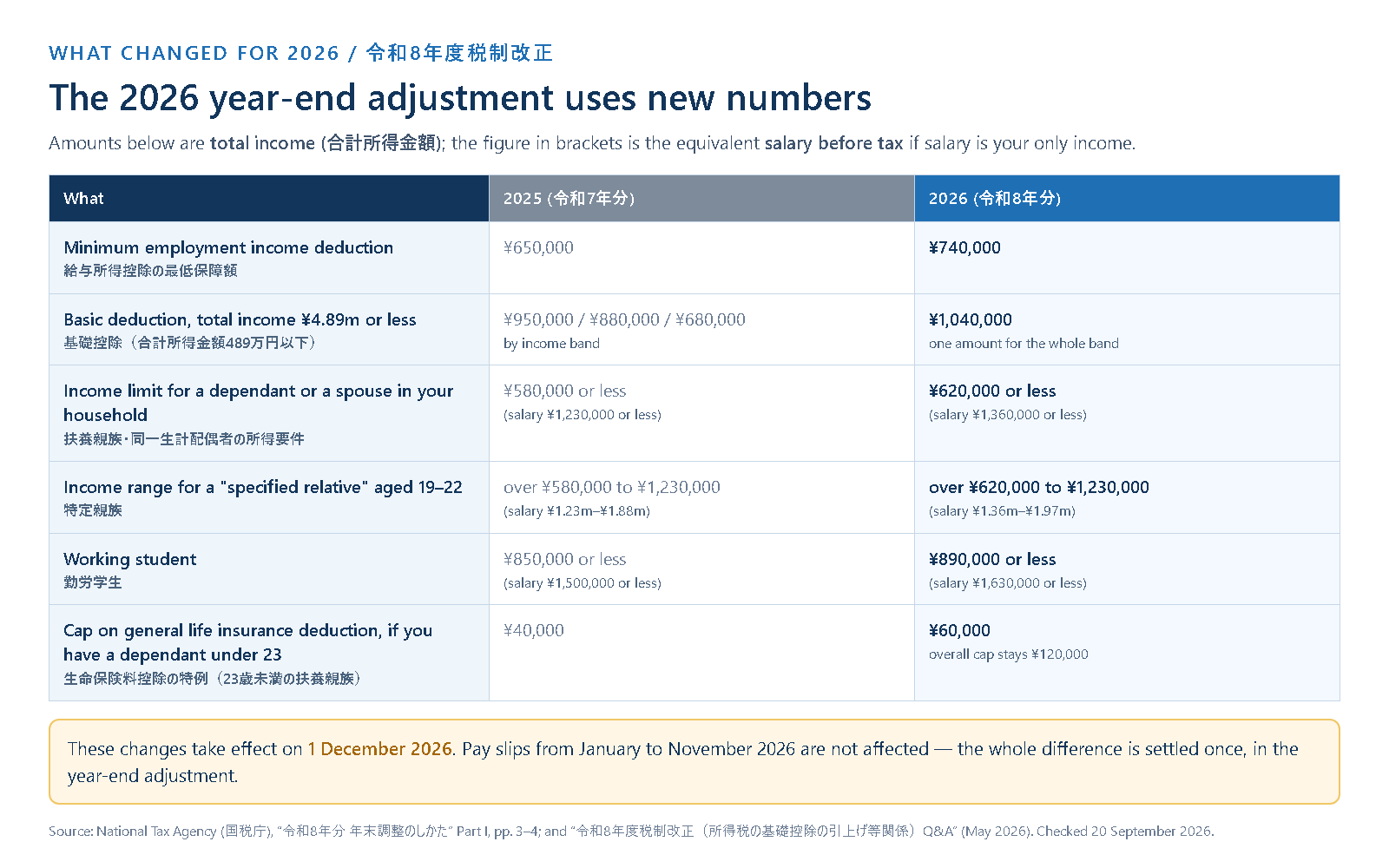
Four consequences are worth knowing.
A family member you could not claim last year may qualify this year. The income ceiling for a dependant went from ¥580,000 to ¥620,000 of total income — in salary terms, from ¥1,230,000 to ¥1,360,000 a year. A spouse or student child who earned, say, ¥1,300,000 was over the line in 2025 and is under it in 2026. If that describes someone in your household, tell your employer, and write 「令和8年12月1日 改正」 in the 異動月日及び事由 (date and reason for change) box on Form 1. That is the NTA’s own suggested wording.
The notes on the back of the form may be out of date. The NTA warns that some copies of the 2026 dependants form carry pre-amendment explanations on the reverse. If the back of your sheet says 58万円 where this article says 62万円, the back of your sheet is the old text.
Nothing changes before December. Your January-to-November pay slips are unaffected. The entire difference is settled in one go at the year-end adjustment, which is one reason December pay often looks unusually good.
One widely reported change does not apply yet. The single-parent deduction (ひとり親控除) rises from ¥350,000 to ¥380,000 — but from the 2027 tax year, not 2026. For this year’s forms, the figure is still ¥350,000.
There is also a narrower timing rule. If the last salary you receive as a Japanese tax resident in 2026 was paid on or before 30 November 2026 — because you left the company or moved abroad — the new figures do not apply to your year-end adjustment, and you would need to file a tax return to benefit from them. The NTA explains this in its May 2026 Q&A.
Is the year-end adjustment enough, or do you also need to file?
For most employees, handing in these three forms is the end of it. No tax return, nothing in February or March.
You must file a tax return (確定申告, kakutei shinkoku) even after a year-end adjustment if any of the following apply:
- Your salary for the year was over ¥20 million.
- You have one employer, and your other income — side work, crypto, rent, and so on — came to more than ¥200,000.
- You have two or more employers, and the salary that was not included in a year-end adjustment plus your other income comes to more than ¥200,000.
- You are an officer of a family company and receive interest or rent from it.
- Your employer is not required to withhold tax — for example, an overseas employer with no office in Japan.
You may want to file, even though nobody requires it, if you want money back for something the year-end adjustment cannot handle:
- Medical expenses over roughly ¥100,000 for your household.
- Furusato nozei donations, if you used more than five municipalities or did not use the one-stop scheme.
- The first year of a housing loan deduction. From year two it moves onto the year-end adjustment.
- Donations to certified organisations.
- Social insurance you paid into another country’s system under a tax treaty — the NTA states plainly that this one cannot be applied at the year-end adjustment.
- You left a job during the year and were not employed anywhere by December, so nobody ran an adjustment for you.
A refund claim can be filed for up to five years, so a missed deduction from an earlier year is usually still recoverable.
Five things that go wrong
Confusing 収入 with 所得. This is the single most common mistake, and it costs people deductions. 収入 (shunyu) is the gross figure — what the job pays, before tax and social insurance come out. 所得 (shotoku) is what remains after the employment income deduction. Every income limit on these forms is stated in 所得. For 2026, a part-time worker earning ¥1,360,000 gross has ¥620,000 of 所得, because the minimum employment income deduction is ¥740,000. Read the box label carefully: if it says 所得, do not write your gross pay there.
Leaving the estimate box blank because you do not know the final figure. It is called 見積額 — an estimate — for a reason. Use your best guess from pay slips so far. If it turns out wrong, that is what a tax return is for.
Handing Form 1 to two employers. If you have two jobs, only one employer may receive it, and only that employer runs your year-end adjustment. The second job is settled by filing a tax return.
Forgetting the 源泉徴収票 from a previous job. If you changed employers during 2026, your new employer needs the withholding slip (源泉徴収票, gensen choshuhyo) from the old one to run the adjustment. Without it they cannot, and you will have to file yourself.
Submitting nothing at all. A blank form still has to be handed in, with your name and address filled in at the top. Submitting nothing means no year-end adjustment, and a higher tax table on your monthly pay from January.
Questions people ask
The deadline my company gave me is in November. Is that the real deadline?
It is your company’s deadline, and you should treat it as real. The legal deadline is the day before you receive your last salary of the year, but payroll needs time to process everyone. Ask for an extension rather than skipping it — a late form is usually still workable, a missing one is not.
Can I fill these in in English?
The NTA publishes the forms in English, Chinese, Portuguese, Spanish, Vietnamese and Filipino, and the 2026 dependants form is among them. But those versions are explicitly marked as reference translations. What you submit should be the Japanese form. Use the English version as a key while you write on the Japanese one.
My employer uses a web system instead of paper. Is it the same?
Yes. Electronic year-end adjustment is officially supported and the NTA even publishes free software for it. The screens follow the same four blocks. Certificates can often be supplied as electronic files from your insurer.
What if I made a mistake after handing the form in?
Tell payroll immediately. If the year-end adjustment has not been run yet, they can usually fix it. If it has, the correction is made by filing a tax return, which you can do from mid-February.
How much money should I expect back?
There is no standard figure — it depends entirely on your income, your family and what you claimed. The refund is the gap between twelve months of estimated withholding and your real tax bill, so it varies from nothing to a substantial sum. Your December pay slip will show it.
I get a pension as well as a salary. Does that change anything?
Possibly. There is a second income adjustment deduction for people with both employment income and public pension income, but it is not handled at the year-end adjustment. Check the NTA page on 所得金額調整控除, or ask at your tax office.
In short
Three forms, three jobs. Form 1 tells your employer about your family. Form 2 works out your basic and spouse deductions. Form 3 is where insurance receipts turn back into money. Only Form 3 needs certificates attached.
For 2026 the numbers moved in your favour, and the change lands on 1 December — so a family member who was just over the line last year may be under it now. If that is your situation, say so on Form 1 rather than waiting to be asked.
If you would like the wider picture of what else changed in Japan this autumn, see what changes in Japan from October 2026.
Sources
- National Tax Agency — 各種申告書・記載例(扶養控除等申告書など) (the forms and worked examples, including the foreign-language versions)
- National Tax Agency — A2-1 給与所得者の扶養控除等の(異動)申告, and the official English version of the 2026 form
- National Tax Agency — A2-4 給与所得者の基礎控除、配偶者(特別)控除、特定親族特別控除及び所得金額調整控除の申告
- National Tax Agency — A2-3 給与所得者の保険料控除の申告 (source of the ¥620,000 / ¥1,360,000 reading note)
- National Tax Agency — 令和8年分 年末調整のしかた, Part I “昨年と比べて変わった点”, pp. 3–4 (the 2026 change tables)
- National Tax Agency — 令和8年度税制改正(所得税の基礎控除の引上げ等関係)Q&A(令和8年5月) (PDF; the 1 December 2026 timing, the 「令和8年12月1日 改正」 wording, and the single-parent deduction note)
- National Tax Agency — No.1199 基礎控除 and No.1410 給与所得控除
- National Tax Agency — No.1180 扶養控除, No.1191 配偶者控除 and No.1177 特定親族特別控除
- National Tax Agency — No.1140 生命保険料控除, No.1130 社会保険料控除 and No.1411 所得金額調整控除
- National Tax Agency — No.1900 給与所得者で確定申告が必要な人
- National Tax Agency — For Those Applying for an Exemption for Dependents, etc. with Regard to Non-resident Relatives (English leaflet, June 2025) and 国外居住親族に係る扶養控除等の適用について
Checked on 20 September 2026 against National Tax Agency pages current as of 1 April 2026 and the 令和8年分 forms. Tax rules change; if your situation is unusual, ask your employer or your local tax office. This article is general information, not individual tax advice.