In short: If you live in Japan, are between 20 and 59, and are not in your company’s pension scheme, you must pay National Pension contributions. The Japan Pension Service mails you paper payment slips, called nōfusho (納付書). For the year from April 2026 to March 2027 the amount is 17,920 yen a month, and each month is due by the end of the following month. If you cannot pay, there is an application to be excused from part or all of it. The important thing is to apply rather than to ignore the letters, because an unpaid month and an excused month are treated very differently.
- Who sent this letter? (kokumin nenkin, the National Pension)
- Do I really have to pay this?
- How much, and by when
- The Japanese words printed on the slip
- Where you can pay
- If you cannot pay: apply, do not ignore
- Why an application beats silence
- How to apply
- Paying it back later
- What happens if you keep ignoring the letters
- Is this letter or phone call real?
- If you are leaving Japan
- Getting help in English
- Sources
- Also on Daily Picks
Who sent this letter? (kokumin nenkin, the National Pension)
The sender is the Japan Pension Service (日本年金機構, Nihon Nenkin Kikō). It is the public body that collects pension contributions and pays pensions. Its local offices are called nenkin jimusho (年金事務所, pension office).
Most envelopes about National Pension arrive at one of these moments:
- About two weeks after you register at your city or ward office as a National Pension member
- Early April every year, with the payment slips for the whole year ahead
- Early July, if your exemption or payment postponement was approved (slips for July to March)
- In the autumn, with a certificate of what you paid, for your year-end tax adjustment or tax return. For the 2025 tax year the paper certificates went out from 24 October
- Any time, if months are unpaid — these are reminder letters, explained further down
Do I really have to pay this?
Yes, if you fall into the group the law calls Category I insured persons (第1号被保険者, dai-ichigō hihokensha). The rule does not depend on nationality. Everyone living in Japan aged 20 to 59 must be covered, and you are Category I if you are not in either of the other two groups:
| Group | Who | Who pays |
|---|---|---|
| Category I | Self-employed people, freelancers, students, part-time and unemployed people, and anyone else not in the two groups below | You pay yourself, using the payment slips |
| Category II | Employees enrolled in Employees’ Pension Insurance (厚生年金保険) through their workplace | Taken from your salary; no slips come to your home |
| Category III | A Category II member’s dependent spouse, aged 20 to 59, living in Japan | No separate contribution |
So if you left a company job, changed to freelance work, or came to Japan and are not yet employed by a company that enrolls you, you usually become Category I. You are expected to register at the National Pension desk of your city, ward, town or village office within 14 days. If slips are arriving, you are already registered.
One point many people miss: the head of your household and your spouse share the legal duty to pay your contributions. That is why reminder letters sometimes go to a family member as well.
How much, and by when
Everyone in Category I pays the same flat amount. It does not go up or down with your income. For the fiscal year running from April 2026 to March 2027, it is 17,920 yen per month.
Each month is due by the last day of the following month. April’s contribution is due by 31 May, May’s by 30 June, and so on. If that last day is a Saturday, Sunday, public holiday, or 31 December, 2 January or 3 January, the deadline moves to the next day banks are open.
Paying several months at once with a prepayment slip is cheaper. These are the amounts and discounts for a cash payment slip this fiscal year:
| How you pay | Amount per payment | You save | Deadline |
|---|---|---|---|
| Month by month | 17,920 yen | — | End of the following month |
| 6 months in advance | 106,650 yen | 870 yen | End of April and end of October |
| 1 year in advance | 211,220 yen | 3,820 yen | End of April |
| 2 years in advance | 418,510 yen | 16,010 yen | End of April |
Paying by automatic bank transfer, credit card or the Nenkin Net service is also possible, but you have to register for those in advance at a pension office.
The Japanese words printed on the slip
The slip itself is only in Japanese. These are the words that actually matter:
| Japanese | Reading | What it means |
|---|---|---|
| 国民年金保険料 | kokumin nenkin hokenryō | National Pension contribution — the thing you are being asked to pay |
| 納付書 | nōfusho | Payment slip. Take it to a bank or convenience store, or scan it in a payment app |
| 納付期限 | nōfu kigen | Due date. You can still pay with this slip for two years after the date shown |
| 使用期限 | shiyō kigen | Expiry date. After this date the slip cannot be used at all |
| 納付期間 | nōfu kikan | The months this slip covers |
| 前納 | zennō | Prepayment. Printed above the period box on discounted multi-month slips |
| 追納 | tsuinō | Paying back an excused month later (see below) |
| 基礎年金番号 | kiso nenkin bangō | Your basic pension number. Keep it — you need it for every application |
| 収納機関番号 / 納付番号 / 確認番号 | shūnō kikan bangō / nōfu bangō / kakunin bangō | Three numbers on the left of the slip, used for online (Pay-easy) payment |
The difference between nōfu kigen and shiyō kigen is worth remembering. A normal monthly slip with a due date still works for two years, so a slip that is a few months old is not wasted paper. A prepayment or back-payment slip stops working on its expiry date, though a pension office can issue a new one.
Where you can pay
- Banks and the post office — any bank, Japan Post Bank, shinkin banks, credit unions, labour banks, and agricultural and fishery co-operatives
- Convenience stores — including Seven-Eleven, FamilyMart, Lawson, Ministop, Daily Yamazaki, Seicomart and Poplar. A single slip of more than 300,000 yen cannot be paid this way
- Online with Pay-easy — at an ATM or in internet, mobile or telephone banking, using the three numbers on the slip. You cannot use it on the day the slip was issued, and no paper receipt is produced
- Smartphone payment apps — by scanning the barcode on the slip with a supported app
There is no handling fee for any of these. Two places that look obvious but do not work: you cannot pay at the city or ward office counter, and pension offices do not normally take payments either. If you have lost the slip or it is too damaged to scan, ask your nearest pension office to issue a new one.
If you cannot pay: apply, do not ignore
17,920 yen a month is a lot when your income is low. Japan has an application for exactly that situation. There are three routes, and which one fits you depends on your situation rather than your preference.
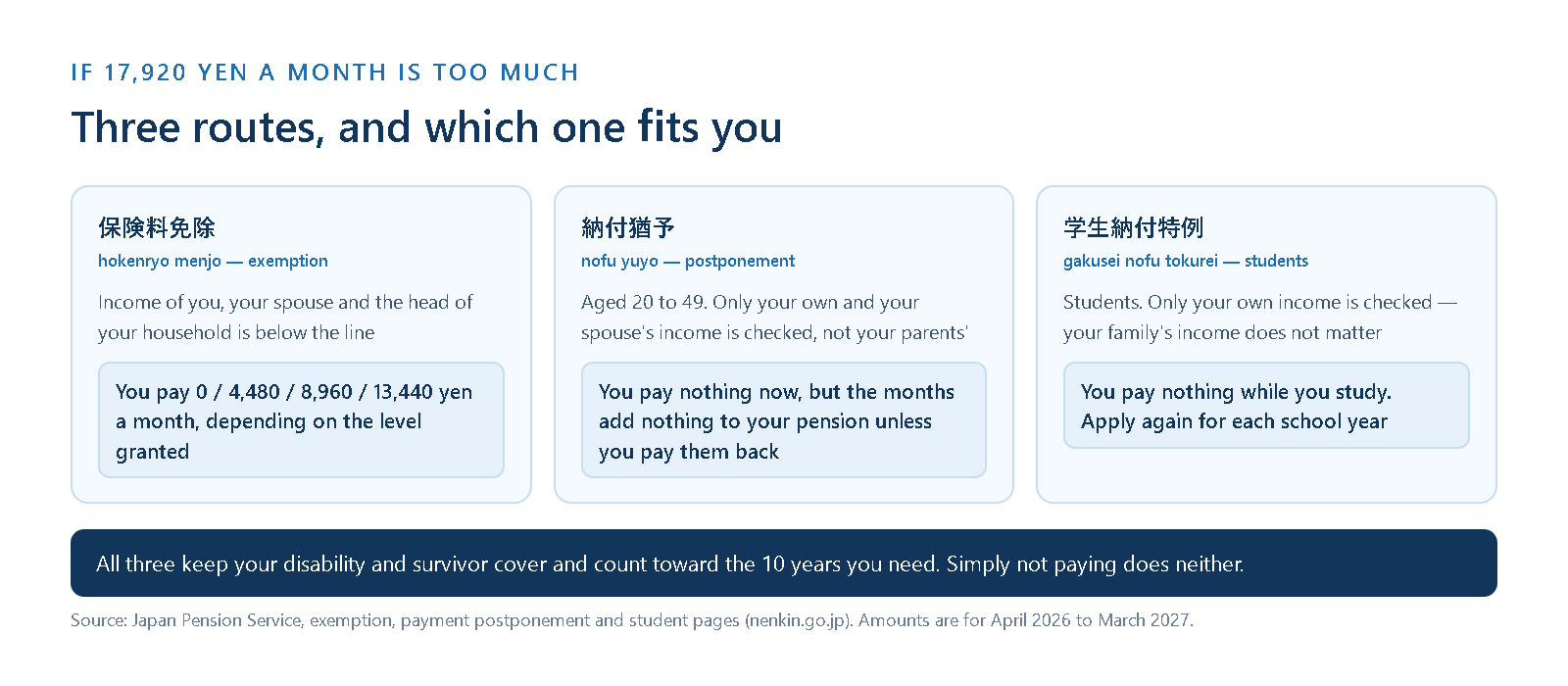
1. Contribution exemption (保険料免除, hokenryō menjo). If last year’s income of you, your spouse and the head of your household was below a set level, part or all of the contribution is waived. There are four levels:
| Level | You still pay each month | Income line (previous year) |
|---|---|---|
| Full exemption | 0 yen | (number of dependents + 1) × 350,000 yen + 320,000 yen |
| 3/4 exemption | 4,480 yen | 880,000 yen + dependant and social insurance deductions |
| Half exemption | 8,960 yen | 1,280,000 yen + dependant and social insurance deductions |
| 1/4 exemption | 13,440 yen | 1,680,000 yen + dependant and social insurance deductions |
A warning about the partial levels: if you are granted a half exemption and then do not pay the remaining 8,960 yen, the month counts as unpaid, not as half exempt. A partial exemption only helps if you pay the rest.
2. Payment postponement (納付猶予, nōfu yūyo). For people aged 20 to 49. Only your own and your spouse’s income is checked, not the head of the household’s, which helps if you live with parents who earn well. The payment is postponed rather than waived.
3. Special payment system for students (学生納付特例, gakusei nōfu tokurei). For students, only your own income is checked — your family’s income does not matter at all. The line is 1,280,000 yen plus 380,000 yen per dependant plus social insurance deductions. Universities, graduate schools, junior colleges, high schools, colleges of technology, special needs schools and most vocational schools are covered, including evening and correspondence courses.
There is also a special route if you lost your job. If you can show a document proving unemployment, business closure or bankruptcy — a copy of your employment insurance separation slip (離職票) or your employment insurance benefit certificate, for example — last year’s income is ignored when your application is judged.
Why an application beats silence
This is the part that costs people real money later. An excused month and an unpaid month look the same in your bank account this year. They are not the same in your record.
| Status of the month | Counts toward the 10 years you need to get a pension | Adds to the amount of your pension | Keeps disability and survivor cover |
|---|---|---|---|
| Paid | Yes | Yes | Yes |
| Fully exempt | Yes | Yes — at half the rate of a paid month | Yes |
| Partly exempt (and the rest paid) | Yes | Yes — at a reduced rate | Yes |
| Payment postponed / student system | Yes | No | Yes |
| Unpaid, no application | No | No | No |
One detail on the second row: fully exempt months from April 2009 onwards count at half the rate of a paid month, while fully exempt months up to March 2009 count at one third.
Two things follow from the bottom row. First, you need 10 years of paid plus exempt periods — counting any time in Employees’ Pension Insurance — before you can receive an old-age pension at all. Unpaid months do not count toward it. Second, the disability and survivor pensions are not only for retirement age. If you have an accident or a serious illness while months are unpaid, cover can be lost, and that is not something you can fix afterwards. An approved exemption keeps that cover even though you paid nothing.
How to apply
You can apply at the National Pension desk of your city, ward, town or village office, at a pension office, by post, or online. Students can often apply through their school, if the school is authorised to handle it.
What to bring or enclose:
- Your basic pension number notice, or another document showing your basic pension number — or your My Number card. Without a My Number card, a document showing your My Number plus photo identification such as a residence card, passport or driving licence
- Students: a copy of your student ID card (both sides if the back shows the validity, year and enrolment date), or an original certificate of enrolment
- If you are applying because you lost your job: the unemployment document described above
- Proof of income is usually not required, because the office checks with your municipality. But if you, your spouse or the head of your household never filed a tax return for the year in question, file your municipal tax return first
Two deadlines to keep in mind. One application covers up to one year, so you have to apply again each year for as long as you need it. And you can only apply for months whose due date is less than two years old — in practice, about two years and one month back from the day you apply. Months older than that cannot be rescued by an application.
Paying it back later
If your income recovers, you can pay back months that were exempted, postponed or covered by the student system. This is tsuinō (追納), and you can go back 10 years from the month your back payment is approved.
Roughly, paying back one year’s worth raises your future annual pension by about 10,000 yen a year for fully exempt periods, and about 20,000 yen a year for postponed or student periods — the difference being that postponed periods currently add nothing at all. The money you pay back also counts as a social insurance deduction on your tax return.
One catch: if you wait until the third fiscal year after the exemption or later, a surcharge is added to the old amount. Paying back sooner is cheaper. Ask a pension office for a back-payment slip; do not wait until the last week of the 10 years, because the paperwork may not clear in time.
What happens if you keep ignoring the letters
The Japan Pension Service does not simply give up. The escalation is published, and it runs like this:
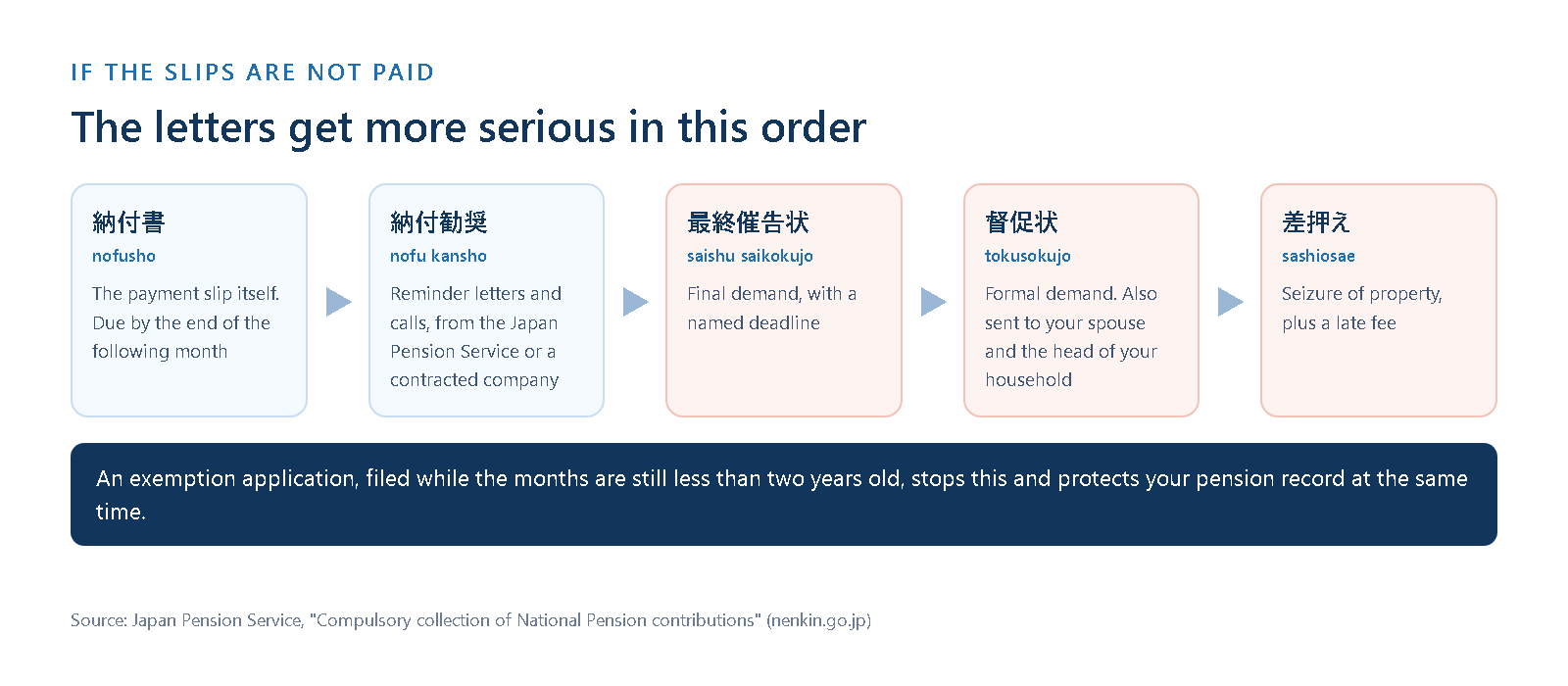
| Stage | Japanese | What it is |
|---|---|---|
| 1 | 納付勧奨 (nōfu kanshō) | Reminders by letter and phone, from Japan Pension Service staff or from a private company it has contracted |
| 2 | 最終催告状 (saishū saikokujō) | Final demand, sent if you can pay but repeatedly have not. It names a deadline |
| 3 | 督促状 (tokusokujō) | Formal demand, sent if the final demand deadline passes. Also sent to the head of your household and your spouse |
| 4 | 差押え (sashiosae) | Seizure of property, which can also reach the head of your household and your spouse |
| — | 延滞金 (entaikin) | A late fee, charged once the demand deadline has passed |
If you genuinely cannot pay, none of this is where you should end up. An exemption application, filed in time, stops the process and protects your record at the same time.
Is this letter or phone call real?
A reasonable question, because the Japan Pension Service really does hire private companies to send reminder letters and make reminder calls about National Pension. A call from a company name you do not recognise is therefore not automatically fake.
Ways to check before you act on anything:
- The Japan Pension Service publishes the list of companies it has contracted, on its own website. Look the name up there
- A genuine payment slip is paid at a bank, a convenience store, through Pay-easy or in a payment app. Nobody legitimate asks you to transfer contributions to a personal bank account, to pay at an ATM under someone’s phone instructions, or to hand cash to a visitor
- When in doubt, stop and call the Japan Pension Service yourself on the number below, rather than a number printed in a message you are unsure about
If you are leaving Japan
There is a system called the Lump-sum Withdrawal Payment (脱退一時金, dattai ichijikin) for non-Japanese people who leave Japan after a short period of coverage. It has its own conditions and its own time limit after you leave, and the application form is published in 14 languages.
We are not going to walk you through the procedure here, because the details depend on your own record and getting it wrong is expensive. Read the official page — Lump-sum Withdrawal Payments — and talk to the Japan Pension Service before you leave.
Getting help in English
You do not have to do any of this in Japanese. The Japan Pension Service provides free interpretation, both on the phone and in person at its branch offices, in English, Chinese, Korean, Portuguese, Spanish, Filipino (Tagalog), Vietnamese, Indonesian, Thai, Nepali and Burmese.
| What you want to ask about | Number |
|---|---|
| National Pension: enrolment, contributions, exemption | 0570-003-004 |
| Claiming a pension, or a Lump-sum Withdrawal Payment | 0570-05-1165 (+81-3-6700-1165 from outside Japan) |
| Employees’ Pension Insurance and health insurance | 0570-007-123 |
English lines are open Monday 8:30 a.m. to 7:00 p.m., Tuesday to Friday 8:30 a.m. to 5:15 p.m., and on the second Saturday of the month 9:30 a.m. to 4:00 p.m. Other languages are Monday to Friday, 8:30 a.m. to 5:15 p.m. Say which language you want at the start of the call. The interpreting is free; you pay only for the call itself.
For the exemption application itself, your city or ward office is often the easier door. It is the same counter that handles your residence registration and National Health Insurance, and many offices in areas with a lot of foreign residents have interpreting support of their own.
Another letter that surprises people who have just moved to Japan is the one about the NHK broadcasting fee. We explain that one separately in The NHK fee letter: what it is and what the law says.
Sources
- Japan Pension Service: National Pension Contributions (English) — 17,920 yen a month for fiscal 2026; due by the end of the following month; ways to pay
- Japan Pension Service: Exemption of National Pension Contributions (English) — the four exemption levels and the remaining amounts (4,480 / 8,960 / 13,440 yen), the student system, and back payment within 10 years
- Japan Pension Service: Enrollment in National Pension (English) — the three categories of insured person, and the 14-day registration rule
- Japan Pension Service: Paying by payment slip (Japanese) — when slips are mailed, the due date and expiry date wording, the Pay-easy numbers, prepayment amounts, where slips can and cannot be paid, reissue
- Japan Pension Service: Exemption and payment postponement (Japanese) — income lines, whose income is checked, the unemployment route, how and where to apply, and the table of what each status counts for
- Japan Pension Service: Special payment system for students (Japanese) — the student income line, which schools qualify, and the documents required
- Japan Pension Service: Back payment of contributions (Japanese) — the 10-year window, the surcharge from the third fiscal year, and the roughly 10,000 / 20,000 yen a year effect
- Japan Pension Service: Compulsory collection of National Pension contributions (Japanese) — the reminder, final demand, demand letter, seizure and late fee sequence, and the joint duty of the household head and spouse
- Japan Pension Service: Private companies contracted for contribution collection (Japanese) — the published list of current and past contractors
- Japan Pension Service: Consultations in multiple languages (English) — the 11 languages, the phone numbers and the opening hours
- Japan Pension Service: Lump-sum Withdrawal Payments (English) — the system for non-Japanese people leaving Japan, with forms in 14 languages
- Japan Pension Service: Social insurance deduction certificate (Japanese) — when the certificate of contributions paid is mailed
All figures are for the fiscal year from April 2026 to March 2027 and were checked against the Japan Pension Service website on 20 September 2026, and again on 18 October 2026 (the monthly amount on the Japan Pension Service English page, the prepayment amounts on Bunkyo City’s page). Contribution amounts are revised every fiscal year. This article explains the public information; it is not advice about your own case. For anything specific to your record, contact the Japan Pension Service or your city or ward office.